
Programowanie
Sergey Popov
Applied SOA Patterns on the Oracle Platform is aimed at architects practicing SOA or traditional integration, and also at technical team leaders implementing Oracle Fusion under SCRUM or WF methodology.
Benjamin Johnston, Ishita Mathur
Machine learning—the ability of a machine to give right answers based on input data—has revolutionized the way we do business. Applied Supervised Learning with Python provides a rich understanding of how you can apply machine learning techniques in your data science projects using Python. You'll explore Jupyter Notebooks, the technology used commonly in academic and commercial circles with in-line code running support.With the help of fun examples, you'll gain experience working on the Python machine learning toolkit—from performing basic data cleaning and processing to working with a range of regression and classification algorithms. Once you’ve grasped the basics, you'll learn how to build and train your own models using advanced techniques such as decision trees, ensemble modeling, validation, and error metrics. You'll also learn data visualization techniques using powerful Python libraries such as Matplotlib and Seaborn. This book also covers ensemble modeling and random forest classifiers along with other methods for combining results from multiple models, and concludes by delving into cross-validation to test your algorithm and check how well the model works on unseen data.By the end of this book, you'll be equipped to not only work with machine learning algorithms, but also be able to create some of your own!
Benjamin Johnston, Aaron Jones , Christopher Kruger
Unsupervised learning is a useful and practical solution in situations where labeled data is not available.Applied Unsupervised Learning with Python guides you in learning the best practices for using unsupervised learning techniques in tandem with Python libraries and extracting meaningful information from unstructured data. The book begins by explaining how basic clustering works to find similar data points in a set. Once you are well-versed with the k-means algorithm and how it operates, you’ll learn what dimensionality reduction is and where to apply it. As you progress, you’ll learn various neural network techniques and how they can improve your model. While studying the applications of unsupervised learning, you will also understand how to mine topics that are trending on Twitter and Facebook and build a news recommendation engine for users. Finally, you will be able to put your knowledge to work through interesting activities such as performing a Market Basket Analysis and identifying relationships between different products.By the end of this book, you will have the skills you need to confidently build your own models using Python.
Sam Morley
Python, one of the world's most popular programming languages, has a number of powerful packages to help you tackle complex mathematical problems in a simple and efficient way. These core capabilities help programmers pave the way for building exciting applications in various domains, such as machine learning and data science, using knowledge in the computational mathematics domain.The book teaches you how to solve problems faced in a wide variety of mathematical fields, including calculus, probability, statistics and data science, graph theory, optimization, and geometry. You'll start by developing core skills and learning about packages covered in Python’s scientific stack, including NumPy, SciPy, and Matplotlib. As you advance, you'll get to grips with more advanced topics of calculus, probability, and networks (graph theory). After you gain a solid understanding of these topics, you'll discover Python's applications in data science and statistics, forecasting, geometry, and optimization. The final chapters will take you through a collection of miscellaneous problems, including working with specific data formats and accelerating code.By the end of this book, you'll have an arsenal of practical coding solutions that can be used and modified to solve a wide range of practical problems in computational mathematics and data science.
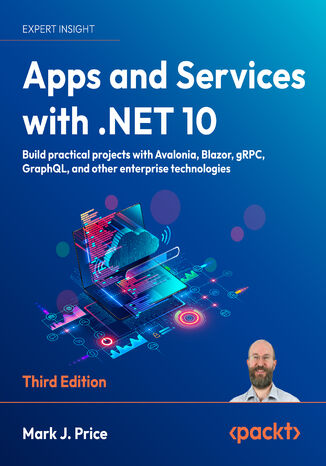
Mark J. Price
Building modern apps and services with C# and .NET isn’t just about knowing the syntax—it’s about knowing the right tools for the job. Whether you’re building for web, desktop, or mobile, the .NET ecosystem offers a vast range of technologies. But with so many choices, it’s easy to get stuck in a narrow skillset. Apps and Services with .NET 10 helps you build real-world experience across the breadth of what .NET has to offer.This edition covers practical implementations across a diverse set of technologies. You'll build APIs with ASP.NET Core Minimal API, gRPC, GraphQL, and SignalR, and create user-facing applications using Blazor for the web, Avalonia for desktop, and .NET MAUI for mobile. You’ll also explore native AOT (Ahead-of-Time) compilation for high-performance web services, along with caching, messaging, and long-running background tasks. Each chapter provides hands-on projects and real-world context for when and why to use each tool.By the end, you’ll have a full-stack command of modern .NET. You’ll know how to select the right UI tech for your target platform, build APIs that scale, architect reliable backend services, and confidently adopt newer patterns. You won’t just understand the tools—you’ll know how to put them together to deliver robust, user-friendly, cross-platform apps in production environments.*Email sign-up and proof of purchase required
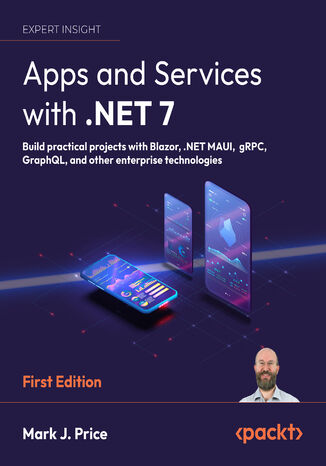
Mark J. Price
Apps and Services with .NET 7 is for .NET 6 and .NET 7 developers who want to kick their C# and .NET understanding up a gear by learning the practical skills and knowledge they need to build real-world applications and services. It covers specialized libraries that will help you monitor and improve performance, secure your data and applications, and internationalize your code and apps.With chapters that put a variety of technologies into practice, including Web API, OData, gRPC, GraphQL, SignalR, and Azure Functions, this book will give you a broader scope of knowledge than other books that often focus on only a handful of .NET technologies. It covers the latest developments, libraries, and technologies that will help keep you up to date.You’ll also leverage .NET MAUI to develop mobile apps for iOS and Android as well as desktop apps for Windows and macOS.
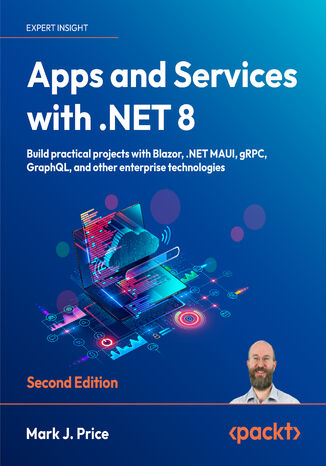
Mark J. Price
Elevate your practical C# and .NET skills to the next level with this new edition of Apps and Services with .NET 8.With chapters that put a variety of technologies into practice, including Web API, gRPC, GraphQL, and SignalR, this book will give you a broader scope of knowledge than other books that often focus on only a handful of .NET technologies. You’ll dive into the new unified model for Blazor Full Stack and leverage .NET MAUI to develop mobile and desktop apps.This new edition introduces the latest enhancements, including the seamless implementation of web services with ADO.NET SqlClient's native Ahead-of-Time (AOT) support. Popular library coverage now includes Humanizer and Noda Time. There’s also a brand-new chapter that delves into service architecture, caching, queuing, and robust background services.By the end of this book, you’ll have a wide range of best practices and deep insights under your belt to help you build rich apps and efficient services.*Email sign-up and proof of purchase required
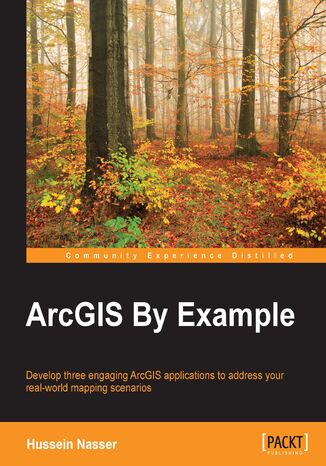
Hussein Nasser
ArcGIS is a geographic information system (GIS) for working with maps and geographic information. It is considered the turnkey solution to creating and sharing interactive maps. ArcGIS is designed to work the way you work. With nothing to install and set up, ArcGIS helps you make your work productive from day one.The book covers the design and development of three ArcGIS applications to guide the readers in crafting their own GIS solution as per their requirements. The book begins by giving you a refresher on the concepts of ArcGIS. Without wasting any time, you’ll begin with developing your first ArcGIS application. You will be developing a cell tower analysis tool. Following this, you will be guided through mapping signal strength and real - time manoeuvring in your GIS system. You will then move on to the second application of the book: a restaurant mapping system. The application will allow tourists to browse restaurants on a map, according to their preferences. Next, you will learn how to work with reviews and ratings and also cover some of the advanced searching options offered by ArcGIS. You will then make use of advanced ArcObjects to develop your third application: an excavation planning manager. The book will conclude by teaching you how work out excavation cost calculations and also saving and retrieving your excavation designs.
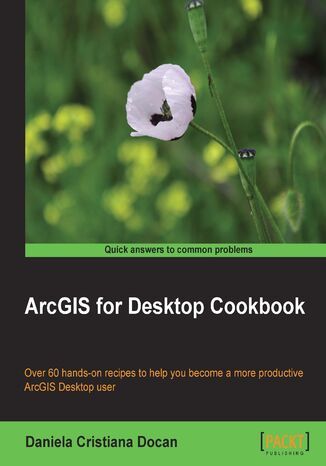
Daniela C Docan
This book is a good companion to get you quickly acquainted with everything you need to increase your productivity with the ArcGIS Desktop.It would be helpful to have a bit of familiarity with basic GIS concepts.If you have no previous experience with ArcGIS, this book will still be helpful for you because it will help you catch up to the acquainted users from a practical point of view.
Tripp Corbin, GISP
ArcGIS is Esri's catalog of GIS applications with powerful tools for visualizing, maintaining, and analyzing data. ArcGIS makes use of the modern ribbon interface and 64-bit processing to increase the speed and efficiency of using GIS. It allows users to create amazing maps in both 2D and 3D quickly and easily. If you want to gain a thorough understanding of the various data formats that can be used in ArcGIS Pro and shared via ArcGIS Online, then this book is for you. Beginning with a refresher on ArcGIS Pro and how to work with projects, this book will quickly take you through recipes about using various data formats supported by the tool. You will learn the limits of each format, such as Shapefiles, Geodatabase, and CAD files, and learn how to link tables from outside sources to existing GIS data to expand the amount of data that can be used in ArcGIS. You'll learn methods for editing 2D and 3D data using ArcGIS Pro and how topology can be used to ensure data integrity. Lastly the book will show you how data and maps can be shared via ArcGIS Online and used with web and mobile applications.
Tripp Corbin, GISP, Kirk Larson
ArcGIS Pro, Esri's newest desktop GIS application, offers powerful tools for visualizing, maintaining, and analyzing data. This cookbook will help existing ArcMap users transition to ArcGIS Pro and teach new users how to utilize its GIS tools effectively. You’ll learn how to create geodatabases, convert data formats, link tables from outside sources, edit 2D and 3D data, ensure data integrity with topology, and enable advanced geodatabase behavior. By the end, you'll be able to effectively use ArcGIS Pro as your primary desktop GIS application, maintaining, analyzing, and displaying data using common methods and tools.
Marcotte, Nick Cosentino
This unique ASP.NET Core book will fill in the gaps in your REST API and backend designs. Learn how to build robust, maintainable, and flexible apps using Gang of Four (GoF) design patterns and modern architectural principles. This new edition is updated for .NET 8 and focuses exclusively on the backend, with new content on REST APIs, the REPR pattern, and building modular monoliths.You’ll start by covering foundational concepts like REST, the SOLID principles, Minimal APIs, dependency injection in .NET, and other ASP.NET Core 8 mechanisms. Then, you’ll learn to develop components using design patterns, including many from the GoF. Finally, you’ll explore organizing your application code with patterns that vary from layers to feature-oriented vertical slice designs, covering CQS and a deep dive into microservices along the way. A brand-new e-commerce project at the end of the book will tie it all together.This how-to guide will teach you how to assemble your own APIs from building blocks, to suit whatever real-world requirements you may have.
Erol Kavas
Infrastructure as code (IaC) and Terraform have become essential tools for managing cloud infrastructure and automating deployment processes. Mastering Terraform on AWS presents a step-by-step approach on how to master these tools and build a secure and scalable AWS infrastructure. The book starts with an introduction to patterns and anti-patterns of IaC and Terraform, explaining the common mistakes and pitfalls you must avoid. You’ll then learn about the importance of planning and designing infrastructure projects in AWS and making informed decisions for projects in AWS Terraform. You’ll find out how to implement Terraform in your projects and deploy serverless projects. Next, you’ll be able to deploy containers in AWS with Terraform, exploring the best practices for Terraform IaC projects. You’ll understand how you can leverage Terraform for enterprises, build Git workflows for IaC and Terraform projects, and automate deployment of Terraform projects. The last set of chapters will teach you how to govern AWS with Terraform and build a secure infrastructure. Finally, you’ll discover how to achieve a perfect AWS infrastructure with Terraform. By the end of this book, you’ll have gained a comprehensive understanding of the various aspects of Terraform and IaC, along with the knowledge required to build, manage, and deploy complex infrastructures on AWS.
Kevin L. Jackson, Scott Goessling
Cloud adoption is a core component of digitaltransformation. Scaling the IT environment,making it resilient, and reducing costs arewhat organizations want. Architecting CloudComputing Solutions presents and explainscritical cloud solution design considerationsand technology decisions required tobe made for deploying the right cloudservice and deployment models,based on your business andtechnology service requirements.This book starts with the fundamentalsof cloud computing and its architecturalconcepts. It then walks you throughcloud service models (IaaS, PaaS, andSaaS), deployment models (public,private, community, and hybrid)and implementation options(enterprise, MSP, and CSP) to explainand describe the key considerations andchallenges organizations face during cloudmigration. Later, this book delves into how toleverage DevOps, Cloud-Native, and serverlessarchitectures in your cloud environmentand presents industry best practices forscaling your cloud environment. Finally,this book addresses in depth how tomanage essential cloud technologyservice components, such as data storage,security controls, and disaster recovery.By the end of this book, you will havemastered all the design considerations andoperational trades required to adopt cloudservices, no matter which cloud serviceprovider you choose.
Safeer CM
Serverless computing has emerged as a mainstream paradigm in both cloud and on-premises computing, with AWS Lambda playing a pivotal role in shaping the Function-as-a-Service (FaaS) landscape. However, with the explosion of serverless technologies and vendors, it has become increasingly challenging to comprehend the foundational services and their offerings.Architecting Cloud Native Serverless Solutions lays a strong foundation for understanding the serverless landscape and technologies in a vendor-agnostic manner. You'll learn how to select the appropriate cloud vendors and technologies based on your specific needs. In addition, you'll dive deep into the serverless services across AWS, GCP, Azure, and Cloudflare followed by open source serverless tools such as Knative, OpenFaaS, and OpenWhisk, along with examples. You'll explore serverless solutions on Kubernetes that can be deployed on both cloud-hosted clusters and on-premises environments, with real-world use cases. Furthermore, you'll explore development frameworks, DevOps approaches, best practices, security considerations, and design principles associated with serverless computing.By the end of this serverless book, you'll be well equipped to solve your business problems by using the appropriate serverless vendors and technologies to build efficient and cost-effective serverless systems independently.
Victor Dantas
Google has been one of the top players in the public cloud domain thanks to its agility and performance capabilities. This book will help you design, develop, and manage robust, secure, and dynamic solutions to successfully meet your business needs.You'll learn how to plan and design network, compute, storage, and big data systems that incorporate security and compliance from the ground up. The chapters will cover simple to complex use cases for devising solutions to business problems, before focusing on how to leverage Google Cloud's Platform-as-a-Service (PaaS) and Software-as-a-Service (SaaS) capabilities for designing modern no-operations platforms. Throughout this book, you'll discover how to design for scalability, resiliency, and high availability. Later, you'll find out how to use Google Cloud to design modern applications using microservices architecture, automation, and Infrastructure-as-Code (IaC) practices. The concluding chapters then demonstrate how to apply machine learning and artificial intelligence (AI) to derive insights from your data. Finally, you will discover best practices for operating and monitoring your cloud solutions, as well as performing troubleshooting and quality assurance.By the end of this Google Cloud book, you'll be able to design robust enterprise-grade solutions using Google Cloud Platform.