
Programowanie
Niezależnie czy dopiero rozpoczynacie swoją przygodę z programowaniem, czy jesteście już uznanymi na rynku profesjonalistami, to w kategorii Programowanie na pewno znajdziecie podręczniki, które pomogą Wam w przebiegu pracy, czy też w nauce podstaw programowania.
W książkach z tego działu zawarta jest wiedza zarówno związana z czysto technicznymi sprawami typu składnia języków, ale także z umiejętnościami bardziej "miękkimi" jak obsługa i wykorzystanie pełnych możliwości środowisk programistycznych, czy też projektowanie oprogramowania lub metody numeryczne czy oraz struktury danych.
MOCKITO COOKBOOK. Over 65 recipes to get you up and running with unit testing using Mockito
Marcin Grzejszczak
This is a focused guide with lots of practical recipes with presentations of business issues and presentation of the whole test of the system. This book shows the use of Mockito's popular unit testing frameworks such as JUnit, PowerMock, TestNG, and so on.If you are a software developer with no testing experience (especially with Mockito) and you want to start using Mockito in the most efficient way then this book is for you. This book assumes that you have a good knowledge level and understanding of Java-based unit testing frameworks.
Mockito Essentials. A practical guide to get you up and running with unit testing using Mockito
Sujoy Acharya
This book is ideal for developers who have some experience in Java application development as well as some basic knowledge of test doubles and JUnit testing. This book also introduces you to the fundamentals of JUnit testing, test doubles, refactoring legacy code, and writing JUnit tests for GWT and web services.
Sujoy Acharya
If you are an application developer with some experience in software testing and want to learn more about testing frameworks, then this technology and book is for you. Mockito for Spring will be perfect as your next step towards becoming a competent software tester with Spring and Mockito.
Madona S. Wambua
Android is a powerful operating system widely used in various devices, phones, TVs, wearables, automobiles, and more. This Android cookbook will teach you how to leverage the latest Android development technologies for creating incredible applications while making effective use of popular Jetpack libraries. You’ll also learn which critical principles to consider when developing Android apps.The book begins with recipes to get you started with the declarative UI framework, Jetpack Compose, and help you with handling UI states, Navigation, Hilt, Room, Wear OS, and more as you learn what's new in modern Android development. Subsequent chapters will focus on developing apps for large screens, leveraging Jetpack’s WorkManager, managing graphic user interface alerts, and tips and tricks within Android studio. Throughout the book, you'll also see testing being implemented for enhancing Android development, and gain insights into harnessing the integrated development environment of Android studio. Finally, you’ll discover best practices for robust modern app development.By the end of this book, you’ll be able to build an Android application using the Kotlin programming language and the newest modern Android development technologies, resulting in highly efficient applications.
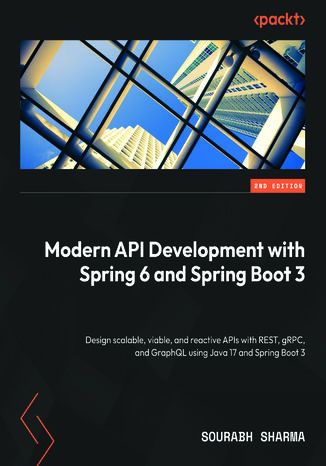
Sourabh Sharma
This book is a practical, in-depth guide to using Spring 6 and Spring Boot 3 for building modern, robust web APIs and services. The book leverages the author’s 20 years of industry experience to cover a wide range of topics essential for API development, including RESTful web service fundamentals, Spring concepts, and API specifications.This second edition expands on topics like security, testing, monitoring, and deploying APIs with the latest tools and frameworks, and all the code examples in the book are based on the latest LTS version, Java 17. You’ll explore asynchronous API design, security, designing user interfaces, testing APIs, and the deployment of web services. This book offers a highly contextual real-world sample app that you can use as a reference for building different types of APIs for real-world applications. This sample app will lead you through the entire API development cycle, encompassing design and specification, implementation, testing, and deployment.By the end of this book, you’ll have learned how to design, develop, test, and deploy scalable and maintainable modern APIs using Spring 6 and Spring Boot 3, which has improved support for reactive programming, along with best practices for bolstering the security and reliability of your apps and improving your app's overall functionality.
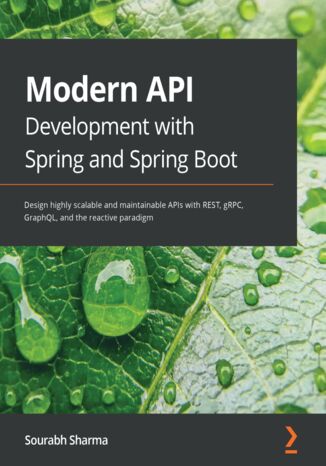
Sourabh Sharma
The philosophy of API development has evolved over the years to serve the modern needs of enterprise architecture, and developers need to know how to adapt to these modern API design principles. Apps are now developed with APIs that enable ease of integration for the cloud environment and distributed systems. With this Spring book, you'll discover various kinds of production-ready API implementation using REST APIs and explore async using the reactive paradigm, gRPC, and GraphQL.You'll learn how to design evolving REST-based APIs supported by HATEOAS and ETAGs and develop reactive, async, non-blocking APIs. After that, you'll see how to secure REST APIs using Spring Security and find out how the APIs that you develop are consumed by the app's UI. The book then takes you through the process of testing, deploying, logging, and monitoring your APIs. You'll also explore API development using gRPC and GraphQL and design modern scalable architecture with microservices. The book helps you gain practical knowledge of modern API implementation using a sample e-commerce app. By the end of this Spring book, you'll be able to develop, test, and deploy highly scalable, maintainable, and developer-friendly APIs to help your customers to transform their business.
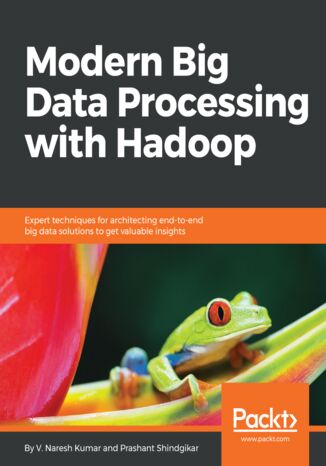
Manoj R Patil, V Naresh Kumar, Prashant...
The complex structure of data these days requires sophisticated solutions for data transformation, to make the information more accessible to the users.This book empowers you to build such solutions with relative ease with the help of Apache Hadoop, along with a host of other Big Data tools.This book will give you a complete understanding of the data lifecycle management with Hadoop, followed by modeling of structured and unstructured data in Hadoop. It will also show you how to design real-time streaming pipelines by leveraging tools such as Apache Spark, and build efficient enterprise search solutions using Elasticsearch. You will learn to build enterprise-grade analytics solutions on Hadoop, and how to visualize your data using tools such as Apache Superset. This book also covers techniques for deploying your Big Data solutions on the cloud Apache Ambari, as well as expert techniques for managing and administering your Hadoop cluster. By the end of this book, you will have all the knowledge you need to build expert Big Data systems.
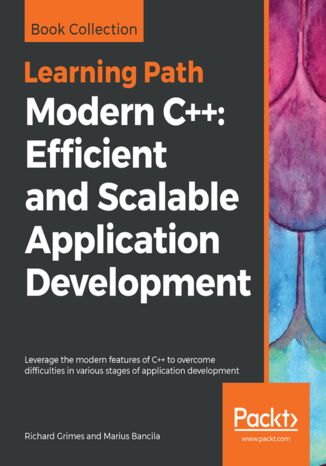
Richard Grimes, Marius Bancila
C++ is one of the most widely used programming languages. It is fast, flexible, and used to solve many programming problems.This Learning Path gives you an in-depth and hands-on experience of working with C++, using the latest recipes and understanding most recent developments. You will explore C++ programming constructs by learning about language structures, functions, and classes, which will help you identify the execution flow through code. You will also understand the importance of the C++ standard library as well as memory allocation for writing better and faster programs.Modern C++: Efficient and Scalable Application Development deals with the challenges faced with advanced C++ programming. You will work through advanced topics such as multithreading, networking, concurrency, lambda expressions, and many more recipes.By the end of this Learning Path, you will have all the skills to become a master C++ programmer.This Learning Path includes content from the following Packt products:• Beginning C++ Programming by Richard Grimes• Modern C++ Programming Cookbook by Marius Bancila• The Modern C++ Challenge by Marius Bancila
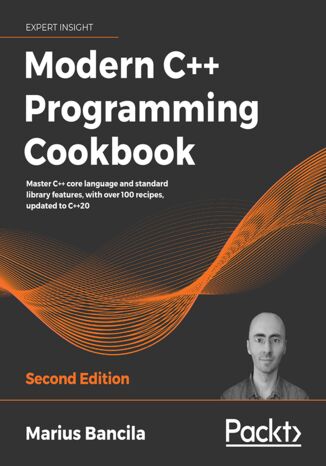
Marius Bancila
C++ has come a long way to be one of the most widely used general-purpose languages that is fast, efficient, and high-performance at its core.The updated second edition of Modern C++ Programming Cookbook addresses the latest features of C++20, such as modules, concepts, coroutines, and the many additions to the standard library, including ranges and text formatting. The book is organized in the form of practical recipes covering a wide range of problems faced by modern developers.The book also delves into the details of all the core concepts in modern C++ programming, such as functions and classes, iterators and algorithms, streams and the file system, threading and concurrency, smart pointers and move semantics, and many others. It goes into the performance aspects of programming in depth, teaching developers how to write fast and lean code with the help of best practices.Furthermore, the book explores useful patterns and delves into the implementation of many idioms, including pimpl, named parameter, and attorney-client, teaching techniques such as avoiding repetition with the factory pattern. There is also a chapter dedicated to unit testing, where you are introduced to three of the most widely used libraries for C++: Boost.Test, Google Test, and Catch2.By the end of the book, you will be able to effectively leverage the features and techniques of C++11/14/17/20 programming to enhance the performance, scalability, and efficiency of your applications.
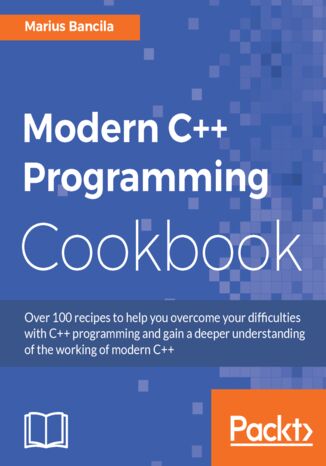
Marius Bancila
C++ is one of the most widely used programming languages. Fast, efficient, and flexible, it is used to solve many problems. The latest versions of C++ have seen programmers change the way they code, giving up on the old-fashioned C-style programming and adopting modern C++ instead.Beginning with the modern language features, each recipe addresses a specific problem, with a discussion that explains the solution and offers insight into how it works. You will learn major concepts about the core programming language as well as common tasks faced while building a wide variety of software. You will learn about concepts such as concurrency, performance, meta-programming, lambda expressions, regular expressions, testing, and many more in the form of recipes. These recipes will ensure you can make your applications robust and fast.By the end of the book, you will understand the newer aspects of C++11/14/17 and will be able to overcome tasks that are time-consuming or would break your stride while developing.
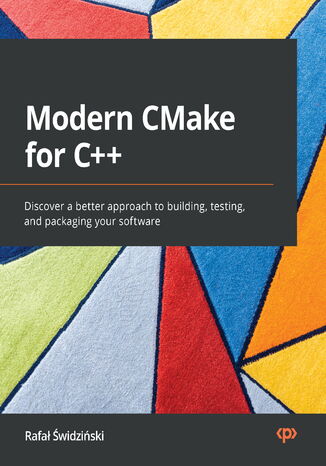
Modern CMake for C++. Discover a better approach to building, testing, and packaging your software
Rafał Świdziński
Creating top-notch software is an extremely difficult undertaking. Developers researching the subject have difficulty determining which advice is up to date and which approaches have already been replaced by easier, better practices. At the same time, most online resources offer limited explanation, while also lacking the proper context and structure.This book offers a simpler, more comprehensive, experience as it treats the subject of building C++ solutions holistically. Modern CMake for C++ is an end-to-end guide to the automatization of complex tasks, including building, testing, and packaging. You'll not only learn how to use the CMake language in CMake projects, but also discover what makes them maintainable, elegant, and clean. The book also focuses on the structure of source directories, building targets, and packages. As you progress, you’ll learn how to compile and link executables and libraries, how those processes work, and how to optimize builds in CMake for the best results. You'll understand how to use external dependencies in your project – third-party libraries, testing frameworks, program analysis tools, and documentation generators. Finally, you'll get to grips with exporting, installing, and packaging for internal and external purposes.By the end of this book, you’ll be able to use CMake confidently on a professional level.
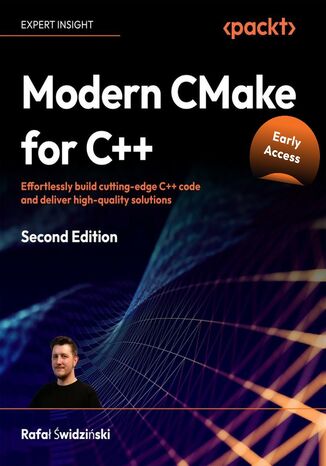
Rafał Świdziński, Alexander Kushnir
Modern CMake for C++ isn't just another reference book, or a repackaging of the documentation, but a blueprint to bridging the gap between learning C++ and being able to use it in a professional setting. It's an end-to-end guide to the automation of complex tasks, including building, testing, and packaging software.This second edition is significantly rewritten, restructured and refreshed with latest additions to CMake, such as support of C++20 Modules.In this book, you'll not only learn how to use the CMake language in CMake projects but also discover how to make those projects maintainable, elegant, and clean. As you progress, you'll dive into the structure of source directories, building targets, and packages, all while learning how to compile and link executables and libraries. You'll also gain a deeper understanding of how those processes work and how to optimize builds in CMake for the best results. You'll discover how to use external dependencies in your project – third-party libraries, testing frameworks, program analysis tools, and documentation generators. Finally, you'll gain profi ciency in exporting, installing, and packaging for internal and external purposes.By the end of this book, you'll be able to use CMake confi dently at a professional level.
Jim Ledin, Dave Farley
Are you a software developer, systems designer, or computer architecture student looking for a methodical introduction to digital device architectures, but are overwhelmed by the complexity of modern systems? This step-by-step guide will teach you how modern computer systems work with the help of practical examples and exercises. You’ll gain insights into the internal behavior of processors down to the circuit level and will understand how the hardware executes code developed in high-level languages.This book will teach you the fundamentals of computer systems including transistors, logic gates, sequential logic, and instruction pipelines. You will learn details of modern processor architectures and instruction sets including x86, x64, ARM, and RISC-V. You will see how to implement a RISC-V processor in a low-cost FPGA board and write a quantum computing program and run it on an actual quantum computer.This edition has been updated to cover the architecture and design principles underlying the important domains of cybersecurity, blockchain and bitcoin mining, and self-driving vehicles.By the end of this book, you will have a thorough understanding of modern processors and computer architecture and the future directions these technologies are likely to take.
V Kishore Ayyadevara, Yeshwanth Reddy
Deep learning is the driving force behind many recent advances in various computer vision (CV) applications. This book takes a hands-on approach to help you to solve over 50 CV problems using PyTorch1.x on real-world datasets.You’ll start by building a neural network (NN) from scratch using NumPy and PyTorch and discover best practices for tweaking its hyperparameters. You’ll then perform image classification using convolutional neural networks and transfer learning and understand how they work. As you progress, you’ll implement multiple use cases of 2D and 3D multi-object detection, segmentation, human-pose-estimation by learning about the R-CNN family, SSD, YOLO, U-Net architectures, and the Detectron2 platform. The book will also guide you in performing facial expression swapping, generating new faces, and manipulating facial expressions as you explore autoencoders and modern generative adversarial networks. You’ll learn how to combine CV with NLP techniques, such as LSTM and transformer, and RL techniques, such as Deep Q-learning, to implement OCR, image captioning, object detection, and a self-driving car agent. Finally, you'll move your NN model to production on the AWS Cloud.By the end of this book, you’ll be able to leverage modern NN architectures to solve over 50 real-world CV problems confidently.
Gaurav Agarwal
Containers have entirely changed how developers and end-users see applications as a whole. With this book, you'll learn all about containers, their architecture and benefits, and how to implement them within your development lifecycle.You'll discover how you can transition from the traditional world of virtual machines and adopt modern ways of using DevOps to ship a package of software continuously. Starting with a quick refresher on the core concepts of containers, you'll move on to study the architectural concepts to implement modern ways of application development. You'll cover topics around Docker, Kubernetes, Ansible, Terraform, Packer, and other similar tools that will help you to build a base. As you advance, the book covers the core elements of cloud integration (AWS ECS, GKE, and other CaaS services), continuous integration, and continuous delivery (GitHub actions, Jenkins, and Spinnaker) to help you understand the essence of container management and delivery. The later sections of the book will take you through container pipeline security and GitOps (Flux CD and Terraform).By the end of this DevOps book, you'll have learned best practices for automating your development lifecycle and making the most of containers, infrastructure automation, and CaaS, and be ready to develop applications using modern tools and techniques.
Gaurav Agarwal
DevOps and the cloud have changed how we look at software development and operations like never before, leading to the rapid growth of various DevOps tools, techniques, and practices. This updated edition helps you pick up the right tools by providing you with everything you need to get started with your DevOps journey.The book begins by introducing you to modern cloud-native architecture, and then teaches you about the architectural concepts needed to implement the modern way of application development. The next set of chapters helps you get familiarized with Git, Docker, Kubernetes, Ansible, Terraform, Packer, and other similar tools to enable you to build a base. As you advance, you’ll explore the core elements of cloud integration—AWS ECS, GKE, and other CaaS services. The chapters also discuss GitOps, continuous integration, and continuous delivery—GitHub actions, Jenkins, and Argo CD—to help you understand the essence of modern app delivery. Later, you’ll operate your container app in production using a service mesh and apply AI in DevOps. Throughout the book, you’ll discover best practices for automating and managing your development lifecycle, infrastructure, containers, and more.By the end of this DevOps book, you'll be well-equipped to develop and operate applications using modern tools and techniques.