
Programowanie
PKS Prakash, Achyutuni Sri Krishna Rao
In this book, we cover not only classical data structures, but also functional data structures.We begin by answering the fundamental question: why data structures? We then move on to cover the relationshipbetween data structures and algorithms, followed by an analysis and evaluation of algorithms. We introduce the fundamentals of data structures, such as lists, stacks, queues, and dictionaries, using real-world examples. We also cover topics such as indexing, sorting, and searching in depth.Later on, you will be exposed to advanced topics such as graph data structures, dynamic programming, and randomized algorithms. You will come to appreciate the intricacies of high performance and scalable programming using R. We also cover special R data structures such as vectors, data frames, and atomic vectors.With this easy-to-read book, you will be able to understand the power of linked lists, double linked lists, and circular linked lists. We will also explore the application of binary search and will go in depth into sorting algorithms such as bubble sort, selection sort, insertion sort, and merge sort.
Mark Hodnett, Joshua F. Wiley
Deep learning is a powerful subset of machine learning that is very successful in domains such as computer vision and natural language processing (NLP). This second edition of R Deep Learning Essentials will open the gates for you to enter the world of neural networks by building powerful deep learning models using the R ecosystem.This book will introduce you to the basic principles of deep learning and teach you to build a neural network model from scratch. As you make your way through the book, you will explore deep learning libraries, such as Keras, MXNet, and TensorFlow, and create interesting deep learning models for a variety of tasks and problems, including structured data, computer vision, text data, anomaly detection, and recommendation systems. You’ll cover advanced topics, such as generative adversarial networks (GANs), transfer learning, and large-scale deep learning in the cloud. In the concluding chapters, you will learn about the theoretical concepts of deep learning projects, such as model optimization, overfitting, and data augmentation, together with other advanced topics.By the end of this book, you will be fully prepared and able to implement deep learning concepts in your research work or projects.
Sigismondo Boschi, Gabriele Santomaggio
RabbitMQ is an open source message broker software (sometimes called message-oriented middleware) that implements the Advanced Message Queuing Protocol (AMQP). The RabbitMQ server is written in the Erlang programming language and is built on the Open Telecom Platform framework for clustering and failover. Messaging enables software applications to connect and scale. Applications can connect to each other as components of a larger application or to user devices and data.RabbitMQ Cookbook touches on all the aspects of RabbitMQ messaging. You will learn how to use this enabling technology for the solution of highly scalable problems dictated by the dynamic requirements of Web and mobile architectures, based for example on cloud computing platforms. This is a practical guide with several examples that will help you to understand the usefulness and the power of RabbitMQ.This book helps you learn the basic functionalities of RabbitMQ with simple examples which describe the use of RabbitMQ client APIs and how a RabbitMQ server works. You will find examples of RabbitMQ deployed in real-life use-cases, where its functionalities will be exploited combined with other technologies. This book helps you understand the advanced features of RabbitMQ that are useful for even the most demanding programmer. Over the course of the book, you will learn about the usage of basic AMQP functionalities and use RabbitMQ to let decoupled applications exchange messages as per enterprise integration applications. The same building blocks are used to implement the architecture of highly scalable applications like today's social networks, and they are presented in the book with some examples. You will also learn how to extend RabbitMQ functionalities by implementing Erlang plugins.This book combines information with detailed examples coupled with screenshots and diagrams to help you create a messaging application with ease.
Lovisa Johansson, David Dossot
RabbitMQ is an open source message queuing software that acts as a message broker using the Advanced Message Queuing Protocol (AMQP). This book will help you to get to grips with RabbitMQ to build your own applications with a message queue architecture. You’ll learn from the experts from CloudAMQP as they share what they've learned while managing the largest fleet of RabbitMQ clusters in the world.Following the case study of Complete Car, you’ll discover how you can use RabbitMQ to provide exceptional customer service and user experience, and see how a message queue architecture makes it easy to upgrade the app and add features as the company grows. From implementing simple synchronous operations through to advanced message routing and tracking, you’ll explore how RabbitMQ streamlines scalable operations for fast distribution. This book will help you understand the advantages of message queue architecture, including application scalability, resource efficiency, and user reliability. Finally, you’ll learn best practices for working with RabbitMQ and be able to use this book as a reference guide for your future app development projects.By the end of this book, you’ll have learned how to use message queuing software to streamline the development of your distributed and scalable applications.
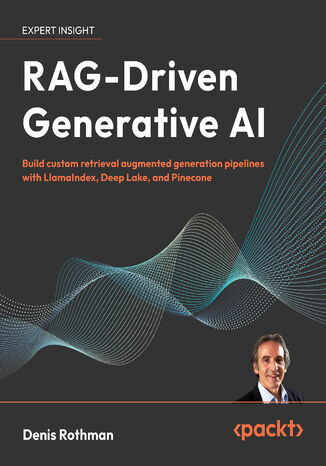
Denis Rothman
RAG-Driven Generative AI provides a roadmap for building effective LLM, computer vision, and generative AI systems that balance performance and costs.This book offers a detailed exploration of RAG and how to design, manage, and control multimodal AI pipelines. By connecting outputs to traceable source documents, RAG improves output accuracy and contextual relevance, offering a dynamic approach to managing large volumes of information. This AI book shows you how to build a RAG framework, providing practical knowledge on vector stores, chunking, indexing, and ranking. You’ll discover techniques to optimize your project’s performance and better understand your data, including using adaptive RAG and human feedback to refine retrieval accuracy, balancing RAG with fine-tuning, implementing dynamic RAG to enhance real-time decision-making, and visualizing complex data with knowledge graphs.You’ll be exposed to a hands-on blend of frameworks like LlamaIndex and Deep Lake, vector databases such as Pinecone and Chroma, and models from Hugging Face and OpenAI. By the end of this book, you will have acquired the skills to implement intelligent solutions, keeping you competitive in fields from production to customer service across any project.*Email sign-up and proof of purchase required
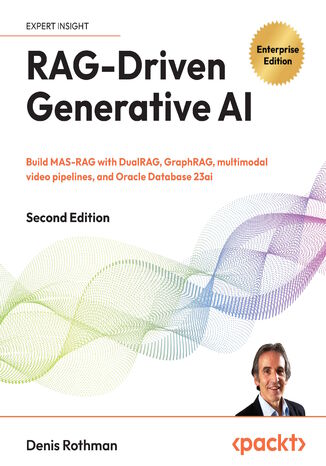
Denis Rothman
Stop moving your data to the AI. This second edition defines a revolutionary architectural shift: bringing the AI to the data. By using Oracle Database 23ai as a converged engine in this book, you will architect Sovereign AI systems that eliminate the fragmentation, latency, and massive security risks inherent in traditional data extraction.You’ll work with DualRAG, synchronizing unstructured vector semantics with the deterministic truth of structured SQL, Graph, and Spatial retrieval. This allows your systems to reason over verified corporate data rather than probabilistic guesses, reducing hallucinations at the source. Moving beyond simple pipelines, you’ll also build MAS-RAG (multi-agent systems for RAG), where autonomous agents coordinate across hybrid retrieval workflows, multimodal video pipelines, and graph-based knowledge structures.Designed for developers and architects, these blueprints transform disconnected data silos into a unified engine to architect autonomous enterprise intelligence that scales with RLHF and model fine-tuning. By the end of the book, you’ll be able to design and deploy enterprise AI systems that combine retrieval, reasoning, and structured data to build reliable generative AI applications.*Email sign-up and proof of purchase required
Eric Berry
Cała wiedza o Rails, której potrzebujesz! Jak zainstalować i skonfigurować Rails? Jak wykorzystać możliwości technologii ActiveRecord? Jak stworzyć dynamiczną aplikację, korzystając z technologii AJAX? Ruby on Rails przebojem wdarł się na rynek szkieletów aplikacji internetowych. Stworzony w architekturze MVC, został niezmiernie dobrze przyjęty przez programistów z całego świata. Niewątpliwie wpływ na ten fakt miały założenia poczynione przez autora projektu - łatwość i przyjemność tworzenia kodu. Powszechnie wiadomo, że te atuty mają niebagatelny wpływ na szybkość tworzenia aplikacji internetowych. Dzięki popularności Ruby on Rails również znajomość języka Ruby, pochodzącego przecież z Dalekiego Wschodu, staje się powszechniejsza. W tej niezwykłej książce znajdziesz odpowiedzi na wszystkie pytania, które mogą pojawić się w trakcie kodowania nowej aplikacji. Dowiesz się, jak skonfigurować Rails, testować napisany kod, wykorzystać technologię ActiveRecord oraz przygotować widoki. Ponadto zdobędziesz wiedzę na temat używania technologii AJAX i REST, nauczysz się wykorzystywać usługi sieciowe oraz logować ważne informacje w trakcie pracy Twojej aplikacji. Z wiedzy tu zawartej możesz skorzystać szybko i w każdej chwili, a co najważniejsze, nie będziesz musiał przedzierać się przez setki niepotrzebnych stron. Tu znajdziesz tylko wiedzę niezbędną w Twojej pracy! Instalacja Rails Struktura plików Konfiguracja Rails Wykorzystanie skryptów Konfiguracja środowiska Sposoby przeprowadzania testów w Rails Używanie technologii ActiveRecord Zarządzanie danymi w bazie Zastosowanie ActionController Tworzenie widoków Sposoby użycia technologii AJAX i REST w Rails Wykorzystanie usług sieciowych Logowanie informacji w trakcie pracy aplikacji Stosowanie metod pomocniczych Wykorzystaj Rails w Twoim projekcie szybko i przyjemnie!
Rails. Projektowanie systemów klasy enterprise
Dan Chak
Poznaj najbardziej zaawansowane tajniki Rails! Jak zorganizować kod, wykorzystując system wtyczek lub moduły? Jakie zalety posiada architektura SOA? Jak zwiększyć wydajność Rails? Rynek szkieletów aplikacji internetowych jest niezwykle urozmaicony. Wśród wielu dostępnych opcji można znaleźć tu rozwiązania przeznaczone dla projektów o różnej skali złożoności, zarówno te mniej, jak i bardziej popularne. Warto jednak sięgnąć po rozwiązanie absolutnie unikatowe i wyjątkowe — Rails. Szkielet ten świetnie sprawdza się zarówno w projektach małych, jak i tych klasy enterprise, a ponadto znany jest ze swoich możliwości, wydajności oraz elastyczności. Warto także podkreślić, że w pakiecie razem z nim dostaniemy liczną, chętną do pomocy społeczność użytkowników! Autor książki porusza interesujące kwestie związane z budową zaawansowanych systemów informatycznych opartych o Rails. W trakcie lektury dowiesz się, jak wykorzystać system wtyczek jako środek organizujący Twój kod oraz jak w tej roli sprawdzą się moduły. Kolejne rozdziały przyniosą solidny zastrzyk wiedzy na temat tworzenia rozbudowanego i bezpiecznego modelu danych, dziedziczenia wielotabelarycznego oraz wykorzystania wyzwalaczy jako narzędzia kontroli skomplikowanych zależności w danych. Dan Chak duży nacisk kładzie na zagadnienia związane z SOA (skrót od ang. Service Oriented Architecture) oraz wydajnością. Jest to genialna pozycja dla wszystkich programistów i projektantów uczestniczących w projekcie wytwarzanym z wykorzystaniem Rails. Komponenty aplikacji Organizacja kodu z wykorzystaniem wtyczek Rola modułów w porządkowaniu kodu Budowa solidnego modelu danych Normalizacja modelu Obsługa danych dziedzinowych Wykorzystanie wyzwalaczy w celu kontroli zależności w danych Dziedziczenie jedno- i wielotabelaryczne Zastosowanie modeli widokowych Architektura SOA Dostarczanie usług typu XML-RPC Usługi typu REST Zwiększenie wydajności Rails Obowiązkowa pozycja dla wszystkich programistów i projektantów korzystających z Rails!
Rob Orsini
Zbiór gotowych rozwiązań dla twórców aplikacji internetowych Instalacja i uruchomienie środowiska Rails Przetwarzanie grafiki Korzystanie z technologii AJAX Dynamiczny rozwój sieci sprawia, że tradycyjne programy są stopniowo wypierane przez aplikacje sieciowe dostępne z poziomu przeglądarki internetowej -- wygodne, niezależne od systemu operacyjnego i łatwe w aktualizowaniu. Nadal jednak kluczowe znaczenie ma szybkość ich przygotowywania i modyfikowania. Dzięki zbiorom bibliotek zwanym "frameworks" proces tworzenia takich produktów znacznie się skrócił -- umożliwia to programistom skoncentrowanie się na faktycznej funkcjonalności tworzonego narzędzia, ponieważ biblioteki te przejmują wiele typowych i wspólnych dla wszystkich aplikacji zadań. Wśród dostępnych w sieci narzędzi tego typu coraz większą popularność zyskuje Ruby on Rails, powoli stający się "ikoną" nurtu Web 2.0. Tworzone za jego pomocą systemy są zwarte i łatwe do skalowania, a ich kod źródłowy jest przejrzysty i czytelny. "Rails. Receptury" to zestaw porad i rozwiązań problemów, przed którymi stają programiści stosujący ten zbiór bibliotek w swojej pracy. Omówione tu zagadnienia przydadzą się zarówno początkującym, jak i doświadczonym twórcom aplikacji sieciowych. Przeczytasz tu o instalowaniu, konfigurowaniu i uruchamianiu środowiska Rails, połączeniach z bazami danych za pomocą ActiveRecord, generowaniu kodu HTML, zabezpieczaniu programów i tworzeniu kontrolerów odpowiadających za funkcjonalność systemu. Dowiesz się, jak wdrażać aplikacje Rails i korzystać w nich z możliwości oferowanych przez mechanizmy AJAX. Instalacja i uruchomienie środowiska Komunikacja z bazami danych Wyświetlanie danych w przeglądarce Wykorzystywanie szablonów RHTML Generowanie kodu XML i RSS Przetwarzanie danych z formularzy Personalizacja narzędzi Korzystanie z JavaScript i AJAX Zabezpieczanie aplikacji Rails Optymalizacja aplikacji Wdrażanie i utrzymywanie systemów na serwerach Przetwarzanie obrazów Skorzystaj ze sprawdzonych receptur i dołącz do twórców Web 2.0!
Rails. Zaawansowane programowanie
Brad Ediger
Twórz zaawansowane projekty w Rails! Jak zadbać o bezpieczeństwo? Jak zapewnić wydajność Twojej aplikacji? Jak stworzyć i utrzymać duży projekt w Rails? Ruby on Rails przebojem wdarł się na rynek szkieletów aplikacji internetowych. Stworzony w architekturze MVC z wykorzystaniem popularnego języka Ruby, został entuzjastycznie przyjęty przez społeczność programistów. Główne założenia autora tego projektu, Davida Heinemeiera Hanssona, to szybkość, łatwość i przyjemność tworzenia kodu. Ruby on Rails jest dojrzałym rozwiązaniem, wykorzystywanym przez wiele firm w aplikacjach internetowych, tworzonych pod kątem ich specyficznych potrzeb. Liczba aplikacji, które powstały z wykorzystaniem tego szkieletu, świadczy o jego wysokiej jakości oraz niewątpliwie ma wpływ na wzrost popularności samego języka Ruby. "Rails. Zaawansowane programowanie" porusza te tematy, które Wy, programiści, lubicie najbardziej! Dzięki tej książce dowiesz się, w jaki sposób wykorzystać gotowe wtyczki oraz jak stworzyć nowe. Nauczysz się stosować zaawansowane funkcje bazy danych oraz podłączać się jednocześnie do wielu baz. Po lekturze tego podręcznika bez problemu zapewnisz swojej aplikacji najwyższy poziom bezpieczeństwa, optymalną wydajność i skalowalność. Autor wskazuje tutaj również niezwykle interesujące kwestie, dotyczące projektowania dużych aplikacji, wykorzystania systemów kontroli wersji oraz utrzymywania właściwej struktury projektu. Przypomnienie i omówienie podstawowych elementów Ruby i Rails Stosowanie ActiveSupport oraz RailTies Zastosowanie i projektowanie wtyczek Zaawansowane wykorzystanie baz danych Uwierzytelnianie za pomocą LDAP Bezpieczne szyfrowanie haseł Bezpieczne przetwarzanie formularzy i danych użytkownika Zapewnienie wydajności Skalowanie architektury Wykorzystywanie usług Web Tworzenie wielojęzycznych aplikacji Zarządzanie dużymi projektami Używanie systemów kontroli wersji Poznaj wszystkie funkcje Ruby on Rails!
Andrey Koleshko
A step-by-step and interactive approach explaining the Rake essentials along with code examples and advanced features. If you are a developer who is acquainted with the Ruby language and want to speed up writing the code concerned with files, then this book is for you. To start reading this book, basic Ruby knowledge is required; however, a huge amount of experience with the language is not necessary.
Rapid Application Development with AWS Amplify. Full stack web development on Amazon Web Servics
Adrian Leung
AWS Amplify is a modern toolkit that includes a command line interface (CLI); libraries for JS, iOS, and Android programming; UI component libraries for frameworks like React, Angular, and Vue.js for web development, and React Native and Flutter for mobile development.You'll begin by learning how to build AWS Amplify solutions with React and React Native with TypeScript from scratch, along with integrating it with existing solutions. This book will show you the fastest way to build a production-ready minimum viable product (MVP) within days instead of years. You'll also discover how to increase development speed without compromising on quality by adopting behavior-driven development (BDD) and Cypress for end-to-end test automation, as well as the Amplify build pipeline (DevOps or CI/CD pipeline) to ensure optimal quality throughout continuous test automation and continuous delivery. As you advance, you'll work with React to determine how to build progressive web apps (PWAs) with Amplify and React Native for cross-platform mobile apps. In addition to this, you'll find out how to set up a custom domain name for your new website and set up the AWS Amplify Admin UI for managing the content of your app effectively.By the end of this AWS book, you'll be able to build a full-stack AWS Amplify solution all by yourself.
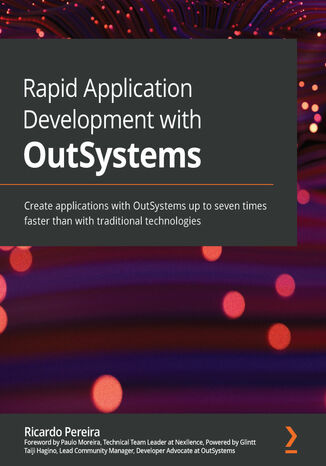
Ricardo Pereira, Paulo Moreira, Taiji Hagino
OutSystems is a software development platform that speeds up the build phase by abstracting code and making almost everything visual. This means replacing textual language with visual artifacts that avoid lexical errors and speed up code composition using accelerators and predefined templates.The book begins by walking you through the fundamentals of the technology, along with a general overview of end-to-end web and mobile software development. You'll learn how to configure your personal area in the cloud and use the OutSystems IDE to connect with it. The book then shows you how to build a web application based on the best architectural and developmental practices in the market, and takes the same approach for the mobile paradigm. As you advance, you'll find out how to develop the same application, and the great potential of reusing code from one paradigm in another and the symbiosis between them is showcased.The only application that'll differ from the application in the exercise is the one used in business process technology (BPT), with a focus on a common market use case.By the end of this OutSystems book, you'll be able to develop enterprise-level applications on the web and mobile, integrating them with third parties and other systems on the market. You'll also understand the concepts of performance, security, and software construction and be able to apply them effectively.
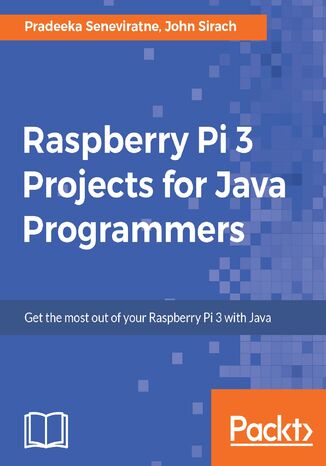
Raspberry Pi 3 Projects for Java Programmers. Get the most out of your Raspberry Pi 3 with Java
John Sirach, Pradeeka Seneviratne
Raspberry Pi is a small, low cost and yet very powerful development platform. It is used to interact with attached electronics by the use of it's GPIO pins for multiple use cases, mainly Home Automation and Robotics. Our book is a project-based guide that will show you how to utilize the Raspberry Pi's GPIO with Java and how you can leverage this utilization with your knowledge of Java. You will start with installing and setting up the necessary hardware to create a seamless development platform. You will then straightaway start by building a project that will utilize light for presence detection. Next, you will program the application, capable of handling real time data using MQTT and utilize RPC to publish data to adafruit.io. Further, you will build a wireless robot on top of the zuma chassis with the Raspberry Pi as the main controller. Lastly, you will end the book with advanced projects that will help you to create a multi-purpose IoT controller along with building a security camera that will perform image capture and recognize faces with the help of notifications.By the end of the book, you will be able to build your own real world usable projects not limited to Home Automation, IoT and/or Robotics utilizing logic, user and web interfaces.
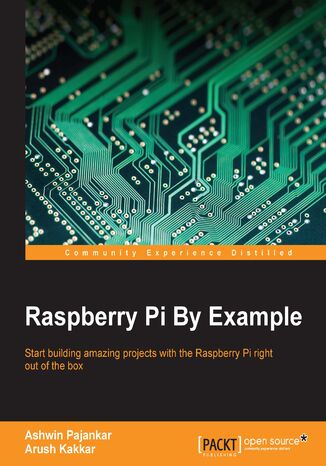
Raspberry Pi By Example. Start building amazing projects with the Raspberry Pi right out of the box
Ashwin Pajankar, Arush Kakkar
Want to put your Raspberry Pi through its paces right out of the box? This tutorial guide is designed to get you learning all the tricks of the Raspberry Pi through building complete, hands-on hardware projects. Speed through the basics and then dive right in to development!Discover that you can do almost anything with your Raspberry Pi with a taste of almost everything. Get started with Pi Gaming as you learn how to set up Minecraft, and then program your own game with the help of Pygame. Turn the Pi into your own home security system with complete guidance on setting up a webcam spy camera and OpenCV computer vision for image recognition capabilities. Get to grips with GPIO programming to make a Pi-based glowing LED system, build a complete functioning motion tracker, and more. Finally, get ready to tackle projects that push your Pi to its limits. Construct a complete Internet of Things home automation system with the Raspberry Pi to control your house via Twitter; turn your Pi into a super-computer through linking multiple boards into a cluster and then add in advanced network capabilities for super speedy processing!
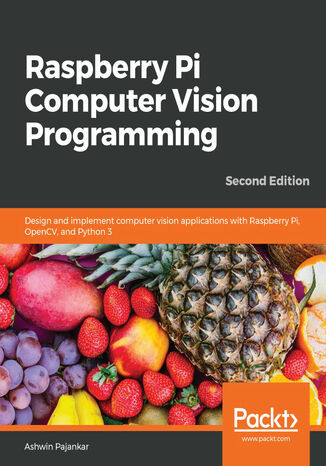
Ashwin Pajankar
Raspberry Pi is one of the popular single-board computers of our generation. All the major image processing and computer vision algorithms and operations can be implemented easily with OpenCV on Raspberry Pi. This updated second edition is packed with cutting-edge examples and new topics, and covers the latest versions of key technologies such as Python 3, Raspberry Pi, and OpenCV. This book will equip you with the skills required to successfully design and implement your own OpenCV, Raspberry Pi, and Python-based computer vision projects.At the start, you'll learn the basics of Python 3, and the fundamentals of single-board computers and NumPy. Next, you'll discover how to install OpenCV 4 for Python 3 on Raspberry Pi, before covering major techniques and algorithms in image processing, manipulation, and computer vision. By working through the steps in each chapter, you'll understand essential OpenCV features. Later sections will take you through creating graphical user interface (GUI) apps with GPIO and OpenCV. You'll also learn to use the new computer vision library, Mahotas, to perform various image processing operations. Finally, you'll explore the Jupyter Notebook and how to set up a Windows computer and Ubuntu for computer vision.By the end of this book, you'll be able to confidently build and deploy computer vision apps.