
Programowanie
Russ McKendrick
With Docker, it is possible to get a lot of apps running on the same old servers, making it very easy to package and ship programs. The ability to extend Docker using plugins and load third-party plugins is incredible, and organizations can massively benefit from it.In this book, you will read about what first and third party tools are available to extend the functionality of your existing Docker installation and how to approach your next Docker infrastructure deployment. We will show you how to work with Docker plugins, install it, and cover its lifecycle. We also cover network and volume plugins, and you will find out how to build your own plugin. You’ll discover how to integrate it with Puppet, Ansible, Jenkins, Flocker, Rancher, Packer, and more with third-party plugins. Then, you’ll see how to use Schedulers such as Kubernetes and Amazon ECS. Finally, we’ll delve into security, troubleshooting, and best practices when extending Docker.By the end of this book, you will learn how to extend Docker and customize it based on your business requirements with the help of various tools and plugins.
Donald Simpson
Jenkins CI is the leading open source continuous integration server. It is written in Java and has a wealth of plugins to support the building and testing of virtually any project. Jenkins supports multiple Software Configuration Management tools such as Git, Subversion, and Mercurial.This book explores and explains the many extension points and customizations that Jenkins offers its users, and teaches you how to develop your own Jenkins extensions and plugins.First, you will learn how to adapt Jenkins and leverage its abilities to empower DevOps, Continuous Integration, Continuous Deployment, and Agile projects. Next, you will find out how to reduce the cost of modern software development, increase the quality of deliveries, and thereby reduce the time to market. We will also teach you how to create your own custom plugins using Extension points.Finally, we will show you how to combine everything you learned over the course of the book into one real-world scenario.
Simon Buxton
Dynamics 365 for Operations is the ERP element of Microsoft’s new Dynamics 365 Enterprise Edition. Operations delivers the infrastructure to allow businesses to achieve growth and make better decisions using scalable and contemporary ERP system tools. This book provides a collection of “recipes” to instruct you on how to create—and extend—a real-world solution using Operations. All key aspects of the new release are covered, and insights into the development language, structure, and tools are discussed in detail. New concepts and patterns that are pivotal to elegant solution designs are introduced and explained, and readers will learn how to extend various aspects of the system to enhance both the usability and capabilities of Operations. Together, this gives the reader important context regarding the new concepts and the confidence to reuse in their own solution designs. This “cookbook” provides the ingredients and methods needed to maximize the efficiency of your business management using the latest in ERP software—Dynamics 365 for Operations.
Extending Microsoft Dynamics NAV 2016 Cookbook. Extend Dynamics NAV 2016 to win the business world
Alexander Drogin
Microsoft Dynamics NAV is an enterprise resource planning (ERP) software suite for organizations. The system offers specialized functionality for manufacturing, distribution, government, retail, and other industries. Its integrated development environment enables customizations with minimal disruption to business processes.The book starts explaining the new features of Dynamics NAV along with how to create and modify a simple module. Moving on, you will learn the importance of thinking beyond the boundaries of C/AL development and the possibilities opened by with it. Next, you will get to know how COM can be used to extend the functionalities of Dynamics NAV. You’ll find out how to extend the Dynamics NAV 2016 version using .NET interoperability and will see the steps required to subscribe to .NET events in order to extend Dynamics NAV. Finally, you’ll see the cmdlets available to manage extension packages. By the end of the book, you will have the knowledge needed to become more efficient in selecting the extending methods, developing and deploying them to the Dynamics NAV, and practicing the best practices.
Omar Khedher
OpenStack is a very popular cloud computing platform that has enabled several organizations during the last few years to successfully implement their Infrastructure as a Service (IaaS) platforms. This book will guide you through new features of the latest OpenStack releases and how to bring them into production straightaway in an agile way.It starts by showing you how to expand your current OpenStack setup and how to approach your next OpenStack Data Center generation deployment. You will discover how to extend your storage and network capacity and also take advantage of containerization technology such as Docker and Kubernetes in OpenStack. Additionally, you'll explore the power of big data as a Service terminology implemented in OpenStack by integrating the Sahara project. This book will teach you how to build Hadoop clusters and launch jobs in a very simple way. Then you'll automate and deploy applications on top of OpenStack. You will discover how to write your own plugin in the Murano project. The final part of the book will go through best practices for security such as identity, access management, and authentication exposed by Keystone in OpenStack. By the end of this book, you will be ready to extend and customize your private cloud based on your requirements.
Luca Zavarella
Python and R allow you to extend Power BI capabilities to simplify ingestion and transformation activities, enhance dashboards, and highlight insights. With this book, you'll be able to make your artifacts far more interesting and rich in insights using analytical languages.You'll start by learning how to configure your Power BI environment to use your Python and R scripts. The book then explores data ingestion and data transformation extensions, and advances to focus on data augmentation and data visualization. You'll understand how to import data from external sources and transform them using complex algorithms. The book helps you implement personal data de-identification methods such as pseudonymization, anonymization, and masking in Power BI. You'll be able to call external APIs to enrich your data much more quickly using Python programming and R programming. Later, you'll learn advanced Python and R techniques to perform in-depth analysis and extract valuable information using statistics and machine learning. You'll also understand the main statistical features of datasets by plotting multiple visual graphs in the process of creating a machine learning model.By the end of this book, you’ll be able to enrich your Power BI data models and visualizations using complex algorithms in Python and R.
Luca Zavarella, Rajat Talwar
The latest edition of this book delves deep into advanced analytics, focusing on enhancing Python and R proficiency within Power BI. New chapters cover optimizing Python and R settings, utilizing Intel's Math Kernel Library (MKL) for performance boosts, and addressing integration challenges. Techniques for managing large datasets beyond available RAM, employing the Parquet data format, and advanced fuzzy matching algorithms are explored. Additionally, it discusses leveraging SQL Server Language Extensions to overcome traditional Python and R limitations in Power BI. It also helps in crafting sophisticated visualizations using the Grammar of Graphics in both R and Python.This Power BI book will help you master data validation with regular expressions, import data from diverse sources, and apply advanced algorithms for transformation. You'll learn how to safeguard personal data in Power BI with techniques like pseudonymization, anonymization, and data masking. You'll also get to grips with the key statistical features of datasets by plotting multiple visual graphs in the process of building a machine learning model. The book will guide you on utilizing external APIs for enrichment, enhancing I/O performance, and leveraging Python and R for analysis.You'll reinforce your learning with questions at the end of each chapter.
Extending Puppet. Tools and Techniques for smarter infrastructure configuration - Second Edition
Alessandro Franceschi, Jaime Soriano Pastor
Puppet has changed the way we manage our systems, but Puppet itself is changing and evolving, and so are the ways we are using it. To tackle our IT infrastructure challenges and avoid common errors when designing our architectures, an up-to-date, practical, and focused view of the current and future Puppet evolution is what we need. With Puppet, you define the state of your IT infrastructure, and it automatically enforces the desired state.This book will be your guide to designing and deploying your Puppet architecture. It will help you utilize Puppet to manage your IT infrastructure. Get to grips with Hiera and learn how to install and configure it, before learning best practices for writing reusable and maintainable code. You will also be able to explore the latest features of Puppet 4, before executing, testing, and deploying Puppet across your systems. As you progress, Extending Puppet takes you through higher abstraction modules, along with tips for effective code workflow management.Finally, you will learn how to develop plugins for Puppet - as well as some useful techniques that can help you to avoid common errors and overcome everyday challenges.
Extending SaltStack. Build and write salt modules
Joseph Hall
Salt already ships with a very powerful set of tools, but that doesn't mean that they all suit your needs perfectly. By adding your own modules and enhancing existing ones, you can bring the functionality that you need to increase your productivity. Extending SaltStack follows a tutorial-based approach to explain different types of modules, from fundamentals to complete and full-functioning modules.Starting with the Loader system that drives Salt, this book will guide you through the most common types of modules. First you will learn how to write execution modules. Then you will extend the configuration using the grain, pillar, and SDB modules. Next up will be state modules and then the renderers that can be used with them. This will be followed with returner and output modules, which increase your options to manage return data. After that, there will be modules for external file servers, clouds, beacons, and finally external authentication and wheel modules to manage the master.With this guide in hand, you will be prepared to create, troubleshoot, and manage the most common types of Salt modules and take your infrastructure to new heights!
F# 4.0 dla zaawansowanych. Wydanie IV
Don Syme, Adam Granicz, Antonio Cisternino
Język F# jest nowoczesnym, lecz dojrzałym językiem programowania, który zyskuje coraz większą popularność. Ułatwia on korzystanie z kilku paradygmatów programowania: programowania funkcyjnego, obiektowego i imperatywnego. Został zaprojektowany do pisania prostego, solidnego i wydajnego kodu, lecz przydaje się do rozwiązywania złożonych problemów. Kod w F# jest zwięzły i efektywny. Sam F# jest projektem open source, jednak stanowi część platformy .NET. To wszystko czyni z niego język przyszłości! Trzymasz w ręku kompletny przewodnik po języku F#, w którym wyczerpująco przedstawiono informacje niezbędne do rozpoczęcia pracy w tej technologii. Zwięźle opisano tu paradygmaty obsługiwane przez F#, a następnie pokazano, w jaki sposób można posłużyć się tym językiem do rozwiązywania problemów z siecią, danymi, programowaniem równoległym i analizami. W ten sposób nauczysz się stosować wspomniane paradygmaty i używać kwerend, co pozwoli Ci osiągnąć wysoką produktywność w pisaniu programów dla wielu systemów i technologii. W tej książce znajdziesz: wyjaśnienie paradygmatów programowania funkcyjnego, obiektowego i imperatywnego kompletne informacje na temat najnowszej wersji języka F# instrukcje dotyczące projektowania bibliotek języka F# wskazówki dotyczące pisania hermetycznego i uporządkowanego kodu zagadnienia programowania reaktywnego, asynchronicznego i równoległego techniki rozwiązywania problemów programistycznych za pomocą F# Z językiem F# rozwiązywanie problemów stanie się przyjemnością! Don Syme — jest architektem języka F#. Brał udział w rozwijaniu typów generycznych w C# i technologii .NET Common Language Runtime. W 2015 roku został odznaczony Srebrnym Medalem Królewskiej Akademii Inżynierii. Adam Granicz — ma 10-letnie doświadczenie w pracy z językiem F#. Pracuje nad narzędziem WebSharper — podstawowym środowiskiem dla języka F#. Regularnie pisze artykuły i zabiera głos na konferencjach. Antonio Cisternino — jest profesorem Uniwersytetu w Pizie we Włoszech. Zajmuje się głównie metaprogramowaniem i budową architektury systemów. Od kilku lat korzysta z F# i bierze udział w rozwijaniu tego języka.
Sudipta Mukherjee
The F# functional programming language enables developers to write simple code to solve complex problems. With F#, developers create consistent and predictable programs that are easier to test and reuse, simpler to parallelize, and are less prone to bugs.If you want to learn how to use F# to build machine learning systems, then this is the book you want. Starting with an introduction to the several categories on machine learning, you will quickly learn to implement time-tested, supervised learning algorithms. You will gradually move on to solving problems on predicting housing pricing using Regression Analysis. You will then learn to use Accord.NET to implement SVM techniques and clustering. You will also learn to build a recommender system for your e-commerce site from scratch. Finally, you will dive into advanced topics such as implementing neural network algorithms while performing sentiment analysis on your data.
Johan Astborg
F# is a functional programming language that allows you to write simple code for complex problems. Currently, it is most commonly used in the financial sector. Quantitative finance makes heavy use of mathematics to model various parts of finance in the real world. If you are interested in using F# for your day-to-day work or research in quantitative finance, this book is a must-have.This book will cover everything you need to know about using functional programming for quantitative finance. Using a functional programming language will enable you to concentrate more on the problem itself rather than implementation details. Tutorials and snippets are summarized into an automated trading system throughout the book.This book will introduce you to F#, using Visual Studio, and provide examples with functional programming and finance combined. The book also covers topics such as downloading, visualizing and calculating statistics from data.F# is a first class programming language for the financial domain.
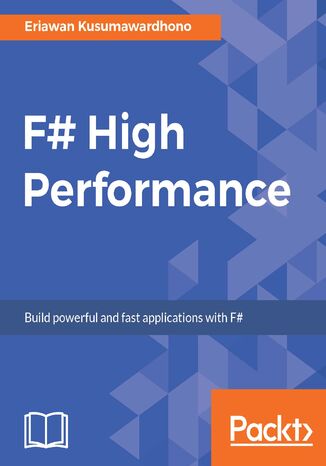
Eriawan Kusumawardhono
F# is a functional programming language and is used in enterprise applications that demand high performance. It has its own unique trait: it is a functional programming language and has OOP support at the same time.This book will help you make F# applications run faster with examples you can easily break down and take into your own work. You will be able to assess the performance of the program and identify bottlenecks. Beginning with a gentle overview of concurrency features in F#, you will get to know the advanced topics of concurrency optimizations in F#, such as F# message passing agent of MailboxProcessor and further interoperation with .NET TPL. Based on this knowledge, you will be able to enhance the performance optimizations when implementing and using other F# language features.The book also covers optimization techniques by using F# best practices and F# libraries. You will learn how the concepts of concurrency and parallel programming will help in improving the performance. With this, you would be able to take advantage of multi-core processors and track memory leaks, root causes, and CPU issues. Finally, you will be able to test their applications to achieve scalability.
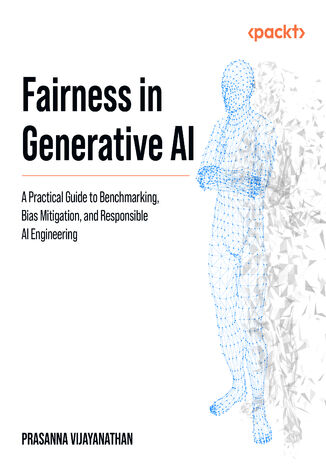
Prasanna Vijayanathan
As generative AI moves into critical applications like hiring, credit decisions, education, and healthcare, the potential for real-world harm escalates. When systems perpetuate stereotypes or skew outcomes based on identity, the impact goes far beyond poor user experience. It results in lost opportunities, violated dignity, and erosion of trust. This book offers practical methods for evaluating and ensuring fairness across text, image, and multimodal GenAI systems. You'll begin with fairness principles that matter for GenAI and learn how to translate philosophical constructs into engineering artifacts. Abstract goals become measurable requirements: what constitutes harm, which groups are in scope, how fairness is defined, and which trade-offs are acceptable. Next, design a benchmarking framework that integrates with existing pipelines. Thereafter, create scenario and prompt libraries, model sensitive attributes and intersections, and run evaluations through an orchestrated pipeline. Implement quantitative metrics and qualitative rubrics, add human review with rater training and agreement checks, and publish results as scorecards and dashboards. Finally, integrate fairness checks into CI and model release gates, monitor drift, and run incident response playbooks so benchmarks stay credible as models and norms evolve.
David Cornelius
Delphi is a strongly typed, event-driven programming language with a rich ecosystem of frameworks and support tools. It comes with an extensive set of web and database libraries for rapid application development on desktop, mobile, and internet-enabled devices. This book will help you keep up with the latest IDE features and provide a sound foundation of project management and recent language enhancements to take your productivity to the next level.You’ll discover how simple it is to support popular mobile device features such as sensors, cameras, and GPS. The book will help you feel comfortable working with FireMonkey and styles and incorporating 3D user interfaces in new ways. As you advance, you’ll be able to build cross-platform solutions that not only look native but also take advantage of a wide array of device capabilities. You’ll also learn how to use embedded databases, such as SQLite and InterBase ToGo, synchronizing them with your own custom backend servers or modules using the powerful RAD Server engine. The book concludes by sharing tips for testing and deploying your end-to-end application suite for a smooth user experience.By the end of this book, you’ll be able to deliver modern enterprise applications using Delphi confidently.
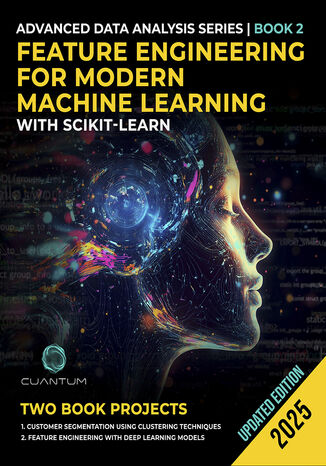
Cuantum Technologies LLC
Feature engineering is essential for building robust predictive models. This book delves into practical techniques for transforming raw data into powerful features using Scikit-Learn. You'll explore automation, deep learning integrations, and advanced topics like feature selection and model evaluation. Learn to handle real-world data challenges, enhance accuracy, and streamline your workflows.Through hands-on projects, readers will gain practical experience with techniques such as clustering, pipelines, and feature selection, applied to domains like retail and healthcare. Step-by-step instructions ensure a comprehensive learning journey, from foundational concepts to advanced automation and hybrid modeling approaches.By combining theory with real-world applications, the book equips data professionals with the tools to unlock the full potential of machine learning models. Whether working with structured datasets or integrating deep learning features, this guide provides actionable insights to tackle any data transformation challenge effectively.