
Programowanie
JSF 2.0 Cookbook: LITE. Converters, Validators, and Security
Anghel Leonard
Practical, hands-on “Cookbook” approach. Full of clear, step-by-step instructions that you can apply straight away. Written for people who want to get maximum results without lots of background and theory reading. JSF developers who want to work with validators, converters and security features of JSF. You don’t need any prior knowledge of JSF to use these recipes.
Ivo Balbaert, Adrian Salceanu
Julia offers the high productivity and ease of use of Python and R with the lightning-fast speed of C++. There’s never been a better time to learn this language, thanks to its large-scale adoption across a wide range of domains, including fintech, biotech and artificial intelligence (AI).You will begin by learning how to set up a running Julia platform, before exploring its various built-in types. This Learning Path walks you through two important collection types: arrays and matrices. You’ll be taken through how type conversions and promotions work, and in further chapters you'll study how Julia interacts with operating systems and other languages. You’ll also learn about the use of macros, what makes Julia suitable for numerical and scientific computing, and how to run external programs.Once you have grasped the basics, this Learning Path goes on to how to analyze the Iris dataset using DataFrames. While building a web scraper and a web app, you’ll explore the use of functions, methods, and multiple dispatches. In the final chapters, you'll delve into machine learning, where you'll build a book recommender system.By the end of this Learning Path, you’ll be well versed with Julia and have the skills you need to leverage its high speed and efficiency for your applications.This Learning Path includes content from the following Packt products:• Julia 1.0 Programming - Second Edition by Ivo Balbaert• Julia Programming Projects by Adrian Salceanu
Bogumił Kamiński, Przemysław Szufel
Julia, with its dynamic nature and high-performance, provides comparatively minimal time for the development of computational models with easy-to-maintain computational code. This book will be your solution-based guide as it will take you through different programming aspects with Julia.Starting with the new features of Julia 1.0, each recipe addresses a specific problem, providing a solution and explaining how it works. You will work with the powerful Julia tools and data structures along with the most popular Julia packages. You will learn to create vectors, handle variables, and work with functions. You will be introduced to various recipes for numerical computing, distributed computing, and achieving high performance. You will see how to optimize data science programs with parallel computing and memory allocation. We will look into more advanced concepts such as metaprogramming and functional programming. Finally, you will learn how to tackle issues while working with databases and data processing, and will learn about on data science problems, data modeling, data analysis, data manipulation, parallel processing, and cloud computing with Julia.By the end of the book, you will have acquired the skills to work more effectively with your data
Ivo Balbaert
The release of Julia 1.0 is now ready to change the technical world by combining the high productivity and ease of use of Python and R with the lightning-fast speed of C++. Julia 1.0 programming gives you a head start in tackling your numerical and data problems. You will begin by learning how to set up a running Julia platform, before exploring its various built-in types. With the help of practical examples, this book walks you through two important collection types: arrays and matrices. In addition to this, you will be taken through how type conversions and promotions work. In the course of the book, you will be introduced to the homo-iconicity and metaprogramming concepts in Julia. You will understand how Julia provides different ways to interact with an operating system, as well as other languages, and then you'll discover what macros are. Once you have grasped the basics, you’ll study what makes Julia suitable for numerical and scientific computing, and learn about the features provided by Julia. By the end of this book, you will also have learned how to run external programs. This book covers all you need to know about Julia in order to leverage its high speed and efficiency for your applications.
Julia Cookbook. Over 40 recipes to get you up and running with programming using Julia
Jalem Raj Rohit
Want to handle everything that Julia can throw at you and get the most of it every day? This practical guide to programming with Julia for performing numerical computation will make you more productive and able work with data more efficiently. The book starts with the main features of Julia to help you quickly refresh your knowledge of functions, modules, and arrays. We’ll also show you how to utilize the Julia language to identify, retrieve, and transform data sets so you can perform data analysis and data manipulation.Later on, you’ll see how to optimize data science programs with parallel computing and memory allocation. You’ll get familiar with the concepts of package development and networking to solve numerical problems using the Julia platform.This book includes recipes on identifying and classifying data science problems, data modelling, data analysis, data manipulation, meta-programming, multidimensional arrays, and parallel computing. By the end of the book, you will acquire the skills to work more effectively with your data.
Julia High Performance. Design and develop high performing programs with Julia
Avik Sengupta
Julia is a high performance, high-level dynamic language designed to address the requirements of high-level numerical and scientific computing. Julia brings solutions to the complexities faced by developers while developing elegant and high performing code. Julia High Performance will take you on a journey to understand the performance characteristics of your Julia programs, and enables you to utilize the promise of near C levels of performance in Julia.You will learn to analyze and measure the performance of Julia code, understand how to avoid bottlenecks, and design your program for the highest possible performance. In this book, you will also see how Julia uses type information to achieve its performance goals, and how to use multuple dispatch to help the compiler to emit high performance machine code. Numbers and their arrays are obviously the key structures in scientific computing – you will see how Julia’s design makes them fast. The last chapter will give you a taste of Julia’s distributed computing capabilities.
Julia: High Performance Programming. Build powerful and fast systems with Julia
Ivo Balbaert, M E Sherrington, Avik Sengupta
In this learning path, you will learn to use an interesting and dynamic programming language—Julia! You will get a chance to tackle your numerical and data problems with Julia. You’ll begin the journey by setting up a running Julia platform before exploring its various built-in types. We’ll then move on to the various functions and constructs in Julia. We’ll walk through the two important collection types—arrays and matrices in Julia.You will dive into how Julia uses type information to achieve its performance goals, and how to use multiple dispatch to help the compiler emit high performance machine code. You will see how Julia’s design makes code fast, and you’ll see its distributed computing capabilities.By the end of this learning path, you will see how data works using simple statistics and analytics, and you’ll discover its high and dynamic performance—its real strength, which makes it particularly useful in highly intensive computing tasks. This learning path combines some of the best that Packt has to offer in one complete, curated package. It includes content from the following Packt products:? Getting Started with Julia by Ivo Balvaert? Julia High Performance by Avik Sengupta? Mastering Julia by Malcolm Sherrington
Christopher Pecoraro , Vincenzo Gambino
Jamstack (JavaScript, API, and Markup) enables web developers to create and publish modern and maintainable websites and web apps focused on speed, security, and accessibility by using tools such as Gatsby, Sanity, and Netlify. Developers working with Jamstack will be able to put their knowledge to good use with this practical guide to static site generation and content management. This Jamstack book takes a hands-on approach to implementation and related methodologies that will have you up and running with modern web development in no time.Complete with step-by-step explanations of essential concepts, practical examples, and self-assessment questions, you'll begin by building an event and venue schema structure, and then expand the functionality, exploring all that the Jamstack has to offer. You’ll learn how an example Jamstack is built, build structured content using Sanity to create a schema, use GraphQL to expose the content, and employ Gatsby to build an event website using page and template components and Tailwind CSS Framework. Lastly, you’ll deploy the website to both, a Netlify server and the Microsoft Static Web Apps Service, and interact with it using Amazon Alexa.By the end of this book, you'll have gained the knowledge and skills you need to install, configure, build, extend, and deploy a simple events website using Jamstack.
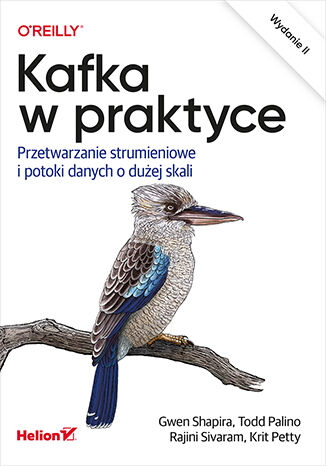
Kafka w praktyce. Przetwarzanie strumieniowe i potoki danych o dużej skali. Wydanie II
Gwen Shapira, Todd Palino, Rajini Sivaram, Krit...
Każda aplikacja korporacyjna tworzy dane. Ich przenoszenie i przetwarzanie jest równie ważne jak same dane. Platforma Apache Kafka została zbudowana właśnie w tym celu: aby umożliwić płynną obsługę strumieni zdarzeń czasu rzeczywistego. Umożliwia to architektom nie tylko łączenie aplikacji z systemami danych, ale również budowanie niestandardowych aplikacji, które same w sobie wyzwalają strumienie danych. Okazuje się, że architektura skupiona wokół strumieni zdarzeń otwiera zupełnie nowy rozdział projektowania dużych systemów. Dzięki temu praktycznemu przewodnikowi komfortowo rozpoczniesz pracę z platformą streamingową Apache Kafka. Poznasz najlepsze praktyki w zakresie jej wdrażania i konfiguracji, aby zapewnić sobie możliwość strumieniowego przetwarzania dużych ilości danych. Zaznajomisz się z AdminClient API Kafki, mechanizmem transakcji i z nowymi funkcjonalnościami zabezpieczeń. W książce znajdziesz szczegółowe instrukcje, w jaki sposób wdrażać klastry produkcyjne Kafki, pisać niezawodne mikrousługi oparte na zdarzeniach i budować skalowalne aplikacje przetwarzania strumieniowego. Opisano w niej też gwarancje niezawodności, kluczowe interfejsy API i szczegóły architektury, w tym protokół replikacji, kontroler i warstwę pamięci masowej. Najciekawsze zagadnienia: wdrażanie i konfigurowanie Kafki w praktyce niezawodne dostarczanie danych budowanie potoków danych i aplikacji monitorowanie, dostrajanie i utrzymywanie działania Kafki w środowisku produkcyjnym wskaźniki pomiarów operacyjnych Kafki Kafka w systemach przetwarzania strumieniowego Kafka: gwarancja niezawodności korporacyjnych aplikacji!
Kanban Development in 30 days. Modern and efficient organization that delivers results
Tomas & Jannika Bjorkholm
Kanban is a simple and elegant Agile framework that helps to control and improve development processes. Originating in traditional 20th century manufacturing in Japan, Kanban has a renewed relevance today, being a crucial methodology in the world of software development. This book explores the key features of Kanban, and demonstrates how to put it into practice through exercises that will help you make the most of this unique approach to managing collaboration and production.Designed as a 30 day action plan, this book will help you understand and implement Kanban – and start seeing results – in a month. Analyze your current situation and define your goals and wider strategic aims, and begin developing a plan to help you and your team confidently work towards achieving them. Involve your team to drive cultural change, learn how to prioritize and organize tasks and projects to efficiently use your time and resources.Create your own value stream map to better understand your processes and identify improvement areas, and adapt and use the features tips and examples to overcome challenges you may face when implementing Kanban.Pick up this book and experience the full results of this vital Agile methodology – fast.
Keras 3. Comprehensive Insights into Keras for Deep Learning and AI Solutions
Rheinwerk Publishing, Inc, Mohammad Nauman
This book provides a comprehensive guide to mastering deep learning with Keras 3, starting from the fundamentals of machine learning and neural networks to advanced techniques in reinforcement learning, transformers, and generative AI. Readers will begin with understanding the core principles of machine learning, including supervised, unsupervised, and reinforcement learning. The book explains how neural networks function and how to build them using Keras, TensorFlow, and Python. You'll dive into critical topics such as convolutional neural networks (CNNs), dropout regularization, and gradient descent optimization. As you progress, you’ll learn advanced deep learning concepts like transfer learning, transformers, and the powerful Keras Functional API for building complex models. There’s a focus on practical applications, such as building and evaluating deep learning models for real-world tasks, and enhancing models using GPU acceleration. You'll also explore generative models, including autoencoders and GANs, and apply them to tasks like image generation and data augmentation. By the end of the book, you’ll be able to implement state-of-the-art AI models and deploy them in production environments.
Stian Thorgersen, Pedro Igor Silva
Implementing authentication and authorization for applications can be a daunting experience, often leaving them exposed to security vulnerabilities. Keycloak is an open-source solution for identity management and access management for modern applications, which can make a world of difference if you learn how to use it. Keycloak, helping you get started with using it and securing your applications. Complete with hands-on tutorials, best practices, and self-assessment questions, this easy-to-follow guide will show you how to secure a sample application and then move on to securing different application types. As you progress, you will understand how to configure and manage Keycloak as well as how to leverage some of its more advanced capabilities. Finally, you'll gain insights into securely using Keycloak in production.By the end of this book, you will have learned how to install and manage Keycloak as well as how to secure new and existing applications.
Kivy Blueprints. Build your very own app-store-ready, multi-touch games and applications with Kivy!
Mark Vasilkov
This book is intended for programmers who are comfortable with the Python language and who want to build desktop and mobile applications with rich GUI in Python with minimal hassle. Knowledge of Kivy is not strictly required—every aspect of the framework is described when it's first used.
Kivy Cookbook. Enhance your skills in developing multi-touch applications with Kivy
Hugo Solis
Kivy is an open-source Python library for rapid development of applications that make use of innovative user interfaces, such as multi-touch apps. It is a promising Python framework to develop UI and UX apps in a cross-platform environment, under the Python philosophy.Kivy Cookbook is a practical book that will guide you through the Kivy framework to develop apps and get your apps ready for distribution in App Store and Android devices.You will start off with installing Kivy and building your interfaces. You will learn how to work the accelerometer and create custom events. Then, you will understand how to use the basics, buttons, labels and text inputs and manipulate the widget tree. Next, you will be able to work with manipulating instructions, create an atlas and layouts. Moving on, you will learn packing for Windows and packing for iOS, and use TestDrive.By the end of the book, you will have learnt in detail the relevant features and tools in Kivy and how to create portable packages to distribute your apps in the most used platforms.
Kod doskonały. Jak tworzyć oprogramowanie pozbawione błędów. Wydanie II
Steve McConnell
Kultowy podręcznik tworzenia doskonałego oprogramowania! Twórz wolny od błędów, najwyższej jakości kod Utrzymuj stałą kontrolę nad złożonymi projektami Wcześnie wykrywaj i rozwiązuj problemy Sprawnie rozwijaj i poprawiaj oprogramowanie Steve McConnell wie więcej o budowie oprogramowania niż ktokolwiek inny; mamy ogromne szczęście, że zdecydował się podzielić swoim doświadczeniem oraz wiedzą w tej ważnej i oryginalnej książce. Alan Cooper, „ojciec” języka Visual Basic, autor książki About Face Zapewne każdy zgodzi się ze stwierdzeniem, że jeśli jakiś proces odpowiada za nawet 70% błędów w gotowym produkcie, z pewnością wymaga znaczącego usprawnienia... Czy masz jednak świadomość, że właśnie tyle problemów generuje samo wytwarzanie oprogramowania? Te błędy powodują nie tylko usterki w już gotowych programach, niespełniających oczekiwań klientów — odpowiadają także za znaczne opóźnienia przy realizacji zleconych projektów i nagminne przekraczanie zaplanowanego budżetu. Każdy ambitny programista staje zatem przed koniecznością zdobycia wiedzy o takich metodach pracy, które pozwolą szybciej i efektywniej realizować projekty, a przy tym zapewniać najwyższą jakość tworzonego kodu. W końcu na podstawie tych właśnie umiejętności oceniana jest także wartość danego programisty w zespole. Z tych właśnie powodów niniejsza książka, będąca przejrzystą kompilacją najlepszych technik programowania, zdobyła tak wielkie uznanie w środowisku zawodowców i studentów, osiągając miano podręcznika kultowego. Przed Tobą drugie, zaktualizowane wydanie słynnej publikacji, w której Steve McConnell przedstawia wszystkie aspekty budowy programów, takie jak jakość czy podejście do procesu wytwarzania. Autor rozwija tu tak istotne zagadnienia, jak przebieg budowy klasy, techniki pracy z danymi i strukturami sterującymi, debugowanie, refaktoryzowanie oraz metody i strategie optymalizacji. Znajdziesz tu dziesiątki list kontrolnych, pomocnych w ocenianiu architektury, jakości klas i procedur, nazw zmiennych czy struktur sterujących, a także ponad 500 przykładów dobrego i złego kodu. Dowiesz się, co było przyczyną wielu typowych problemów w przeszłości i jak ich dzisiaj unikać. Opisane metody pracy pomogą utrzymać kontrolę nad dużymi projektami oraz efektywnie rozwijać i modyfikować oprogramowanie w odpowiedzi na zmiany wymagań. Co ważne, można je skutecznie wykorzystywać niezależnie od stosowanego języka programowania! Dzięki tej książce nauczysz się skutecznie: projektować z zachowaniem minimalnej złożoności; praktycznie wykorzystywać metody pracy zespołowej; programować defensywnie, by unikać błędów w kodzie i jak najszybciej je z niego usuwać; wykorzystywać okazje do refaktoryzacji oraz rozwijania kodu i robić to w sposób bezpieczny; korzystać z metod programowania dopasowanych do projektu; szybko i efektywnie debugować; wcześnie i we właściwy sposób rozwiązywać najważniejsze problemy z konstrukcją oprogramowania; dbać o jakość kodu od pierwszego do ostatniego dnia projektu. Posiądź kluczowe umiejętności tworzenia najwyższej jakości oprogramowania! Steve McConnell jest jednym z najbardziej szanowanych ekspertów w świecie informatyki. Jest głównym programistą w firmie Construx Software oraz znanym autorem bestsellerowych książek, m.in. Kod doskonały i Rapid Development — obie zostały uhonorowane nagrodą Jolt magazynu „Software Development”, przyznawaną co roku najlepszej książce poświęconej procesowi wytwarzania oprogramowania. Brał udział w projektach realizowanych dla takich firm, jak Microsoft czy Boeing, a w 1998 roku czytelnicy magazynu „Software Development” uznali go obok Billa Gatesa i Linusa Torvaldsa za jedną z trzech najbardziej wpływowych osób w branży oprogramowania.

Charles Petzold
Początki techniki komputerowej obfitowały w zaskakujące szczegóły. Zagłębianie się w historię odkryć i wynalazków, dzięki którym obecnie możemy się cieszyć wyrafinowaną technologią, jest świetną rozrywką, jednak cofnięcie się do korzeni świata komputerów niesie ze sobą wiele dodatkowych korzyści. Najważniejszą z nich jest łatwiejsze zrozumienie zasad działania komputerów i innych urządzeń związanych z procesorami. W końcu dziś nawet zwykły użytkownik powinien wiedzieć, jaka jest różnica między pamięcią operacyjną a masową, znać koncepcję plików i folderów czy mieć choćby podstawową wiedzę z zakresu grafiki komputerowej. Ta książka jest fascynującą i nieco sentymentalną opowieścią o tajemnym życiu toczącym się wewnątrz komputerów i innych inteligentnych urządzeń. Mówi też o historii poszczególnych wynalazków. Dzięki niej zrozumiesz, co w ciągu ostatnich dwustu lat doprowadziło ludzi, chcących po prostu sprawniej się porozumiewać, do wynalezienia różnych urządzeń. Przeczytasz również o rzeczywistych mechanizmach działania komputerów osobistych, multimediów cyfrowych i internetu. Nie musisz posiadać zaawansowanej wiedzy technicznej, aby zrozumieć, czym jest tranzystor, jak działają systemy operacyjne i czym się różnią bity od bajtów. Książka jest napisana w przystępny sposób, a jej lektura sprawi Ci ogromną przyjemność! Dowiedz się, czym w istocie są: różne rodzaje kodów systemy dziesiętny, binarny i szesnastkowy bramki logiczne, sumowanie i przerzutniki pamięć, mikroprocesor, magistrala system operacyjny i języki programowania Ukryty kod maszyny. Wróć do źródeł!