
Programowanie
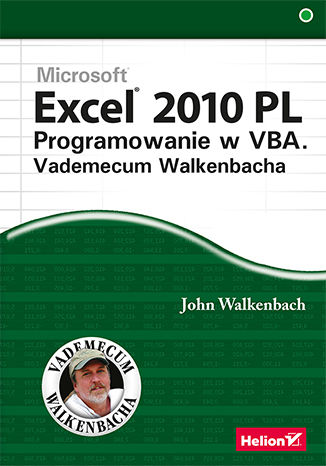
Excel 2010 PL. Programowanie w VBA. Vademecum Walkenbacha
John Walkenbach
Opanuj możliwości VBA z największym autorytetem w dziedzinie Excela! Jak projektować przyjazne użytkownikom okna dialogowe? Jak stosować VBA do tworzenia użytecznych aplikacji dla Excela? Jak rozszerzać możliwości Excela i tworzyć praktyczne dodatki? Nie należysz do osób, które onieśmiela potencjał Excela? Sprawnie tworzysz skoroszyty, wprowadzasz formuły, używasz funkcji arkuszowych i swobodnie posługujesz się Wstążką programu? Czujesz, że drzemie w nim jeszcze ogrom niezwykłych możliwości, ale nie wiesz, jak po nie sięgnąć? Najwyższa pora na naukę z Johnem Walkenbachem - najsłynniejszym ekspertem w dziedzinie Excela! Jeśli poznałeś już podstawowe funkcje tego programu, dzięki tej książce bez trudu opanujesz narzędzia zaawansowane, czyli takie, które naprawdę ułatwią i przyspieszą Twoją codzienną pracę! Swoją naukę pod okiem mistrza zaczniesz od odświeżenia informacji na temat używania rozmaitych formuł oraz plików stosowanych i generowanych przez Excel. Zaraz potem przejdziesz do fascynującej części, poświęconej projektowaniu aplikacji w tym programie. Dowiesz się, czym taka aplikacja jest i jak szczegółowo wyglądają etapy jej tworzenia. Następnie opanujesz całą niezbędną wiedzę na temat języka VBA, aby sprawnie w nim programować oraz tworzyć funkcje i procedury. Nauczysz się również wykorzystywać jego możliwości podczas używania tabel przestawnych i wykresów. Ponadto wzbogacisz się o informacje na temat projektowania niestandardowych, przyjaznych okien dialogowych UserForm, automatycznej obsługi zdarzeń czy tworzenia praktycznych dodatków dla Excela. Przegląd możliwości Excela 2010 Projektowanie aplikacji w programie Excel Język Visual Basic for Applications Zastosowanie formularzy UserForm Niestandardowe okna dialogowe Zaawansowane metody programowania Tabele przestawne, wykresy i obsługa zdarzeń Projektowanie dodatków do Excela Tworzenie systemów pomocy dla aplikacji Tworzenie aplikacji przyjaznych dla użytkownika Metody użycia VBA do pracy z plikami Posiądź wiedzę profesjonalistów - wykorzystaj wszystkie możliwości Excela i poszerzaj je! Sięgnij po mistrzowskie umiejętności! Oto seria podręczników, w których najsłynniejszy ekspert w dziedzinie Excela, John Walkenbach, pokazuje, jak wykrzesać z tego programu maksimum możliwości! Te dedykowane średnio i bardzo zaawansowanym użytkownikom książki pozwalają wyjść poza świat standardowych narzędzi i dają praktyczną wiedzę o tym, jak rozszerzać i dopasowywać funkcjonalność Excela do własnych potrzeb! Fascynują Cię formuły, tworzenie makr, VBA czy projektowanie złożonych, przyjaznych dla użytkownika aplikacji? Nikt nie nauczy Cię więcej o Excelu niż sam mistrz Walkenbach!
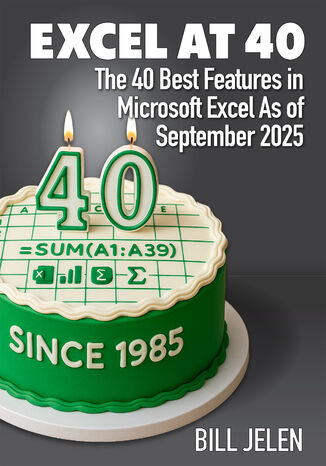
Excel at 40. The 40 Best Features in Excel as of September 2025
MrExcel's Holy Macro! Books, Bill Jelen
This book highlights 40 defining features that have made Excel indispensable since its creation. It opens with early innovations like AutoSum, Freeze Panes, and Pivot Tables before progressing to advanced tools such as Power Query, Dynamic Arrays, and the Copilot AI revolution. Each chapter presents history, context, and application, helping readers appreciate both legacy and cutting-edge updates.Through storytelling and expert insights, the book connects Excel’s past and present, offering a complete perspective on how the tool empowers business intelligence and everyday efficiency. Practical guidance throughout helps readers understand not only how to use each feature but why it matters in the evolution of data work.By exploring practical examples and future directions, readers gain deep appreciation and mastery of Excel’s evolving ecosystem. The combination of technical know-how, anecdotes, and forward-looking analysis makes this book a must-read for anyone invested in the future of productivity and data analysis.
Expert Android Programming. Master skills to build enterprise grade Android applications
Prajyot Mainkar
Android O brings a number of important changes for the users as well as the developers. If you want to create smart android applications which are fast, lightweight and also highly efficient then this is the book that will solve all your problems. You will create a complex enterprise grade app in this book. You will get a quick refresher of the latest android SDK and how to configure your development environment. Then you will move onto creating app layouts, component and module building, creating smart and efficient UIs. The most important part of a modern day app is how real time they are. With this book, you will create a smooth back-end for your app, ensure dynamic and real time communication between different app layers. As we move on, you will learn to leverage the different Android APIs and create an efficient SQLite data layer for your apps. You will implement effective testing techniques to make your app reliable and robust and finally you will learn to deploy it efficiently. The multiple stages of android development will also be simplified by giving you an industry standard set of best practices.
Atul Mistry
Expert AWS Development begins with theinstallation of the AWS SDK and you will goon to get hands-on experience of creatingan application using the AWS ManagementConsole and the AWS Command LineInterface (CLI). Then, you will integrateapplications with AWS services such asDynamoDB, Amazon Kinesis, AWS Lambda,Amazon SQS, and Amazon SWF.Following this, you will get well versed withCI/CD workflow and work with four majorphases in the release process – Source,Build, Test, and Production. Then, you willlearn to apply AWS Developer tools to yourContinuous Integration (CI) and ContinuousDeployment (CD) workflow. Later, youwill learn about user authentication usingAmazon Cognito, and also how you canevaluate the best architecture as per yourinfrastructure costs. You will learn aboutAmazon EC2 service and will deploy anapp using it. You will also deploy a practicalreal-world example of a CI/CD applicationwith the Serverless Application Framework,which is known as AWS Lambda.Finally, you will learn how to build, develop,and deploy the Application using AWSDeveloper tools such as AWS CodeCommit,AWS CodeBuild, AWS CodeDeploy, andAWS CodePipeline, as per your projectrequirements.
Vardan Grigoryan, Shunguang Wu
C++ has evolved over the years and the latest release – C++20 – is now available. Since C++11, C++ has been constantly enhancing the language feature set. With the new version, you’ll explore an array of features such as concepts, modules, ranges, and coroutines. This book will be your guide to learning the intricacies of the language, techniques, C++ tools, and the new features introduced in C++20, while also helping you apply these when building modern and resilient software.You’ll start by exploring the latest features of C++, and then move on to advanced techniques such as multithreading, concurrency, debugging, monitoring, and high-performance programming. The book will delve into object-oriented programming principles and the C++ Standard Template Library, and even show you how to create custom templates. After this, you’ll learn about different approaches such as test-driven development (TDD), behavior-driven development (BDD), and domain-driven design (DDD), before taking a look at the coding best practices and design patterns essential for building professional-grade applications. Toward the end of the book, you will gain useful insights into the recent C++ advancements in AI and machine learning.By the end of this C++ programming book, you’ll have gained expertise in real-world application development, including the process of designing complex software.
Marcelo Guerra Hahn, Araks Tigranyan, John Asatryan,...
Are you an experienced C++ developer eager to take your skills to the next level? This updated edition of Expert C++ is tailored to propel you toward your goals.This book takes you on a journey of building C++ applications while exploring advanced techniques beyond object-oriented programming. Along the way, you'll get to grips with designing templates, including template metaprogramming, and delve into memory management and smart pointers. Once you have a solid grasp of these foundational concepts, you'll advance to more advanced topics such as data structures with STL containers and explore advanced data structures with C++. Additionally, the book covers essential aspects like functional programming, concurrency, and multithreading, and designing concurrent data structures. It also offers insights into designing world-ready applications, incorporating design patterns, and addressing networking and security concerns. Finally, it adds to your knowledge of debugging and testing and large-scale application design.With Expert C++ as your guide, you'll be empowered to push the boundaries of your C++ expertise and unlock new possibilities in software development.
Expert Data Visualization. Advanced information visualization with D3.js 4.x
Jos Dirksen
Do you want to make sense of your data? Do you want to create interactive charts, data trees, info-graphics, geospatial charts, and maps efficiently? This book is your ideal choice to master interactive data visualization with D3.js V4. The book includes a number of extensive examples that to help you hone your skills with data visualization. Throughout nine chapters these examples will help you acquire a clear practical understanding of the various techniques, tools and functionality provided by D3.js. You will first setup your D3.JS development environment and learn the basic patterns needed to visualize your data. After that you will learn techniques to optimize different processes such as working with selections; animating data transitions; creating graps and charts, integrating external resources (static as well as streaming); visualizing information on maps; working with colors and scales; utilizing the different D3.js APIs; and much more. The book will also guide you through creating custom graphs and visualizations, and show you how to go from the raw data to beautiful visualizations. The extensive examples will include working with complex and realtime data streams, such as seismic data, geospatial data, scientific data, and more. Towards the end of the book, you will learn to add more functionality on top of D3.js by using it with other external libraries and integrating it with Ecmascript 6 and Typescript
Expert Delphi. Robust and fast cross-platform application development
Paweł Głowacki
Delphi is the most powerful Object Pascal IDE and component library for cross-platform native app development. It enables building natively compiled, blazingly fast apps for all major platforms including Android, iOS, Windows, Mac, and Linux.If you want to build server-side applications, create web services, and have clear GUIs for your project, then this book is for you. The book begins with a basic primer on Delphi helping you get accustomed to the IDE and the Object Pascal language and will then quickly move on to advanced-level concepts. Through this book, we’ll help you understand the architecture of applications and will teach you the important concepts of the FireMonkey library, show you how to build server-side services, and enable you to interact with the Internet of Things. Towards the end, you will learn to integrate your app with various web services and deploy them. By the end of the book, you will be able to build powerful, cross-platform, native apps for iOS and Android with a single code base.