
Programowanie
Niezależnie czy dopiero rozpoczynacie swoją przygodę z programowaniem, czy jesteście już uznanymi na rynku profesjonalistami, to w kategorii Programowanie na pewno znajdziecie podręczniki, które pomogą Wam w przebiegu pracy, czy też w nauce podstaw programowania.
W książkach z tego działu zawarta jest wiedza zarówno związana z czysto technicznymi sprawami typu składnia języków, ale także z umiejętnościami bardziej "miękkimi" jak obsługa i wykorzystanie pełnych możliwości środowisk programistycznych, czy też projektowanie oprogramowania lub metody numeryczne czy oraz struktury danych.
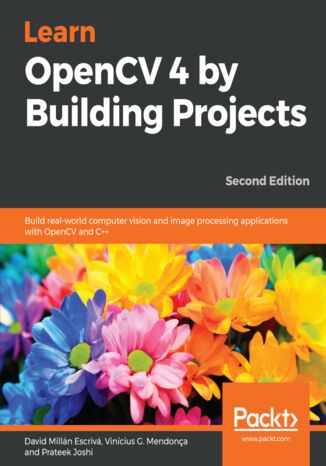
David Millán Escrivá, Vinícius G. Mendonça, Prateek...
OpenCV is one of the best open source libraries available, and can help you focus on constructing complete projects on image processing, motion detection, and image segmentation. Whether you’re completely new to computer vision, or have a basic understanding of its concepts, Learn OpenCV 4 by Building Projects – Second edition will be your guide to understanding OpenCV concepts and algorithms through real-world examples and projects. You’ll begin with the installation of OpenCV and the basics of image processing. Then, you’ll cover user interfaces and get deeper into image processing. As you progress through the book, you'll learn complex computer vision algorithms and explore machine learning and face detection. The book then guides you in creating optical flow video analysis and background subtraction in complex scenes. In the concluding chapters, you'll also learn about text segmentation and recognition and understand the basics of the new and improved deep learning module.By the end of this book, you'll be familiar with the basics of Open CV, such as matrix operations, filters, and histograms, and you'll have mastered commonly used computer vision techniques to build OpenCV projects from scratch.
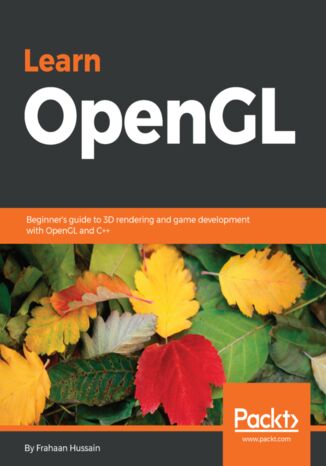
Learn OpenGL. Beginner's guide to 3D rendering and game development with OpenGL and C++
Frahaan Hussain
Learn OpenGL is your one-stop reference guide to get started with OpenGL and C++ for game development. From setting up the development environment to getting started with basics of drawing and shaders, along with concepts such as lighting, model loading, and cube mapping, this book will get you up to speed with the fundamentals.You begin by setting up your development environment to use OpenGL on Windows and macOS. With GLFW and GLEW set up using absolute and relative linking done, you are ready to setup SDL and SFML for both the operating systems.Now that your development environment is set up, you'll learn to draw using simple shaders as well as make the shader more adaptable and reusable. Then we move on to more advanced topics like texturing your objects with images and transforming your objects using translate, rotate and scale.With these concepts covered, we'll move on to topics like lighting to enable you to incorporate amazing dynamic lights in your game world.By the end of the book, you'll learn about model loading, right from setting up ASSIMP to learning about the model class and loading a model in your game environment. We will conclude by understanding cube mapping to bring advance worlds to your game.
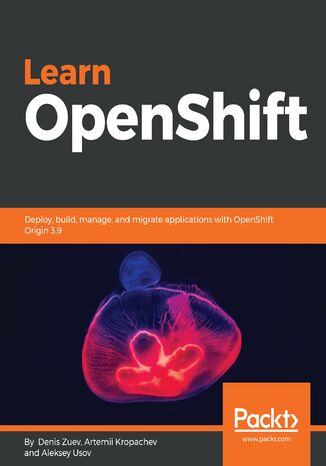
Learn OpenShift. Deploy, build, manage, and migrate applications with OpenShift Origin 3.9
Denis Zuev, Artemii Kropachev, Aleksey Usov
Docker containers transform application delivery technologies to make them faster and more reproducible, and to reduce the amount of time wasted on configuration. Managing Docker containers in the multi-node or multi-datacenter environment is a big challenge, which is why container management platforms are required. OpenShift is a new generation of container management platforms built on top of both Docker and Kubernetes. It brings additional functionality to the table, something that is lacking in Kubernetes. This new functionality significantly helps software development teams to bring software development processes to a whole new level.In this book, we’ll start by explaining the container architecture, Docker, and CRI-O overviews. Then, we'll look at container orchestration and Kubernetes. We’ll cover OpenShift installation, and its basic and advanced components. Moving on, we’ll deep dive into concepts such as deploying application OpenShift. You’ll learn how to set up an end-to-end delivery pipeline while working with applications in OpenShift as a developer or DevOps. Finally, you’ll discover how to properly design OpenShift in production environments.This book gives you hands-on experience of designing, building, and operating OpenShift Origin 3.9, as well as building new applications or migrating existing applications to OpenShift.
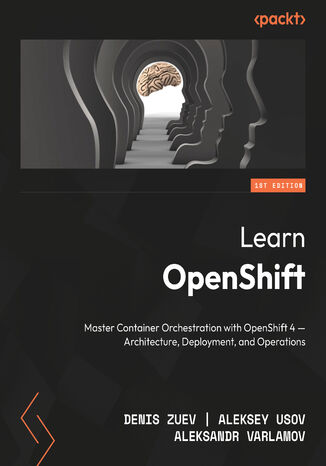
Aleksey Usov, Aleksandr Varlamov, Denis Zuev
OpenShift is a powerful enterprise Kubernetes platform that simplifies the development, deployment, and management of containerized applications. Learn OpenShift is a comprehensive, hands-on guide designed for architects, DevOps engineers, SREs, and system administrators who want to take OpenShift 4 from architecture to production deployment. Drawing on the experience of seasoned architects who’ve worked on some of the world’s largest OpenShift projects, this book covers both fundamentals and advanced scenarios rarely discussed elsewhere. You’ll explore OpenShift 4 internals, understand its architecture, master cluster installation and upgrades, and gain deep insights into managing applications, configuring security, application builds, observability, and service mesh. With practical examples and real-world guidance, you’ll confidently deploy OpenShift on bare metal, virtualization, and cloud environments, and learn how to extend, maintain, and operate clusters at scale. By the end of this book, you’ll be able to install, secure, and operate OpenShift 4 clusters in enterprise production environments, deploy containerized applications at scale, and troubleshoot real-world issues with confidence.
Cody Jackson
Python is a cross-platform language used by organizations such as Google and NASA. It lets you work quickly and efficiently, allowing you to concentrate on your work rather than the language. Based on his personal experiences when learning to program, Learn Programming in Python with Cody Jackson provides a hands-on introduction to computer programming utilizing one of the most readable programming languages–Python. It aims to educate readers regarding software development as well as help experienced developers become familiar with the Python language, utilizing real-world lessons to help readers understand programming concepts quickly and easily. The book starts with the basics of programming, and describes Python syntax while developing the skills to make complete programs. In the first part of the book, readers will be going through all the concepts with short and easy-to-understand code samples that will prepare them for the comprehensive application built in parts 2 and 3. The second part of the book will explore topics such as application requirements, building the application, testing, and documentation. It is here that you will get a solid understanding of building an end-to-end application in Python. The next part will show you how to complete your applications by converting text-based simulation into an interactive, graphical user interface, using a desktop GUI framework. After reading the book, you will be confident in developing a complete application in Python, from program design to documentation to deployment.
Philipp Kats, David Katz
Python is the most widely used programming language for building data science applications. Complete with step-by-step instructions, this book contains easy-to-follow tutorials to help you learn Python and develop real-world data science projects. The “secret sauce” of the book is its curated list of topics and solutions, put together using a range of real-world projects, covering initial data collection, data analysis, and production.This Python book starts by taking you through the basics of programming, right from variables and data types to classes and functions. You’ll learn how to write idiomatic code and test and debug it, and discover how you can create packages or use the range of built-in ones. You’ll also be introduced to the extensive ecosystem of Python data science packages, including NumPy, Pandas, scikit-learn, Altair, and Datashader. Furthermore, you’ll be able to perform data analysis, train models, and interpret and communicate the results. Finally, you’ll get to grips with structuring and scheduling scripts using Luigi and sharing your machine learning models with the world as a microservice.By the end of the book, you’ll have learned not only how to implement Python in data science projects, but also how to maintain and design them to meet high programming standards.
Learn Python in 7 Days. Begin your journey with Python
Mohit Raj, Bhaskar N. Das
Python is a great language to get started in the world of programming and application development. This book will help you to take your skills to the next level having a good knowledge of the fundamentals of Python.We begin with the absolute foundation, covering the basic syntax, type variables and operators. We'll then move on to concepts like statements, arrays, operators, string processing and I/O handling. You’ll be able to learn how to operate tuples and understand the functions and methods of lists. We’ll help you develop a deep understanding of list and tuples and learn python dictionary. As you progress through the book, you’ll learn about function parameters and how to use control statements with the loop. You’ll further learn how to create modules and packages, storing of data as well as handling errors. We later dive into advanced level concepts such as Python collections and how to use class, methods, objects in python.By the end of this book, you will be able to take your skills to the next level having a good knowledge of the fundamentals of Python.
Fabrizio Romano, Heinrich Kruger
Learn Python Programming, Fourth Edition, provides a comprehensive, up-to-date introduction to Python programming, covering fundamental concepts and practical applications. This edition has been meticulously updated to include the latest features from Python versions 3.9 to 3.12, new chapters on type hinting and CLI applications, and updated examples reflecting modern Python web development practices. This Python book empowers you to take ownership of writing your software and become independent in fetching the resources you need. By the end of this book, you will have a clear idea of where to go and how to build on what you have learned from the book.Through examples, the book explores a wide range of applications and concludes by building real-world Python projects based on the concepts you have learned. This Python book offers a clear and practical guide to mastering Python and applying it effectively in various domains, such as data science, web development, and automation.