
Programowanie
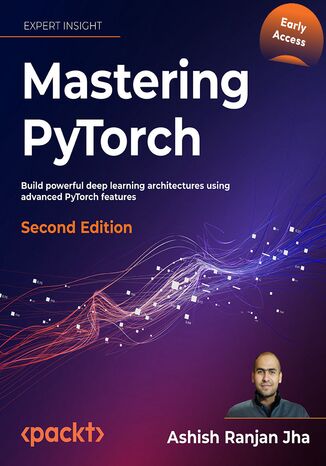
Ashish Ranjan Jha
PyTorch is making it easier than ever before for anyone to build deep learning applications. This PyTorch deep learning book will help you uncover expert techniques to get the most out of your data and build complex neural network models.You’ll build convolutional neural networks for image classification and recurrent neural networks and transformers for sentiment analysis. As you advance, you'll apply deep learning across different domains, such as music, text, and image generation, using generative models, including diffusion models. You'll not only build and train your own deep reinforcement learning models in PyTorch but also learn to optimize model training using multiple CPUs, GPUs, and mixed-precision training. You’ll deploy PyTorch models to production, including mobile devices. Finally, you’ll discover the PyTorch ecosystem and its rich set of libraries. These libraries will add another set of tools to your deep learning toolbelt, teaching you how to use fastai to prototype models and PyTorch Lightning to train models. You’ll discover libraries for AutoML and explainable AI (XAI), create recommendation systems, and build language and vision transformers with Hugging Face.By the end of this book, you'll be able to perform complex deep learning tasks using PyTorch to build smart artificial intelligence models.
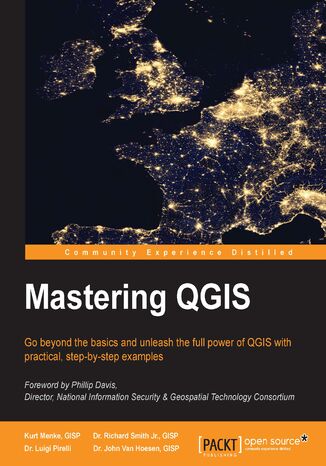
Kurt Menke, GISP
If you are a GIS professional, a consultant, a student, or perhaps a fast learner who wants to go beyond the basics of QGIS, then this book is for you. It will prepare you to realize the full potential of QGIS.
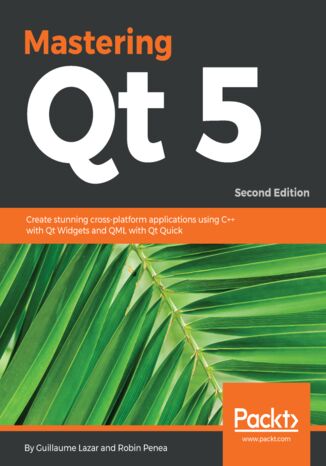
Guillaume Lazar, Robin Penea
Qt 5.11 is an app development framework that provides a great user experience and develops full capability applications with Qt Widgets, QML, and even Qt 3D. Whether you're building GUI prototypes or fully-fledged cross-platform GUI applications with a native look and feel, Mastering Qt 5 is your fastest, easiest, and most powerful solution. This book addresses various challenges and teaches you to successfully develop cross-platform applications using the Qt framework, with the help of well-organized projects.Working through this book, you will gain a better understanding of the Qt framework, as well as the tools required to resolve serious issues, such as linking, debugging, and multithreading. You'll start off your journey by discovering the new Qt 5.11 features, soon followed by exploring different platforms and learning to tame them. In addition to this, you'll interact with a gamepad using Qt Gamepad. Each chapter is a logical step for you to complete in order to master Qt.By the end of this book, you'll have created an application that has been tested and is ready to be shipped.
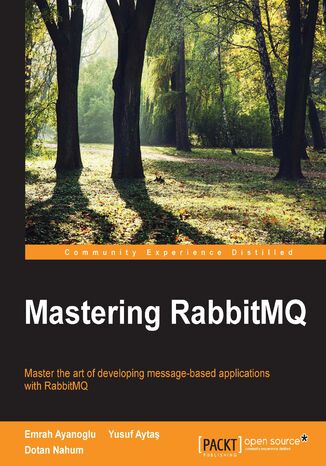
Mastering RabbitMQ. Master the art of developing message-based applications with RabbitMQ
Emrah Ayanoglu, Yusuf Aytas, Dotan Nahum
RabbitMQ is one of the most powerful Open Source message broker software, which is widely used in tech companies such as Mozilla, VMware, Google, AT&T, and so on. RabbitMQ gives you lots of fantastic and easy-to-manage functionalities to control and manage the messaging facility with lots of community support. As scalability is one of our major modern problems, messaging with RabbitMQ is the main part of the solution to this problemThis book explains and demonstrates the RabbitMQ server in a detailed way. It provides you with lots of real-world examples and advanced solutions to tackle the scalability issues.You’ll begin your journey with the installation and configuration of the RabbitMQ server, while also being given specific details pertaining to the subject. Next, you’ll study the major problems that our server faces, including scalability and high availability, and try to get the solutions for both of these issues by using the RabbitMQ mechanisms. Following on from this, you’ll get to design and develop your own plugins using the Erlang language and RabbitMQ’s internal API. This knowledge will help you to start with the management and monitoring of the messages, tools, and applications. You’ll also gain an understanding of the security and integrity of the messaging facilities that RabbitMQ provides. In the last few chapters, you will build and keep track of your clients (senders and receivers) using Java, Python, and C#.
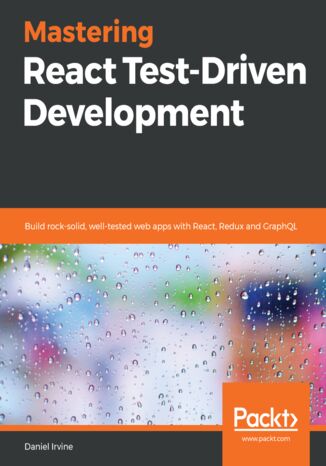
Daniel Irvine
Many programmers are aware of TDD but struggle to apply it beyond basic examples. This book teaches how to build complex, real-world applications using Test-Driven Development (TDD). It takes a first principles approach to the TDD process using plain Jest and includes test-driving the integration of libraries including React Router, Redux, and Relay (GraphQL).Readers will practice systematic refactoring while building out their own test framework, gaining a deep understanding of TDD tools and techniques. They will learn how to test-drive features such as client- and server-side form validation, data filtering and searching, navigation and user workflow, undo/redo, animation, LocalStorage access, WebSocket communication, and querying GraphQL endpoints.The book covers refactoring codebases to use the React Router and Redux libraries. via TDD. Redux is explored in depth, with reducers, middleware, sagas, and connected React components. The book also covers acceptance testing using Cucumber and Puppeteer.The book is fully up to date with React 16.9 and has in-depth coverage of hooks and the ‘act’ test helper.
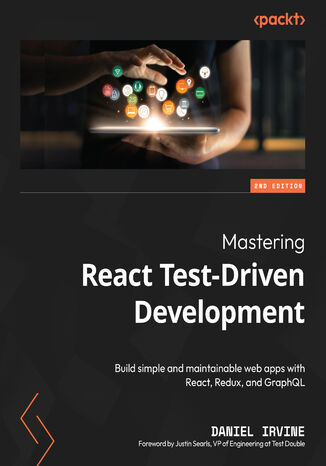
Daniel Irvine
Test-driven development (TDD) is a programming workflow that helps you build your apps by specifying behavior as automated tests. The TDD workflow future-proofs apps so that they can be modified without fear of breaking existing functionality. Another benefit of TDD is that it helps software development teams communicate their intentions more clearly, by way of test specifications.This book teaches you how to apply TDD when building React apps. You’ll create a sample app using the same React libraries and tools that professional React developers use, such as Jest, React Router, Redux, Relay (GraphQL), Cucumber, and Puppeteer. The TDD workflow is supported by various testing techniques and patterns, which are useful even if you’re not following the TDD process. This book covers these techniques by walking you through the creation of a component test framework. You’ll learn automated testing theory which will help you work with any of the test libraries that are in standard usage today, such as React Testing Library. This second edition has been revised with a stronger focus on concise code examples and has been fully updated for React 18.By the end of this TDD book, you’ll be able to use React, Redux, and GraphQL to develop robust web apps.
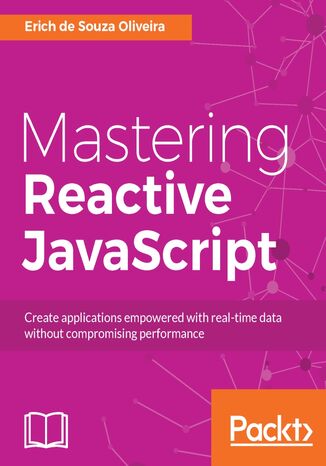
Mastering Reactive JavaScript. Building asynchronous and high performing web apps with RxJS
Erich de Souza Oliveira
If you’re struggling to handle a large amount of data and don’t know how to improve your code readability, then reactive programming is the right solution for you. It lets you describe how your code behaves when changes happen and makes it easier to deal with real-time data. This book will teach you what reactive programming is, and how you can use it to write better applications.The book starts with the basics of reactive programming, what Reactive Extensions is, and how can you use it in JavaScript along with some reactive code using Bacon. Next, you’ll discover what an Observable and an Observer are and when to use them.You'll also find out how you can query data through operators, and how to use schedulers to react to changes.Moving on, you’ll explore the RxJs API, be introduced to the problem of data traffic (backpressure), and see how you can mitigate it. You’ll also learn about other important operators that can help improve your code readability, and you’ll see how to use transducers to compose operators.At the end of the book, you’ll get hands-on experience of using RxJs, and will create a real-time web chat using RxJs on the client and server, providing you with the complete package to master RxJs.
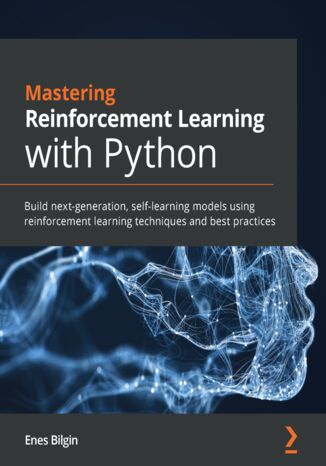
Enes Bilgin
Reinforcement learning (RL) is a field of artificial intelligence (AI) used for creating self-learning autonomous agents. Building on a strong theoretical foundation, this book takes a practical approach and uses examples inspired by real-world industry problems to teach you about state-of-the-art RL.Starting with bandit problems, Markov decision processes, and dynamic programming, the book provides an in-depth review of the classical RL techniques, such as Monte Carlo methods and temporal-difference learning. After that, you will learn about deep Q-learning, policy gradient algorithms, actor-critic methods, model-based methods, and multi-agent reinforcement learning. Then, you'll be introduced to some of the key approaches behind the most successful RL implementations, such as domain randomization and curiosity-driven learning.As you advance, you’ll explore many novel algorithms with advanced implementations using modern Python libraries such as TensorFlow and Ray’s RLlib package. You’ll also find out how to implement RL in areas such as robotics, supply chain management, marketing, finance, smart cities, and cybersecurity while assessing the trade-offs between different approaches and avoiding common pitfalls.By the end of this book, you’ll have mastered how to train and deploy your own RL agents for solving RL problems.