
Programowanie
Sandielly Ortega Polanco, Gogula Aryalingam, Abu Bakar...
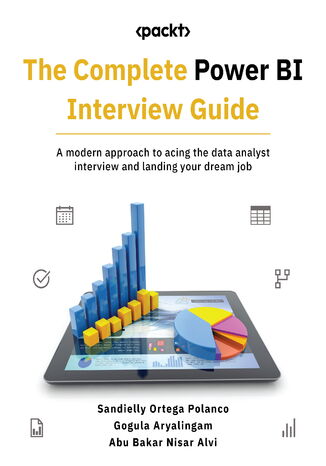
The Complete Power Interview Guide helps you excel in a Power BI interview, secure desired roles, and be ready with the knowledge and skills to ace your role from the first day. Whether you're beginning your career journey or transitioning into a data analytics role, this guide offers hands-on skills and interview questions you need to succeed as a BI or data analyst. This book also offers supplemental content for PowerBI certification exams like PL-300. The book will equip you with the knowledge and strategies to effectively navigate the competitive job market. From creating an outstanding online professional profile to optimizing your resume and building a compelling work portfolio, you'll learn how to establish a strong personal brand. The essentials of Power BI, including data preparation, data modeling, DAX programming, expert report development, and impactful storytelling, are covered in-depth through real-world examples and valuable tips.By the end of this book, you'll have the confidence to interview for Power BI roles, navigate technical assessments, answer behavioral questions, and tackle case studies. You’ll have gained applied knowledge and the competitive edge needed to succeed in the data analytics job market and stay ahead of industry trends for career advancement.
Rahul Sharma, Vesa Kaihlavirta, Claus Matzinger
Rust is a powerful language with a rare combination of safety, speed, and zero-cost abstractions. This Learning Path is filled with clear and simple explanations of its features along with real-world examples, demonstrating how you can build robust, scalable, and reliable programs.You’ll get started with an introduction to Rust data structures, algorithms, and essential language constructs. Next, you will understand how to store data using linked lists, arrays, stacks, and queues. You’ll also learn to implement sorting and searching algorithms, such as Brute Force algorithms, Greedy algorithms, Dynamic Programming, and Backtracking. As you progress, you’ll pick up on using Rust for systems programming, network programming, and the web. You’ll then move on to discover a variety of techniques, right from writing memory-safe code, to building idiomatic Rust libraries, and even advanced macros. By the end of this Learning Path, you’ll be able to implement Rust for enterprise projects, writing better tests and documentation, designing for performance, and creating idiomatic Rust code.This Learning Path includes content from the following Packt products:• Mastering Rust - Second Edition by Rahul Sharma and Vesa Kaihlavirta• Hands-On Data Structures and Algorithms with Rust by Claus Matzinger
Hafsa Asad , Vishwesh Ravi Shrimali ,...
Computer Vision (CV) has become an important aspect of AI technology. From driverless cars to medical diagnostics and monitoring the health of crops to fraud detection in banking, computer vision is used across all domains to automate tasks. The Computer Vision Workshop will help you understand how computers master the art of processing digital images and videos to mimic human activities.Starting with an introduction to the OpenCV library, you'll learn how to write your first script using basic image processing operations. You'll then get to grips with essential image and video processing techniques such as histograms, contours, and face processing. As you progress, you'll become familiar with advanced computer vision and deep learning concepts, such as object detection, tracking, and recognition, and finally shift your focus from 2D to 3D visualization. This CV course will enable you to experiment with camera calibration and explore both passive and active canonical 3D reconstruction methods.By the end of this book, you'll have developed the practical skills necessary for building powerful applications to solve computer vision problems.
Mercury Learning and Information, Jean E. Tardy
This book delves into Generative AI and the potential for AI to achieve consciousness. It covers historical and modern perspectives on AI, from ancient myths to the Turing Test and current advancements. The book explores the theoretical and practical aspects of creating a conscious AI, including specifications for synthetic consciousness and integrating AI with human cognition. It questions whether generative AI can meet traditional criteria of consciousness.The journey begins with understanding consciousness, tracing AI's origins, and clarifying human cognition through AI. It examines early AI failures, fears of success, and the engineering of consciousness. The book also explores archaic AI representations, the intelligence of automatons, and the relevance of the Turing Test, concluding with strategies for achieving synthetic consciousness.These concepts are crucial for advancing AI towards synthetic consciousness. This book transitions readers from historical perspectives to modern AI challenges, blending theory with practical insights. It is an essential resource for understanding the future of AI and its potential to achieve consciousness.
The Cyber Resilience Handbook. Achieve Full Cyber Resilience with ISO 27001 and ISO 22301
IT Governance Publishing, Andrew Pattison
This book begins by introducing cyber resilience and its significance in today’s business landscape. It explains how resilience goes beyond traditional cybersecurity, incorporating elements like governance, protection, detection, and recovery to ensure organizational stability in the face of cyber threats. The first chapter outlines the core concepts, including the integration of legal and assurance frameworks.The second section focuses on achieving cyber resilience with ISO 27001 and ISO 22301. These globally recognized standards offer a structured methodology for building a resilient infrastructure. The author explains how to implement these frameworks effectively, ensuring businesses can address cybersecurity challenges and maintain continuity in operations. This section also covers integrating ISO 27001 with other systems to optimize resilience.The final section provides practical strategies for implementing cyber resilience, including project initiation, leadership, risk assessments, and performance evaluation. It also discusses certification processes and maintaining resilience over time, including through third-party vendors. The book concludes with guidance on creating a culture of security and continuous improvement within organizations.
Gururajan Govindan , Shubhangi Hora , Konstantin...
Businesses today operate online and generate data almost continuously. While not all data in its raw form may seem useful, if processed and analyzed correctly, it can provide you with valuable hidden insights. The Data Analysis Workshop will help you learn how to discover these hidden patterns in your data, to analyze them, and leverage the results to help transform your business.The book begins by taking you through the use case of a bike rental shop. You'll be shown how to correlate data, plot histograms, and analyze temporal features. As you progress, you’ll learn how to plot data for a hydraulic system using the Seaborn and Matplotlib libraries, and explore a variety of use cases that show you how to join and merge databases, prepare data for analysis, and handle imbalanced data.By the end of the book, you'll have learned different data analysis techniques, including hypothesis testing, correlation, and null-value imputation, and will have become a confident data analyst.
The Data Science Workshop. A New, Interactive Approach to Learning Data Science
Anthony So , Thomas Joseph, Robert Thas...
You already know you want to learn data science, and a smarter way to learn data science is to learn by doing. The Data Science Workshop focuses on building up your practical skills so that you can understand how to develop simple machine learning models in Python or even build an advanced model for detecting potential bank frauds with effective modern data science. You'll learn from real examples that lead to real results.Throughout The Data Science Workshop, you'll take an engaging step-by-step approach to understanding data science. You won't have to sit through any unnecessary theory. If you're short on time you can jump into a single exercise each day or spend an entire weekend training a model using sci-kit learn. It's your choice. Learning on your terms, you'll build up and reinforce key skills in a way that feels rewarding.Every physical print copy of The Data Science Workshop unlocks access to the interactive edition. With videos detailing all exercises and activities, you'll always have a guided solution. You can also benchmark yourself against assessments, track progress, and receive content updates. You'll even earn a secure credential that you can share and verify online upon completion. It's a premium learning experience that's included with your printed copy. To redeem, follow the instructions located at the start of your data science book.Fast-paced and direct, The Data Science Workshop is the ideal companion for data science beginners. You'll learn about machine learning algorithms like a data scientist, learning along the way. This process means that you'll find that your new skills stick, embedded as best practice. A solid foundation for the years ahead.
Anthony So , Thomas Joseph, Robert Thas...
Where there’s data, there’s insight. With so much data being generated, there is immense scope to extract meaningful information that’ll boost business productivity and profitability. By learning to convert raw data into game-changing insights, you’ll open new career paths and opportunities.The Data Science Workshop begins by introducing different types of projects and showing you how to incorporate machine learning algorithms in them. You’ll learn to select a relevant metric and even assess the performance of your model. To tune the hyperparameters of an algorithm and improve its accuracy, you’ll get hands-on with approaches such as grid search and random search.Next, you’ll learn dimensionality reduction techniques to easily handle many variables at once, before exploring how to use model ensembling techniques and create new features to enhance model performance. In a bid to help you automatically create new features that improve your model, the book demonstrates how to use the automated feature engineering tool. You’ll also understand how to use the orchestration and scheduling workflow to deploy machine learning models in batch.By the end of this book, you’ll have the skills to start working on data science projects confidently. By the end of this book, you’ll have the skills to start working on data science projects confidently.