
Uczenie maszynowe
Tadej Magajna
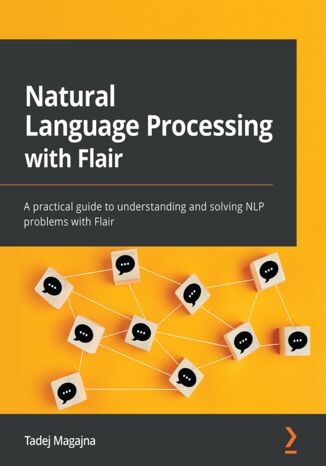
Flair is an easy-to-understand natural language processing (NLP) framework designed to facilitate training and distribution of state-of-the-art NLP models for named entity recognition, part-of-speech tagging, and text classification. Flair is also a text embedding library for combining different types of embeddings, such as document embeddings, Transformer embeddings, and the proposed Flair embeddings.Natural Language Processing with Flair takes a hands-on approach to explaining and solving real-world NLP problems. You'll begin by installing Flair and learning about the basic NLP concepts and terminology. You will explore Flair's extensive features, such as sequence tagging, text classification, and word embeddings, through practical exercises. As you advance, you will train your own sequence labeling and text classification models and learn how to use hyperparameter tuning in order to choose the right training parameters. You will learn about the idea behind one-shot and few-shot learning through a novel text classification technique TARS. Finally, you will solve several real-world NLP problems through hands-on exercises, as well as learn how to deploy Flair models to production.By the end of this Flair book, you'll have developed a thorough understanding of typical NLP problems and you’ll be able to solve them with Flair.
Cuantum Technologies LLC
Embark on a comprehensive journey to master natural language processing (NLP) with Python. Begin with foundational concepts like text preprocessing, tokenization, and key Python libraries such as NLTK, spaCy, and TextBlob. Explore the challenges of text data and gain hands-on experience in cleaning, tokenizing, and building basic NLP pipelines. Early chapters provide practical exercises to solidify your understanding of essential techniques.Advance to sophisticated topics like feature engineering using Bag of Words, TF-IDF, and embeddings like Word2Vec and BERT. Delve into language modeling with RNNs, syntax parsing, and sentiment analysis, learning to apply these techniques in real-world scenarios. Chapters on topic modeling and text summarization equip you to extract insights from data, while transformer-based models like BERT take your skills to the next level. Each concept is paired with Python-based examples, ensuring practical mastery.The final chapters focus on real-world projects, such as developing chatbots, sentiment analysis dashboards, and news aggregators. These hands-on applications challenge you to design, train, and deploy robust NLP solutions. With its structured approach and practical focus, this book equips you to confidently tackle real-world NLP challenges and innovate in the field.
Thushan Ganegedara
Natural language processing (NLP) supplies the majority of data available to deep learning applications, while TensorFlow is the most important deep learning framework currently available. Natural Language Processing with TensorFlow brings TensorFlow and NLP together to give you invaluable tools to work with the immense volume of unstructured data in today’s data streams, and apply these tools to specific NLP tasks.Thushan Ganegedara starts by giving you a grounding in NLP and TensorFlow basics. You'll then learn how to use Word2vec, including advanced extensions, to create word embeddings that turn sequences of words into vectors accessible to deep learning algorithms. Chapters on classical deep learning algorithms, like convolutional neural networks (CNN) and recurrent neural networks (RNN), demonstrate important NLP tasks as sentence classification and language generation. You will learn how to apply high-performance RNN models, like long short-term memory (LSTM) cells, to NLP tasks. You will also explore neural machine translation and implement a neural machine translator.After reading this book, you will gain an understanding of NLP and you'll have the skills to apply TensorFlow in deep learning NLP applications, and how to perform specific NLP tasks.
Thushan Ganegedara
Learning how to solve natural language processing (NLP) problems is an important skill to master due to the explosive growth of data combined with the demand for machine learning solutions in production. Natural Language Processing with TensorFlow, Second Edition, will teach you how to solve common real-world NLP problems with a variety of deep learning model architectures.The book starts by getting readers familiar with NLP and the basics of TensorFlow. Then, it gradually teaches you different facets of TensorFlow 2.x. In the following chapters, you then learn how to generate powerful word vectors, classify text, generate new text, and generate image captions, among other exciting use-cases of real-world NLP.TensorFlow has evolved to be an ecosystem that supports a machine learning workflow through ingesting and transforming data, building models, monitoring, and productionization. We will then read text directly from files and perform the required transformations through a TensorFlow data pipeline. We will also see how to use a versatile visualization tool known as TensorBoard to visualize our models.By the end of this NLP book, you will be comfortable with using TensorFlow to build deep learning models with many different architectures, and efficiently ingest data using TensorFlow Additionally, you’ll be able to confidently use TensorFlow throughout your machine learning workflow.
Manpreet Singh Ghotra, Rajdeep Dua
If you're aware of the buzz surrounding the terms such as machine learning, artificial intelligence, or deep learning, you might know what neural networks are. Ever wondered how they help in solving complex computational problem efficiently, or how to train efficient neural networks? This book will teach you just that.You will start by getting a quick overview of the popular TensorFlow library and how it is used to train different neural networks. You will get a thorough understanding of the fundamentals and basic math for neural networks and why TensorFlow is a popular choice Then, you will proceed to implement a simple feed forward neural network. Next you will master optimization techniques and algorithms for neural networks using TensorFlow. Further, you will learn to implement some more complex types of neural networks such as convolutional neural networks, recurrent neural networks, and Deep Belief Networks. In the course of the book, you will be working on real-world datasets to get a hands-on understanding of neural network programming. You will also get to train generative models and will learn the applications of autoencoders.By the end of this book, you will have a fair understanding of how you can leverage the power of TensorFlow to train neural networks of varying complexities, without any hassle. While you are learning about various neural network implementations you will learn the underlying mathematics and linear algebra and how they map to the appropriate TensorFlow constructs.
James Loy
Neural networks are at the core of recent AI advances, providing some of the best resolutions to many real-world problems, including image recognition, medical diagnosis, text analysis, and more. This book goes through some basic neural network and deep learning concepts, as well as some popular libraries in Python for implementing them.It contains practical demonstrations of neural networks in domains such as fare prediction, image classification, sentiment analysis, and more. In each case, the book provides a problem statement, the specific neural network architecture required to tackle that problem, the reasoning behind the algorithm used, and the associated Python code to implement the solution from scratch. In the process, you will gain hands-on experience with using popular Python libraries such as Keras to build and train your own neural networks from scratch.By the end of this book, you will have mastered the different neural network architectures and created cutting-edge AI projects in Python that will immediately strengthen your machine learning portfolio.
V Kishore Ayyadevara
This book will take you from the basics of neural networks to advanced implementations of architectures using a recipe-based approach.We will learn about how neural networks work and the impact of various hyper parameters on a network's accuracy along with leveraging neural networks for structured and unstructured data.Later, we will learn how to classify and detect objects in images. We will also learn to use transfer learning for multiple applications, including a self-driving car using Convolutional Neural Networks.We will generate images while leveraging GANs and also by performing image encoding. Additionally, we will perform text analysis using word vector based techniques. Later, we will use Recurrent Neural Networks and LSTM to implement chatbot and Machine Translation systems.Finally, you will learn about transcribing images, audio, and generating captions and also use Deep Q-learning to build an agent that plays Space Invaders game.By the end of this book, you will have developed the skills to choose and customize multiple neural network architectures for various deep learning problems you might encounter.
Neural Networks with R. Build smart systems by implementing popular deep learning models in R
Balaji Venkateswaran, Giuseppe Ciaburro
Neural networks are one of the most fascinating machine learning models for solving complex computational problems efficiently. Neural networks are used to solve wide range of problems in different areas of AI and machine learning.This book explains the niche aspects of neural networking and provides you with foundation to get started with advanced topics. The book begins with neural network design using the neural net package, then you’ll build a solid foundation knowledge of how a neural network learns from data, and the principles behind it. This book covers various types of neural network including recurrent neural networks and convoluted neural networks. You will not only learn how to train neural networks, but will also explore generalization of these networks. Later we will delve into combining different neural network models and work with the real-world use cases.By the end of this book, you will learn to implement neural network models in your applications with the help of practical examples in the book.