
Python
W kategorii Python zostały zebrane podręczniki poruszające tematykę programowania z zastosowaniem praktycznie niezależnego sprzętowo, dostępnego na licencji Open Source języka. Książki przedstawią Wam wszechstronności i elastyczności Pythona a także różne typy tworzenia kodu poprzez programowanie strukturalne, obiektowe czy funkcjonalne.
Nauczycie się tworzyć aplikacje sieciowe o dowolnym przeznaczeniu, komunikujące się z systemami operacyjnymi, lub korzystające z baz danych. Techniki analizy składni, przetwarzanie tekstu czy rozłożenie obciążenia programu na wiele wątków i procesów przestanie być problematyczne.
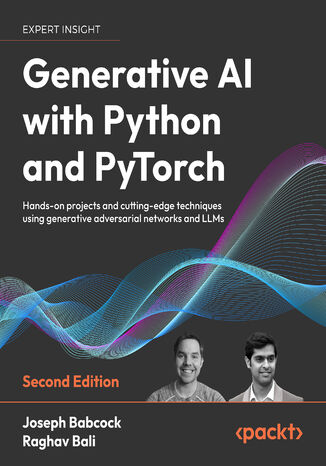
Joseph Babcock, Raghav Bali
Become an expert in Generative AI through hands-on projects that leverage today’s most powerful models for Natural Language Processing (NLP) and computer vision. This book is your end-to-end guide to creating advanced AI applications, made easy by Raghav Bali, a seasoned data scientist with multiple patents in AI, and Joseph Babcock, a PhD and machine learning expert. Through business-tested approaches, this book simplifies complex GenAI concepts, making learning both accessible and immediately applicable.From NLP to image generation, this second edition explores practical applications and the underlying theories that power these technologies. By integrating the latest advancements in LLMs, it prepares you to design and implement powerful AI systems that transform data into actionable intelligence.You’ll build your versatile LLM toolkit by gaining expertise in GPT-4, LangChain, RLHF, LoRA, RAG, and more. You’ll also explore deep learning techniques for image generation and apply styler transfer using GANs, before advancing to implement CLIP and diffusion models.Whether you’re generating dynamic content or developing complex AI-driven solutions, this book equips you with everything you need to harness the full transformative power of Python and AI.*Email sign-up and proof of purchase required
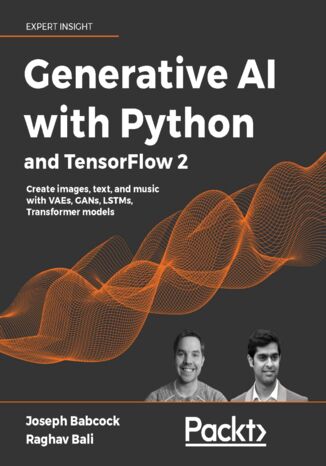
Joseph Babcock, Raghav Bali
Machines are excelling at creative human skills such as painting, writing, and composing music. Could you be more creative than generative AI?In this book, you’ll explore the evolution of generative models, from restricted Boltzmann machines and deep belief networks to VAEs and GANs. You’ll learn how to implement models yourself in TensorFlow and get to grips with the latest research on deep neural networks.There’s been an explosion in potential use cases for generative models. You’ll look at Open AI’s news generator, deepfakes, and training deep learning agents to navigate a simulated environment.Recreate the code that’s under the hood and uncover surprising links between text, image, and music generation.
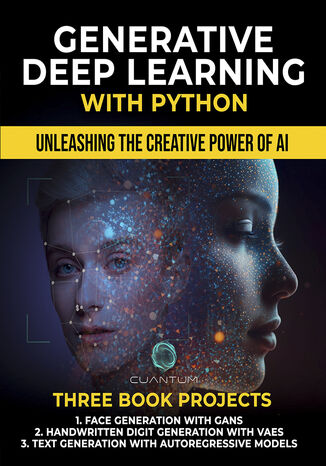
Generative Deep Learning with Python. Unleashing the Creative Power of AI by Mastering AI and Python
Cuantum Technologies LLC
Generative Deep Learning with Python opens the door to the fascinating world of AI where machines create. This course begins with an introduction to deep learning, establishing the essential concepts and techniques. You will then delve into generative models, exploring their theoretical foundations and practical applications. As you progress, you will gain a deep understanding of Generative Adversarial Networks (GANs), learning how they function and how to implement them for tasks like face generation.The course's hands-on projects, such as creating GANs for face generation and using Variational Autoencoders (VAEs) for handwritten digit generation, provide practical experience that reinforces your learning. You'll also explore autoregressive models for text generation, allowing you to see the versatility of generative models across different types of data. Advanced topics will prepare you for cutting-edge developments in the field.Throughout your journey, you will gain insights into the future landscape of generative deep learning, equipping you with the skills to innovate and lead in this rapidly evolving field. By the end of the course, you will have a solid foundation in generative deep learning and be ready to apply these techniques to real-world challenges, driving advancements in AI and machine learning.
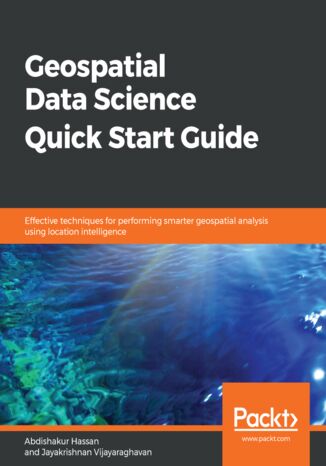
Abdishakur Hassan, Jayakrishnan Vijayaraghavan
Data scientists, who have access to vast data streams, are a bit myopic when it comes to intrinsic and extrinsic location-based data and are missing out on the intelligence it can provide to their models. This book demonstrates effective techniques for using the power of data science and geospatial intelligence to build effective, intelligent data models that make use of location-based data to give useful predictions and analyses.This book begins with a quick overview of the fundamentals of location-based data and how techniques such as Exploratory Data Analysis can be applied to it. We then delve into spatial operations such as computing distances, areas, extents, centroids, buffer polygons, intersecting geometries, geocoding, and more, which adds additional context to location data. Moving ahead, you will learn how to quickly build and deploy a geo-fencing system using Python. Lastly, you will learn how to leverage geospatial analysis techniques in popular recommendation systems such as collaborative filtering and location-based recommendations, and more.By the end of the book, you will be a rockstar when it comes to performing geospatial analysis with ease.
Michael Hsieh
Amazon SageMaker Studio is the first integrated development environment (IDE) for machine learning (ML) and is designed to integrate ML workflows: data preparation, feature engineering, statistical bias detection, automated machine learning (AutoML), training, hosting, ML explainability, monitoring, and MLOps in one environment.In this book, you'll start by exploring the features available in Amazon SageMaker Studio to analyze data, develop ML models, and productionize models to meet your goals. As you progress, you will learn how these features work together to address common challenges when building ML models in production. After that, you'll understand how to effectively scale and operationalize the ML life cycle using SageMaker Studio.By the end of this book, you'll have learned ML best practices regarding Amazon SageMaker Studio, as well as being able to improve productivity in the ML development life cycle and build and deploy models easily for your ML use cases.
Vineeth Gopalakrishnan Nair
Beautiful Soup is a Python library designed for quick turnaround projects like screen-scraping. Beautiful Soup provides a few simple methods and Pythonic idioms for navigating, searching, and modifying a parse tree: a toolkit for dissecting a document and extracting what you need without writing excess code for an application. It doesn't take much code to write an application using Beautiful Soup.Getting Started with Beautiful Soup is a practical guide to Beautiful Soup using Python. The book starts by walking you through the installation of each and every feature of Beautiful Soup using simple examples which include sample Python codes as well as diagrams and screenshots wherever required for better understanding. The book discusses the problems of how exactly you can get data out of a website and provides an easy solution with the help of a real website and sample code.Getting Started with Beautiful Soup goes over the different methods to install Beautiful Soup in both Linux and Windows systems. You will then learn about searching, navigating, content modification, encoding support, and output formatting with the help of examples and sample Python codes for each example so that you can try them out to get a better understanding. This book is a practical guide for scraping information from any website. If you want to learn how to efficiently scrape pages from websites, then this book is for you.
Sudharsan Ravichandiran
BERT (bidirectional encoder representations from transformer) has revolutionized the world of natural language processing (NLP) with promising results. This book is an introductory guide that will help you get to grips with Google's BERT architecture. With a detailed explanation of the transformer architecture, this book will help you understand how the transformer’s encoder and decoder work.You’ll explore the BERT architecture by learning how the BERT model is pre-trained and how to use pre-trained BERT for downstream tasks by fine-tuning it for NLP tasks such as sentiment analysis and text summarization with the Hugging Face transformers library. As you advance, you’ll learn about different variants of BERT such as ALBERT, RoBERTa, and ELECTRA, and look at SpanBERT, which is used for NLP tasks like question answering. You'll also cover simpler and faster BERT variants based on knowledge distillation such as DistilBERT and TinyBERT. The book takes you through MBERT, XLM, and XLM-R in detail and then introduces you to sentence-BERT, which is used for obtaining sentence representation. Finally, you'll discover domain-specific BERT models such as BioBERT and ClinicalBERT, and discover an interesting variant called VideoBERT.By the end of this BERT book, you’ll be well-versed with using BERT and its variants for performing practical NLP tasks.
Tim Cox, Steven Lawrence Fernandes, Sai Yamanoor,...
This Learning Path takes you on a journey in the world of robotics and teaches you all that you can achieve with Raspberry Pi and Python.It teaches you to harness the power of Python with the Raspberry Pi 3 and the Raspberry Pi zero to build superlative automation systems that can transform your business. You will learn to create text classifiers, predict sentiment in words, and develop applications with the Tkinter library. Things will get more interesting when you build a human face detection and recognition system and a home automation system in Python, where different appliances are controlled using the Raspberry Pi. With such diverse robotics projects, you'll grasp the basics of robotics and its functions, and understand the integration of robotics with the IoT environment.By the end of this Learning Path, you will have covered everything from configuring a robotic controller, to creating a self-driven robotic vehicle using Python.• Raspberry Pi 3 Cookbook for Python Programmers - Third Edition by Tim Cox, Dr. Steven Lawrence Fernandes• Python Programming with Raspberry Pi by Sai Yamanoor, Srihari Yamanoor• Python Robotics Projects by Prof. Diwakar Vaish