
Python
W kategorii Python zostały zebrane podręczniki poruszające tematykę programowania z zastosowaniem praktycznie niezależnego sprzętowo, dostępnego na licencji Open Source języka. Książki przedstawią Wam wszechstronności i elastyczności Pythona a także różne typy tworzenia kodu poprzez programowanie strukturalne, obiektowe czy funkcjonalne.
Nauczycie się tworzyć aplikacje sieciowe o dowolnym przeznaczeniu, komunikujące się z systemami operacyjnymi, lub korzystające z baz danych. Techniki analizy składni, przetwarzanie tekstu czy rozłożenie obciążenia programu na wiele wątków i procesów przestanie być problematyczne.
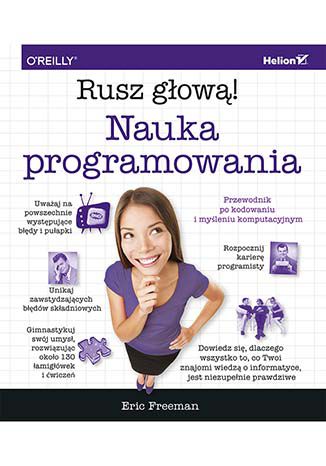
Nauka programowania. Rusz głową!
Eric Freeman
Przewodnik po kodowaniu i myśleniu komputacyjnym Programista to bardzo szczególny typ specjalisty. Jeśli uważasz, że myśli w inny sposób niż tak zwani normalni ludzie, to masz rację. Dobra wiadomość jest taka, że i Ty możesz się nauczyć myślenia komputacyjnego - umiejętności, która się przydaje niezależnie od charakteru rozwiązywanego problemu, środowiska czy języka programowania. Tylko w ten sposób można od początku nauki programowania pisać przejrzysty, uporządkowany, znakomity kod, zgodny z najlepszymi praktykami wypracowanymi przez mistrzów. Innymi słowy: pracować jak profesjonalny programista. Ta książka jest niezwykłym podręcznikiem programowania. Być może wygląda nieco dziwacznie, ale prędko się przekonasz, że to podręcznik jest wyjątkowo skuteczny: w końcu jego formuła została opracowana na podstawie najlepszych osiągnięć neurologii i kognitywistyki. W ten sposób Twój mózg się zaangażuje i błyskawicznie przyswoi sobie zasady programowania w Pythonie. Autor wykorzystał oczywistą prawdę, że najszybciej uczymy się wtedy, gdy uwzględnimy specyfikę działania własnego mózgu! Najpierw więc się zainteresujesz, potem zaangażujesz, wreszcie przygotujesz sobie warsztat pracy, czyli zainstalujesz Pythona. Później zaczniesz ćwiczyć myślenie komputacyjne i oczywiście napiszesz swój pierwszy program. A dalej będzie coraz ciekawiej... W tej książce między innymi: Istotne koncepcje programistyczne Zasady programowania w Pythonie Funkcje i rekurencja Programowanie obiektowe Tworzenie API dla aplikacji internetowych Widgety i zdarzenia Neurony płoną. Emocje szaleją. Tak napiszesz kod godny mistrza!
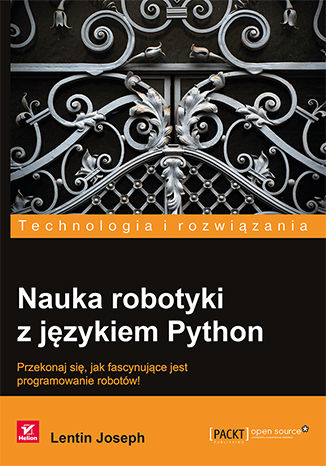
Nauka robotyki z językiem Python
Lentin Joseph
Roboty wkraczają do różnych dziedzin naszego życia, więc robotyka nabiera coraz większego znaczenia. Nauka o robotach, ich budowaniu i programowaniu jest dość złożoną, ale fascynującą dziedziną. Jej opanowanie wymaga wysiłku, jednak aby zaprojektować łatwy do wykorzystania interfejs, wystarczy posłużyć się kilkoma programami narzędziowymi oraz językiem Python. W ten sposób można zaprojektować zachowania robota, określić, w jaki sposób będzie zmierzał do celu, reagował na sygnały otaczającego świata, czy sprawić, by oczekiwał na instrukcje. Dzięki tej książce można się nauczyć, jak z wykorzystaniem języka Python oraz kilku popularnych frameworków stosowanych w robotyce, takich jak system ROS, budować autonomiczne roboty mobilne. Omówiono w niej również inne frameworki programistyczne, w tym również te dla Pythona. Aby równocześnie pokazać praktyczne wykorzystanie przedstawianego materiału, omówiono krok po kroku proces budowania robota-służącego ChefBot, który na przykład może podawać posiłki w domu, hotelu czy restauracji. W tej książce przedstawiono: zwięzłe podstawy robotyki i zasady projektowania oprogramowania robotów, aspekty projektowania CAD 2D i 3D z wykorzystaniem programów LibreCAD i Blender, budowanie modeli 3D z wykorzystaniem API Blender dla Pythona, zagadnienia sprzętowej warstwy projektowania robota, zasady obsługi sensorów robotów, w tym programowanie sensorów wizji, obsługę rozpoznawania mowy i syntezę mowy z wykorzystaniem Pythona i ROS, implementację sztucznej inteligencji za pomocą Pythona, zagadnienie testowania i kalibrowania robota. Przekonaj się, jak fascynujące jest programowanie robotów! Lentin Joseph — inżynier elektroniki, entuzjasta robotyki i ekspert w dziedzinie systemów wbudowanych. Szczególnie interesuje się robotyką, przetwarzaniem obrazu i zastosowaniem języka Python w programowaniu robotów. Jest również znawcą wielu platform oprogramowania robotów, takich jak system ROS (ang. Robot Operating system), V-REP i Actin. Biegle posługuje się bibliotekami przetwarzania obrazu, w tym OpenCV, OpenNI i PCL. Specjalizuje się również w dziedzinie projektowania 3D i programowania systemów wbudowanych na platformach Arduino i Launchpad Stellaris. Jest właścicielem firmy Qbotics Labs zajmującej się rozwijaniem robotyki i jej zastosowaniami w wielu dziedzinach.
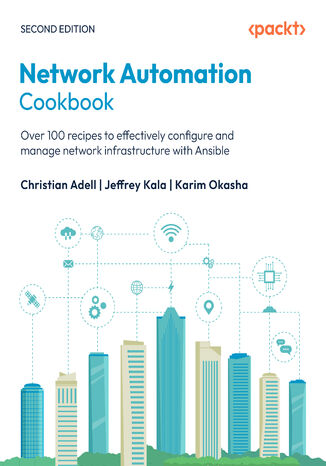
Christian Adell, Jeffrey Kala, Karim Okasha
Network Automation Cookbook, now in its second edition, is your essential guide to building robust network automation workflows across modern hybrid infrastructures. Building on the foundation laid in the first edition, this version dives deeper into Ansible’s role in automating network infrastructure, expanding coverage to include modern use cases across enterprise and cloud networks.The book introduces Ansible’s core concepts, such as playbooks, inventories, variables, loops, and templates, and progresses to advanced topics such as parallelism, fact caching, custom filters, and modular design. You will automate real-world scenarios using Nokia SR, Cisco IOS, Juniper, and Arista devices in a fully reproducible virtual lab. The chapters also help you explore cloud automation for AWS, Azure, and Google Cloud, and integrate validation tools such as PyATS, Batfish, and Nautobot. New chapters cover event-driven automation, AWX for workflow execution, and Terraform integration. By using hands-on labs and fully reproducible recipes, you can practice real-world scenarios and reinforce your skills.By the end of this book, you’ll be well-equipped with the tools and workflows to automate infrastructure efficiently with Ansible.
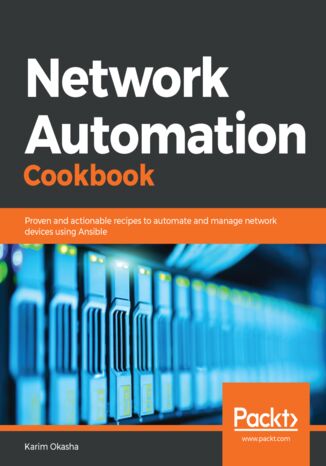
Karim Okasha
Network Automation Cookbook is designed to help system administrators, network engineers, and infrastructure automation engineers to centrally manage switches, routers, and other devices in their organization's network. This book will help you gain hands-on experience in automating enterprise networks and take you through core network automation techniques using the latest version of Ansible and Python. With the help of practical recipes, you'll learn how to build a network infrastructure that can be easily managed and updated as it scales through a large number of devices. You'll also cover topics related to security automation and get to grips with essential techniques to maintain network robustness. As you make progress, the book will show you how to automate networks on public cloud providers such as AWS, Google Cloud Platform, and Azure. Finally, you will get up and running with Ansible 2.9 and discover troubleshooting techniques and network automation best practices. By the end of this book, you'll be able to use Ansible to automate modern network devices and integrate third-party tools such as NAPALM, NetBox, and Batfish easily to build robust network automation solutions.
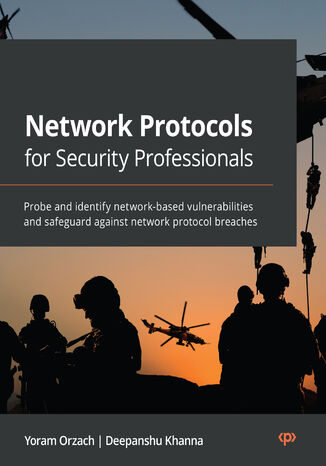
Yoram Orzach, Deepanshu Khanna
With the increased demand for computer systems and the ever-evolving internet, network security now plays an even bigger role in securing IT infrastructures against attacks. Equipped with the knowledge of how to find vulnerabilities and infiltrate organizations through their networks, you’ll be able to think like a hacker and safeguard your organization’s network and networking devices. Network Protocols for Security Professionals will show you how.This comprehensive guide gradually increases in complexity, taking you from the basics to advanced concepts. Starting with the structure of data network protocols, devices, and breaches, you’ll become familiar with attacking tools and scripts that take advantage of these breaches. Once you’ve covered the basics, you’ll learn about attacks that target networks and network devices. Your learning journey will get more exciting as you perform eavesdropping, learn data analysis, and use behavior analysis for network forensics. As you progress, you’ll develop a thorough understanding of network protocols and how to use methods and tools you learned in the previous parts to attack and protect these protocols.By the end of this network security book, you’ll be well versed in network protocol security and security countermeasures to protect network protocols.
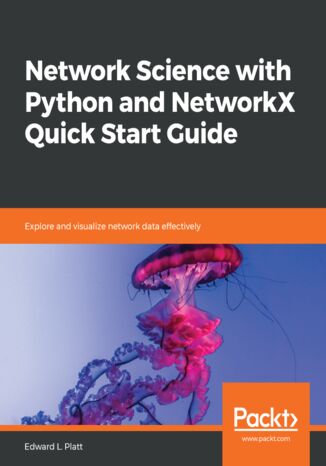
Edward L. Platt
NetworkX is a leading free and open source package used for network science with the Python programming language. NetworkX can track properties of individuals and relationships, find communities, analyze resilience, detect key network locations, and perform a wide range of important tasks. With the recent release of version 2, NetworkX has been updated to be more powerful and easy to use.If you’re a data scientist, engineer, or computational social scientist, this book will guide you in using the Python programming language to gain insights into real-world networks. Starting with the fundamentals, you’ll be introduced to the core concepts of network science, along with examples that use real-world data and Python code. This book will introduce you to theoretical concepts such as scale-free and small-world networks, centrality measures, and agent-based modeling. You’ll also be able to look for scale-free networks in real data and visualize a network using circular, directed, and shell layouts.By the end of this book, you’ll be able to choose appropriate network representations, use NetworkX to build and characterize networks, and uncover insights while working with real-world systems.
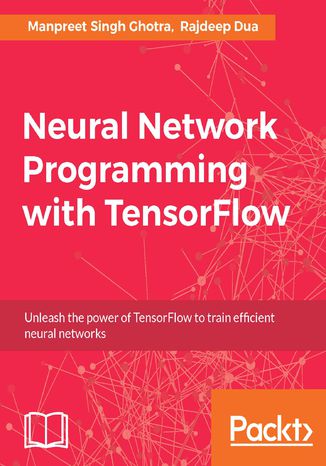
Manpreet Singh Ghotra, Rajdeep Dua
If you're aware of the buzz surrounding the terms such as machine learning, artificial intelligence, or deep learning, you might know what neural networks are. Ever wondered how they help in solving complex computational problem efficiently, or how to train efficient neural networks? This book will teach you just that.You will start by getting a quick overview of the popular TensorFlow library and how it is used to train different neural networks. You will get a thorough understanding of the fundamentals and basic math for neural networks and why TensorFlow is a popular choice Then, you will proceed to implement a simple feed forward neural network. Next you will master optimization techniques and algorithms for neural networks using TensorFlow. Further, you will learn to implement some more complex types of neural networks such as convolutional neural networks, recurrent neural networks, and Deep Belief Networks. In the course of the book, you will be working on real-world datasets to get a hands-on understanding of neural network programming. You will also get to train generative models and will learn the applications of autoencoders.By the end of this book, you will have a fair understanding of how you can leverage the power of TensorFlow to train neural networks of varying complexities, without any hassle. While you are learning about various neural network implementations you will learn the underlying mathematics and linear algebra and how they map to the appropriate TensorFlow constructs.
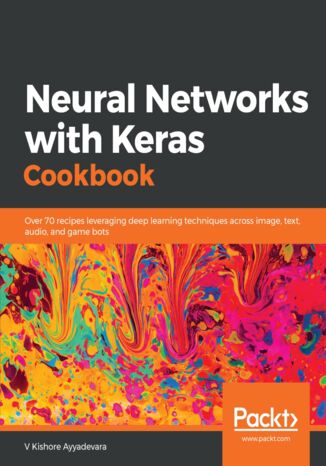
V Kishore Ayyadevara
This book will take you from the basics of neural networks to advanced implementations of architectures using a recipe-based approach.We will learn about how neural networks work and the impact of various hyper parameters on a network's accuracy along with leveraging neural networks for structured and unstructured data.Later, we will learn how to classify and detect objects in images. We will also learn to use transfer learning for multiple applications, including a self-driving car using Convolutional Neural Networks.We will generate images while leveraging GANs and also by performing image encoding. Additionally, we will perform text analysis using word vector based techniques. Later, we will use Recurrent Neural Networks and LSTM to implement chatbot and Machine Translation systems.Finally, you will learn about transcribing images, audio, and generating captions and also use Deep Q-learning to build an agent that plays Space Invaders game.By the end of this book, you will have developed the skills to choose and customize multiple neural network architectures for various deep learning problems you might encounter.