
Python
W kategorii Python zostały zebrane podręczniki poruszające tematykę programowania z zastosowaniem praktycznie niezależnego sprzętowo, dostępnego na licencji Open Source języka. Książki przedstawią Wam wszechstronności i elastyczności Pythona a także różne typy tworzenia kodu poprzez programowanie strukturalne, obiektowe czy funkcjonalne.
Nauczycie się tworzyć aplikacje sieciowe o dowolnym przeznaczeniu, komunikujące się z systemami operacyjnymi, lub korzystające z baz danych. Techniki analizy składni, przetwarzanie tekstu czy rozłożenie obciążenia programu na wiele wątków i procesów przestanie być problematyczne.
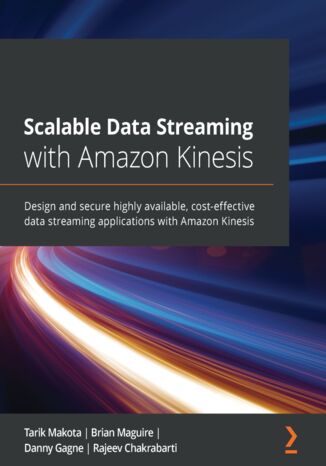
Tarik Makota, Brian Maguire, Danny Gagne, Rajeev...
Amazon Kinesis is a collection of secure, serverless, durable, and highly available purpose-built data streaming services. This data streaming service provides APIs and client SDKs that enable you to produce and consume data at scale.Scalable Data Streaming with Amazon Kinesis begins with a quick overview of the core concepts of data streams, along with the essentials of the AWS Kinesis landscape. You'll then explore the requirements of the use case shown through the book to help you get started and cover the key pain points encountered in the data stream life cycle. As you advance, you'll get to grips with the architectural components of Kinesis, understand how they are configured to build data pipelines, and delve into the applications that connect to them for consumption and processing. You'll also build a Kinesis data pipeline from scratch and learn how to implement and apply practical solutions. Moving on, you'll learn how to configure Kinesis on a cloud platform. Finally, you’ll learn how other AWS services can be integrated into Kinesis. These services include Redshift, Dynamo Database, AWS S3, Elastic Search, and third-party applications such as Splunk.By the end of this AWS book, you’ll be able to build and deploy your own Kinesis data pipelines with Kinesis Data Streams (KDS), Kinesis Data Firehose (KFH), Kinesis Video Streams (KVS), and Kinesis Data Analytics (KDA).
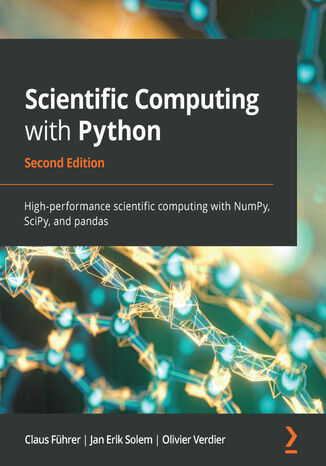
Claus Führer, Claus Fuhrer, Jan Erik Solem,...
Python has tremendous potential within the scientific computing domain. This updated edition of Scientific Computing with Python features new chapters on graphical user interfaces, efficient data processing, and parallel computing to help you perform mathematical and scientific computing efficiently using Python.This book will help you to explore new Python syntax features and create different models using scientific computing principles. The book presents Python alongside mathematical applications and demonstrates how to apply Python concepts in computing with the help of examples involving Python 3.8. You'll use pandas for basic data analysis to understand the modern needs of scientific computing, and cover data module improvements and built-in features. You'll also explore numerical computation modules such as NumPy and SciPy, which enable fast access to highly efficient numerical algorithms. By learning to use the plotting module Matplotlib, you will be able to represent your computational results in talks and publications. A special chapter is devoted to SymPy, a tool for bridging symbolic and numerical computations.By the end of this Python book, you'll have gained a solid understanding of task automation and how to implement and test mathematical algorithms within the realm of scientific computing.
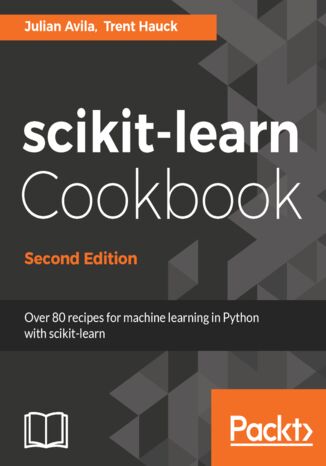
Julian Avila, Trent Hauck
Python is quickly becoming the go-to language for analysts and data scientists due to its simplicity and flexibility, and within the Python data space, scikit-learn is the unequivocal choice for machine learning. This book includes walk throughs and solutions to the common as well as the not-so-common problems in machine learning, and how scikit-learn can be leveraged to perform various machine learning tasks effectively.The second edition begins with taking you through recipes on evaluating the statistical properties of data and generates synthetic data for machine learning modelling. As you progress through the chapters, you will comes across recipes that will teach you to implement techniques like data pre-processing, linear regression, logistic regression, K-NN, Naïve Bayes, classification, decision trees, Ensembles and much more. Furthermore, you’ll learn to optimize your models with multi-class classification, cross validation, model evaluation and dive deeper in to implementing deep learning with scikit-learn. Along with covering the enhanced features on model section, API and new features like classifiers, regressors and estimators the book also contains recipes on evaluating and fine-tuning the performance of your model. By the end of this book, you will have explored plethora of features offered by scikit-learn for Python to solve any machine learning problem you come across.
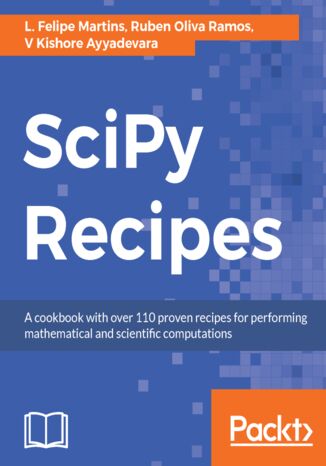
Luiz Felipe Martins, Ke Wu, Ruben Oliva...
With the SciPy Stack, you get the power to effectively process, manipulate, and visualize your data using the popular Python language. Utilizing SciPy correctly can sometimes be a very tricky proposition. This book provides the right techniques so you can use SciPy to perform different data science tasks with ease.This book includes hands-on recipes for using the different components of the SciPy Stack such as NumPy, SciPy, matplotlib, and pandas, among others. You will use these libraries to solve real-world problems in linear algebra, numerical analysis, data visualization, and much more. The recipes included in the book will ensure you get a practical understanding not only of how a particular feature in SciPy Stack works, but also of its application to real-world problems. The independent nature of the recipes also ensure that you can pick up any one and learn about a particular feature of SciPy without reading through the other recipes, thus making the book a very handy and useful guide.
Cody Jackson
This book covers the unexplored secrets of Python, delve into its depths, and uncover its mysteries.You’ll unearth secrets related to the implementation of the standard library, by looking at how modules actually work. You’ll understand the implementation of collections, decimals, and fraction modules. If you haven’t used decorators, coroutines, and generator functions much before, as you make your way through the recipes, you’ll learn what you’ve been missing out on. We’ll cover internal special methods in detail, so you understand what they are and how they can be used to improve the engineering decisions you make. Next, you’ll explore the CPython interpreter, which is a treasure trove of secret hacks that not many programmers are aware of. We’ll take you through the depths of the PyPy project, where you’ll come across several exciting ways that you can improve speed and concurrency. Finally, we’ll take time to explore the PEPs of the latest versions to discover some interesting hacks.
Corey Charles Sr., Frank McMahon
Designed to address the most common pain point for security teams—scalability—Security Automation with Python leverages the author’s years of experience in vulnerability management to provide you with actionable guidance on automating security workflows to streamline your operations and improve your organization’s overall security posture.What makes this book stand out is its hands-on approach. You won’t just learn theoretical concepts—you’ll apply Python-based automation techniques directly to real-world scenarios. Whether you're automating vulnerability scans, managing firewall rules, or responding to security incidents, this book provides clear examples and use cases, breaking down complex topics into easily digestible steps. With libraries like Paramiko, Requests, and PyAutoGUI, you’ll automate everything from network scanning and threat intelligence gathering to system patching and alert management. Plus, this book focuses heavily on practical tips for error handling, scaling automation workflows, and integrating Python scripts into larger security infrastructures.By the end of this book, you'll have developed a set of highly valuable skills, from creating custom automation scripts to deploying them in production environments, and completed projects that can be immediately put to use in your organization.
Anthony Virtuoso, Mert Turkay Hocanin , Aaron...
Amazon Athena is an interactive query service that makes it easy to analyze data in Amazon S3 using SQL, without needing to manage any infrastructure.This book begins with an overview of the serverless analytics experience offered by Athena and teaches you how to build and tune an S3 Data Lake using Athena, including how to structure your tables using open-source file formats like Parquet. You’ll learn how to build, secure, and connect to a data lake with Athena and Lake Formation. Next, you’ll cover key tasks such as ad hoc data analysis, working with ETL pipelines, monitoring and alerting KPI breaches using CloudWatch Metrics, running customizable connectors with AWS Lambda, and more. Moving on, you’ll work through easy integrations, troubleshooting and tuning common Athena issues, and the most common reasons for query failure. You will also review tips to help diagnose and correct failing queries in your pursuit of operational excellence. Finally, you’ll explore advanced concepts such as Athena Query Federation and Athena ML to generate powerful insights without needing to touch a single server.By the end of this book, you’ll be able to build and use a data lake with Amazon Athena to add data-driven features to your app and perform the kind of ad hoc data analysis that often precedes many of today’s ML modeling exercises.
Skrypty powłoki systemu Linux. Zagadnienia zaawansowane. Wydanie II
Mokhtar Ebrahim, Andrew Mallett
Mimo że nowe wydania dystrybucji Linuksa są coraz łatwiejsze w obsłudze, a ważniejsze czynności administracyjne mogą być wykonywane za pomocą intuicyjnego interfejsu graficznego, wciąż nie można się obejść bez powłoki Bourne'a, znanej jako bash. Dobrze napisany skrypt powłoki pozwala na automatyzację nudnych obowiązków, umożliwia monitorowanie stanu systemu, optymalizację jego wydajności czy dostosowanie go do potrzeb. Warto też wypróbować ciekawą alternatywę dla tradycyjnych skryptów powłoki bash, czyli kod Pythona. Dzięki tej książce nauczysz się wszystkiego, co jest potrzebne do pisania profesjonalnych skryptów powłoki. Dowiesz się, czym są powłoki systemu Linux, dlaczego tak ważna jest powłoka bash i w jaki sposób edytuje się skrypty. Nauczysz się pracy na zmiennych, debugowania kodu i tworzenia skryptów interaktywnych. Będziesz korzystać z instrukcji warunkowych i pętli, a także z edytora vim, pakietu Visual Studio Code oraz edytora strumieniowego sed. Zapoznasz się z zasadami pisania funkcji, dzięki którym będziesz mógł wielokrotnie używać uniwersalnych fragmentów kodu. Ponadto zdobędziesz umiejętność przetwarzania danych tekstowych, zarówno za pomocą polecenia AWK, jak i wyrażeń regularnych. Na koniec przekonasz się, jak ciekawą alternatywą dla skryptów powłoki bash jest kod napisany w Pythonie! W tej książce między innymi: wyczerpujące wprowadzenie do tworzenia i debugowania skryptów powłoki składnia alternatywna i operacje arytmetyczne praca z blokami kodu i korzystanie z funkcji automatyzacja tworzenia hostów wirtualnych zaawansowane korzystanie z polecenia AWK skrypty do analizy plików dziennika i tworzenia raportów Opanuj sztukę pisania doskonałych skryptów powłoki!