
Python
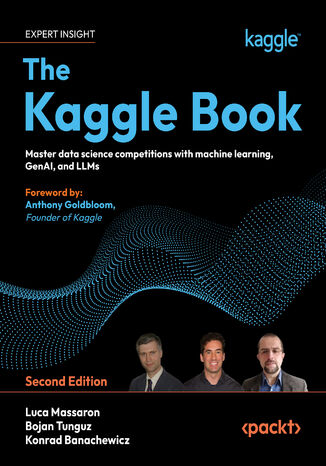
Luca Massaron, Bojan Tunguz, Konrad Banachewicz, Anthony...
Kaggle has become the proving ground for millions of data enthusiasts worldwide, offering what no classroom tutorial can match: battle-tested skills built through real-world challenges and the hands-on experience that employers seek. Every competition sharpens your data analysis skills, expands your network within the data scientist community, and gives compelling proof of expertise to unlock career opportunities.The first book of its kind, The Kaggle Book brings together everything you need to excel in competitions, data science projects, and beyond. This new edition includes fresh content and new chapters on Kaggle Models, time series, and Generative AI competitions, with three Kaggle Grandmasters guiding you through modeling strategies and sharing hard-earned insights accumulated over years of competition.The book extends far past competition tactics, revealing techniques for tackling image, tabular, and textual data as well as reinforcement learning tasks. You’ll also discover tips for designing better validation schemes and working confidently with both standard and unconventional evaluation metrics.Whether you want to climb the Kaggle leaderboard, accelerate your data science career, or improve the accuracy of your models, this book is for you.Join our Discord community of over 1,000 members to learn, share, and grow together!
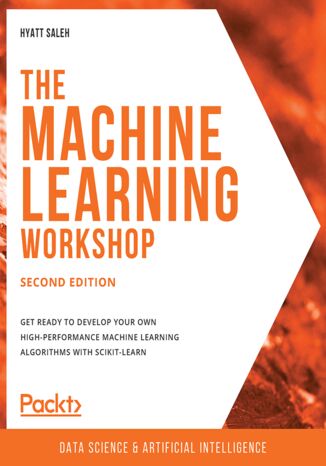
Hyatt Saleh , John Wesley Doyle ,...
Machine learning algorithms are an integral part of almost all modern applications. To make the learning process faster and more accurate, you need a tool flexible and powerful enough to help you build machine learning algorithms quickly and easily. With The Machine Learning Workshop, you'll master the scikit-learn library and become proficient in developing clever machine learning algorithms.The Machine Learning Workshop begins by demonstrating how unsupervised and supervised learning algorithms work by analyzing a real-world dataset of wholesale customers. Once you've got to grips with the basics, you'll develop an artificial neural network using scikit-learn and then improve its performance by fine-tuning hyperparameters. Towards the end of the workshop, you'll study the dataset of a bank's marketing activities and build machine learning models that can list clients who are likely to subscribe to a term deposit. You'll also learn how to compare these models and select the optimal one.By the end of The Machine Learning Workshop, you'll not only have learned the difference between supervised and unsupervised models and their applications in the real world, but you'll also have developed the skills required to get started with programming your very own machine learning algorithms.
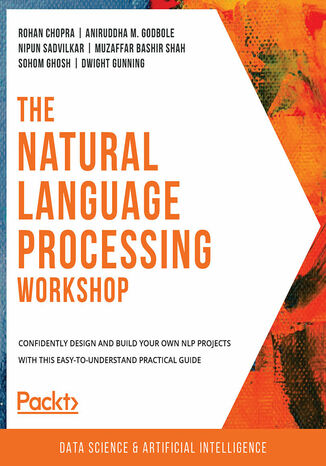
Rohan Chopra , Aniruddha M. Godbole ,...
Do you want to learn how to communicate with computer systems using Natural Language Processing (NLP) techniques, or make a machine understand human sentiments? Do you want to build applications like Siri, Alexa, or chatbots, even if you’ve never done it before?With The Natural Language Processing Workshop, you can expect to make consistent progress as a beginner, and get up to speed in an interactive way, with the help of hands-on activities and fun exercises.The book starts with an introduction to NLP. You’ll study different approaches to NLP tasks, and perform exercises in Python to understand the process of preparing datasets for NLP models. Next, you’ll use advanced NLP algorithms and visualization techniques to collect datasets from open websites, and to summarize and generate random text from a document. In the final chapters, you’ll use NLP to create a chatbot that detects positive or negative sentiment in text documents such as movie reviews.By the end of this book, you’ll be equipped with the essential NLP tools and techniques you need to solve common business problems that involve processing text.
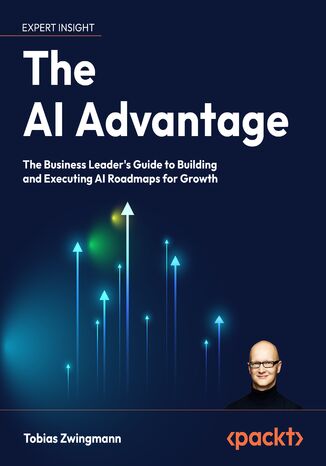
Tobias Zwingmann, Armand Ruiz
Artificial Intelligence has the power to dramatically enhance business performance—but knowing where to begin can be overwhelming. The Profitable AI Advantage offers a clear, actionable roadmap for business leaders, entrepreneurs, and CTOs to identify, design, and scale profitable AI initiatives. You'll learn how AI expands margins by reducing costs, increasing throughput, minimizing risk, and unlocking new revenue streams—without incurring proportional costs.Instead of relying on complex financial models, this guide presents simple thresholds, cost caps, and quick-sizing techniques you can apply to your own financials. The book moves efficiently from foundational AI concepts to practical applications, covering predictive AI, generative AI, and agent-based tools.Frameworks like the Pain Points and Bottlenecks Canvas and the Integration-Automation AI Framework help you identify high-impact opportunities, design use cases, build roadmaps, and prototype solutions quickly and cost-effectively. With real-world case studies from seasoned AI expert Tobias Zwingmann, you’ll sidestep pitfalls, streamline implementation, and drive measurable P&L impact.By the end, you’ll be equipped to scale AI strategically, align your teams, and boost decision-making, productivity, and competitive edge.
The Python Apprentice. Introduction to the Python Programming Language
Robert Smallshire, Austin Bingham
Experienced programmers want to know how to enhance their craft and we want to help them start as apprentices with Python. We know that before mastering Python you need to learn the culture and the tools to become a productive member of any Python project. Our goal with this book is to give you a practical and thorough introduction to Python programming, providing you with the insight and technical craftsmanship you need to be a productive member of any Python project. Python is a big language, and it’s not our intention with this book to cover everything there is to know. We just want to make sure that you, as the developer, know the tools, basic idioms and of course the ins and outs of the language, the standard library and other modules to be able to jump into most projects.
Andrew Bird, Dr. Lau Cher Han, Mario...
Have you always wanted to learn Python, but never quite known how to start?More applications than we realize are being developed using Python because it is easy to learn, read, and write. You can now start learning the language quickly and effectively with the help of this interactive tutorial.The Python Workshop starts by showing you how to correctly apply Python syntax to write simple programs, and how to use appropriate Python structures to store and retrieve data. You'll see how to handle files, deal with errors, and use classes and methods to write concise, reusable, and efficient code.As you advance, you'll understand how to use the standard library, debug code to troubleshoot problems, and write unit tests to validate application behavior.You'll gain insights into using the pandas and NumPy libraries for analyzing data, and the graphical libraries of Matplotlib and Seaborn to create impactful data visualizations. By focusing on entry-level data science, you'll build your practical Python skills in a way that mirrors real-world development. Finally, you'll discover the key steps in building and using simple machine learning algorithms.By the end of this Python book, you'll have the knowledge, skills and confidence to creatively tackle your own ambitious projects with Python.
Alessandro Palmas , Emanuele Ghelfi , Dr....
Various intelligent applications such as video games, inventory management software, warehouse robots, and translation tools use reinforcement learning (RL) to make decisions and perform actions that maximize the probability of the desired outcome. This book will help you to get to grips with the techniques and the algorithms for implementing RL in your machine learning models.Starting with an introduction to RL, youÔÇÖll be guided through different RL environments and frameworks. YouÔÇÖll learn how to implement your own custom environments and use OpenAI baselines to run RL algorithms. Once youÔÇÖve explored classic RL techniques such as Dynamic Programming, Monte Carlo, and TD Learning, youÔÇÖll understand when to apply the different deep learning methods in RL and advance to deep Q-learning. The book will even help you understand the different stages of machine-based problem-solving by using DARQN on a popular video game Breakout. Finally, youÔÇÖll find out when to use a policy-based method to tackle an RL problem.By the end of The Reinforcement Learning Workshop, youÔÇÖll be equipped with the knowledge and skills needed to solve challenging problems using reinforcement learning.
Peter Farrell , Alvaro Fuentes , Ajinkya...
Are you looking to start developing artificial intelligence applications? Do you need a refresher on key mathematical concepts? Full of engaging practical exercises, The Statistics and Calculus with Python Workshop will show you how to apply your understanding of advanced mathematics in the context of Python.The book begins by giving you a high-level overview of the libraries you'll use while performing statistics with Python. As you progress, you'll perform various mathematical tasks using the Python programming language, such as solving algebraic functions with Python starting with basic functions, and then working through transformations and solving equations. Later chapters in the book will cover statistics and calculus concepts and how to use them to solve problems and gain useful insights. Finally, you'll study differential equations with an emphasis on numerical methods and learn about algorithms that directly calculate values of functions.By the end of this book, you’ll have learned how to apply essential statistics and calculus concepts to develop robust Python applications that solve business challenges.