
Webmasterstwo
pytest Quick Start Guide. Write better Python code with simple and maintainable tests
Bruno Oliveira
Python's standard unittest module is based on the xUnit family of frameworks, which has its origins in Smalltalk and Java, and tends to be verbose to use and not easily extensible.The pytest framework on the other hand is very simple to get started, but powerful enough to cover complex testing integration scenarios, being considered by many the true Pythonic approach to testing in Python.In this book, you will learn how to get started right away and get the most out of pytest in your daily work?ow, exploring powerful mechanisms and plugins to facilitate many common testing tasks. You will also see how to use pytest in existing unittest-based test suites and will learn some tricks to make the jump to a pytest-style test suite quickly and easily.
Python, C++, JavaScript. Zadania z programowania
Marek Luliński, Gniewomir Sarbicki
Zadania z programowania? Zbiór programów do napisania! Pascal, C++, JavaScript i Python — oto zbiór języków, które przećwiczysz dzięki zadaniom w tej książce. Każdy z nich ma nieco inne zastosowania, wszystkie zaś są lub będą w najbliższym czasie wykorzystywane na lekcjach informatyki i na egzaminach, a ich zastosowanie w obliczu realnych problemów może wydatnie uprościć Ci życie. Jak najłatwiej i najszybciej nauczyć się programować w tych językach? Oczywiście dzięki ćwiczeniom! Z tą książką napiszesz konkretne programy rozwiązujące zadania numeryczne, logiczne i matematyczne — w każdym z powyższych języków. Z praktycznym zestawem zawartych tu zadań spróbujesz znaleźć permutacje zbioru, zaszyfrować tekst szyfrem Cezara, zbudować trójkąt Pascala i wskazać punkty kratowe wewnątrz koła o promieniu r. Napiszesz według własnego pomysłu programy odpowiadające na postawione w zadaniach pytania. Jeśli jesteś uczniem, będziesz mógł w ten sposób ćwiczyć nie tylko umiejętności programistyczne, lecz także matematyczne. Jeśli jesteś nauczycielem, znajdziesz tu wiele inspiracji dla swoich uczniów. Gotowy pogram będziesz mógł później porównać z rozwiązaniami proponowanymi przez autorów. Dogadaj się z komputerem — w każdym z czterech języków! --- UWAGA: Skala trudności zadań odpowiada poziomowi szkoły średniej.
Python GUI Programming with Tkinter. Develop responsive and powerful GUI applications with Tkinter
Alan D. Moore
Tkinter is a lightweight, portable, and easy-to-use graphical toolkit available in the Python Standard Library, widely used to build Python GUIs due to its simplicity and availability. This book teaches you to design and build graphical user interfaces that are functional, appealing, and user-friendly using the powerful combination of Python and Tkinter.After being introduced to Tkinter, you will be guided step-by-step through the application development process. Over the course of the book, your application will evolve from a simple data-entry form to a complex data management and visualization tool while maintaining a clean and robust design. In addition to building the GUI, you'll learn how to connect to external databases and network resources, test your code to avoid errors, and maximize performance using asynchronous programming. You'll make the most of Tkinter's cross-platform availability by learning how to maintain compatibility, mimic platform-native look and feel, and build executables for deployment across popular computing platforms.By the end of this book, you will have the skills and confidence to design and build powerful high-end GUI applications to solve real-world problems.
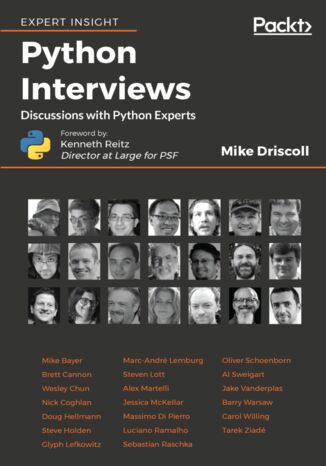
Python Interviews. Discussions with Python Experts
Michael Driscoll
Each of these twenty Python Interviews can inspire and refresh your relationship with Python and the people who make Python what it is today. Let these interviews spark your own creativity, and discover how you also have the ability to make your mark on a thriving tech community. This book invites you to immerse in the Python landscape, and let these remarkable programmers show you how you too can connect and share with Python programmers around the world. Learn from their opinions, enjoy their stories, and use their tech tips.• Brett Cannon - former director of the PSF, Python core developer, led the migration to Python 3.• Steve Holden - tireless Python promoter and former chairman and director of the PSF.• Carol Willing - former director of the PSF and Python core developer, Project Jupyter Steering Council member.• Nick Coghlan - founding member of the PSF's Packaging Working Group and Python core developer.• Jessica McKellar - former director of the PSF and Python activist.• Marc-André Lemburg - Python core developer and founding member of the PSF.• Glyph Lefkowitz - founder of Twisted and fellow of the PSF• Doug Hellmann - fellow of the PSF, creator of the Python Module of the Week blog, Python community member since 1998.• Massimo Di Pierro - fellow of the PSF, data scientist and the inventor of web2py. • Alex Martelli - fellow of the PSF and co-author of Python in a Nutshell.• Barry Warsaw - fellow of the PSF, Python core developer since 1995, and original member of PythonLabs.• Tarek Ziadé - founder of Afpy and author of Expert Python Programming.• Sebastian Raschka - data scientist and author of Python Machine Learning.• Wesley Chun - fellow of the PSF and author of the Core Python Programming books.• Steven Lott - Python blogger and author of Python for Secret Agents.• Oliver Schoenborn - author of Pypubsub and wxPython mailing list contributor.• Al Sweigart - bestselling author of Automate the Boring Stuff with Python and creator of the Python modules Pyperclip and PyAutoGUI.• Luciano Ramalho - fellow of the PSF and the author of Fluent Python.• Mike Bayer - fellow of the PSF, creator of open source libraries including SQLAlchemy.• Jake Vanderplas - data scientist and author of Python Data Science Handbook.
Python Microservices Development. Build, test, deploy, and scale microservices in Python
Tarek Ziadé
We often deploy our web applications into the cloud, and our code needs to interact with many third-party services. An efficient way to build applications to do this is through microservices architecture. But, in practice, it's hard to get this right due to the complexity of all the pieces interacting with each other.This book will teach you how to overcome these issues and craft applications that are built as small standard units, using all the proven best practices and avoiding the usual traps. It's a practical book: you’ll build everything using Python 3 and its amazing tooling ecosystem. You will understand the principles of TDD and apply them. You will use Flask, Tox, and other tools to build your services using best practices. You will learn how to secure connections between services, and how to script Nginx using Lua to build web application firewall features such as rate limiting. You will also familiarize yourself with Docker’s role in microservices, and use Docker containers, CoreOS, and Amazon Web Services to deploy your services.This book will take you on a journey, ending with the creation of a complete Python application based on microservices. By the end of the book, you will be well versed with the fundamentals of building, designing, testing, and deploying your Python microservices.
Daniel Furtado, Marcus Pennington
Python is a very powerful, high-level, object-oriented programming language. It's known for its simplicity and huge community support. Python Programming Blueprints will help you build useful, real-world applications using Python.In this book, we will cover some of the most common tasks that Python developers face on a daily basis, including performance optimization and making web applications more secure. We will familiarize ourselves with the associated software stack and master asynchronous features in Python. We will build a weather application using command-line parsing. We will then move on to create a Spotify remote control where we'll use OAuth and the Spotify Web API. The next project will cover reactive extensions by teaching you how to cast votes on Twitter the Python way. We will also focus on web development by using the famous Django framework to create an online game store. We will then create a web-based messenger using the new Nameko microservice framework. We will cover topics like authenticating users and, storing messages in Redis.By the end of the book, you will have gained hands-on experience in coding with Python.
Lazar Telebak, Michael Heydt, Mei Lu
Python Web Scraping Cookbook is a solution-focused book that will teach you techniques to develop high-performance scrapers and deal with crawlers, sitemaps, forms automation, Ajax-based sites, caches, and more. You'll explore a number of real-world scenarios where every part of the development/product life cycle will be fully covered. You will not only develop the skills needed to design and develop reliable performance data flows, but also deploy your codebase to AWS. If you are involved in software engineering, product development, or data mining (or are interested in building data-driven products), you will find this book useful as each recipe has a clear purpose and objective. Right from extracting data from the websites to writing a sophisticated web crawler, the book's independent recipes will be a godsend. This book covers Python libraries, requests, and BeautifulSoup. You will learn about crawling, web spidering, working with Ajax websites, paginated items, and more. You will also learn to tackle problems such as 403 errors, working with proxy, scraping images, and LXML.By the end of this book, you will be able to scrape websites more efficiently and able todeploy and operate your scraper in the cloud.
Katharine Jarmul
The Internet contains the most useful set of data ever assembled, most of which is publicly accessible for free. However, this data is not easily usable. It is embedded within the structure and style of websites and needs to be carefully extracted. Web scraping is becoming increasingly useful as a means to gather and make sense of the wealth of information available online.This book is the ultimate guide to using the latest features of Python 3.x to scrape data from websites. In the early chapters, you'll see how to extract data from static web pages. You'll learn to use caching with databases and files to save time and manage the load on servers. Aftercovering the basics, you'll get hands-on practice building a more sophisticated crawler using browsers, crawlers, and concurrent scrapers.You'll determine when and how to scrape data from a JavaScript-dependent website using PyQt and Selenium. You'll get a better understanding of how to submit forms on complex websites protected by CAPTCHA. You'll find out how to automate these actions with Python packages such as mechanize. You'll also learn how to create class-based scrapers with Scrapy libraries and implement your learning on real websites.By the end of the book, you will have explored testing websites with scrapers, remote scraping, best practices, working with images, and many other relevant topics.