
Hardware
Dział poświęcony w całości tematyce związanej ze sprzętem komputerowym. Gdy Twój pecet nie działa jak należy, sięgnij po którąś z niniejszych pozycji.
Książki nie tylko dla profesjonalistów: serwisantów, projektantów urządzeń współpracujących z PC i programistów. Każdy, kto chce dowiedzieć się jak działa jego pecet znajdzie tu odpowiedzi na wszystkie swoje pytania.
Niedoświadczony użytkownik komputera nie będzie musiał się już obawiać samodzielnego majstrowania we wnętrzu "peceta". Dzięki naszym książkom pozna dokładnie budowę komputera, dowie się jak połączyć poszczególne jego komponenty, tak by pracował on szybko i stabilnie. Zaawansowani znajdą tu wiele cennych wskazówek, podpowiedzi i sprawdzonych sposobów osiągania maksymalnej wydajności komputera.
Alexey Kapranov
Nginx is clearly winning the race to be the dominant software to power modern websites. It is fast and open source, maintained with passion by a brilliant team. This book will help you maintain your Nginx instances in a healthy and predictable state.It will lead you through all the types of problems you might encounter as a web administrator, with a special focus on performance and migration from older software.You will learn how to write good configuration files and will get good insights into Nginx logs. It will provide you solutions to problems such as missing or broken functionality and also show you how to tackle performance issues with the Nginx server. A special chapter is devoted to the art of prevention, that is, monitoring and alerting services you may use to detect problems before they manifest themselves on a big scale. The books ends with a reference to error and warning messages Nginx could emit to help you during incident investigations.
Ivan Idris
Today's world of science and technology is all about speed and flexibility. When it comes to scientific computing, NumPy is on the top of the list. NumPy will give you both speed and high productivity.NumPy Cookbook will teach you all about NumPy, a leading scientific computing library. NumPy replaces a lot of the functionality of Matlab and Mathematica, but in contrast to those products, it is free and open source.Numpy Cookbook will teach you to write readable, efficient, and fast code that is as close to the language of Mathematics as much as possible with the cutting edge open source NumPy software library.You will learn about installing and using NumPy and related concepts. At the end of the book, we will explore related scientific computing projects.This book will give you a solid foundation in NumPy arrays and universal functions. You will also learn about plotting with Matplotlib and the related SciPy project through examples.NumPy Cookbook will help you to be productive with NumPy and write clean and fast code.
Matthew Gifford
Are you tired of procedural programming or is your extensive code base starting to become un-manageable? Breathe some new life into your code and improve your development skills with the basic concepts of object-oriented programming. Utilize objects, modular components, and design patterns to expand your skills and improve your ColdFusion applications. Packed with example code, and written in a friendly, easy-to-read style, this book is just what you need if you are serious about ColdFusion.This book is a fast-paced tutorial to important ColdFusion object-oriented programming topics. It will give you clear, concise, and practical guidance to take you from the basics of ColdFusion to the skills that will make you a ColdFusion developer to be reckoned with. Don't be put off by jargon or complex diagrams; read and see how you can benefit from this book and extend your development skills in the process.Using the practical examples within this guide, you will learn how to structure your applications and code, applying the fundamental basics of object-oriented programming to develop modular, reusable components that will scale easily with your application. You will learn the basic fundamental practices of object-oriented programming, from object creation and re-use, to Bean objects, service layers, Data Access objects, and sample design patterns to gain a better understanding of OOP using examples that can be altered and applied in your application. Complete with detailed code samples and snippets, and written in a friendly easy-to-follow style, you will be able to break free from writing purely procedural code and enhance your applications by building structured applications utilizing basic design patterns and object-oriented principles.
Odoo Development Cookbook. Build effective applications by applying Odoo development best practices
Holger Brunn, Alexandre Fayolle, Daniel Reis
Odoo is a full-featured open source ERP with a focus on extensibility. The flexibility and sustainability of open source is also a key selling point of Odoo. It is built on a powerful framework for rapid application development, both for back-end applications and front-end websites.The book starts by covering Odoo installation and administration, and provides a gentle introduction to application development. It then dives deep into several of the areas that an experienced developer will need to use. You’ll learn implement business logic, adapt the UI, and extend existing features.
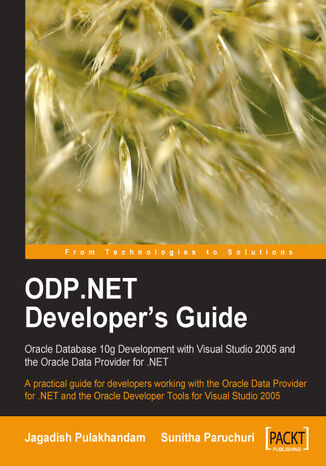
Jagadish Pulakhandam, Sunitha Paruchuri
The Oracle Data Provider for .NET (ODP.NET) features optimized data access to the Oracle database from a .NET environment and allows developers to take advantage of advanced Oracle database functionality, including Real Application Clusters, XML DB, and advanced security. It can be used from any .NET language, including C# and VB.NET.This book is a practical guide that will give you the in-depth information you need to work with the Oracle 10g v10.2 database from Visual Studio .NET 2005, using the Oracle Developer Tools and ODP.NET. After introducing ODP.NET, we move on to dealing with SQL, PL/SQL, and XML DB using ODP.NET. Next we look at application development with ODP.NET: Web Applications, Web Services, and Mobile Applications. The last chapter covers Oracle Developer Tools for Visual Studio .NET. All the code examples are in Visual Basic.NET 2005.https://www.packtpub.com/article/ODP-dot-net-oracle-data-provider-table-of-conten - Read the full Table of Contents for ODP.NET Developer's GuideChapter-by-ChapterChapter 1 introduces the concept of Oracle Database Extensions for .NET and provides information about Oracle Developer tools for Visual Studio.Chapter 2 introduces the Provider Independent Model in ADO.NET 2.0, and shows how to connect to Oracle databases from .NET, working with .NET data providers, connection pooling, system privileged connection, and single sign-on etc.Chapter 3 shows you several methods to retrieve data from an Oracle database. You will work with the core ODP.NET classes like OracleCommand, OracleDataReader, OracleDataAdapter, OracleParameter and ADO.NET classes like Dataset, DataTable, and DataRow etc.Chapter 4 is about inserting, updating, and deleting data in the database. You will also learn about statement caching, array binding, working with offline data, implementing transactions, and handling errors and exceptions encountered during database work.Chapter 5 deals with working with PL/SQL blocks, PL/SQL stored procedures, and functions. It also teaches you how to execute routines in PL/SQL packages, how to pass and receive arrays from the Oracle database, and working with REF CURSOR using ODP.NET.Chapter 6 is completely dedicated to dealing with Large objects in Oracle. This chapter illustrates concepts, configurations, and programming for BFILE, BLOB, and CLOB (or NCLOB) in conjunction with ODP.NET.Chapter 7 gives details about Oracle XML DB, an add-on feature of Oracle database. It provides information about generating XML from existing rows in tables, manipulating rows in a table using XML, and working with native XML in the Oracle database.Chapter 8 deals with real-time application development scenarios like Oracle database change notifications, Asynchronous Application development, Web Application development using ASP.NET 2.0, Web Reporting (including grouping, sub-totals, charts etc.), Object-Oriented Development with ODP.NET and ASP.NET, XML Web Services development using ODP.NET and Smart Device Application development (for clients like the Pocket PC etc.).Chapter 9 introduces you to Oracle Developer Tools for Visual Studio 2005. It teaches you to connect to Oracle from the Visual Studio 2005 environment, retrieve Oracle information from Visual Studio, and work with database objects from Visual Studio. It also provides information about how to create and debug PL/SQL stored procedures and .NET CLR Stored Procedures in Oracle.
OGRE 3D 1.7 Beginner's Guide. Create real time 3D applications using OGRE 3D from scratch
Felix Kerger
Want to make your own 3D applications, simulations, and games?OGRE 3D, an open source Object-Oriented 3D Graphics Rendering Engine written in C++, which can be utilized to create a variety of 3D applications and is commonly used in game creation, can help you to do so!OGRE 3D 1.7 Beginner's Guide, based on the latest version 1.7, makes it super easy for you to make your own monsters, spaceship shooters, weapons, enemies, and more!OGRE 3D 1.7 Beginner's Guide will teach you to develop 3D applications that are exciting and interesting and if used correctly can result in stunning games and simulations. You will start from the very beginning and then work your way up to complex scenes and stunning effects.In this book you will start with how to download and configure OGRE 3D, then create your first example scene. With the help of this sample scene, you will be introduced to several related topics each of which will be explained through several other examples and by do-it-yourself tasks.After each example there is a section that explains the theory behind the technique used for deeper understanding. You will also use what you learned in one example in another example and repeat each technique several times while learning new ones at the same time to strengthen the topics learned. Within no time you will master the art of game creation. Imagine how great you will feel when all your friends are playing the great-looking games you've created with OGRE 3D and this book.
Ruben Olsen
If a picture is worth a thousand words, why settle for anything less? Creating good visualizations to substantiate your ideas is essential in today's corporate environment. Use OmniGraffle's remarkably powerful and flexible features to get your diagrams right. Although fun to use, it can get cumbersome to find out exactly how to get what you want.This book will teach you how to make stunning diagrams without spending much time and energy. No matter if you have never used OmniGraffle, or if you are using it on a daily basis, this book will teach you how to get the most out of this splendid diagramming tool. It will first teach you the basics of the program and then extend your knowledge to a higher level.The book will teach you to make eye-popping visuals using a lot of useful, step-by-step examples. It begins with covering concepts that beef up your basics of using OmniGraffle. The earlier chapters will teach you to prepare dazzling diagrams from scratch with the many stencils, shapes, and fonts that are included in OmniGraffle. As your understanding of OmniGraffle broadens, the book will go even deeper to explain the less understood features of the software. It also covers some handy time-saving techniques such as workspaces and keyboard shortcuts.By the time you reach the end of this book, you will have mastered OmniGraffle to turn your ideas into diagrams.
Bill Aronson
Open Text ProVision® (formerly known as Metastorm ProVision®) is an Enterprise Architecture (EA) solution allowing for effective planning and decision making throughout the enterprise. It enables an organization to have a central repository of information about the business, reducing organizational risks and better optimizing business resources.Implemented well, it enables better and more actionable decisions exactly when you need them.This book combines theory and practice to provide a step- by- step guide to building a successful customer- centric model of your business. The approach is simple and down to earth, and along the way, with various real-world examples, you will learn how to make a business case, use a framework, and adopt a methodology with Open Text ProVision®. This book draws on the experience of ProVision® experts around the world. By combining theory with practice from the field you can avoid common mistakes and develop a successful customer centric strategy for implementing ProVision®. Each chapter builds on the previous one to give you the confidence to implement a central repository, dealing with both the technical and human issues that you might face.