
Kryptografia
Ankur Daharwal, Imran Bashir, Pranav Burnwal
Publisher's Note: This edition from 2018 is outdated and does not cover the latest insights on consensus algorithms, Ethereum 2.0, tokenization, and enterprise blockchains. A new and updated edition of this book that includes all the newest developments and improvements in Blockchain including the above topics is now available.A blockchain is a distributed ledger that is replicated across multiple nodes and enables immutable, transparent and cryptographically secure record-keeping of transactions. The blockchain technology is the backbone of cryptocurrencies, and it has applications in finance, government, media and almost all other industries. Mastering Blockchain, Second Edition has been thoroughly updated and revised to provide a detailed description of this leading technology and its implementation in the real world. This book begins with the technical foundations of blockchain technology, teaching you the fundamentals of distributed systems, cryptography and how it keeps data secure. You will learn about the mechanisms behind cryptocurrencies and how to develop applications using Ethereum, a decentralized virtual machine. You will also explore different other blockchain solutions and get an introduction to business blockchain frameworks under Hyperledger, a collaborative effort for the advancement of blockchain technologies hosted by the Linux Foundation. You will also be shown how to implement blockchain solutions beyond currencies, Internet of Things with blockchain, blockchain scalability, and the future scope of this fascinating and powerful technology.
Imran Bashir
Blockchain is the backbone of cryptocurrencies, it has had a massive impact in many sectors, including finance, supply chains, healthcare, government, and media. It’s also being used for cutting edge technologies such as AI and IoT. This new edition is thoroughly revised to offer a practical approach to using Ethereum, Hyperledger, Fabric, and Corda with step-by-step tutorials and real-world use-cases to help you understand everything you need to know about blockchain development and implementation. With new chapters on Decentralized Finance and solving privacy, identity, and security issues, as well as bonus online content exploring alternative blockchains, this is an unmissable read for everyone who wants to gain a deep understanding of blockchain.The book doesn’t shy away from advanced topics and practical expertise, such as decentralized application (DApp) development using smart contracts and oracles, and emerging trends in the blockchain space. Throughout the book, you’ll explore blockchain solutions beyond cryptocurrencies, such as the IoT with blockchain, enterprise blockchains, and tokenization, and gain insight into the future scope of this fascinating and disruptive technology.By the end of this blockchain book, you will have gained a thorough comprehension of the various facets of blockchain and understand the potential of this technology in diverse real-world scenarios.
Jitendra Chittoda
Solidity is among the most popular and contract-oriented programming languages used for writing decentralized applications (DApps) on Ethereum blockchain. If you’re looking to perfect your skills in writing professional-grade smart contracts using Solidity, this book can help.You will get started with a detailed introduction to blockchain, smart contracts, and Ethereum, while also gaining useful insights into the Solidity programming language. A dedicated section will then take you through the different Ethereum Request for Comments (ERC) standards, including ERC-20, ERC-223, and ERC-721, and demonstrate how you can choose among these standards while writing smart contracts. As you approach later chapters, you will cover the different smart contracts available for use in libraries such as OpenZeppelin. You’ll also learn to use different open source tools to test, review and improve the quality of your code and make it production-ready. Toward the end of this book, you’ll get to grips with techniques such as adding security to smart contracts, and gain insights into various security considerations. By the end of this book, you will have the skills you need to write secure, production-ready smart contracts in Solidity from scratch for decentralized applications on Ethereum blockchain.
Mastering Endpoint Management using Microsoft Intune Suite. Learn Everything About Intune Suite
Saurabh Sarkar, Rahul Singh, Rudy Ooms, Anoop...
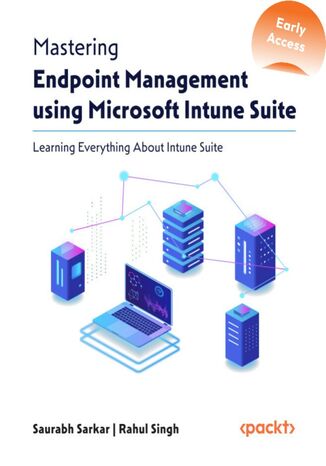
Mastering Endpoint Management using Microsoft Intune Suite is one of the first books focused solely on Microsoft’s premium Intune features, offering hands-on, in-depth coverage for IT admins, security professionals, and endpoint engineers. Co-authored by a Microsoft Intune Product Manager and a Principal Consultant who is also a Microsoft Certified Trainer (MCT), this book walks you through real-world implementation using backend architecture diagrams, registry insights, and troubleshooting techniques.You’ll start with cloud public key infrastructure (PKI), learning how to simplify certificate-based authentication. Then you’ll move on to endpoint privilege management (EPM) to enforce least-privilege access at scale. You will learn about Enterprise App Management, which helps you how to modernize app delivery, as well as Advanced Analytics, which reveals how to use Kusto Query Language (KQL) and Security Copilot for actionable insights. The book also covers Remote Help for secure support and Microsoft Tunnel for enabling BYOD access, and concludes with a curated list of essential Intune learning resources.By the end of this Intune book, you will have the practical expertise to implement, manage, and troubleshoot Intune Suite confidently in real-world enterprise environments.
Pramiti Bhatnagar, Merill Fernando
In the modern way of working, identity is the new front door to the organization’s resources. Organizations must enforce Zero Trust, protect privileged access, secure external collaboration, and manage hybrid environments without increasing risk. Mastering Microsoft Entra ID provides a structured, end-to-end journey to help you design, secure, and govern enterprise identity with confidence.You will begin by building a strong foundation in identity architecture and core capabilities, learning how to deploy tenants, manage users and groups, configure authentication, and implement Conditional Access. From there, you will move into identity governance, where you will automate lifecycle workflows, manage privileged roles with PIM, and enforce least privilege at scale.As your expertise deepens, you will explore identity protection, workload and decentralized identities, and secure external access scenarios. The book then guides you through Global Secure Access, monitoring and health insights, and practical migration strategies to modernize on-premises environments.Written by a Microsoft Entra Principal Product Manager, this guide blends strategic clarity with real-world implementation insight. By the end of this journey, you will be equipped to secure enterprise identities, reduce risk, and confidently lead identity transformation across hybrid and cloud environments.
Andrew Taylor, Lior Bela, Lavanya Lakshman
Microsoft Intune Cookbook, Second Edition, is a hands-on guide for IT administrators managing and supporting modern endpoints, built around the latest Intune capabilities and endpoint security enhancements.Written by Andrew Taylor, an experienced Intune practitioner and active community contributor, it focuses on everyday admin tasks and turns them into clear, repeatable recipes. You’ll start by preparing an Intune tenant and setting up key Entra ID foundations, then work through managing Windows, macOS, iOS, Android, and Linux using practical, proven workflows. Along the way, you’ll configure policies, enroll devices, deploy apps, and strengthen security with compliance, Microsoft Defender integration, encryption, and Conditional Access. You’ll also go beyond the portal by using PowerShell and Microsoft Graph to automate routine work, reduce manual effort, and make changes at scale. Monitoring and reporting are covered so you can track device health, security posture, and deployment outcomes with confidence.Advanced scenarios include secure remote support, privilege elevation, cloud-based certificate management, real-time queries, and AI-assisted guidance to speed up troubleshooting and decision-making. By the end, you’ll have practical techniques you can apply immediately to run a modern, cloud-first Intune environment.
NIST CSF 2.0. Your essential introduction to managing cybersecurity risks
IT Governance Publishing, Andrew Pattison
This comprehensive guide introduces the origins, aims, and components of the NIST Cybersecurity Framework (CSF) 2.0. It explores the core structure including functions, categories, subcategories, and profiles, and provides detailed implementation tiers and examples.Readers are then guided through a deep dive into all six framework categories—from Govern to Recover—and learn how to develop and apply risk management strategies within an organization. The content covers NIST SP 800-53, informative references, and practical quick-start guides to help translate theory into action.The final sections offer a seven-step implementation roadmap, including gap analysis, target profiles, and continuous improvement. The book concludes by mapping the CSF to international standards like ISO 27001 and ISO 22301, offering a well-rounded and interoperable cybersecurity strategy.
Vivek Acharya, Anand Eswararao Yerrapati, Nimesh Prakash
Hyperledger Fabric empowers enterprises to scale out in an unprecedented way, allowing organizations to build and manage blockchain business networks. This quick start guide systematically takes you through distributed ledger technology, blockchain, and Hyperledger Fabric while also helping you understand the significance of Blockchain-as-a-Service (BaaS).The book starts by explaining the blockchain and Hyperledger Fabric architectures. You'll then get to grips with the comprehensive five-step design strategy - explore, engage, experiment, experience, and in?uence. Next, you'll cover permissioned distributed autonomous organizations (pDAOs), along with the equation to quantify a blockchain solution for a given use case. As you progress, you'll learn how to model your blockchain business network by defining its assets, participants, transactions, and permissions with the help of examples. In the concluding chapters, you'll build on your knowledge as you explore Oracle Blockchain Platform (OBP) in depth and learn how to translate network topology on OBP.By the end of this book, you will be well-versed with OBP and have developed the skills required for infrastructure setup, access control, adding chaincode to a business network, and exposing chaincode to a DApp using REST configuration.