
Inne
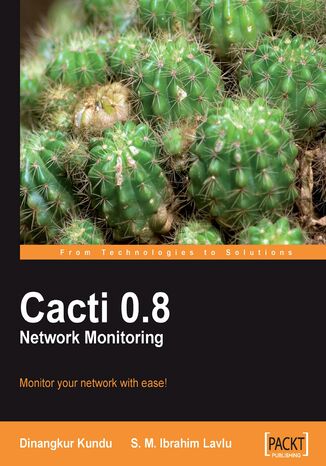
Cacti 0.8 Network Monitoring. Monitor your network with ease!
Dinangkur Kundu, S.M. Ibrahim Lavlu
Cacti is a network monitoring tool that provides graphic solutions to your everyday monitoring issues. It has a wide variety of features and misusing them can mean that you are not monitoring your network as closely as you think. This book takes you through all of the key features of Cacti and shows how to use them for maximum effectiveness.This book will teach you how to use Cacti effectively to monitor your network through its web interface leaving aside all the heavy chunks of code. You will be introduced to all the features of Cacti in an easy-to-understand format. This book introduces Cacti and goes through its complete installation and setup. After a quick look, it will teach you to use Cacti's amazing graph templating and user management features. You will learn to customize graphs and make them better looking and easier to understand. It will teach you to provide the paths to any external script or command using Cacti. Then it will take you through importing and managing new templates and also customizing them. Creating users and assigning permissions to them is the next step in this book. Towards the end, you will learn to take backups and restore the system.
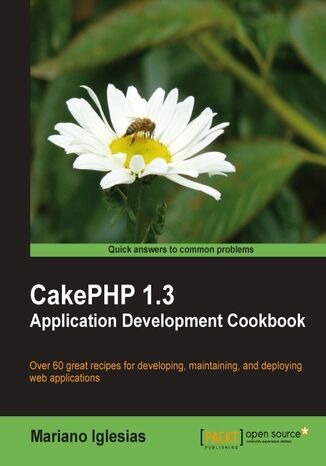
Mariano Iglesias
CakePHP is a rapid development framework for PHP that provides an extensible architecture for developing, maintaining, and deploying web applications. While the framework has a lot of documentation and reference guides available for beginners, developing more sophisticated and scalable applications require a deeper knowledge of CakePHP features, a challenge that proves difficult even for well established developers.The recipes in this cookbook will give you instant results and help you to develop web applications, leveraging the CakePHP features that allow you to build robust and complex applications. Following the recipes in this book you will be able to understand and use these features in no time. We start with setting up authentication on a CakePHP application. One of the most important aspects of a CakePHP application: the relationship between models, also known as model bindings. Model binding is an integral part of any application's logic and we can manipulate it to get the data we need and when we need. We will go through a series of recipes that will show us how to change the way bindings are fetched, what bindings and what information from a binding is returned, how to create new bindings, and how to build hierarchical data structures. We also define our custom find types that will extend the three basic ones, allowing our code to be even more readable and also create our own find type, with pagination support. This book also has recipes that cover two aspects of CakePHP models that are fundamental to most applications: validation, and behaviors.
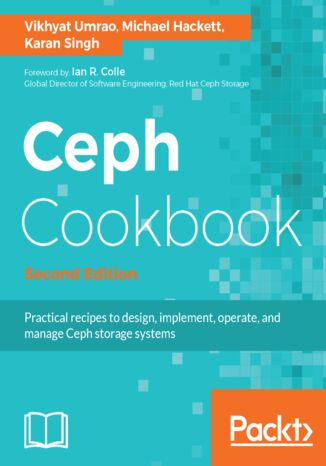
Karan Singh, Michael Hackett, Vikhyat Umrao
Ceph is a unified distributed storage system designed for reliability and scalability. This technology has been transforming the software-defined storage industry and is evolving rapidly as a leader with its wide range of support for popular cloud platforms such as OpenStack, and CloudStack, and also for virtualized platforms. Ceph is backed by Red Hat and has been developed by community of developers which has gained immense traction in recent years. This book will guide you right from the basics of Ceph , such as creating blocks, object storage, and filesystem access, to advanced concepts such as cloud integration solutions. The book will also cover practical and easy to implement recipes on CephFS, RGW, and RBD with respect to the major stable release of Ceph Jewel. Towards the end of the book, recipes based on troubleshooting and best practices will help you get to grips with managing Ceph storage in a production environment. By the end of this book, you will have practical, hands-on experience of using Ceph efficiently for your storage requirements.
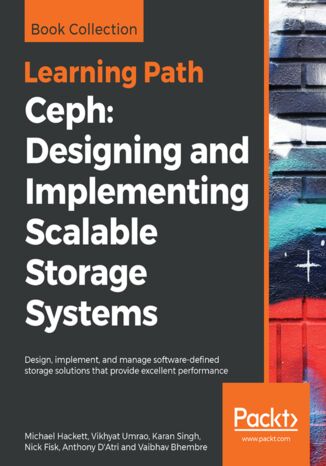
Michael Hackett, Vikhyat Umrao, Karan Singh, Nick...
This Learning Path takes you through the basics of Ceph all the way to gaining in-depth understanding of its advanced features. You’ll gather skills to plan, deploy, and manage your Ceph cluster. After an introduction to the Ceph architecture and its core projects, you’ll be able to set up a Ceph cluster and learn how to monitor its health, improve its performance, and troubleshoot any issues. By following the step-by-step approach of this Learning Path, you’ll learn how Ceph integrates with OpenStack, Glance, Manila, Swift, and Cinder. With knowledge of federated architecture and CephFS, you’ll use Calamari and VSM to monitor the Ceph environment. In the upcoming chapters, you’ll study the key areas of Ceph, including BlueStore, erasure coding, and cache tiering. More specifically, you’ll discover what they can do for your storage system. In the concluding chapters, you will develop applications that use Librados and distributed computations with shared object classes, and see how Ceph and its supporting infrastructure can be optimized. By the end of this Learning Path, you'll have the practical knowledge of operating Ceph in a production environment.This Learning Path includes content from the following Packt products:• Ceph Cookbook by Michael Hackett, Vikhyat Umrao and Karan Singh• Mastering Ceph by Nick Fisk• Learning Ceph, Second Edition by Anthony D'Atri, Vaibhav Bhembre and Karan Singh
Adrian Thompson
ChatGPT for Conversational AI and Chatbots is a definitive resource for exploring conversational AI, ChatGPT, and large language models.This book introduces the fundamentals of ChatGPT and conversational AI automation. You’ll explore the application of ChatGPT in conversation design, the use of ChatGPT as a tool to create conversational experiences, and a range of other practical applications. As you progress, you’ll delve into LangChain, a dynamic framework for LLMs, covering topics such as prompt engineering, chatbot memory, using vector stores, and validating responses. Additionally, you’ll learn about creating and using LLM-enabling tools, monitoring and fine tuning, LangChain UI tools such as LangFlow, and the LangChain ecosystem. You’ll also cover popular use cases, such as using ChatGPT in conjunction with your own data. Later, the book focuses on creating a ChatGPT-powered chatbot that can comprehend and respond to queries directly from your unique data sources. The book then guides you through building chatbot UIs with ChatGPT API and some of the tools and best practices available.By the end of this book, you’ll be able to confidently leverage ChatGPT technologies to build conversational AI solutions.
Nirav Mehta
There are many powerful open source CMSs available to take the pain away from managing a web site. These systems are feature rich, often easy to use, and free. Unfortunately, there are so many choices it's tough to be sure you're choosing the right one. How can you be sure that you are selecting and working with the right tool?This book will guide you through choosing the right CMS for your needs. You can be confident in your choice of CMS for the needs of your project. It will also help you make a start using the CMS, and give you a feel for what it's like to use it ñ even before you install it yourself.Are you bewildered by the many open source CMSs available online? Open source CMSs are the best way to create and manage sophisticated web sites. You can create a site that precisely meets your business goals, and keep the site up to date easily because these systems give you full control over every aspect of your site. Because open source CMSs are free to download, you have a huge amount of choice between the various systems.Yet there are many open source CMSs to choose from, each with unique strengths ñ and occasionally limitations too. Choosing between the bewildering number of options can be tough.Making the wrong choice early on may lead to a lot of wasted work, because you'll have a half-finished site that doesn't meet your initial requirements ñ and needs to be restarted from scratch.This book will show you how to avoid choosing the wrong CMS. It will guide you through assessing your site requirements, and then using that assessment to identify the CMS that will best fit your needs. It contains discussions of the major CMSs, and the issues that you should consider when choosing: their complexity to use, their features and the power they offer. It discusses technical considerations such as programming languages and compliance with best practice standards in a clear, friendly way that non-technical readers can understand.The book also contains quick-start guides and examples for the most popular CMSs such as WordPress, Joomla!, and Drupal, so that you can experiment with these CMSs, get a feel for how they work, and start using them to build your site.After reading this book, you can be confident that your CMS choice will support your web site's needs because you have carefully assessed your requirements and explored the available options.
Bob Janes
Joomla! is a fantastic way to create a dynamic CMS. Now you want to go to the next step and interact with your users. Forms are the way you ask questions and get replies. ChronoForms is the extension that lets you do that and this book tells you how.From building your first form to creating rich form based applications we will cover the features that ChronoForms offers you in a clear hands-on way. Drawing on three years daily experience using ChronoForms and supporting users there is valuable help for new users and experienced developers alike.We will take you through form development step by step: from creating your first form using ChronoForms’ built-in drag-and-drop tool; validating user input; emailing the results; saving data in the database, showing the form in your Joomla! site and much more.Each chapter addresses a topic like ‘validation’ or ‘email’ and the recipes in the chapter each address a different user question from the beginners’ question ‘How do I set up an email?’ through to more advanced questions like using some PHP to create a custom email Subject line.Over eight chapters and eighty recipes we cover all of the ‘Frequently Asked Questions’ that new users and developers have about using ChronoForms. The recipe structure allows you to pick and choose just the solution that you need.
Hemang Doshi, Javen Khoo Ai Wee
Following on from the success of its bestselling predecessor, this third edition of the CISA - Certified Information Systems Auditor Study Guide serves as your go-to resource for acing the CISA exam. Written by renowned CISA expert Hemang Doshi, this guide equips you with practical skills and in-depth knowledge to excel in information systems auditing, setting the foundation for a thriving career.Fully updated to align with the 28th edition of the CISA Official Review Manual, this guide covers the latest exam objectives and provides a deep dive into essential IT auditing areas, including IT governance, systems development, and asset protection. The book follows a structured, three-step approach to solidify your understanding. First, it breaks down the fundamentals with clear, concise explanations. Then, it highlights critical exam-focused points to ensure you concentrate on key areas. Finally, it challenges you with self-assessment questions that reflect the exam format, helping you assess your knowledge.Additionally, you’ll gain access to online resources, including mock exams, interactive flashcards, and invaluable exam tips, ensuring you’re fully prepared for the exam with unlimited practice opportunities.By the end of this guide, you’ll be ready to pass the CISA exam with confidence and advance your career in auditing.