
Bezpieczeństwo sieci
Bezpieczeństwo sieci komputerowych jest aktualnie ważnym, lecz coraz bardziej skomplikowanym zagadnieniem. Książki zebrane w tej kategorii przedstawiają praktycznie wszystkie jego aspekty. Nauczycie się implementacji bezpiecznych połączeń z wykorzystaniem szeregu różnych protokołów sieciowych, a także wykorzystywać protokół SSH do pracy na zdalnych systemach.
Opanujecie ponadto umiejętność konfiguracji tuneli VPN z wykorzystaniem protokołów SSL i IPSec. Dzięki wiedzy zawartej w tym dziale, nauczycie się skutecznie bronić przed włamaniami, atakami DDoS czy działaniom typu IP-spoofing.
Dr. Gerald Auger, Jaclyn "Jax" Scott, Jonathan...
Cybersecurity is an emerging career trend and will continue to become increasingly important. Despite the lucrative pay and significant career growth opportunities, many people are unsure of how to get started.This book is designed by leading industry experts to help you enter the world of cybersecurity with confidence, covering everything from gaining the right certification to tips and tools for finding your first job. The book starts by helping you gain a foundational understanding of cybersecurity, covering cyber law, cyber policy, and frameworks. Next, you’ll focus on how to choose the career field best suited to you from options such as security operations, penetration testing, and risk analysis. The book also guides you through the different certification options as well as the pros and cons of a formal college education versus formal certificate courses. Later, you’ll discover the importance of defining and understanding your brand. Finally, you’ll get up to speed with different career paths and learning opportunities.By the end of this cyber book, you will have gained the knowledge you need to clearly define your career path and develop goals relating to career progression.
Dr. Erdal Ozkaya
The chief information security officer (CISO) is responsible for an organization's information and data security. The CISO's role is challenging as it demands a solid technical foundation as well as effective communication skills. This book is for busy cybersecurity leaders and executives looking to gain deep insights into the domains important for becoming a competent cybersecurity leader.The book begins by introducing you to the CISO's role, where you'll learn key definitions, explore the responsibilities involved, and understand how you can become an efficient CISO. You'll then be taken through end-to-end security operations and compliance standards to help you get to grips with the security landscape. In order to be a good leader, you'll need a good team. This book guides you in building your dream team by familiarizing you with HR management, documentation, and stakeholder onboarding. Despite taking all that care, you might still fall prey to cyber attacks; this book will show you how to quickly respond to an incident to help your organization minimize losses, decrease vulnerabilities, and rebuild services and processes. Finally, you'll explore other key CISO skills that'll help you communicate at both senior and operational levels.By the end of this book, you'll have gained a complete understanding of the CISO's role and be ready to advance your career.
Tim Rains, Jeff Jones
Designing a cybersecurity strategy that actually works is difficult when threats evolve faster than budgets, teams, and tools. This book helps security leaders cut through noise by focusing on how organizations are compromised, which strategies succeed, and how to measure outcomes.Written by Tim Rains, a former Global Chief Security Advisor at Microsoft and senior security leader at AWS and Fortune-scale enterprises, this edition expands on the previous editions with major updates and new chapters. You will learn how threat intelligence, attack-centric security, intrusion kill chains, and MITRE ATT&CK can help defenders design stronger strategies.New and expanded content covers ransomware, API security, “living off the land” attacks, resilience as a cybersecurity strategy, and the security of AI systems alongside practical guidance on using AI to improve security outcomes. This book takes a practical, evidence-based approach to cybersecurity strategy, helping you assess trade-offs, avoid costly missteps, and communicate clearly with executives and boards.By the end of this book, you’ll be able to evaluate cybersecurity strategies more effectively, improve enterprise defenses, and communicate security priorities clearly to executives and boards.
Cybersecurity: The Beginner's Guide. A comprehensive guide to getting started in cybersecurity
Dr. Erdal Ozkaya
It's not a secret that there is a huge talent gap in the cybersecurity industry. Everyone is talking about it including the prestigious Forbes Magazine, Tech Republic, CSO Online, DarkReading, and SC Magazine, among many others. Additionally, Fortune CEO's like Satya Nadella, McAfee's CEO Chris Young, Cisco's CIO Colin Seward along with organizations like ISSA, research firms like Gartner too shine light on it from time to time.This book put together all the possible information with regards to cybersecurity, why you should choose it, the need for cyber security and how can you be part of it and fill the cybersecurity talent gap bit by bit. Starting with the essential understanding of security and its needs, we will move to security domain changes and how artificial intelligence and machine learning are helping to secure systems. Later, this book will walk you through all the skills and tools that everyone who wants to work as security personal need to be aware of. Then, this book will teach readers how to think like an attacker and explore some advanced security methodologies. Lastly, this book will deep dive into how to build practice labs, explore real-world use cases and get acquainted with various cybersecurity certifications.By the end of this book, readers will be well-versed with the security domain and will be capable of making the right choices in the cybersecurity field.
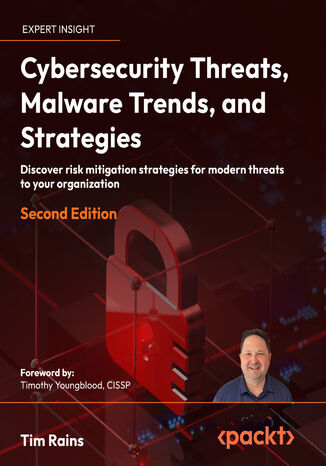
Tim Rains, Timothy Youngblood
Tim Rains is Microsoft's former Global Chief Security Advisor and Amazon Web Services’ former Global Security Leader for Worldwide Public Sector. He has spent the last two decades advising private and public sector organizations all over the world on cybersecurity strategies.Cybersecurity Threats, Malware Trends, and Strategies, Second Edition builds upon the success of the first edition that has helped so many aspiring CISOs, and cybersecurity professionals understand and develop effective data-driven cybersecurity strategies for their organizations. In this edition, you’ll examine long-term trends in vulnerability disclosures and exploitation, regional differences in malware infections and the socio-economic factors that underpin them, and how ransomware evolved from an obscure threat to the most feared threat in cybersecurity. You’ll also gain valuable insights into the roles that governments play in cybersecurity, including their role as threat actors, and how to mitigate government access to data. The book concludes with a deep dive into modern approaches to cybersecurity using the cloud.By the end of this book, you will have a better understanding of the threat landscape, how to recognize good Cyber Threat Intelligence, and how to measure the effectiveness of your organization's cybersecurity strategy.
Cybersecurity w pytaniach i odpowiedziach
Wojciech Ciemski
Co o cyberbezpieczeństwie każdy wiedzieć powinien W świecie, w którym większość naszych mniej lub bardziej wrażliwych danych przechowywana jest w sieci, cyberbezpieczeństwo powinno być tematem numer jeden. Niestety, na ogół nie jest, bo… Po prostu nie chce się nam myśleć o zastosowaniu odpowiednich zabezpieczeń. Stają się one dla nas kluczowe dopiero, kiedy ktoś się cyberwłamie i realnie skradnie coś, co było dla nas istotne: hasło do poczty e-mail, pieniądze z konta w banku, zdjęcia, które wolelibyśmy zachować dla siebie, itd. Tyle że wtedy jest już za późno. Ta książka powstała po to, by jej czytelnik zdążył wyprzedzić zagrożenie. Stanowi wprowadzenie do zagadnienia cyberbezpieczeństwa. Podzielona na kilka kluczowych części (systemy operacyjne, sieci komputerowe, aplikacje webowe, kryptografia, wreszcie cyberbezpieczeństwo jako takie), pozwala zapoznać się z najważniejszymi zagrożeniami i ze sposobami zabezpieczeń. Przybliża terminologię związaną z tematem i stanowi świetny punkt wyjścia do dalszego zgłębiania jego wybranych aspektów. Cyberniebezpieczeństwo czyha. Czy jesteś na nie przygotowany?
Maxim Lapan
Deep Reinforcement Learning Hands-On, Second Edition is an updated and expanded version of the bestselling guide to the very latest reinforcement learning (RL) tools and techniques. It provides you with an introduction to the fundamentals of RL, along with the hands-on ability to code intelligent learning agents to perform a range of practical tasks.With six new chapters devoted to a variety of up-to-the-minute developments in RL, including discrete optimization (solving the Rubik's Cube), multi-agent methods, Microsoft's TextWorld environment, advanced exploration techniques, and more, you will come away from this book with a deep understanding of the latest innovations in this emerging field.In addition, you will gain actionable insights into such topic areas as deep Q-networks, policy gradient methods, continuous control problems, and highly scalable, non-gradient methods. You will also discover how to build a real hardware robot trained with RL for less than $100 and solve the Pong environment in just 30 minutes of training using step-by-step code optimization.In short, Deep Reinforcement Learning Hands-On, Second Edition, is your companion to navigating the exciting complexities of RL as it helps you attain experience and knowledge through real-world examples.
Parth Pandit, Robert Hardt
As Kubernetes (or K8s) becomes more prolific, managing large clusters at scale in a multi-cloud environment becomes more challenging – especially from a developer productivity and operational efficiency point of view. DevSecOps in Practice with VMware Tanzu addresses these challenges by automating the delivery of containerized workloads and controlling multi-cloud Kubernetes operations using Tanzu tools.This comprehensive guide begins with an overview of the VMWare Tanzu platform and discusses its tools for building useful and secure applications using the App Accelerator, Build Service, Catalog service, and API portal. Next, you’ll delve into running those applications efficiently at scale with Tanzu Kubernetes Grid and Tanzu Application Platform. As you advance, you’ll find out how to manage these applications, and control, observe, and connect them using Tanzu Mission Control, Tanzu Observability, and Tanzu Service Mesh. Finally, you’ll explore the architecture, capabilities, features, installation, configuration, implementation, and benefits of these services with the help of examples.By the end of this VMware book, you’ll have gained a thorough understanding of the VMWare Tanzu platform and be able to efficiently articulate and solve real-world business problems.