
Wydawca: Packt Publishing
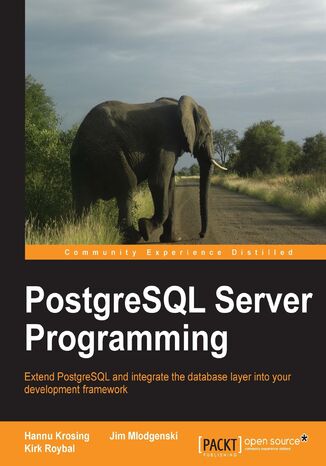
Hannu Krosing, Jim Mlodgenski, Kirk Roybal
Learn how to work with PostgreSQL as if you spent the last decade working on it. PostgreSQL is capable of providing you with all of the options that you have in your favourite development language and then extending that right on to the database server. With this knowledge in hand, you will be able to respond to the current demand for advanced PostgreSQL skills in a lucrative and booming market.PostgreSQL Server Programming will show you that PostgreSQL is so much more than a database server. In fact, it could even be seen as an application development framework, with the added bonuses of transaction support, massive data storage, journaling, recovery and a host of other features that the PostgreSQL engine provides. This book will take you from learning the basic parts of a PostgreSQL function, then writing them in languages other than the built-in PL/PgSQL. You will see how to create libraries of useful code, group them into even more useful components, and distribute them to the community. You will see how to extract data from a multitude of foreign data sources, and then extend PostgreSQL to do it natively. And you can do all of this in a nifty debugging interface that will allow you to do it efficiently and with reliability.
Andrea Pinillos, Tim Weinzapfel
Microsoft Power Apps is ideal for businesses seeking to digitally transform their operations by developing custom applications quickly and efficiently, without the heavy investment required for software development. This book leverages the authors’ combined experience in Power Platform, among others, to lay down the foundation for successful app development, focusing on defining project scope and understanding requirements.In this book, you’ll go through several key development areas, including solution creation and Power Platform environments, both critical areas for effective app development and deployment. You'll also discover best practices for choosing when to build a canvas app or a model-driven app based on project requirements and data connections. The chapters will take you through advanced development techniques and show you how to integrate Power Apps with other applications. You'll get a clear understanding of the key aspects of governance, security, app maintenance, and error handling, ensuring that your Power Apps solutions are not only effective but also secure and sustainable.By the end, you’ll confidently create scalable, secure, and maintainable Power Apps for your business needs.
Power BI for Finance. Design effective dashboards, models, and forecasts for finance teams
Martin Kratky
Martin Kratky brings his global experience of over 20 years as co-founder of Managility and creator of Acterys to empower CFOs and accountants with Power BI for Finance through this hands-on guide to streamlining and enhancing financial processes.Starting with the foundation of every effective BI solution, a well-designed data model, the book shows you how to structure star schemas and integrate common financial data sources like ERP and accounting systems. You’ll then learn to implement key financial logic using DAX and M, covering calendars, KPIs, and variance calculations. The book offers practical advice on creating clear and compliant financial reports, such as income statements, balance sheets, and cash flows with visual design and formatting best practices.With dedicated chapters on advanced workflows, you’ll learn how to handle multi-currency setups, perform group consolidations, and implement planning models like rolling forecasts, annual budgets, and sales and operations planning (S&OP). As you advance, you’ll gain insights from real-world case studies covering company valuations, Excel integration, and the use of write-back methods with Dynamics Business Performance Planning and Acterys. The concluding chapters highlight how AI and Copilot enhance financial analytics.*Email sign-up and proof of purchase required
Greg Beaumont
Microsoft Power BI is the ultimate solution for businesses looking to make data-driven decisions and unlock the full potential of their data. Unleashing Your Data with Power BI Machine Learning and OpenAI is designed for data scientists and BI professionals seeking to improve their existing solutions and workloads using AI. The book explains the intricacies of the subject by using a workshop-style data story for data ingestion, data modeling, analytics, and predictive analytics with Power BI machine learning. Along the way, you’ll learn about AI features, AI visuals, R/Python integration, and OpenAI integration. The workshop-style content allows you to practice all your learnings in real-life challenges and gain hands-on experience. Additionally, you’ll gain an understanding of AI/ML, step by step, with replicable examples and references. From enhancing data visualizations to building SaaS Power BI ML models, and integrating Azure OpenAI, this book will help you unlock new capabilities in Power BI.By the end of this book, you’ll be well-equipped to build ML models in Power BI, plan projects for both BI and ML, understand R/Python visuals with Power BI, and introduce OpenAI to enhance your analytics solutions.
Aaron Guilmette
In this AI era, employing leading machine learning and AI models such as ChatGPT for responding to customer feedback and prototyping applications is crucial to drive business success in the competitive market. This book is an indispensable guide to integrating cutting-edge technology into business operations and leveraging AI to analyze sentiment at scale, helping free up valuable time to enhance customer relationships.Immerse yourself in the future of AI-enabled application development by working with Power Automate, Power Apps, and the new Copilot Studio. With this book, you’ll learn foundational AI concepts as you explore the extensive capabilities of the low-code Power Platform. You’ll see how Microsoft's advanced machine learning technologies can streamline common business tasks such as extracting key data elements from customer documents, reviewing customer emails, and validating passports and drivers’ licenses. The book also guides you in harnessing the power of generative AI to expedite tasks like creating executive summaries, building presentations, and analyzing resumes. You’ll build apps using natural language prompting and see how ChatGPT can be used to power chatbots in your organization.By the end of this book, you’ll have charted your path to developing your own reusable AI automation patterns to propel your business operations into the future.
Andrea Janicijevic
Power Query is a data preparation tool that enables data engineers and business users to connect, reshape, enrich, and transform their data to facilitate relevant business insights and analysis. With Power Query's wide range of features, you can perform no-code transformations and complex M code functions at the same time to get the most out of your data.This Power Query book will help you to connect to data sources, achieve intuitive transformations, and get to grips with preparation practices. Starting with a general overview of Power Query and what it can do, the book advances to cover more complex topics such as M code and performance optimization. You'll learn how to extend these capabilities by gradually stepping away from the Power Query GUI and into the M programming language. Additionally, the book also shows you how to use Power Query Online within Power BI Dataflows.By the end of the book, you'll be able to leverage your source data, understand your data better, and enrich it with a full stack of no-code and custom features that you'll learn to design by yourself for your business requirements.
Philip Brandon Sellers
If you are a virtualization professional who wants to unleash the power of automation and combat the complexity of sprawling virtual environments, this book is ideal for you. This book will enhance your skills of administering VMware vSphere and vCloud Director with PowerCLI.