Verleger: K-i-s-publishing
Daniel Bass
Advanced Serverless Architectures with Microsoft Azure redefines your experience of designing serverless systems. It shows you how to tackle challenges of varying levels, not just the straightforward ones. You'll be learning how to deliver features quickly by building systems, which retain the scalability and benefits of serverless.You'll begin your journey by learning how to build a simple, completely serverless application. Then, you'll build a highly scalable solution using a queue, load messages onto the queue, and read them asynchronously. To boost your knowledge further, the book also features durable functions and ways to use them to solve errors in a complex system. You'll then learn about security by building a security solution from serverless components. Next, you’ll gain an understanding of observability and ways to leverage application insights to bring you performance benefits. As you approach the concluding chapters, you’ll explore chaos engineering and the benefits of resilience, by actively switching off a few of the functions within a complex system, submitting a request, and observing the resulting behavior. By the end of this book, you will have developed the skills you need to build and maintain increasingly complex systems that match evolving platform requirements.
Advanced Splunk. Click here to enter text
Ashish Kumar Tulsiram Yadav
Master the power of Splunk and learn the advanced strategies to get the most out of your machine data with this practical advanced guide. Make sense of the hidden data of your organization – the insight of your servers, devices, logs, traffic and clouds. Advanced Splunk shows you how.Dive deep into Splunk to find the most efficient solution to your data problems. Create the robust Splunk solutions you need to make informed decisions in big data machine analytics. From visualizations to enterprise integration, this well-organized high level guide has everything you need for Splunk mastery.Start with a complete overview of all the new features and advantages of the latest version of Splunk and the Splunk Environment. Go hands on with uploading data, search commands for basic and advanced analytics, advanced visualization techniques, and dashboard customizing. Discover how to tweak Splunk to your needs, and get a complete on Enterprise Integration of Splunk with various analytics and visualization tools. Finally, discover how to set up and use all the new features of the latest version of Splunk.
Peter O'Hanlon
With the demand for ever more complex websites, the need to write robust, standard-compliant JavaScript has never been greater. TypeScript is modern JavaScript with the support of a first-class type system, which makes it simpler to write complex web systems. With this book, you’ll explore core concepts and learn by building a series of websites and TypeScript apps.You’ll start with an introduction to TypeScript features that are often overlooked in other books, before moving on to creating a simple markdown parser. You’ll then explore React and get up to speed with creating a client-side contacts manager. Next, the book will help you discover the Angular framework and use the MEAN stack to create a photo gallery. Later sections will assist you in creating a GraphQL Angular Todo app and then writing a Socket.IO chatroom. The book will also lead you through developing your final Angular project which is a mapping app. As you progress, you’ll gain insights into React with Docker and microservices. You’ll even focus on how to build an image classification program with machine learning using TensorFlow. Finally, you’ll learn to combine TypeScript and C# to create an ASP.NET Core-based music library app.By the end of this book, you’ll be able to confidently use TypeScript 3.0 and different JavaScript frameworks to build high-quality apps.
Jonathon L Wright, Meir Bar-Tal, Jonathon Lee...
John Sotiropoulos
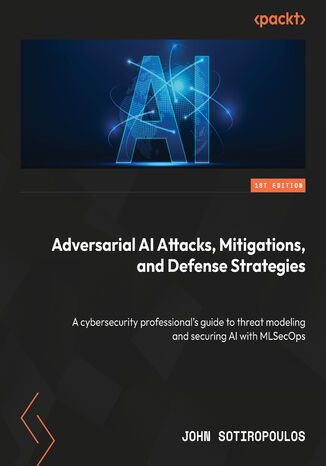
Adversarial attacks trick AI systems with malicious data, creating new security risks by exploiting how AI learns. This challenges cybersecurity as it forces us to defend against a whole new kind of threat. This book demystifies adversarial attacks and equips you with the skills to secure AI technologies. Learn how to defend AI and LLM systems against manipulation and intrusion through adversarial attacks such as poisoning, trojan horses, and model extraction, leveraging DevSecOps, MLOps, and other methods to secure systems.This is a comprehensive guide to AI security, combining structured frameworks with practical examples to help you identify and counter adversarial attacks. Part 1 introduces the foundations of AI and adversarial attacks. Parts 2, 3, and 4 cover key attack types, showing how each is performed and how to defend against them. Part 5 presents secure-by-design AI strategies, including threat modeling, MLSecOps, and guidance aligned with OWASP and NIST. The book concludes with a blueprint for maturing enterprise AI security based on NIST pillars, addressing ethics and safety under Trustworthy AI.By the end of this book, you’ll be able to develop, deploy, and secure AI systems against the threat of adversarial attacks effectively.*Email sign-up and proof of purchase required
Dan Borges
Little has been written about what to do when live hackers are on your system and running amok. Even experienced hackers tend to choke up when they realize the network defender has caught them and is zoning in on their implants in real time. This book will provide tips and tricks all along the kill chain of an attack, showing where hackers can have the upper hand in a live conflict and how defenders can outsmart them in this adversarial game of computer cat and mouse.This audiobook contains two subsections in each chapter, specifically focusing on the offensive and defensive teams. It begins by introducing you to adversarial operations and principles of computer conflict where you will explore the core principles of deception, humanity, economy, and more about human-on-human conflicts. Additionally, you will understand everything from planning to setting up infrastructure and tooling that both sides should have in place.Throughout this audiobook, you will learn how to gain an advantage over opponents by disappearing from what they can detect. You will further understand how to blend in, uncover other actors’ motivations and means, and learn to tamper with them to hinder their ability to detect your presence. Finally, you will learn how to gain an advantage through advanced research and thoughtfully concluding an operation.By the end of this audiobook, you will have achieved a solid understanding of cyberattacks from both an attacker’s and a defender’s perspective.
Adversarial Tradecraft in Cybersecurity. Offense versus defense in real-time computer conflict
Dan Borges
Little has been written about what to do when live hackers are on your system and running amok. Even experienced hackers tend to choke up when they realize the network defender has caught them and is zoning in on their implants in real time. This book will provide tips and tricks all along the kill chain of an attack, showing where hackers can have the upper hand in a live conflict and how defenders can outsmart them in this adversarial game of computer cat and mouse.This book contains two subsections in each chapter, specifically focusing on the offensive and defensive teams. It begins by introducing you to adversarial operations and principles of computer conflict where you will explore the core principles of deception, humanity, economy, and more about human-on-human conflicts. Additionally, you will understand everything from planning to setting up infrastructure and tooling that both sides should have in place.Throughout this book, you will learn how to gain an advantage over opponents by disappearing from what they can detect. You will further understand how to blend in, uncover other actors’ motivations and means, and learn to tamper with them to hinder their ability to detect your presence. Finally, you will learn how to gain an advantage through advanced research and thoughtfully concluding an operation.By the end of this book, you will have achieved a solid understanding of cyberattacks from both an attacker’s and a defender’s perspective.
Dr. Ali Arsanjani, Juan Pablo Bustos, Thomas...
Generative AI has moved beyond the hype, and enterprises now face the challenge of turning prototypes into scalable solutions. This book is your guide to building intelligent agents powered by LLMs.Starting with a GenAI maturity model, you’ll learn how to assess your organization’s readiness and create a roadmap toward agentic AI adoption. You’ll master foundational topics such as model selection and LLM deployment, progressing to advanced methods such as RAG, fine-tuning, in-context learning, and LLMOps, especially in the context of agentic AI. You'll explore a rich library of agentic AI design patterns to address coordination, explainability, fault tolerance, and human-agent interaction. This book introduces a concrete, hierarchical multi-agent architecture where high-level orchestrator agents manage complex business workflows by delegating entire sub-processes to specialized agents. You’ll see how these agents collaborate and communicate using the Agent-to-Agent (A2A) protocol.To ensure your systems are production-ready, we provide a practical framework for observability using life cycle callbacks, giving you the granular traceability needed for debugging, compliance, and cost management. Each pattern is backed by real-world scenarios and code examples using the open source Agent Development Kit (ADK).*Email sign-up and proof of purchase required
Bipin Chadha, Sylvester Juwe
DataRobot enables data science teams to become more efficient and productive. This book helps you to address machine learning (ML) challenges with DataRobot's enterprise platform, enabling you to extract business value from data and rapidly create commercial impact for your organization.You'll begin by learning how to use DataRobot's features to perform data prep and cleansing tasks automatically. The book then covers best practices for building and deploying ML models, along with challenges faced while scaling them to handle complex business problems. Moving on, you'll perform exploratory data analysis (EDA) tasks to prepare your data to build ML models and ways to interpret results. You'll also discover how to analyze the model's predictions and turn them into actionable insights for business users. Next, you'll create model documentation for internal as well as compliance purposes and learn how the model gets deployed as an API. In addition, you'll find out how to operationalize and monitor the model's performance. Finally, you'll work with examples on time series forecasting, NLP, image processing, MLOps, and more using advanced DataRobot capabilities.By the end of this book, you'll have learned to use DataRobot's AutoML and MLOps features to scale ML model building by avoiding repetitive tasks and common errors.
Dr. Bruce Powel Douglass
Agile MBSE can help organizations manage constant change and uncertainty while continuously ensuring system correctness and meeting customers’ needs. But deploying it isn’t easy.Agile Model-Based Systems Engineering Cookbook is a little different from other MBSE books out there. This book focuses on workflows – or recipes, as the author calls them – that will help MBSE practitioners and team leaders address practical situations that are part of deploying MBSE as part of an agile development process across the enterprise.Written by Dr. Bruce Powel Douglass, a world-renowned expert in MBSE, this book will take you through important systems engineering workflows and show you how they can be performed effectively with an agile and model-based approach. You’ll start with the key concepts of agile methods for systems engineering, but we won’t linger on the theory for too long. Each of the recipes will take you through initiating a project, defining stakeholder needs, defining and analyzing system requirements, designing system architecture, performing model-based engineering trade studies, all the way to handling systems specifications off to downstream engineering.By the end of this MBSE book, you’ll have learned how to implement critical systems engineering workflows and create verifiably correct systems engineering models.
Dr. Bruce Powel Douglass, Dr. Christian von...
Agile MBSE can help organizations manage change while ensuring system correctness and meeting customers’ needs. But deployment challenges have changed since our first edition.The Agile Model-Based Systems Engineering Cookbook’s second edition focuses on workflows – or recipes – that will help MBSE practitioners and team leaders address practical situations that are part of deploying MBSE as part of an agile development process across the enterprise. In this 2nd edition, the Cameo MagicDraw Systems Modeler tool – the most popular tool for MBSE – is used in examples (models are downloadable by readers).Written by a world-renowned expert in MBSE, this book will take you through systems engineering workflows in the Cameo Systems Modeler SysML modeling tool and show you how they can be used with an agile and model-based approach. You’ll start with the key concepts of agile methods for systems engineering. Next, each recipe will take you through initiating a project, outlining stakeholder needs, defining and analyzing system requirements, specifying system architecture, performing model-based engineering trade studies, all the way to handling systems specifications off to downstream engineering.By the end of this MBSE book, you’ll learn how to implement systems engineering workflows and create systems engineering models.
Jaibeer Malik
Agile methodologies like Scrum focus on customer values in an incremental way. Regular planning, tracking, reporting, and improving can become equally challenging from a project management perspective. GreenHopper is a tooling support for JIRA that offers easy adoption of agile practices through rich interfaces for effective team collaboration and project management.Agile Project Management with GreenHopper 6 Blueprints is a step-by-step guide that teaches you how to manage agile projects using the GreenHopper tooling system. With easy adoption using pre-sets for Scrum & Kanban, the rich interface focuses on the work at hand, increasing team productivity. Executing sprints, tracking sprints, and reporting on agile projects has never been so easy. The integration with different development environments helps teams to focus on collaboration, communication, and continuous improvement. This book covers agile project management concepts using GreenHopper.You will learn about backlog management for your agile team, how to create projects and boards for your agile team, and how to create new backlog items, prioritize items, estimate backlog items, create sprints, and update technical task status and report on the same.You will learn everything you need to know about managing an agile project using GreenHopper and how to achieve the best value for your team.
Agile Security Operations. Engineering for agility in cyber defense, detection, and response
Hinne Hettema
Agile security operations allow organizations to survive cybersecurity incidents, deliver key insights into the security posture of an organization, and operate security as an integral part of development and operations. It is, deep down, how security has always operated at its best.Agile Security Operations will teach you how to implement and operate an agile security operations model in your organization. The book focuses on the culture, staffing, technology, strategy, and tactical aspects of security operations. You'll learn how to establish and build a team and transform your existing team into one that can execute agile security operations. As you progress through the chapters, you’ll be able to improve your understanding of some of the key concepts of security, align operations with the rest of the business, streamline your operations, learn how to report to senior levels in the organization, and acquire funding.By the end of this Agile book, you'll be ready to start implementing agile security operations, using the book as a handy reference.
Pedro M. Santos, Marco Consolaro, Alessandro Di...
The number of popular technical practices has grown exponentially in the last few years. Learning the common fundamental software development practices can help you become a better programmer. This book uses the term Agile as a wide umbrella and covers Agile principles and practices, as well as most methodologies associated with it. You’ll begin by discovering how driver-navigator, chess clock, and other techniques used in the pair programming approach introduce discipline while writing code. You’ll then learn to safely change the design of your code using refactoring. While learning these techniques, you’ll also explore various best practices to write efficient tests. The concluding chapters of the book delve deep into the SOLID principles - the five design principles that you can use to make your software more understandable, flexible and maintainable. By the end of the book, you will have discovered new ideas for improving your software design skills, the relationship within your team, and the way your business works.
Jeffrey Winesett, Qiang Xue (Project)
This book is a step by step tutorial in developing a real-world application using the incremental and iterative approach to software development. You learn about agile software development by leaning on the agile nature of the Yii application development framework. You touch on each aspect of the software development lifecycle by building a project task management application from concept through production deployment.After a brief, general introduction to the Yii framework and outlining the software development approach taken throughout the book, the chapters break down in the same way as software development iterations do in real-world projects. After the 1st iteration, you will have a working and tested application with a valid, tested connection to a database.In the 2nd and 3rd iterations, we flesh out our main database entities and domain object model and become familiar with Yii's object-relational-mapping (ORM) layer, Active Record. We also learn how to lean on Yii's auto-generation tools to automatically build our create/read/update/delete (CRUD) functionality against our newly created model. These iterations also focus on how Yii's form validation and submission model works. By the end of the third iteration you will have a working application that allows you to mange projects and issues (tasks) within those projects.The 4th and 5th iterations are dedicated to user management. We learn about the built-in authentication model within Yii to assist in application login and logout functionality. We then dive into the authorization model, first taking advantage of a Yii's simple access control model, then implementing the more sophisticated role-based access control (RBAC) framework that Yii provides.By the end of the 5th iteration, all of the basics of a task management application are in place. The next several iterations are focused on the nice-to-haves. We add user comment functionality, introducing a reusable content portlet architecture approach in the process. We add in an RSS Web feed and demonstrate how easy it is to integrate other third-party tools within a Yii application. We take advantage of Yii's theming structure to help streamline and design the application, and then introduce Yii's internationalization (I18N) features so the application can be adapted to various languages and regions without engineering changes.Finally, we turn our focus to production deployment. We introduce ways to optimize performance and security to prepare the application for a real-world production environment.