Wydawca: Rheinwerk Publishing
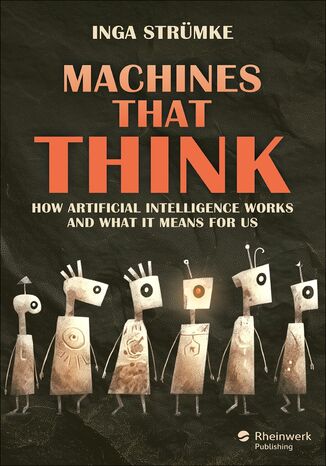
Machines That Think. How Artificial Intelligence Works and What It Means for Us
Rheinwerk Publishing, Inc, Inga Strümke
Machines That Think explores the evolution of artificial intelligence (AI), from its roots in early theoretical frameworks to modern machine learning technologies. It begins by diving into the history of AI, featuring the foundational contributions of pioneers like Alan Turing and John von Neumann. The book then examines the attempts to make machines intelligent, covering symbolic AI, expert systems, and the rise of neural networks. With a focus on the technological advancements that shaped AI, this book provides readers with a deep understanding of how AI systems have evolved over time.The book continues by addressing the growing importance of data in AI systems. It explores how data shapes machine learning models and the inherent challenges faced by data scientists when gathering and processing data for AI applications. The impact of data on model accuracy and the ethical dilemmas surrounding its collection and usage are also discussed. In the final chapters, the book delves into the ethical and societal implications of AI, exploring issues such as privacy, accountability, and the future of AI in everyday life. It speculates on the future of artificial general intelligence (AGI) and superintelligence, contemplating the potential consequences of these technologies.
Node.js. The Comprehensive Guide
Rheinwerk Publishing, Inc, Sebastian Springer
This comprehensive guide begins by introducing the core principles of Node.js, covering installation, environment setup, and modular programming. Readers then build foundational skills by creating their first applications and exploring essential web technologies like HTTP and popular frameworks such as Express and Nest. The journey continues into advanced topics like template engines, database integration, and authentication techniques, equipping readers to build full-featured web applications.As readers progress, the book delves into building RESTful and GraphQL APIs, real-time applications with WebSockets, and writing type-safe Node.js code using TypeScript. Later chapters explore command-line tools, asynchronous programming with Promises and RxJS, streams, and file handling. Comprehensive sections on package management, quality assurance, testing, and security provide practical insights to produce robust, maintainable software.The final chapters focus on deploying scalable applications, performance optimization, microservices architecture, and introduce the emerging Deno runtime. Throughout the book, detailed examples and step-by-step explanations guide readers from fundamental concepts to advanced techniques, making this an essential resource for developers seeking mastery of server-side JavaScript development with Node.js.
PHP and MySQL. The Comprehensive Guide
Rheinwerk Publishing, Inc, Christian Wenz, Tobias Hauser
PHP and MySQL is an essential guide for both beginner and intermediate developers looking to master web development using PHP and MySQL. The book starts with the basics, including installation, syntax, and testing, providing a solid foundation for those new to programming. It then moves on to cover core PHP concepts such as functions, arrays, strings, and object-oriented programming, giving readers a comprehensive understanding of the language.As you progress through the chapters, the book dives deeper into more advanced topics, including working with databases using MySQL, PDO, and other database systems like PostgreSQL, Oracle, and MongoDB. It also explores web technologies such as JavaScript, XML, and APIs, empowering readers to create dynamic, data-driven applications.In the final chapters, the book addresses crucial topics like security, email functionality, session handling, and unit testing with PHPUnit. With practical examples and tips, PHP and MySQL equips developers with the skills needed to build robust web applications, troubleshoot effectively, and contribute to the PHP ecosystem.
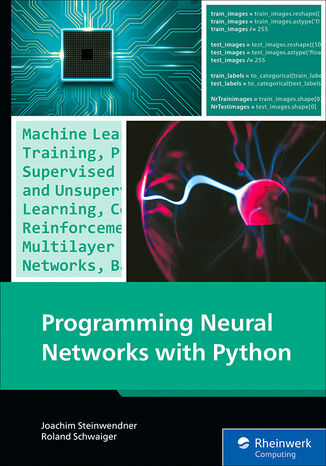
Rheinwerk Publishing, Inc, Dr. Joachim Steinwendner, Dr....
This book offers a comprehensive guide to understanding and programming neural networks and deep learning. Starting with the basics, readers will learn how to build neural networks using Python and TensorFlow. By the end, they’ll master key algorithms and techniques to apply them to real-world machine learning challenges. The book walks through the development of simple perceptrons and progresses to complex multilayer networks, showing how deep learning methods work in practice. The evolution of neural networks is explored, from the origins of artificial neurons to cutting-edge deep learning architectures. Along the way, readers will learn about the different types of neural networks, including convolutional and transformer networks. The book also delves into optimization techniques like gradient descent and backpropagation. Hands-on coding exercises ensure practical learning, preparing readers to implement neural networks for tasks like image recognition, natural language processing, and data classification. By the end of the book, readers will be equipped to apply neural networks to solve diverse AI problems effectively.
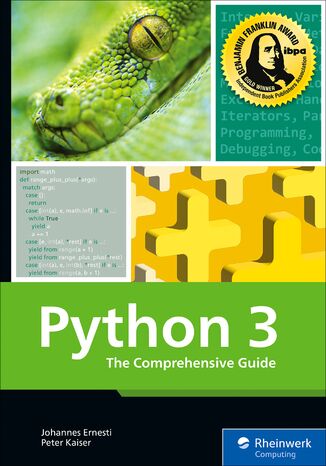
Python 3. The Comprehensive Guide
Rheinwerk Publishing, Inc, Johannes Ernesti, Peter Kaiser
This in-depth guide to Python 3 begins by helping readers install the language and understand its core syntax through interactive exploration. Early chapters cover variables, control structures, functions, and data types like lists, tuples, dictionaries, and sets. Readers then move into file handling, error management, and object-oriented programming, building a solid foundation for real-world development.As the journey continues, the book introduces advanced concepts including decorators, generators, type hints, structural pattern matching, and context managers. It thoroughly explores the Python standard library, with practical applications in math, file systems, logging, regular expressions, parallel processing, and debugging. Readers also learn how to manage packages, virtual environments, and distributions.Later chapters shift to applied development—building GUIs with tkinter and PySide6, creating web applications with Django, and working with scientific tools like NumPy, pandas, and SciPy. The book concludes with insights on using alternative interpreters, localization, and migrating from Python 2 to 3. This resource grows with the reader, from basics to expert-level Python programming.
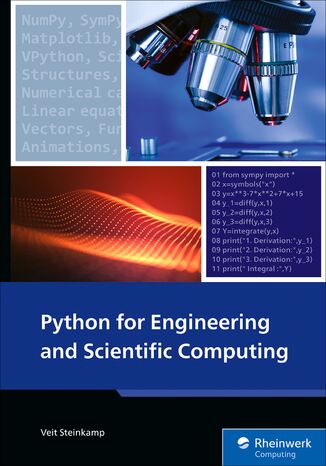
Rheinwerk Publishing, Inc, Veit Steinkamp
This book provides a thorough introduction to Python programming designed for engineers and scientists. It begins with foundational topics like development environments and program structures, then introduces key Python libraries such as NumPy, SymPy, SciPy, Matplotlib, and VPython. Clear explanations and practical exercises help readers write efficient, well-structured code while progressing through increasingly complex projects.The content covers core programming paradigms including functions, branching, and object-oriented design, followed by numerical analysis with NumPy and symbolic math with SymPy. Detailed chapters on data visualization with Matplotlib and 3D animations with VPython enhance comprehension. Additional focus on statistical computations, Boolean algebra, and interactive GUI programming with Tkinter prepares readers for real-world applications. Each chapter ends with project tasks reinforcing hands-on learning.Throughout the book, readers build a strong skill set combining programming expertise and scientific problem-solving. By the end, they will confidently use Python’s libraries to solve diverse engineering and scientific challenges. This practical, project-based approach ensures knowledge is both solid and immediately useful in research and professional work.
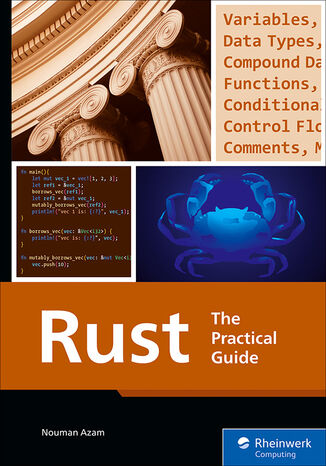
Rheinwerk Publishing, Inc, Nouman Azam
This book begins by introducing the core concepts of Rust programming, starting with installation, writing basic programs, and understanding variables, data types, and functions. It covers Rust’s unique ownership system, which is central to the language, explaining how borrowing and memory management work to ensure safety and efficiency. Basic control flow concepts like conditionals and loops are also explored, providing a solid foundation for beginners.As the book progresses, more advanced topics are introduced, such as structs, enums, and collections, which allow for the creation of flexible and efficient data structures. Rust’s powerful memory management features, including smart pointers, lifetimes, and borrowing, are discussed in detail. Readers will also dive into functional programming aspects like closures, iterators, and function pointers, which enhance the flexibility and expressiveness of Rust code.The final chapters focus on concurrency and advanced topics such as macros and web programming. Readers will learn how to handle multithreading in Rust, work with asynchronous programming, and build web servers. Practical problems at the end help reinforce the concepts learned, providing readers with the tools to solve real-world challenges efficiently using Rust.
Scripting. Automation with Bash, PowerShell, and Python
Rheinwerk Publishing, Inc, Michael Kofler
This comprehensive scripting guide empowers system administrators, developers, and power users to automate repetitive IT tasks across platforms using three major scripting languages: Bash, PowerShell, and Python. The book opens with foundational scripting concepts and showcases what you can accomplish with just ten lines of code. It continues with in-depth chapters on each language, emphasizing syntax, control structures, error handling, and modularity.Readers will explore practical techniques for managing files, parsing text, utilizing regular expressions, and working with JSON, XML, and INI formats. The book dives into job automation with cron and Task Scheduler, secure communication via SSH, and scripting in professional environments with tools like Visual Studio Code and Git.The final section applies scripting to real-world cases, including system backups, image processing, web scraping, API consumption, database interactions, cloud integration, and virtual machine automation. With this book, readers build a strong scripting toolkit to efficiently manage modern IT workflows.