
Programowanie
Antonio Gulli, Dr. Amita Kapoor, Sujit Pal
Deep Learning with TensorFlow 2 and Keras, Second Edition teaches neural networks and deep learning techniques alongside TensorFlow (TF) and Keras. You’ll learn how to write deep learning applications in the most powerful, popular, and scalable machine learning stack available.TensorFlow is the machine learning library of choice for professional applications, while Keras offers a simple and powerful Python API for accessing TensorFlow. TensorFlow 2 provides full Keras integration, making advanced machine learning easier and more convenient than ever before.This book also introduces neural networks with TensorFlow, runs through the main applications (regression, ConvNets (CNNs), GANs, RNNs, NLP), covers two working example apps, and then dives into TF in production, TF mobile, and using TensorFlow with AutoML.
Deep Learning with Theano. Perform large-scale numerical and scientific computations efficiently
Christopher Bourez
This book offers a complete overview of Deep Learning with Theano, a Python-based library that makes optimizing numerical expressions and deep learning models easy on CPU or GPU.The book provides some practical code examples that help the beginner understand how easy it is to build complex neural networks, while more experimented data scientists will appreciate the reach of the book, addressing supervised and unsupervised learning, generative models, reinforcement learning in the fields of image recognition, natural language processing, or game strategy.The book also discusses image recognition tasks that range from simple digit recognition, image classification, object localization, image segmentation, to image captioning. Natural language processing examples include text generation, chatbots, machine translation, and question answering. The last example deals with generating random data that looks real and solving games such as in the Open-AI gym. At the end, this book sums up the best -performing nets for each task. While early research results were based on deep stacks of neural layers, in particular, convolutional layers, the book presents the principles that improved the efficiency of these architectures, in order to help the reader build new custom nets.
Maxim Lapan
Start your journey into reinforcement learning (RL) and reward yourself with the third edition of Deep Reinforcement Learning Hands-On. This book takes you through the basics of RL to more advanced concepts with the help of various applications, including game playing, discrete optimization, stock trading, and web browser navigation. By walking you through landmark research papers in the field, this deep RL book will equip you with practical knowledge of RL and the theoretical foundation to understand and implement most modern RL papers. The book retains its approach of providing concise and easy-to-follow explanations from the previous editions. You'll work through practical and diverse examples, from grid environments and games to stock trading and RL agents in web environments, to give you a well-rounded understanding of RL, its capabilities, and its use cases. You'll learn about key topics, such as deep Q-networks (DQNs), policy gradient methods, continuous control problems, and highly scalable, non-gradient methods. If you want to learn about RL through a practical approach using OpenAI Gym and PyTorch, concise explanations, and the incremental development of topics, then Deep Reinforcement Learning Hands-On, Third Edition, is your ideal companion*Email sign-up and proof of purchase required
Maxim Lapan
Deep Reinforcement Learning Hands-On, Second Edition is an updated and expanded version of the bestselling guide to the very latest reinforcement learning (RL) tools and techniques. It provides you with an introduction to the fundamentals of RL, along with the hands-on ability to code intelligent learning agents to perform a range of practical tasks.With six new chapters devoted to a variety of up-to-the-minute developments in RL, including discrete optimization (solving the Rubik's Cube), multi-agent methods, Microsoft's TextWorld environment, advanced exploration techniques, and more, you will come away from this book with a deep understanding of the latest innovations in this emerging field.In addition, you will gain actionable insights into such topic areas as deep Q-networks, policy gradient methods, continuous control problems, and highly scalable, non-gradient methods. You will also discover how to build a real hardware robot trained with RL for less than $100 and solve the Pong environment in just 30 minutes of training using step-by-step code optimization.In short, Deep Reinforcement Learning Hands-On, Second Edition, is your companion to navigating the exciting complexities of RL as it helps you attain experience and knowledge through real-world examples.
Maxim Lapan
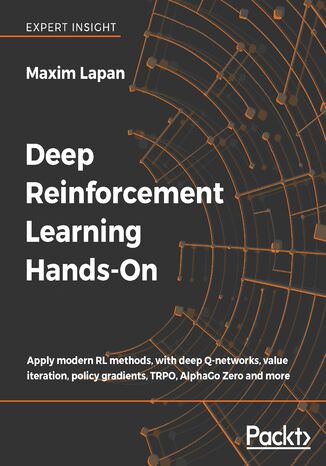
Deep Reinforcement Learning Hands-On is a comprehensive guide to the very latest DL tools and their limitations. You will evaluate methods including Cross-entropy and policy gradients, before applying them to real-world environments. Take on both the Atari set of virtual games and family favorites such as Connect4.The book provides an introduction to the basics of RL, giving you the know-how to code intelligent learning agents to take on a formidable array of practical tasks. Discover how to implement Q-learning on 'grid world' environments, teach your agent to buy and trade stocks, and find out how natural language models are driving the boom in chatbots.
Sudharsan Ravichandiran
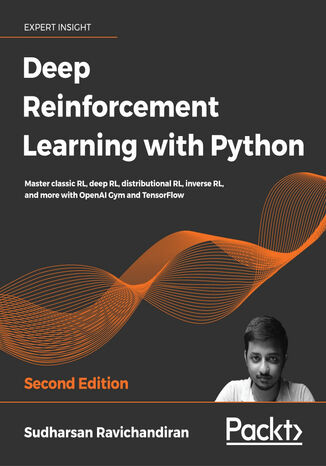
With significant enhancements in the quality and quantity of algorithms in recent years, this second edition of Hands-On Reinforcement Learning with Python has been revamped into an example-rich guide to learning state-of-the-art reinforcement learning (RL) and deep RL algorithms with TensorFlow 2 and the OpenAI Gym toolkit.In addition to exploring RL basics and foundational concepts such as Bellman equation, Markov decision processes, and dynamic programming algorithms, this second edition dives deep into the full spectrum of value-based, policy-based, and actor-critic RL methods. It explores state-of-the-art algorithms such as DQN, TRPO, PPO and ACKTR, DDPG, TD3, and SAC in depth, demystifying the underlying math and demonstrating implementations through simple code examples.The book has several new chapters dedicated to new RL techniques, including distributional RL, imitation learning, inverse RL, and meta RL. You will learn to leverage stable baselines, an improvement of OpenAI’s baseline library, to effortlessly implement popular RL algorithms. The book concludes with an overview of promising approaches such as meta-learning and imagination augmented agents in research.By the end, you will become skilled in effectively employing RL and deep RL in your real-world projects.
Delphi 2007 dla WIN32 i bazy danych
Marian Wybrańczyk
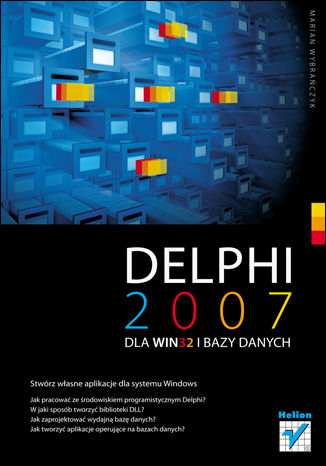
Stwórz własne aplikacje dla systemu Windows Jak pracować ze środowiskiem programistycznym Delphi? W jaki sposób tworzyć biblioteki DLL? Jak zaprojektować wydajną bazę danych? Jak tworzyć aplikacje operujące na bazach danych? Wśród wszystkich środowisk programistycznych umożliwiających tworzenie aplikacji Delphi jest jednym z najbardziej znanych i popularnych. To narzędzie, obecne na rynku od ponad dwunastu lat, cieszy się zasłużonym uznaniem twórców oprogramowania -- dzięki sporym możliwościom, ogromnej bibliotece komponentów i czytelnej składni języka Object Pascal, będącego podstawą tego środowiska. Najnowsza wersja Delphi, oznaczona symbolem RAD Studio 2007, nie tylko umożliwia tworzenie "klasycznych" aplikacji dla Windows, opartych o Windows API, ale także udostępnia kontrolki platformy .NET. Książka "Delphi 2007 dla WIN32 i bazy danych" to podręcznik opisujący zasady tworzenia aplikacji dla systemu Windows w najnowszej wersji Delphi. Przedstawia ona techniki tworzenia aplikacji bazodanowych w oparciu o mechanizmy Windows API i kontrolki VCL. Czytając ją, poznasz komponenty, jakie Delphi oferuje programiście, i dowiesz się, jak korzystać z nich we własnych aplikacjach. Opanujesz mechanizmy komunikacji z niemal wszystkimi systemami zarządzania bazami danych dostępnymi na rynku. Przeczytasz także o tworzeniu wersji instalacyjnych napisanych przez siebie aplikacji. Interfejs użytkownika Delphi 2007 Komponenty dostępne w Delphi Przetwarzanie grafiki Korzystanie z komponentów VCL Aplikacje wielowątkowe Tworzenie bibliotek DLL Operacje na plikach Obsługa dokumentów XML Projektowanie bazy danych i struktury tabel Komunikacja z bazami danych Mechanizmy blokowania rekordów Tworzenie wersji instalacyjnych aplikacji Wykorzystaj możliwości najnowszej wersji środowiska programistycznego, które zrewolucjonizowało proces tworzenia aplikacji!
Daniele Teti
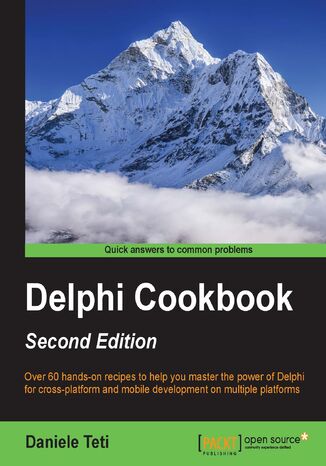
Delphi is a cross-platform Integrated Development Environment (IDE) that supports rapid application development for Microsoft Windows, Apple Mac OS X, Google Android, and Apple iOS. It helps you to concentrate on the real business and save yourself the pain of wandering amid GUI widget details, or having to tackle inter-platform incompatibilities. It also has a wide range of drag-and-drop controls, helping you code your business logic into your business model, and it compiles natively for desktop and mobile platforms.This book will teach you how to design and develop applications, deploy them on the cloud platform, and distribute them within an organization via Google Play and other similar platforms.You will begin with the basics of Delphi and get acquainted with JSON format strings, XSLT transformations, unicode encodings and various types of streams. We then move on to more advanced topics such as developing higher-order functions and using enumerators and RTTI. You will get an understanding of how Delphi RTL functions and how to use FireMonkey in a VCL application. We will then cover topics such as multithreading, using the parallel programming library and putting Delphi on a server. We will also take a look at the new feature of WebBroker Apache modules and then ride the mobile revolution with FireMonkey. By the end of the book, you will be able to develop and deploy cross-platform applications using Delphi .