
Programowanie
Alex Antonov
Spring Boot is Spring's convention-over-configuration solution. This feature makes it easy to create Spring applications and services with absolute minimum fuss. Spring Boot has the great ability to be customized and enhanced, and is specifically designed to simplify development of a new Spring application.This book will provide many detailed insights about the inner workings of Spring Boot, as well as tips and recipes to integrate the third-party frameworks and components needed to build complex enterprise-scale applications.The book starts with an overview of the important and useful Spring Boot starters that are included in the framework, and teaches you to create and add custom Servlet Filters, Interceptors, Converters, Formatters, and PropertyEditors to a Spring Boot web application. Next it will cover configuring custom routing rules and patterns, adding additional static asset paths, and adding and modifying servlet container connectors and other properties such as enabling SSL.Moving on, the book will teach you how to create custom Spring Boot Starters, and explore different techniques to test Spring Boot applications. Next, the book will show you examples of configuring your build to produce Docker images and self-executing binary files for Linux/OSX environments.Finally, the book will teach you how to create custom health indicators, and access monitoring data via HTTP and JMX.
Ravi Kant Soni, Rajesh R V, Amuthan...
This carefully designed course aims to get you started with Spring, the most widely adopted Java framework, and then goes on to more advanced topics such as building microservices using Spring Boot within Spring. With additional coverage of popular web frameworks such as Struts, WebWork, Java Server Faces, Tapestry, Docker, and Mesos, you'll have all the skills and expertise you need to build great applications. Starting with the Spring Framework architecture and setting up the key components of the Spring Application Development Environment, you will learn how to configure Spring Container and manage Spring beans using XML and Annotation. Next, you will delve into Spring MVC, which will help you build flexible and loosely coupled web applications. You'll also get to grips with testing applications for reliability. Moving on, this course will help you implement the microservice architecture in Spring Framework, Spring Boot, and Spring Cloud. Written to the latest specifications of Spring, this book will help you build modern, Internet-scale Java applications in no time.This Learning Path combines some of the best that Packt has to offer in one complete, curated package. It includes content from the following Packt products:? Learning Spring Application Development by Ravi Kant Soni? Spring MVC Beginner's Guide - Second Edition by Amuthan Ganeshan? Spring Microservices by Rajesh RV
Shameer Kunjumohamed, Hamidreza Sattari
Spring is an open source Java application development framework to build and deploy systems and applications that run on the JVM. It is the industry standard and the most popular framework among Java developers with over two-thirds of developers using it.Spring Essentials makes learning Spring so much quicker and easier with the help of illustrations and practical examples. Starting from the core concepts of features such as inversion of Control Container and BeanFactory, we move on to a detailed look at aspect-oriented programming. We cover the breadth and depth of Spring MVC, the WebSocket technology, Spring Data, and Spring Security with various authentication and authorization mechanisms. Packed with real-world examples, you’ll get an insight into utilizing the power of Spring Expression Language in your applications for higher maintainability. You’ll also develop full-duplex real-time communication channels using WebSocket and integrate Spring with web technologies such as JSF, Struts 2, and Tapestry. At the tail end, you will build a modern SPA using EmberJS at the front end and a Spring MVC-based API at the back end.By the end of the book, you will be able to develop your own dull-fledged applications with Spring.
Spring Microservices. Internet-scale architecture with Spring framework, Spring Cloud, Spring Boot
Rajesh R V
The Spring Framework is an application framework and inversion of the control container for the Java platform. The framework's core features can be used by any Java application, but there are extensions to build web applications on top of the Java EE platform. This book will help you implement the microservice architecture in Spring Framework, Spring Boot, and Spring Cloud. Written to the latest specifications of Spring, you'll be able to build modern, Internet-scale Java applications in no time.We would start off with the guidelines to implement responsive microservices at scale. We will then deep dive into Spring Boot, Spring Cloud, Docker, Mesos, and Marathon. Next you will understand how Spring Boot is used to deploy autonomous services, server-less by removing the need to have a heavy-weight application server. Later you will learn how to go further by deploying your microservices to Docker and manage it with Mesos. By the end of the book, you'll will gain more clarity on how to implement microservices using Spring Framework and use them in Internet-scale deployments through real-world examples.
Spring: Microservices with Spring Boot. Build and deploy microservices with Spring Boot
Ranga Rao Karanam
Microservices helps in decomposing applications into small services and move away from a single monolithic artifact. It helps in building systems that are scalable, flexible, and high resilient. Spring Boot helps in building REST-oriented, production-grade microservices. This book is a quick learning guide on how to build, monitor, and deploy microservices with Spring Boot. You'll be first familiarized with Spring Boot before delving into building microservices. You will learn how to document your microservice with the help of Spring REST docs and Swagger documentation. You will then learn how to secure your microservice with Spring Security and OAuth2. You will deploy your app using a self-contained HTTP server and also learn to monitor a microservice with the help of Spring Boot actuator. This book is ideal for Java developers who knows the basics of Spring programming and want to build microservices with Spring Boot.This book is embedded with useful assessments that will help you revise the concepts you have learned in this book. This book is repurposed for this specific learning experience from material from Packt's Mastering Spring 5.0 by Ranga Rao Karanam.
Spring MVC 4. Projektowanie zaawansowanych aplikacji WWW
Geoffroy Warin
Wszyscy jesteśmy świadkami dynamicznego rozwoju branży aplikacji internetowych. Projektanci i programiści muszą jeszcze szybciej tworzyć coraz doskonalsze i atrakcyjniejsze aplikacje, a następnie błyskawicznie udostępniać je użytkownikom, przy dość ograniczonym budżecie. Platforma Spring Boot i środowiska chmurowe pozwalają sprostać tym wymaganiom: niezwykłe aplikacje można tworzyć i przekazywać w rekordowym tempie, w dodatku wyposażone w tak istotne funkcjonalności jak internacjonalizacja, sesje rozproszone, logowanie społecznościowe, wielowątkowość i wiele innych. Jeśli programujesz w Javie, choć trochę znasz platformę Spring i chcesz tworzyć użyteczne oraz nowoczesne aplikacje WWW, masz w ręku właściwą książkę. Ten podręcznik w niezwykle praktyczny sposób podchodzi do zagadnienia budowy skomplikowanych aplikacji z wykorzystaniem nowoczesnych technologii. Podczas lektury poszczególnych rozdziałów będziesz mógł od podstaw przyjrzeć się konstruowaniu w pełni działającej aplikacji WWW, a potem spróbować własnych sił w tej dziedzinie, z wykorzystaniem internacjonalizacji, weryfikacji formularzy oraz obsługi rozproszonych sesji i pamięci podręcznej. Dowiesz się również, jak porządnie przetestować aplikację i opublikować ją w internecie. W tej książce znajdziesz: praktyczne omówienie platformy Spring Boot i Spring Tool Suite wyjaśnienie implementacji architektury MVC wskazówki dotyczące projektowania zaawansowanych formularzy, weryfikacji typów danych wprowadzanych przez użytkownika i obsługi błędów zasady działania aplikacji REST i wykorzystywania zapytań HTTP wyczerpujące omówienie zagadnień bezpieczeństwa aplikacji opis dobrych praktyk, takich jak testy jednostkowe i testy akceptacji, optymalizacja zapytań, metody zarządzania pamięcią podręczną Programuj jak mistrz — odkryj Spring MVC! Geoffroy Warin — programuje od dziecka. Jest gorącym orędownikiem tworzenia otwartego kodu. Niezachwianie wierzy w ideę Software Craftsmanship (osiągania mistrzostwa w programowaniu). Jest uznanym specjalistą w dziedzinie budowania biznesowych aplikacji WWW w języku Java i entuzjastą platform Groovy oraz Spring. Po godzinach prowadzi bloga, jest szkoleniowcem i autorem oraz współautorem książek.
Amuthan Ganeshan
Spring MVC helps you build flexible and loosely coupled web applications. The Spring MVC Framework is architected and designed in such a way that every piece of logic and functionality is highly configurable. Also, Spring can integrate effortlessly with other popular web frameworks such as Struts, WebWork, Java Server Faces, and Tapestry. The book progressively teaches you to configure the Spring development environment, architecture, controllers, libraries, and more before moving on to developing a full web application. It begins with an introduction to the Spring development environment and architecture so you're familiar with the know-hows. From here, we move on to controllers, views, validations, Spring Tag libraries, and more. Finally, we integrate it all together to develop a web application. You'll also get to grips with testing applications for reliability.
Sherwin John C. Tragura
Spring MVC is the ideal tool to build modern web applications on the server side. With the arrival of Spring Boot, developers can really focus on the code and deliver great value, leveraging the rich Spring ecosystem with minimal configuration.Spring makes it simple to create RESTful applications, interact with social services, communicate with modern databases, secure your system, and make your code modular and easy to test. It is also easy to deploy the result on different cloud providers.This book starts all the necessary topics in starting a Spring MVC-based application. Moving ahead it explains how to design model objects to handle file objects. save files into a data store and how Spring MVC behaves when an application deals with uploading and downloading files. Further it highlights form transactions and the user of Validation Framework as the tool in validating data input. It shows how to create a customer feedback system which does not require a username or password to log in. It will show you the soft side of Spring MVC where layout and presentation are given importance. Later it will discuss how to use Spring Web Flow on top of Spring MVC to create better web applications. Moving ahead, it will teach you how create an Invoice Module that receives and transport data using Web ServicesBy the end of the book you will be able to create efficient and flexible real-time web applications using all the frameworks in Spring MVC.
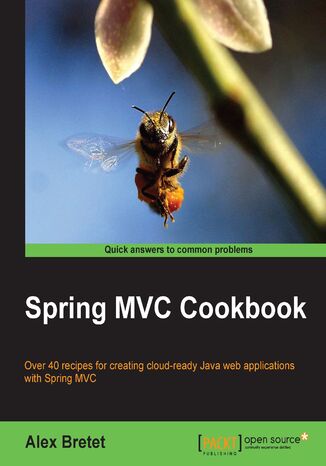
Spring MVC Cookbook. Over 40 recipes for creating cloud-ready Java web applications with Spring MVC
Alex Bretet
Spring MVC is a lightweight application framework that comes with a great configuration by default. Being part of the Spring Framework, it naturally extended and supported it with an amazing set of recognizable annotations. External libraries can be plugged in and plugged out. It also possesses a request flow.Complete support of REST web services makes the Spring architecture an extremely consistent choice to support your front-end needs and Internet transformations.From the design of your Maven modules, you will achieve an Enterprise-standard for a stateless REST application based on Spring and Spring MVC with this book.This guide is unique in its style as it features a massive overview of practical development techniques brought together from the Spring ecosystem, the new JEE standards, the JavaScript revolution and Internet of Things.You will begin with the very first steps of Spring MVC's product design. Focused on deployment, viability, and maintainability, you will learn the use of Eclipse, Maven, and Git. You will walk through the separation of concerns driven by the microservices principles. Using Bootstrap and AngularJS, you will develop a responsive front-end, capable of interacting autonomously with a REST API.Later in the book, you will setup the Java Persistence API (JPA) within Spring; learn how to configure your Entities to reflect your domain needs, and discover Spring Data repositories. You will analyze how Spring MVC responds to complex HTTP requests. You will implement Hypermedia and HATEOAS to guide your customer's stateless conversation with the product and see how a messaging-service based on WebSocket can be configured. Finally you will learn how to set up and organize different levels of automated-tests, including logging and monitoring.
Spring MVC: Designing Real-World Web Applications. Click here to enter text
Alex Bretet, Shameer Kunjumohamed, Geoffroy Warin, Hamidreza...
Spring MVC helps you build flexible and loosely coupled web applications. The Spring MVC Framework is designed in such a way that every piece of logic and functionality is highly configurable. This Learning Path aims to make you an expert in designing web applications with Spring MVC 4.In our first module, we’ll begin with an introduction to the Spring framework. You'll then learn aspect-oriented programming. Packed with real-world examples, you’ll get an insight into how you can use Spring Expression Language in your applications to make them easier to manage and maintain.In the second module, you'll learn everything you need to build modern Spring-based enterprise web applications. From practical development techniques and useful tools from the wider Spring ecosystem, to the new JEE standards, the impact of JavaScript, and even the Internet of Things, you'll feel confident that you can deploy Spring for an impressive range of creative purposes. In the final module, you'll find out how to take advantage of Spring MVC's advanced features - essential if you are to properly master the framework. To do this you'll investigate the inner mechanics of Spring MVC, and how they tie into to the broader principles that inform many modern web architectures. With further guidance on how to test, secure, and optimize your application, as well as designing RESTful services, you'll very quickly be ready to use Spring in your next web project.This Learning Path combines some of the best that Packt has to offer in one complete, curated package. It includes content from the following Packt products:• Spring Essentials by Shameer Kunjumohamed, Hamidreza Sattari• Spring MVC Cookbook by Alex Bretet• Mastering Spring MVC 4 by Geoffroy Warin
Spring MVC. Przewodnik dla początkujących
Amuthan G
Wykorzystaj możliwości Spring MVC! Nauka przez praktykę, mniej teorii, więcej ćwiczeń Spring MVC to szkielet dostarczający architekturę model-widok-kontroler (ang. Model View Controller). Z jego pomocą można zbudować wiele zaawansowanych aplikacji internetowych oraz REST-owe API. Spring MVC zapewnia niezwykłą elastyczność oraz gwarantuje programistom wygodę. To leży u podstaw jego ogromnej popularności. Wokół tego szkieletu powstała też duża społeczność, zawsze chętna do udzielania pomocy. Jeżeli chcesz poznać możliwości Spring MVC i zbudować z nim Twoją pierwszą aplikację, nie mogłeś trafić lepiej. Ta książka wprowadzi Cię w najważniejsze zagadnienia oraz w niezwykle przejrzysty sposób przedstawi dostępne możliwości. Na samym początku zainstalujesz środowisko JDK oraz przydatne narzędzia, takie jak Maven i Spring Tool Suite. Budowana tu przykładowa aplikacja to sklep internetowy działający na serwerze Apache Tomcat. Z kolejnych rozdziałów nauczysz się, jak korzystać z kontrolerów, bibliotek znaczników oraz walidatorów. Książka ta jest obowiązkową lekturą dla wszystkich początkujących użytkowników Spring MVC. Dzięki tej książce: Zapoznasz się ze strukturą środowiska programistycznego Springa. Poznasz architekturę aplikacji internetowej oraz przepływ żądania w Spring MVC. Zintegrujesz walidację beanów z niestandardową walidacją. Nauczysz się obsługiwać błędy oraz wyjątki. Zaznajomisz się z implementacją RESTowych usług internetowych oraz Ajaxem. Utworzysz testy dla aplikacji. Dowiesz się, jak zastosować szkielety Tiles oraz Web Flow w Twojej aplikacji MVC.
Gary Mak, Daniel Rubio, Josh Long
Najlepsze receptury na wykorzystanie Springa! Spring zadebiutował na rynku w 2004 roku, osiem lat po opublikowaniu pierwszej wersji języka Java i od tego czasu jest dynamicznie rozwijany. Dzięki licznym modułom pozwala on błyskawicznie tworzyć skomplikowane aplikacje i wyręcza programistów w trudzie ustawiania typowych konfiguracji. Jeżeli do tego dołożyć ogromną społecznoć i świetną dokumentację, to nie ma się co dziwić, że jest tak popularny! Jeżeli wykorzystujesz Springa w swojej codziennej pracy lub chcesz wypróbować jego możliwoci, to trafiłe na doskonałą książkę. Należy ona do cenionej wśród programistów serii Receptury. Znajdziesz w niej omówienie zarówno podstawowych zagadnień związanych ze Springiem, jak i tych zaawansowanych. Na samym początku poznasz kontener IoC (ang. Inversion of Control), nauczysz się tworzyć ziarna oraz wstrzykiwać je na różne sposoby. W kolejnych rozdziałach odkryjesz, jak korzystać z AspectJ, Spring WebFlow oraz Spring-WS. Ponadto zobaczysz, jak używać REST, testów jednostkowych i integracyjnych oraz ORM. Spring wspiera te i wiele innych obszarów codziennej pracy programisty. Książka ta jest doskonałym omówieniem Springa na podstawie przykładów jego zastosowań. Dzięki tej książce: stworzysz kontener IoC skonstruujesz ziarna i wstrzykniesz je poznasz dostępne moduły przygotujesz usługi sieciowe i skorzystasz z tych usług Wykorzystaj potencjał Springa i zoptymalizuj swoją pracę!
Badr Nasslahsen
With experienced hackers constantly targeting apps, properly securing them becomes challenging when you integrate this factor with legacy code, new technologies, and other frameworks. Written by a Lead Cloud and Security Architect as well as CISSP, this book helps you easily secure your Java apps with Spring Security, a trusted and highly customizable authentication and access control framework.The book shows you how to implement different authentication mechanisms and properly restrict access to your app. You’ll learn to integrate Spring Security with popular web frameworks like Thymeleaf and Microservice and Cloud services like Zookeeper and Eureka, along with architecting solutions that leverage its full power while staying loosely coupled. You’ll also see how Spring Security defends against session fixation, moves into concurrency control, and how you can use session management for administrative functions. This fourth edition aligns with Java 17/21 and Spring Security 6, covering advanced security scenarios for RESTful web services and microservices. This ensures you fully understand the issues surrounding stateless authentication and discover a concise approach to solving those issues.By the end of this book, you’ll be able to integrate Spring Security 6 with GraalVM native images seamlessly, from start to finish.
Mick Knutson, Robert Winch, Peter Mularien
Knowing that experienced hackers are itching to test your skills makes security one of the most difficult and high-pressured concerns of creating an application. The complexity of properly securing an application is compounded when you must also integrate this factor with existing code, new technologies, and other frameworks. Use this book to easily secure your Java application with the tried and trusted Spring Security framework, a powerful and highly customizable authentication and access-control framework.The book starts by integrating a variety of authentication mechanisms. It then demonstrates how to properly restrict access to your application. It also covers tips on integrating with some of the more popular web frameworks. An example of how Spring Security defends against session fixation, moves into concurrency control, and how you can utilize session management for administrative functions is also included.It concludes with advanced security scenarios for RESTful webservices and microservices, detailing the issues surrounding stateless authentication, and demonstrates a concise, step-by-step approach to solving those issues. And, by the end of the book, readers can rest assured that integrating version 4.2 of Spring Security will be a seamless endeavor from start to finish.
Rodrigo Santiago, Shalini Goyal
Software system design goes beyond just writing code—it requires a structured approach to translating real-world requirements into scalable, maintainable solutions. With Rodrigo Santiago’s hands-on mentoring style and Java Spring expertise, he makes system design accessible to developers at all levels.Spring System Design in Practice guides you through building robust software architectures with Spring. From breaking down complex business needs into actionable use cases to implementing services using Spring Boot, this book equips you with the tools and best practices needed for developing secure, high-performance applications. You'll explore inter-service communication, security, and aspect-oriented programming to streamline development. Covering microservices architecture, the book demonstrates how to create self-configuring, resilient, and event-driven services that integrate seamlessly into the cloud. Through hands-on experience, you'll apply best practices to enhance reliability and scalability while tackling complex challenges such as state management, resilience patterns, concurrency issues, and distributed transactions—including bottlenecks related to asynchronous and reactive programming.By the end of this book, you'll have the confidence to analyze system requirements and design well-structured, scalable architectures.
Craig Walls
Kompletne źródło informacji o Spring Framework! Spring Framework odmienił sposób konstruowania aplikacji w języku Java. Prawdopodobnie jest on najczęściej wybieranym narzędziem do tworzenia aplikacji, niezależnie od tego, czy są one internetowe, czy biurkowe. Czym zasłużył sobie na taką popularność? Niezwykle wygodna konfiguracja, ogromna ilość różnego rodzaju bibliotek, przemyślana architektura to tylko niektóre z jego atutów. Jeżeli do tego dodać ogromną społeczność, chętną do udzielania wszelkich porad, otrzymujemy wyjątkowe narzędzie do zadań specjalnych. Kolejne wydanie książki uwzględnia wszystkie zmiany wprowadzone w trzeciej wersji Spring Framework. A jest ich sporo. Dzięki nim praca z tym narzędziem stała się jeszcze prostsza. W trakcie lektury dowiesz się, jak zminimalizować użycie XML do konfiguracji, wstrzykiwać zależności oraz korzystać z potencjału programowania aspektowego. Ponadto znajdziesz tu komplet informacji na temat współpracy z bazami danych, a pojęcia takie, jak transakcje, JPA, JDBC przestaną być Ci obce. Twoją ciekawość powinien wzbudzić rozdział poświęcony bezpieczeństwu - dzięki Spring Security implementacja tego kluczowego elementu aplikacji staje się o niebo przyjaźniejsza. Książka ta jest skarbnicą informacji o Spring Framework, którą powinien zainteresować się każdy programista języka Java! Dzięki Spring Framework: zbudujesz lepszą architekturę Twojej aplikacji wykorzystasz potencjał aspektów i wstrzykiwania zależności zagwarantujesz bezpieczeństwo Twoim rozwiązaniom stworzysz zaawansowaną aplikację! Sprawdź, jak Spring Framework ułatwia życie!