
Programowanie
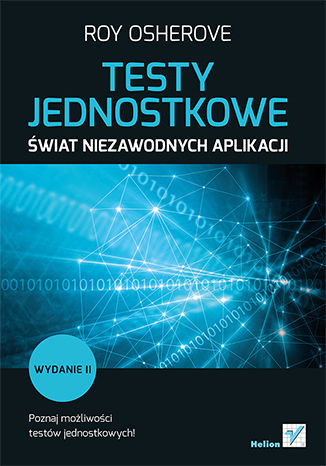
Testy jednostkowe. Świat niezawodnych aplikacji. Wydanie II
Roy Osherove
Poznaj możliwości testów jednostkowych! System informatyczny to inteligentne połączenie modułów i zależności, otoczone setkami tysięcy, a nawet milionami linii kodu źródłowego. Zmiana w jednym obszarze może mieć fatalny wpływ na działanie systemu w zupełnie innym miejscu. Ta zależność prowadzi do ogromnych kosztów wprowadzenia nawet najdrobniejszej zmiany w oprogramowaniu. Czy istnieje rozwiązanie tego problemu? Jak stworzyć system, w którym błyskawiczna weryfikacja lub wprowadzona zmiana nie spowodują nowych błędów w innej części? Oczywiście, że można to zrobić! Odpowiedzią na te i wiele innych problemów są testy automatyczne. Ten przewodnik to doskonała okazja, by głębiej poznać temat testów jednostkowych. Jeżeli uważasz, że ich pisanie jest uciążliwe, czasochłonne, trudne lub po prostu nie wiesz, jak je tworzyć, ta książka rozwiąże wszystkie Twoje problemy! W trakcie lektury dowiesz się, jak pisać testy, tworzyć zestawy testowe oraz przygotowywać makiety i namiastki. Poznasz narzędzia Moq, FakeItEasy oraz Typemock Isolator. Ponadto zdobędziesz wiedzę na temat organizacji testów oraz strategii testowania kodu odziedziczonego. Książka ta jest obowiązkową lekturą dla wszystkich programistów C# szukających świetnego przewodnika po świecie testów jednostkowych! Dzięki tej książce: rozwiejesz swoje wątpliwości dotyczące testów poznasz najpopularniejsze narzędzia wspomagające testowanie zorganizujesz swoje testy jednostkowe zapoznasz się z kluczowymi elementami dobrych testów stworzysz niezawodny i tani w utrzymaniu kod Niezawodny kod jest w Twoim zasięgu!

Testy jednostkowe. Zasady, praktyki i wzorce
Vladimir Khorikov
Każdy inżynier oprogramowania zna teoretyczne podstawy testowania. O tym, że sumienne przeprowadzenie testów ma podstawowe znaczenie dla jakości gotowego produktu, nie trzeba nikogo przekonywać. A jednak wciąż zbyt często okazuje się, że zaplanowanie, napisanie i przeprowadzenie testów jednostkowych w praktyce nie jest łatwym zadaniem. Co gorsza, niewłaściwe testy psują kod, mnożą błędy i zabierają mnóstwo cennego czasu i pieniędzy. Okazuje się, że dla uzyskania maksymalnej jakości projektu, który trzeba dostarczyć w krótkim czasie, konieczne jest nauczenie się praktycznego stosowania zasad i wzorców testowania jednostkowego. Jeśli znasz już podstawy testowania jednostkowego, dzięki tej książce nauczysz się projektowania i pisania testów, które obierają za cel model domeny i pozostałe kluczowe obszary kodu. Ten przejrzyście napisany przewodnik poprowadzi Cię przez proces tworzenia zestawów testowych o optymalnej wartości, bezpiecznej automatyzacji testowania i umiejętnego włączania go w cykl życia oprogramowania. W książce znalazły się uniwersalne wskazówki dotyczące analizy dowolnych testów jednostkowych oraz porady odnoszące się do zmian testów następujących wraz ze zmianami kodu produkcyjnego. Nie zabrakło również informacji, dzięki którym sprawnie zidentyfikujesz i wykluczysz ewentualne antywzorce testowania. Materiał został bogato zilustrowany przejrzystymi przykładami kodu napisanego w C#. Naturalnie, mają one zastosowanie także dla innych języków programowania. W książce między innymi: cel testowania jednostkowego i cechy dobrych testów fundamenty porządnego testowania jednostkowego wpływ zaślepek i sterowników na stabilność testów style testowania jednostkowego zalety i ograniczenia testowania integracyjnego Przed wdrożeniem dobrze przetestuj swój kod!
Christopher J Mears
Not all text editors are created equal. TextMate was created with versatility and power to the developer. Whether you want to organize your files in projects, utilize the efficiency of code completion, take advantage of the thousands of publicly available bundles, or gain insight using powerful regular expression searching, TextMate is an essential and easy-to-use tool you need in your development arsenal.TextMate How-To is a practical guide filled with conventional recipes on using one of the most popular text editors on the OS X platform. It is a great resource for anyone who wants to learn how to code more efficiently and effectively, no matter what programming or scripting language you use.This book will guide the reader through using TextMate for practical purposes. It will start with configuring the application, then cover navigation and editing of files, and finish with bundles and advanced features. Throughout the book, the reader will quickly master the key features of the application through easy to follow tasks.Using this book, the reader will learn the most common text editing and coding tasks including navigation through the document and searching of text. The reader will then learn about working with and navigating between files and projects as well as utilizing bundles to greatly speed up development. Finally, explore the ability to use shell commands and macros to increase productivity.With just a few hours, TextMate How-To will teach the reader everything necessary to hit the ground running with this powerful text editor.
Avisekhar Roy
Gaming in android is an already established market and growing each day. Previously games were made for specific platforms, but this is the time of cross platform gaming with social connectivity. It requires vision of polishing, design and must follow user behavior. This book would help developers to predict and create scopes of improvement according to user behavior.You will begin with the guidelines and rules of game development on the Android platform followed by a brief description about the current variants of Android devices available. Next you will walk through the various tools available to develop any Android games and learn how to choose the most appropriate tools for a specific purpose. You will then learn JAVA game coding standard and style upon the Android SDK. Later, you would focus on creation, maintenance of Game Loop using Android SDK, common mistakes in game development and the solutions to avoid them to improve performance. We will deep dive into Shaders and learn how to optimize memory and performance for an Android Game before moving on to another important topic, testing and debugging Android Games followed by an overview about Virtual Reality and how to integrate them into Android games. Want to program a different way? Inside you’ll also learn Android game Development using C++ and OpenGL. Finally you would walk through the required tools to polish and finalize the game and possible integration of any third party tools or SDKs in order to monetize your game when it’s one the market!
The Ansible Workshop. Hands-On Learning For Rapid Mastery
Aymen El Amri
The Ansible Workshop offers a comprehensive journey through the world of Ansible, guiding readers from foundational concepts to advanced applications in automation. Readers delve into creating and managing inventories, an essential aspect of organizing systems for automation.As the journey progresses, the book covers the creation and use of playbooks, providing step-by-step instructions and practical examples. Readers learn how to gather and utilize Ansible facts, debug issues effectively, and manage sensitive data with Ansible Vault. The exploration of Ansible blocks, modules, plugins, and filters further enhances the reader's ability to customize and extend Ansible's functionality.The book then introduces the concept of Ansible roles, enabling readers to structure and reuse their automation tasks efficiently. Performance optimization techniques are also discussed, ensuring that automation workflows are both fast and reliable. The practical applications of Ansible are showcased through chapters on managing Docker and Docker Compose, as well as automating Kubernetes, highlighting Ansible's versatility in modern IT environments. To provide a quick reference and reinforce learning, an Ansible cheat sheet is included, summarizing key commands and concepts.
Krishna Sankar , Jeffrey Jackovich , Ruze...
Are you fascinated with applications like Alexa and Siri and how they accurately process information within seconds before returning accurate results? Are you looking for a practical guide that will teach you how to build intelligent applications that can revolutionize the world of artificial intelligence? The Applied AI and NLP Workshop will take you on a practical journey where you will learn how to build artificial intelligence (AI) and natural language processing (NLP) applications with Amazon Web services (AWS).Starting with an introduction to AI and machine learning, this book will explain how Amazon S3, or Amazon Simple Storage Service, works. You’ll then integrate AI with AWS to build serverless services and use Amazon’s NLP service Comprehend to perform text analysis on a document. As you advance, the book will help you get to grips with topic modeling to extract and analyze common themes on a set of documents with unknown topics. You’ll also work with Amazon Lex to create and customize a chatbot for task automation and use Amazon Rekognition for detecting objects, scenes, and text in images.By the end of The Applied AI and NLP Workshop, you’ll be equipped with the knowledge and skills needed to build scalable intelligent applications with AWS.
Anthony So , William So , Zsolt...
You already know that artificial intelligence (AI) and machine learning (ML) are present in many of the tools you use in your daily routine. But do you want to be able to create your own AI and ML models and develop your skills in these domains to kickstart your AI career?The Applied Artificial Intelligence Workshop gets you started with applying AI with the help of practical exercises and useful examples, all put together cleverly to help you gain the skills to transform your career.The book begins by teaching you how to predict outcomes using regression. You will then learn how to classify data using techniques such as k-nearest neighbor (KNN) and support vector machine (SVM) classifiers. As you progress, you’ll explore various decision trees by learning how to build a reliable decision tree model that can help your company find cars that clients are likely to buy. The final chapters will introduce you to deep learning and neural networks. Through various activities, such as predicting stock prices and recognizing handwritten digits, you’ll learn how to train and implement convolutional neural networks (CNNs) and recurrent neural networks (RNNs).By the end of this applied AI book, you’ll have learned how to predict outcomes and train neural networks and be able to use various techniques to develop AI and ML models.
Alex Galea, Paul Van Branteghem, Guillermina Bea...
From banking and manufacturing through to education and entertainment, using data science for business has revolutionized almost every sector in the modern world. It has an important role to play in everything from app development to network security.Taking an interactive approach to learning the fundamentals, this book is ideal for beginners. You’ll learn all the best practices and techniques for applying data science in the context of real-world scenarios and examples.Starting with an introduction to data science and machine learning, you’ll start by getting to grips with Jupyter functionality and features. You’ll use Python libraries like sci-kit learn, pandas, Matplotlib, and Seaborn to perform data analysis and data preprocessing on real-world datasets from within your own Jupyter environment. Progressing through the chapters, you’ll train classification models using sci-kit learn, and assess model performance using advanced validation techniques. Towards the end, you’ll use Jupyter Notebooks to document your research, build stakeholder reports, and even analyze web performance data.By the end of The Applied Data Science Workshop, you’ll be prepared to progress from being a beginner to taking your skills to the next level by confidently applying data science techniques and tools to real-world projects.
Harveen Singh Chadha , Luis Capelo ,...
Machine learning gives computers the ability to learn like humans. It is becoming increasingly transformational to businesses in many forms, and a key skill to learn to prepare for the future digital economy.As a beginner, you’ll unlock a world of opportunities by learning the techniques you need to contribute to the domains of machine learning, deep learning, and modern data analysis using the latest cutting-edge tools.The Applied TensorFlow and Keras Workshop begins by showing you how neural networks work. After you’ve understood the basics, you will train a few networks by altering their hyperparameters. To build on your skills, you’ll learn how to select the most appropriate model to solve the problem in hand. While tackling advanced concepts, you’ll discover how to assemble a deep learning system by bringing together all the essential elements necessary for building a basic deep learning system - data, model, and prediction. Finally, you’ll explore ways to evaluate the performance of your model, and improve it using techniques such as model evaluation and hyperparameter optimization.By the end of this book, you'll have learned how to build a Bitcoin app that predicts future prices, and be able to build your own models for other projects.
Christopher Lee
The Art of Crafting User Stories is a must-read for product managers, UX professionals, and product developers dedicated to creating meaningful digital experiences. This book provides a comprehensive, step-by-step approach to empower you to master the techniques for creating user stories that drive effective product development.This book takes you on a journey from identifying and capturing user needs, goals, and perspectives through user stories, to crafting impactful stories for design choices and organizing tasks efficiently. You’ll learn how to define the problem area, recognize user personas, and develop user scenarios with the aid of real-world examples, practical tips, and exercises designed to help you develop your skills in crafting user-centered experiences. Moreover, you’ll gain a thorough understanding of user stories, their role in Agile development, and how to use them to plan and manage products effectively.By the end of this book, you’ll be able to improve the quality and efficiency of your own products by applying the hands-on practical skills to create compelling digital experiences that resonate with users and stay relevant in the market.
Florian Rappl, Lothar Schöttner
Micro frontend is a web architecture for frontend development borrowed from the idea of microservices in software development, where each module of the frontend is developed and shipped in isolation to avoid complexity and a single point of failure for your frontend.Complete with hands-on tutorials, projects, and self-assessment questions, this easy-to-follow guide will take you through the patterns available for implementing a micro frontend solution. You’ll learn about micro frontends in general, the different architecture styles and their areas of use, how to prepare teams for the change to micro frontends, as well as how to adjust the UI design for scalability. Starting with the simplest variants of micro frontend architectures, the book progresses from static approaches to fully dynamic solutions that allow maximum scalability with faster release cycles. In the concluding chapters, you'll reinforce the knowledge you’ve gained by working on different case studies relating to micro frontends.By the end of this book, you'll be able to decide if and how micro frontends should be implemented to achieve scalability for your user interface (UI).
Fedor G. Pikus
The great free lunch of performance taking care of itself is over. Until recently, programs got faster by themselves as CPUs were upgraded, but that doesn't happen anymore. The clock frequency of new processors has almost peaked, and while new architectures provide small improvements to existing programs, this only helps slightly. To write efficient software, you now have to know how to program by making good use of the available computing resources, and this book will teach you how to do that.The Art of Efficient Programming covers all the major aspects of writing efficient programs, such as using CPU resources and memory efficiently, avoiding unnecessary computations, measuring performance, and how to put concurrency and multithreading to good use. You'll also learn about compiler optimizations and how to use the programming language (C++) more efficiently. Finally, you'll understand how design decisions impact performance.By the end of this book, you'll not only have enough knowledge of processors and compilers to write efficient programs, but you'll also be able to understand which techniques to use and what to measure while improving performance. At its core, this book is about learning how to learn.
Chinmay Arankalle , Gareth Dwyer , Bas...
Social networking sites see an average of 350 million uploads daily - a quantity impossible for humans to scan and analyze. Only AI can do this job at the required speed, and to leverage an AI application at its full potential, you need an efficient and scalable data storage pipeline. The Artificial Intelligence Infrastructure Workshop will teach you how to build and manage one.The Artificial Intelligence Infrastructure Workshop begins taking you through some real-world applications of AI. You’ll explore the layers of a data lake and get to grips with security, scalability, and maintainability. With the help of hands-on exercises, you’ll learn how to define the requirements for AI applications in your organization. This AI book will show you how to select a database for your system and run common queries on databases such as MySQL, MongoDB, and Cassandra. You’ll also design your own AI trading system to get a feel of the pipeline-based architecture. As you learn to implement a deep Q-learning algorithm to play the CartPole game, you’ll gain hands-on experience with PyTorch. Finally, you’ll explore ways to run machine learning models in production as part of an AI application.By the end of the book, you’ll have learned how to build and deploy your own AI software at scale, using various tools, API frameworks, and serialization methods.
Stéphane Eyskens, Ed Price
Azure offers a wide range of services that enable a million ways to architect your solutions. Complete with original maps and expert analysis, this book will help you to explore Azure and choose the best solutions for your unique requirements.Starting with the key aspects of architecture, this book shows you how to map different architectural perspectives and covers a variety of use cases for each architectural discipline. You'll get acquainted with the basic cloud vocabulary and learn which strategic aspects to consider for a successful cloud journey. As you advance through the chapters, you'll understand technical considerations from the perspective of a solutions architect. You'll then explore infrastructure aspects, such as network, disaster recovery, and high availability, and leverage Infrastructure as Code (IaC) through ARM templates, Bicep, and Terraform. The book also guides you through cloud design patterns, distributed architecture, and ecosystem solutions, such as Dapr, from an application architect's perspective. You'll work with both traditional (ETL and OLAP) and modern data practices (big data and advanced analytics) in the cloud and finally get to grips with cloud native security.By the end of this book, you'll have picked up best practices and more rounded knowledge of the different architectural perspectives.
Sam Morley
Solve complex problems in C++ by learning how to think like a computer scientist. This book introduces computational thinking—a framework for solving problems using decomposition, abstraction, and pattern recognition—and shows you how to apply it using modern C++ features. You'll learn how to break down challenges, choose the right abstractions, and build solutions that are both maintainable and efficient. Through small examples and a large case study, this book guides you from foundational concepts to high-performance applications. You’ll explore reusable templates, algorithms, modularity, and even parallel computing and GPU acceleration. With each chapter, you’ll not only expand your C++ skillset, but also refine the way you approach and solve real-world problems. Written by a seasoned research engineer and C++ developer, this book combines practical insight with academic rigor. Whether you're designing algorithms or profiling production code, this book helps you deliver elegant, effective solutions with confidence.
Rainer Grimm
Standard template library enables programmers to speed up application development using the built-in data structures and algorithms in their codes. The C++ Standard Library is a comprehensive guide to the updated library of classes, algorithms, functions, iterators, and containers and serves as the best reference to the current C++ 17 standard. Starting with the introduction and history of the standard library, this book goes on to demonstrate how quickly you can manipulate various C++ template classes while writing your applications. You'll also learn in detail the four types of STL components. Then you'll discover the best methods to analyze or modify a string. You'll also learn how to make your application communicate with the outside world using input and output streams and how to use the non-owning string objects with regular strings. By the end of this book, you'll be able to take your programming skills to a higher level by leveraging the standard C++ libraries.