
Programowanie
Niezależnie czy dopiero rozpoczynacie swoją przygodę z programowaniem, czy jesteście już uznanymi na rynku profesjonalistami, to w kategorii Programowanie na pewno znajdziecie podręczniki, które pomogą Wam w przebiegu pracy, czy też w nauce podstaw programowania.
W książkach z tego działu zawarta jest wiedza zarówno związana z czysto technicznymi sprawami typu składnia języków, ale także z umiejętnościami bardziej "miękkimi" jak obsługa i wykorzystanie pełnych możliwości środowisk programistycznych, czy też projektowanie oprogramowania lub metody numeryczne czy oraz struktury danych.
Kerry Townsend
Salesforce Sales Cloud is a system rich in functionality, addressing many sales business challenges such as sales productivity, forecast visibility, and sales enablement. However, unlocking the full value of the system and getting maximum returns pose a challenge, especially if you’re new to the technology.This implementation handbook goes beyond mere configuration to ensure a successful implementation journey. From laying the groundwork for your project to engaging stakeholders with sales-specific business insights, this book equips you with the knowledge you need to plan and execute.As you progress, you’ll learn how to design a robust data model to support the sales and lead generation process, followed by crafting an intuitive user experience to drive productivity. You’ll then explore crucial post-building aspects such as testing, training, and releasing functionality. Finally, you’ll discover how the solutions’ capability can be expanded by adding and integrating other tools to address typical sales use cases.By the end of this book, you’ll have grasped how to leverage Sales Cloud to solve sales challenges and have gained the confidence to design and implement solutions successfully with the help of real-world use cases.
Vishwas Madhuvarshi, Vijaya Kumar Ganugula
SAP Intelligent Robotic Process Automation (RPA) enables businesses to automate repetitive work and integrate automation capabilities across SAP and non-SAP systems.This book provides end-to-end coverage of business process automation using SAP Intelligent RPA and shows how to build multiple SAP Intelligent RPA projects from start to finish. Some of these projects may build upon the work done in previous chapters to showcase the Agile development process in SAP Intelligent RPA.As you progress, you'll cover the SAP Intelligent RPA factory, Desktop Studio, Cloud Studio, and the Bot store. You'll also learn about the building blocks of the SAP Intelligent RPA solution and creating bots from initial application declaration to workflow design and deployment, along with making bots run in attended and unattended modes.You'll also learn about SAP Process Automation, the new SAP service that is going to replace the SAP Intelligent RPA service soon. Finally, we will discuss the migration path for your SAP Intelligent RPA projects to SAP Process Automation and showcase that the RPA development remains similar in both services.By the end of this RPA book, you’ll be able to create and manage complex bots that are capable of interacting with SAP and non-SAP systems.
SAP on Azure Implementation Guide. Move your business data to the cloud
Nick Morgan, Bartosz Jarkowski
Cloud technologies have now reached a level where even the most critical business systems can run on them. For most organizations SAP is the key business system. If SAP is unavailable for any reason then potentially your business stops. Because of this, it is understandable that you will be concerned whether such a critical system can run in the public cloud. However, the days when you truly ran your IT system on-premises have long since gone. Most organizations have been getting rid of their own data centers and increasingly moving to co-location facilities. In this context the public cloud is nothing more than an additional virtual data center connected to your existing network.There are typically two main reasons why you may consider migrating SAP to Azure: You need to replace the infrastructure that is currently running SAP, or you want to migrate SAP to a new database. Depending on your goal SAP offers different migration paths. You can decide either to migrate the current workload to Azure as-is, or to combine it with changing the database and execute both activities as a single step. SAP on Azure Implementation Guide covers the main migration options to lead you through migrating your SAP data to Azure simply and successfully.
Bass Jobsen
Sass and Compass Designer's Cookbook helps you to get most out of CSS3 and harness its benefits to create engaging and receptive applications. This book will help you develop faster and reduce the maintenance time for your web development projects by using Sass and Compass. You will learn how to use with CSS frameworks such as Bootstrap and Foundation and understand how to use other libraries of pre-built mixins. You will also learn setting up a development environment with Gulp. This book guides you through all the concepts and gives you practical examples for full understanding.
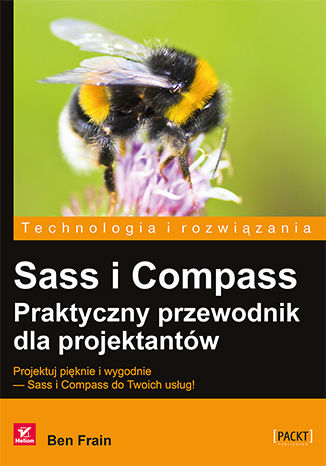
Sass i Compass. Praktyczny przewodnik dla projektantów
Ben Frain
Projektuj pięknie i wygodnie — Sass i Compass do Twoich usług! Instalowanie Sass i Compass oraz konfigurowanie projektów, czyli od czego zacząć naukę Kolory, siatki i responsywność, czyli jak zapewnić stronie dobry wygląd na każdym urządzeniu Automatyzacja pisania kodu CSS, czyli jak działać szybko i eliminować zbędne czynności Kaskadowe arkusze stylów są dziś wykorzystywane przez wszystkich projektantów stron internetowych na całym świecie. Jest to bardzo wygodne i elastyczne narzędzie, jednak prawdziwie spektakularne efekty można osiągnąć dzięki zastosowaniu CSS w połączeniu z preprocesorem Sass oraz technologią Compass. Możliwe, że nie bardzo wiesz, co znaczą te nazwy, i nie masz pojęcia, do czego mogłyby Ci się przydać te dodatki. Jeśli jednak jesteś projektantem, powinieneś czym prędzej zapoznać się z tymi narzędziami, ponieważ niebywale ułatwią Ci pracę. I nie musisz być geniuszem ani informatykiem, żeby skorzystać z ich mocy. Wystarczy, że znasz HTML i CSS. Ta książka nie została napisana z myślą o programistach. Jej celem jest pokazanie spektrum działania technologii Sass i Compass wszystkim tym, którzy często używają CSS. Znajdziesz tu informacje na temat instalowania i konfigurowania obu dodatków, sprawnego posługiwania się kolorami i tworzenia responsywnych układów stron. Po tych podstawach przyjdzie czas na naukę pisania zapytań medialnych i eksperymentalnych deklaracji CSS dla różnych przeglądarek, a także ćwiczenia ze sporządzania statystyk. Następnie dowiesz się, jak utworzyć idealnego duszka w rekordowo krótkim czasie i zautomatyzować swoją pracę za pomocą inteligentnych pętli. Przeczytaj i zastosuj, a szybko zakochasz się w dodatkach Sass i Compass! Sass i Compass dla początkujących Tworzenie projektu Sass i Compass Zagnieżdżanie, rozszerzanie, symbole zastępcze i domieszki Praca z kolorami Responsywne i elastyczne siatki Tworzenie zapytań medialnych za pomocą Sass i domieszek CSS3, duszki i inne cuda Logika programistyczna w Sass Sass i Compass dla zaawansowanych Sass i Compass skrócą Ci drogę do pięknych stron!
Sridhar Alla, Md. Rezaul Karim
Scala has been observing wide adoption over the past few years, especially in the field of data science and analytics. Spark, built on Scala, has gained a lot of recognition and is being used widely in productions. Thus, if you want to leverage the power of Scala and Spark to make sense of big data, this book is for you.The first part introduces you to Scala, helping you understand the object-oriented and functional programming concepts needed for Spark application development. It then moves on to Spark to cover the basic abstractions using RDD and DataFrame. This will help you develop scalable and fault-tolerant streaming applications by analyzing structured and unstructured data using SparkSQL, GraphX, and Spark structured streaming. Finally, the book moves on to some advanced topics, such as monitoring, configuration, debugging, testing, and deployment.You will also learn how to develop Spark applications using SparkR and PySpark APIs, interactive data analytics using Zeppelin, and in-memory data processing with Alluxio.By the end of this book, you will have a thorough understanding of Spark, and you will be able to perform full-stack data analytics with a feel that no amount of data is too big.
Ivan Nikolov
Design patterns make developers’ lives easier by helping them write great software that is easy to maintain, runs efficiently, and is valuable to the company or people concerned. You’ll learn about the various features of Scala and will be able to apply well-known, industry-proven design patterns in your work. The book starts off by focusing on some of the most interesting and latest features of Scala while using practical real-world examples. We will be learning about IDE’s and Aspect Oriented Programming. We will be looking into different components in Scala. We will also cover the popular Gang of Four design patterns and show you how to incorporate functional patterns effectively. The book ends with a practical example that demonstrates how the presented material can be combined in real-life applications. You’ll learn the necessary concepts to build enterprise-grade applications. By the end of this book, you’ll have enough knowledge and understanding to quickly assess problems and come up with elegant solutions.
Pascal Bugnion
Scala is a multi-paradigm programming language (it supports both object-oriented and functional programming) and scripting language used to build applications for the JVM. Languages such as R, Python, Java, and so on are mostly used for data science. It is particularly good at analyzing large sets of data without any significant impact on performance and thus Scala is being adopted by many developers and data scientists. Data scientists might be aware that building applications that are truly scalable is hard. Scala, with its powerful functional libraries for interacting with databases and building scalable frameworks will give you the tools to construct robust data pipelines.This book will introduce you to the libraries for ingesting, storing, manipulating, processing, and visualizing data in Scala.Packed with real-world examples and interesting data sets, this book will teach you to ingest data from flat files and web APIs and store it in a SQL or NoSQL database. It will show you how to design scalable architectures to process and modelling your data, starting from simple concurrency constructs such as parallel collections and futures, through to actor systems and Apache Spark. As well as Scala’s emphasis on functional structures and immutability, you will learn how to use the right parallel construct for the job at hand, minimizing development time without compromising scalability. Finally, you will learn how to build beautiful interactive visualizations using web frameworks.This book gives tutorials on some of the most common Scala libraries for data science, allowing you to quickly get up to speed with building data science and data engineering solutions.
Scala Functional Programming Patterns. Grok and perform effective functional programming in Scala
Atul S. Khot
Scala is used to construct elegant class hierarchies for maximum code reuse and extensibility and to implement their behavior using higher-order functions. Its functional programming (FP) features are a boon to help you design “easy to reason about” systems to control the growing software complexities. Knowing how and where to apply the many Scala techniques is challenging. Looking at Scala best practices in the context of what you already know helps you grasp these concepts quickly, and helps you see where and why to use them. This book begins with the rationale behind patterns to help you understand where and why each pattern is applied. You will discover what tail recursion brings to your table and will get an understanding of how to create solutions without mutations. We then explain the concept of memorization and infinite sequences for on-demand computation. Further, the book takes you through Scala’s stackable traits and dependency injection, a popular technique to produce loosely-coupled software systems.You will also explore how to currying favors to your code and how to simplify it by de-construction via pattern matching. We also show you how to do pipeline transformations using higher order functions such as the pipes and filters pattern. Then we guide you through the increasing importance of concurrent programming and the pitfalls of traditional code concurrency. Lastly, the book takes a paradigm shift to show you the different techniques that functional programming brings to your plate.This book is an invaluable source to help you understand and perform functional programming and solve common programming problems using Scala’s programming patterns.
Vikash Sharma
Scala jest językiem programowania ogólnego przeznaczenia, który łączy cechy języków funkcyjnych i obiektowych. Jego twórcy postawili sobie za cel skalowalność napisanych w nim aplikacji - stąd wzięła się nazwa Scala. Scala jest oparta na wirtualnej maszynie Javy, umożliwia programowanie funkcyjne i oferuje bogaty wybór typów. Dzięki tym cechom można tworzyć kod mniej podatny na występowanie błędów w trakcie działania programu. Po uzyskaniu pewnej biegłości w kodowaniu praca z tym językiem staje się prawdziwą przyjemnością, nawet podczas tworzenia frameworków czy bibliotek. Ten przystępny podręcznik przeznaczono dla programistów, którzy chcą poznać język Scala, aby wykorzystywać go do pisania współbieżnych, skalowalnych i reaktywnych aplikacji. Przedstawiono tu podstawy niezbędne do rozpoczęcia kodowania w Scali: składnię języka, podstawowe typy danych, literały czy zmienne. Następnie omówiono struktury danych w Scali i sposoby korzystania z funkcji wyższego rzędu. Zaprezentowano również takie koncepcje jak dopasowanie wzorca, klasy przypadku oraz zagadnienia związane z programowaniem funkcyjnym i programowaniem zorientowanym obiektowo. Opisano techniki programowania asynchronicznego i reaktywnego. Znalazło się tu także obszerne wprowadzenie do frameworka Akka. W tej książce między innymi: paradygmaty programowania a korzystanie ze Scali kolekcje modyfikowalne i niemodyfikowalne koncepcja domniemania i praca z wyjątkami programowanie równoległe, asynchroniczne i reaktywne programowanie sterowane testami w Scali Scala: nowoczesność i prostota w każdej skali!
Joshua Suereth D.
Scala to słowo, które ostatnio nie schodzi z ust programistów Javy. Pod tą nazwą kryje się język łączący światy programowania funkcyjnego i obiektowego. Jego ogromną zaletą jest działanie w oparciu o wirtualną maszynę Javy. Pozwala to między innymi na bezproblemową komunikację i współdzielenie kodu między oboma językami. James Gosling, twórca Javy, zapytany o to, jakiego języka oprogramowania działającego w ten sposób użyłby obecnie (gdyby nie mógł wykorzystać Javy), odparł bez zastanowienia: „Scala!”. To chyba najlepszy dowód na to, że ten język wart jest Twojego czasu! Dzięki tej książce opanujesz Scalę szybko i bezboleśnie, więc będziesz mógł wykorzystać jej zalety już w najbliższym projekcie. W trakcie lektury poznasz składnię, fundamentalne zasady tworzenia oprogramowania w Scali oraz konwencje kodowania w tym języku. W kolejnych rozdziałach dowiesz się, czym są niejawne widoki, jakie typy danych masz do dyspozycji i jakie są ich ograniczenia. Co jeszcze? Integracja Scali z Javą to niezwykle istotny temat, dający Ci pole do popisu! Ponadto poznasz wzorce stosowane w programowaniu funkcyjnym. Słowo wstępne do tej niezwykłej książki napisał sam Martin Odersky - twórca języka Scala! Niniejsza książka jest najlepszym kompendium wiedzy na temat programowania w tym języku. Musisz ją mieć! Poznaj: konwencje obowiązujące w Scali składnię języka najlepsze wzorce projektowe stosowane w programowaniu funkcyjnym potencjał języka Scala! Poznaj i wykorzystaj potęgę programowania funkcyjnego!
Mikael Valot, Nicolas Jorand
Scala Programming Projects is a comprehensive project-based introduction for those who are new to Scala. Complete with step-by-step instructions and easy-to-follow tutorials that demonstrate best practices when building applications, this Scala book will have you building real-world projects in no time.Starting with the fundamentals of software development, you’ll begin with simple projects, such as developing a financial independence calculator, and then advance to more complex projects, such as a building a shopping application and a Bitcoin transaction analyzer. You’ll explore a variety of Scala features, including its OOP and FP capabilities, and learn how to write concise, reactive, and concurrent applications in a type-safe manner. You’ll also understand how to use libraries such as Akka and Play. Furthermore, you’ll be able to integrate your Scala apps with Kafka, Spark, and Zeppelin, along with deploying applications on a cloud platform.By the end of the book, you’ll have a firm foundation in Java programming that’ll enable you to solve a variety of real-world problems, and you’ll have built impressive projects to add to your professional portfolio.
Rambabu Posa
Reactive programming is a scalable, fast way to build applications, and one that helps us write code that is concise, clear, and readable. It can be used for many purposes such as GUIs, robotics, music, and others, and is central to many concurrent systems. This book will be your guide to getting started with Reactive programming in Scala.You will begin with the fundamental concepts of Reactive programming and gradually move on to working with asynchronous data streams. You will then start building an application using Akka Actors and extend it using the Play framework. You will also learn about reactive stream specifications, event sourcing techniques, and different methods to integrate Akka Streams into the Play Framework. This book will also take you one step forward by showing you the advantages of the Lagom framework while working with reactive microservices. You will also learn to scale applications using multi-node clusters and test, secure, and deploy your microservices to the cloud.By the end of the book, you will have gained the knowledge to build robust and distributed systems with Scala and Akka.
Scala Test-Driven Development. Write clean scala code that works
Gaurav Sood
Test-driven development (TDD) produces high-quality applications in less time than is possible with traditional methods. Due to the systematic nature of TDD, the application is tested in individual units as well as cumulatively, right from the design stage, to ensure optimum performance and reduced debugging costs. This step-by-step guide shows you how to use the principles of TDD and built-in Scala testing modules to write clean and fully tested Scala code and give your workflow the change it needs to let you create better applications than ever before. After an introduction to TDD, you will learn the basics of ScalaTest, one of the most flexible and most popular testing tools around for Scala, by building your first fully test-driven application. Building on from that you will learn about the ScalaTest API and how to refactor code to produce high-quality applications. We’ll teach you the concepts of BDD (Behavior-driven development) and you’ll see how to add functional tests to the existing suite of tests. You’ll be introduced to the concepts of Mocks and Stubs and will learn to increase test coverage using properties. With a concluding chapter on miscellaneous tools, this book will enable you to write better quality code that is easily maintainable and watch your apps change for the better.
Jason Myerscough
Azure Data Explorer (ADX) enables developers and data scientists to make data-driven business decisions. This book will help you rapidly explore and query your data at scale and secure your ADX clusters.The book begins by introducing you to ADX, its architecture, core features, and benefits. You'll learn how to securely deploy ADX instances and navigate through the ADX Web UI, cover data ingestion, and discover how to query and visualize your data using the powerful Kusto Query Language (KQL). Next, you'll get to grips with KQL operators and functions to efficiently query and explore your data, as well as perform time series analysis and search for anomalies and trends in your data. As you progress through the chapters, you'll explore advanced ADX topics, including deploying your ADX instances using Infrastructure as Code (IaC). The book also shows you how to manage your cluster performance and monthly ADX costs by handling cluster scaling and data retention periods. Finally, you'll understand how to secure your ADX environment by restricting access with best practices for improving your KQL query performance.By the end of this Azure book, you'll be able to securely deploy your own ADX instance, ingest data from multiple sources, rapidly query your data, and produce reports with KQL and Power BI.
Tarik Makota, Brian Maguire, Danny Gagne, Rajeev...
Amazon Kinesis is a collection of secure, serverless, durable, and highly available purpose-built data streaming services. This data streaming service provides APIs and client SDKs that enable you to produce and consume data at scale.Scalable Data Streaming with Amazon Kinesis begins with a quick overview of the core concepts of data streams, along with the essentials of the AWS Kinesis landscape. You'll then explore the requirements of the use case shown through the book to help you get started and cover the key pain points encountered in the data stream life cycle. As you advance, you'll get to grips with the architectural components of Kinesis, understand how they are configured to build data pipelines, and delve into the applications that connect to them for consumption and processing. You'll also build a Kinesis data pipeline from scratch and learn how to implement and apply practical solutions. Moving on, you'll learn how to configure Kinesis on a cloud platform. Finally, you’ll learn how other AWS services can be integrated into Kinesis. These services include Redshift, Dynamo Database, AWS S3, Elastic Search, and third-party applications such as Splunk.By the end of this AWS book, you’ll be able to build and deploy your own Kinesis data pipelines with Kinesis Data Streams (KDS), Kinesis Data Firehose (KFH), Kinesis Video Streams (KVS), and Kinesis Data Analytics (KDA).
Dean MacNeil, Aslam Cader
Jira Align is a platform purpose-built for enterprises to connect strategy with execution and drive transparency, consistency, and predictability at all levels of scale. The platform supports business value delivery in agile frameworks such as LeSS, DAD, and SAFe. It also caters to organizations that mix agile with waterfall to support scaled bimodal delivery.Starting with an introduction to the platform and its features, this book takes you through the foundational building blocks of Jira Align. You’ll learn how an organization can benefit from implementing Jira Align and understand how to connect dimensions such as people, work, time, and outcomes. The book takes you through the typical steps for implementing Jira Align for maximizing outcomes and helps you solve common team, program, and portfolio-level challenges by enhancing visibility, tracking dependencies and risks, and using reports for real-time, distributed decision making. Throughout the book, you’ll explore features such as remote agile ceremonies, live roadmaps, and objectives and key results (OKRs). You’ll also get to grips with lean portfolio management, financial reporting, and using the program board for planning and execution.By the end of this book, you’ll be well versed in the key features of Jira Align and be able to leverage them to support all levels of agile at scale.
Hrishikesh Vijay Karambelkar
This book is a step-by-step guide for readers who would like to learn how to build complete enterprise search solutions, with ample real-world examples and case studies. If you are a developer, designer, or architect who would like to build enterprise search solutions for your customers or organization, but have no prior knowledge of Apache Solr/Lucene technologies, this is the book for you.
Claus Führer, Claus Fuhrer, Jan Erik Solem,...
Python has tremendous potential within the scientific computing domain. This updated edition of Scientific Computing with Python features new chapters on graphical user interfaces, efficient data processing, and parallel computing to help you perform mathematical and scientific computing efficiently using Python.This book will help you to explore new Python syntax features and create different models using scientific computing principles. The book presents Python alongside mathematical applications and demonstrates how to apply Python concepts in computing with the help of examples involving Python 3.8. You'll use pandas for basic data analysis to understand the modern needs of scientific computing, and cover data module improvements and built-in features. You'll also explore numerical computation modules such as NumPy and SciPy, which enable fast access to highly efficient numerical algorithms. By learning to use the plotting module Matplotlib, you will be able to represent your computational results in talks and publications. A special chapter is devoted to SymPy, a tool for bridging symbolic and numerical computations.By the end of this Python book, you'll have gained a solid understanding of task automation and how to implement and test mathematical algorithms within the realm of scientific computing.
Julian Avila, Trent Hauck
Python is quickly becoming the go-to language for analysts and data scientists due to its simplicity and flexibility, and within the Python data space, scikit-learn is the unequivocal choice for machine learning. This book includes walk throughs and solutions to the common as well as the not-so-common problems in machine learning, and how scikit-learn can be leveraged to perform various machine learning tasks effectively.The second edition begins with taking you through recipes on evaluating the statistical properties of data and generates synthetic data for machine learning modelling. As you progress through the chapters, you will comes across recipes that will teach you to implement techniques like data pre-processing, linear regression, logistic regression, K-NN, Naïve Bayes, classification, decision trees, Ensembles and much more. Furthermore, you’ll learn to optimize your models with multi-class classification, cross validation, model evaluation and dive deeper in to implementing deep learning with scikit-learn. Along with covering the enhanced features on model section, API and new features like classifiers, regressors and estimators the book also contains recipes on evaluating and fine-tuning the performance of your model. By the end of this book, you will have explored plethora of features offered by scikit-learn for Python to solve any machine learning problem you come across.
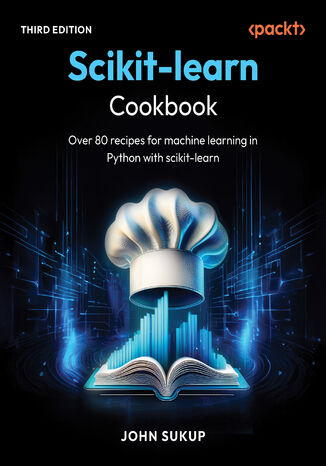
John Sukup
Trusted by data scientists, ML engineers, and software developers alike, scikit-learn offers a versatile, user-friendly framework for implementing a wide range of ML algorithms, enabling the efficient development and deployment of predictive models in real-world applications. This third edition of scikit-learn Cookbook will help you master ML with real-world examples and scikit-learn 1.5 features.This updated edition takes you on a journey from understanding the fundamentals of ML and data preprocessing, through implementing advanced algorithms and techniques, to deploying and optimizing ML models in production. Along the way, you’ll explore practical, step-by-step recipes that cover everything from feature engineering and model selection to hyperparameter tuning and model evaluation, all using scikit-learn.By the end of this book, you’ll have gained the knowledge and skills needed to confidently build, evaluate, and deploy sophisticated ML models using scikit-learn, ready to tackle a wide range of data-driven challenges.*Email sign-up and proof of purchase required
Luiz Felipe Martins, Ke Wu, Ruben Oliva...
With the SciPy Stack, you get the power to effectively process, manipulate, and visualize your data using the popular Python language. Utilizing SciPy correctly can sometimes be a very tricky proposition. This book provides the right techniques so you can use SciPy to perform different data science tasks with ease.This book includes hands-on recipes for using the different components of the SciPy Stack such as NumPy, SciPy, matplotlib, and pandas, among others. You will use these libraries to solve real-world problems in linear algebra, numerical analysis, data visualization, and much more. The recipes included in the book will ensure you get a practical understanding not only of how a particular feature in SciPy Stack works, but also of its application to real-world problems. The independent nature of the recipes also ensure that you can pick up any one and learn about a particular feature of SciPy without reading through the other recipes, thus making the book a very handy and useful guide.
Michael Badger
The book uses step-by-step instructions along with full code listings for each exercise. After each exercise, the author pauses to reflect, explain, and offer insights before building on the project. The author approaches the content with the belief that we are all teachers and that you are reading this book not only because you want to learn, but because you want to share your knowledge with others. Motivated students can pick up this book and teach themselves how to program because the book takes a simple, strategic, and structured approach to learning Scratch. Parents can grasp the fundamentals so that they can guide their children through introductory Scratch programming exercises. It’s perfect for homeschool families. Teachers of all disciplines from computer science to English can quickly get up to speed with Scratch and adapt the projects for use in the classroom.
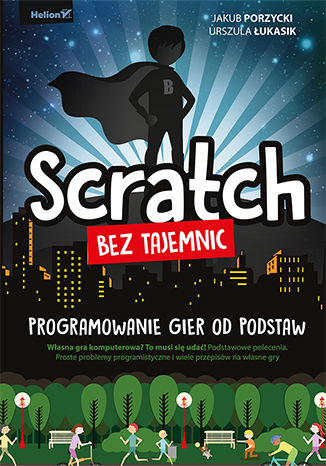
Scratch bez tajemnic. Programowanie gier od podstaw
Jakub Porzycki, Urszula Łukasik
Własna gra komputerowa? To musi się udać! Podstawowe polecenia Proste problemy programistyczne i własne bloczki Twoja pierwsza gra komputerowa ze Scratchem Jeśli sięgasz po tę książkę, na pewno uwielbiasz gry komputerowe i zastanawiasz się, jak samodzielnie stworzyć własną. Albo masz już gotowy pomysł i szukasz sposobów na jego realizację. Ta książka będzie dla Ciebie idealnym przewodnikiem na start. Od czego zacząć i jak nauczyć się programowania, które pozwoli Ci stworzyć swój własny mikroświat w komputerze? Scratch bez tajemnic zawiera kilkanaście projektów prostych gier napisanych w języku Scratch, stworzonym specjalnie do nauki programowania. Zabawne i intrygujące zadania, które Cię tu czekają, będą nie tylko świetną rozrywką, lecz także wstępem do samodzielnego pisania gier. Zobacz, jak przygotować kosmiczną bitwę, zaprojektować zmasowany atak bakterii i stworzyć swoją własną platformówkę. Baw się tymi przykładami, rozbudowuj je i zmieniaj według własnych pomysłów. Programowanie nie jest tak trudne, jak Ci się wydaje! Projekt akwarium Znikający duszek i okrutna matematyka Pogrywamy sobie w kotka i myszkę Przygody w kosmosie i kosmiczna bitwa Żuczek na autostradzie i arkanoid Twoje własne bloczki Inwazja bakterii Rysowanie jest proste Platformówki Wąż Turniej łuczniczy Niech zabrzmią działa Programuj i graj!