
Programowanie
Niezależnie czy dopiero rozpoczynacie swoją przygodę z programowaniem, czy jesteście już uznanymi na rynku profesjonalistami, to w kategorii Programowanie na pewno znajdziecie podręczniki, które pomogą Wam w przebiegu pracy, czy też w nauce podstaw programowania.
W książkach z tego działu zawarta jest wiedza zarówno związana z czysto technicznymi sprawami typu składnia języków, ale także z umiejętnościami bardziej "miękkimi" jak obsługa i wykorzystanie pełnych możliwości środowisk programistycznych, czy też projektowanie oprogramowania lub metody numeryczne czy oraz struktury danych.
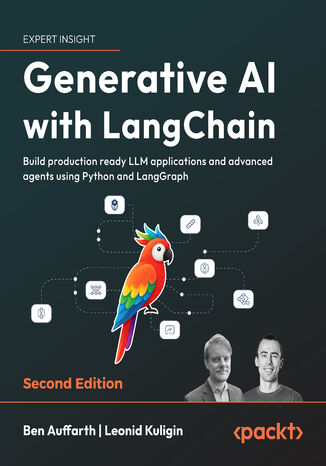
Ben Auffarth, Leonid Kuligin
This second edition tackles the biggest challenge facing companies in AI today: moving from prototypes to production. Fully updated to reflect the latest developments in the LangChain ecosystem, it captures how modern AI systems are developed, deployed, and scaled in enterprise environments. This edition places a strong focus on multi-agent architectures, robust LangGraph workflows, and advanced retrieval-augmented generation (RAG) pipelines.You'll explore design patterns for building agentic systems, with practical implementations of multi-agent setups for complex tasks. The book guides you through reasoning techniques such as Tree-of -Thoughts, structured generation, and agent handoffs—complete with error handling examples. Expanded chapters on testing, evaluation, and deployment address the demands of modern LLM applications, showing you how to design secure, compliant AI systems with built-in safeguards and responsible development principles. This edition also expands RAG coverage with guidance on hybrid search, re-ranking, and fact-checking pipelines to enhance output accuracy.Whether you're extending existing workflows or architecting multi-agent systems from scratch, this book provides the technical depth and practical instruction needed to design LLM applications ready for success in production environments.
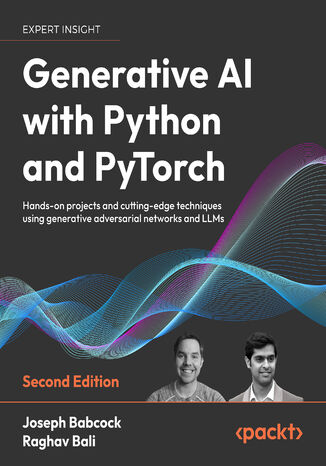
Joseph Babcock, Raghav Bali
Become an expert in Generative AI through hands-on projects that leverage today’s most powerful models for Natural Language Processing (NLP) and computer vision. This book is your end-to-end guide to creating advanced AI applications, made easy by Raghav Bali, a seasoned data scientist with multiple patents in AI, and Joseph Babcock, a PhD and machine learning expert. Through business-tested approaches, this book simplifies complex GenAI concepts, making learning both accessible and immediately applicable.From NLP to image generation, this second edition explores practical applications and the underlying theories that power these technologies. By integrating the latest advancements in LLMs, it prepares you to design and implement powerful AI systems that transform data into actionable intelligence.You’ll build your versatile LLM toolkit by gaining expertise in GPT-4, LangChain, RLHF, LoRA, RAG, and more. You’ll also explore deep learning techniques for image generation and apply styler transfer using GANs, before advancing to implement CLIP and diffusion models.Whether you’re generating dynamic content or developing complex AI-driven solutions, this book equips you with everything you need to harness the full transformative power of Python and AI.*Email sign-up and proof of purchase required
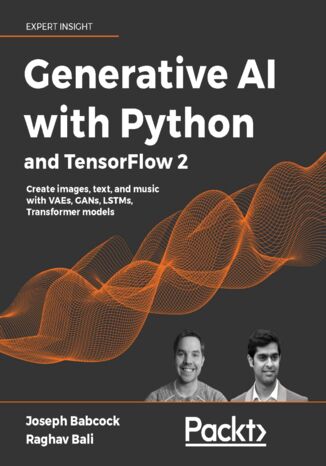
Joseph Babcock, Raghav Bali
Machines are excelling at creative human skills such as painting, writing, and composing music. Could you be more creative than generative AI?In this book, you’ll explore the evolution of generative models, from restricted Boltzmann machines and deep belief networks to VAEs and GANs. You’ll learn how to implement models yourself in TensorFlow and get to grips with the latest research on deep neural networks.There’s been an explosion in potential use cases for generative models. You’ll look at Open AI’s news generator, deepfakes, and training deep learning agents to navigate a simulated environment.Recreate the code that’s under the hood and uncover surprising links between text, image, and music generation.

Generative AI with Python. Harness the Power of Python for Building Generative AI Models
Rheinwerk Publishing, Inc, Bert Gollnick
Generative AI with Python introduces readers to the fascinating world of AI model development. It begins with essential concepts in AI and deep learning, building a solid foundation for working with generative models. You will explore how to create models that generate text, images, and more, with clear, practical examples. The book provides an in-depth look at large language models and pretrained tools like Hugging Face, demonstrating how they can be leveraged in real-world applications. Each chapter blends theoretical concepts with hands-on coding exercises to ensure you understand both the principles and practical implementation of generative AI. Starting with the basics of natural language processing and deep learning, the book guides you to more advanced applications such as text summarization, image generation, and model fine-tuning. You'll also learn about optimizing AI models and deploying them in various environments. By the end of the book, you’ll be able to confidently build AI-driven applications with Python, capable of transforming business processes and enhancing consumer products.
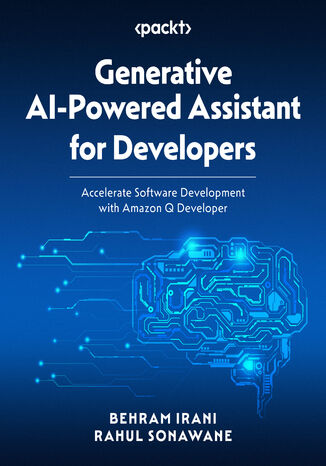
Behram Irani, Rahul Sonawane
Many developers face the challenge of managing repetitive tasks and maintaining productivity. This book will help you tackle both these challenges with Amazon Q Developer, a generative AI-powered assistant designed to optimize coding and streamline workflows.This book takes you through the setup and customization of Amazon Q Developer, demonstrating how to leverage its capabilities for auto-code generation, code explanation, and transformation across multiple IDEs and programming languages. You'll learn to use Amazon Q Developer to enhance coding experiences, generate accurate code references, and ensure security by scanning for vulnerabilities. The book also shows you how to use Amazon Q Developer for AWS-related tasks, including solution building, applying architecture best practices, and troubleshooting errors. Each chapter provides practical insights and step-by-step guidance to help you fully integrate this powerful tool into your development process. You’ll get to grips with effortless code implementation, explanation, transformation, and documentation, helping you create applications faster and improve your development experience.By the end of this book, you’ll have mastered Amazon Q Developer to accelerate your software development lifecycle, improve code quality, and build applications faster and more efficiently.
Generative Deep Learning with Python. Unleashing the Creative Power of AI by Mastering AI and Python
Cuantum Technologies LLC
Generative Deep Learning with Python opens the door to the fascinating world of AI where machines create. This course begins with an introduction to deep learning, establishing the essential concepts and techniques. You will then delve into generative models, exploring their theoretical foundations and practical applications. As you progress, you will gain a deep understanding of Generative Adversarial Networks (GANs), learning how they function and how to implement them for tasks like face generation.The course's hands-on projects, such as creating GANs for face generation and using Variational Autoencoders (VAEs) for handwritten digit generation, provide practical experience that reinforces your learning. You'll also explore autoregressive models for text generation, allowing you to see the versatility of generative models across different types of data. Advanced topics will prepare you for cutting-edge developments in the field.Throughout your journey, you will gain insights into the future landscape of generative deep learning, equipping you with the skills to innovate and lead in this rapidly evolving field. By the end of the course, you will have a solid foundation in generative deep learning and be ready to apply these techniques to real-world challenges, driving advancements in AI and machine learning.
GeoServer Beginner's Guide. Share geospatial data using Open Source standards - Second Edition
Stefano Iacovella
GeoServer is an opensource server writtenin Java that allows users to share, process,and edit geospatial data. This book willguide you through the new featuresand improvements of GeoServer and willhelp you get started with it. GeoServerBeginner's Guide gives you the impetus tobuild custom maps using your data withoutthe need for costly commercial softwarelicenses and restrictions. Even if you donot have prior GIS knowledge, you will beable to make interactive maps after readingthis book.You will install GeoServer, access your datafrom a database, and apply style points,lines, polygons, and labels to impress sitevisitors with real-time maps. Then youfollow a step-by-step guide that installsGeoServer in minutes. You will explorethe web-based administrative interfaceto connect to backend data stores suchas PostGIS, and Oracle. Going ahead, youcan display your data on web-basedinteractive maps, use style lines, points,polygons, and embed images to visualizethis data for your web visitors. You willwalk away from this book with a workingapplication ready for production.After reading GeoServer Beginner's Guide,you will be able to build beautiful custommaps on your website using your geospatialdata.
Stefano Iacovella
This book is ideal for GIS experts, developers, and system administrators who have had a first glance at GeoServer and who are eager to explore all its features in order to configure professional map servers. Basic knowledge of GIS and GeoServer is required.