
Programowanie
Niezależnie czy dopiero rozpoczynacie swoją przygodę z programowaniem, czy jesteście już uznanymi na rynku profesjonalistami, to w kategorii Programowanie na pewno znajdziecie podręczniki, które pomogą Wam w przebiegu pracy, czy też w nauce podstaw programowania.
W książkach z tego działu zawarta jest wiedza zarówno związana z czysto technicznymi sprawami typu składnia języków, ale także z umiejętnościami bardziej "miękkimi" jak obsługa i wykorzystanie pełnych możliwości środowisk programistycznych, czy też projektowanie oprogramowania lub metody numeryczne czy oraz struktury danych.
Ashish Belagali, Akshay Chordiya, Hardik Trivedi
Kotlin is a powerful language that has applications in a wide variety of fields. It is a concise, safe, interoperable, and tool-friendly language. The Android team has also announced first-class support for Kotlin, which is an added boost to the language. Kotlin’s growth is fueled through carefully designed business and technology benefits.The collection of projects demonstrates the versatility of the language and enables you to build standalone applications on your own. You’ll build comprehensive applications using the various features of Kotlin. Scale, performance, and high availability lie at the heart of the projects, and the lessons learned throughout this book.You’ll learn how to build a social media aggregator app that will help you efficiently track various feeds, develop a geospatial webservice with Kotlin and Spring Boot, build responsive web applications with Kotlin, build a REST API for a news feed reader, and build a server-side chat application with Kotlin.It also covers the various libraries and frameworks used in the projects. Through the course of building applications, you’ll not only get to grips with the various features of Kotlin, but you’ll also discover how to design and prototype professional-grade applications.
Alexey Soshin
This book shows you how easy it can be to implement traditional design patterns in the modern multi-paradigm Kotlin programming language, and takes you through the new patterns and paradigms that have emerged.This second edition is updated to cover the changes introduced from Kotlin 1.2 up to 1.5 and focuses more on the idiomatic usage of coroutines, which have become a stable language feature. You'll begin by learning about the practical aspects of smarter coding in Kotlin, as well as understanding basic Kotlin syntax and the impact of design patterns on your code.The book also provides an in-depth explanation of the classical design patterns, such as Creational, Structural, and Behavioral families, before moving on to functional programming. You'll go through reactive and concurrent patterns, and finally, get to grips with coroutines and structured concurrency to write performant, extensible, and maintainable code.By the end of this Kotlin book, you'll have explored the latest trends in architecture and design patterns for microservices. You’ll also understand the tradeoffs when choosing between different architectures and make informed decisions.
Raghavendra Rao K
Kotlin was developed with a view to solving programmers’ difficulties and operational challenges. This book guides you in making Kotlin and Java EE work in unison to build enterprise-grade applications. Together, they can be used to create services of any size with just a few lines of code and let you focus on the business logic.Kotlin for Enterprise Applications using Java EE begins with a brief tour of Kotlin and helps you understand what makes it a popular and reasonable choice of programming language for application development, followed by its incorporation in the Java EE platform. We will then learn how to build applications using the Java Persistence API (JPA) and Enterprise JavaBeans (EJB), as well as develop RESTful web services and MicroServices. As we work our way through the chapters, we’ll use various performance improvement and monitoring tools for your application and see how they optimize real-world applications. At each step along the way, we will see how easy it is to develop enterprise applications in Kotlin. By the end of this book, we will have learned design patterns and how to implement them using Kotlin.
Kotlin Programming By Example. Build real-world Android and web applications the Kotlin way
Iyanu Adelekan
Kotlin greatly reduces the verbosity of source code. With Google having announced their support for Kotlin as a first-class language for writing Android apps, now's the time learn how to create apps from scratch with KotlinKotlin Programming By Example takes you through the building blocks of Kotlin, such as functions and classes. You’ll explore various features of Kotlin by building three applications of varying complexity. For a quick start to Android development, we look at building a classic game, Tetris, and elaborate on object-oriented programming in Kotlin. Our next application will be a messenger app, a level up in terms of complexity. Before moving onto the third app, we take a look at data persistent methods, helping us learn about the storage and retrieval of useful applications. Our final app is a place reviewer: a web application that will make use of the Google Maps API and Place Picker.By the end of this book, you will have gained experience of of creating and deploying Android applications using Kotlin.
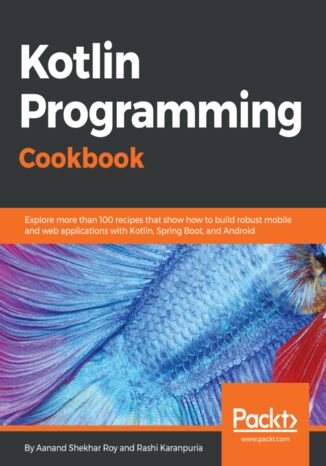
Aanand Shekhar Roy , Rashi Karanpuria
The Android team has announced first-class support for Kotlin 1.1. This acts as an added boost to the language and more and more developers are now looking at Kotlin for their application development. This recipe-based book will be your guide to learning the Kotlin programming language. The recipes in this book build from simple language concepts to more complex applications of the language. After the fundamentals of the language, you will learn how to apply the object-oriented programming features of Kotlin 1.1. Programming with Lambdas will show you how to use the functional power of Kotlin. This book has recipes that will get you started with Android programming with Kotlin 1.1, providing quick solutions to common problems encountered during Android app development. You will also be taken through recipes that will teach you microservice and concurrent programming with Kotlin. Going forward, you will learn to test and secure your applications with Kotlin. Finally, this book supplies recipes that will help you migrate your Java code to Kotlin and will help ensure that it's interoperable with Java.
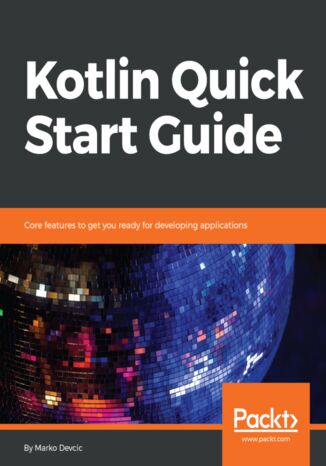
Kotlin Quick Start Guide. Core features to get you ready for developing applications
Marko Devcic
Kotlin is a general purpose, object-oriented language that primarily targets the JVM and Android. Intended as a better alternative to Java, its main goals are high interoperability with Java and increased developer productivity. Kotlin is still a new language and this book will help you to learn the core Kotlin features and get you ready for developing applications with Kotlin.This book covers Kotlin features in detail and explains them with practical code examples.You will learn how to set up the environment and take your frst steps with Kotlin and its syntax. We will cover the basics of the language, including functions, variables, and basic data types. With the basics covered, the next chapters show how functions are first-class citizens in Kotlin and deal with the object-oriented side of Kotlin.You will move on to more advanced features of Kotlin. You will explore Kotlin's Standard Library and learn how to work with the Collections API. The book finishes by putting Kotlin in to practice, showing how to build a desktop app.By the end of this book, you will be confident enough to use Kotlin for your next project.
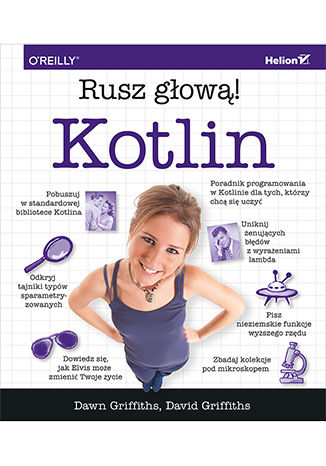
Dawn Griffiths, David Griffiths
Kariera Kotlina nabrała rozpędu, gdy w 2017 roku na konferencji Google ogłoszono go jednym z oficjalnie wspieranych języków programowania aplikacji dla Androida. Jest lubiany za zwartą składnię, elastyczność i ścisłą integrację z kodem Javy. Oczywiście odpowiada też kryteriom nowoczesnego i innowacyjnego języka programowania. Jest bardzo dobrym wyborem dla każdego, kto chce się stać profesjonalnym programistą, ale też osoby programujące hobbystycznie będą zadowolone z jego możliwości. Problemów z tym idealnym językiem programowania jest niewiele: trzeba poznać Kotlina, zrozumieć kilka niuansów i nauczyć się kodowania... Ta książka, podobnie jak inne pozycje z serii Rusz głową!, została przygotowana zgodnie z jedyną w swoim rodzaju metodyką nauczania wykorzystującą zasady funkcjonowania ludzkiego mózgu. Dzięki niej nauczysz się myśleć jak najlepsi programiści i niepostrzeżenie zaczniesz tworzyć wydajny kod w Kotlinie. Autorzy zastosowali najlepsze osiągnięcia psychologii, neurologii i innych nauk o uczeniu się, stąd niecodzienny wygląd i struktura książki. W efekcie zamiast klasycznego podręcznika otrzymujesz polisensoryczne doświadczenie poznawcze zaprojektowane tak, aby już wkrótce Kotlin stał się pewnym, niezawodnym narzędziem w Twoich rękach! W tej książce między innymi: solidne podstawy tworzenia kodu i pisanie pierwszych projektów typy sparametryzowane w Kotlinie praca na obiektach: dziedziczenie, klasy, kolekcje funkcje wyższego rzędu i wyrażenia lambda współbieżność wykonywania kodu i najciekawsze rozszerzenia Kotlin: oto radość z pisania kodu!
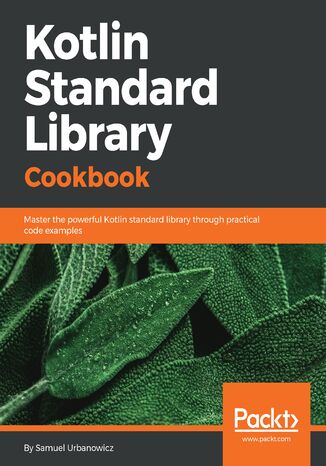
Samuel Urbanowicz
For developers who prefer a more simplistic approach to coding, Kotlin has emerged as a valuable solution for effective software development. The Kotlin standard library provides vital tools that make day-to-day Kotlin programming easier. This library features core attributes of the language, such as algorithmic problems, design patterns, data processing, and working with files and data streams.With a recipe-based approach, this book features coding solutions that you can readily execute. Through the book, you’ll encounter a variety of interesting topics related to data processing, I/O operations, and collections transformation. You’ll get started by exploring the most effective design patterns in Kotlin and understand how coroutines add new features to JavaScript. As you progress, you'll learn how to implement clean, reusable functions and scalable interfaces containing default implementations. Toward the concluding chapters, you’ll discover recipes on functional programming concepts, such as lambdas, monads, functors, and Kotlin scoping functions, which will help you tackle a range of real-life coding problems. By the end of this book, you'll be equipped with the expertise you need to address a range of challenges that Kotlin developers face by implementing easy-to-follow solutions.