
Programowanie
Chad Cooper
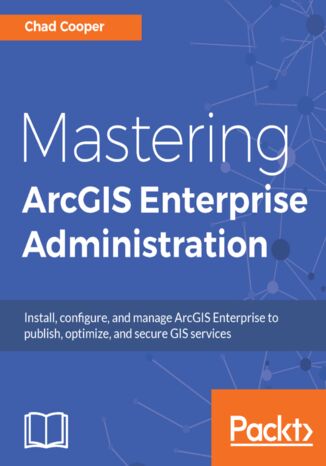
ArcGIS Enterprise, the next evolution of the ArcGIS Server product line, is a full-featured mapping and analytics platform. It includes a powerful GIS web services server and a dedicated Web GIS infrastructure for organizing and sharing your work. You will learn how to first install ArcGIS Enterprise to then plan, design, and finally publish and consume GIS services. You will install and configure an Enterprise geodatabase and learn how to administer ArcGIS Server, Portal, and Data Store through user interfaces, the REST API, and Python scripts.This book starts off by explaining how ArcGIS Enterprise 10.5.1 is different from earlier versions of ArcGIS Server and covers the installation of all the components required for ArcGIS Enterprise. We then move on to geodatabase administration and content publication, where you will learn how to use ArcGIS Server Manager to view the server logs, stop and start services, publish services, define users and roles for security, and perform other administrative tasks. You will also learn how to apply security mechanisms on ArcGIS Enterprise and safely expose services to the public in a secure manner. Finally, you’ll use the RESTful administrator API to automate server management tasks using the Python scripting language. You’ll learn all the best practices and troubleshooting methods to streamline the management of all the interconnected parts of ArcGIS Enterprise.
Mastering Arduino. A project-based approach to electronics, circuits, and programming
Jon Hoffman, Ejike (George Steve) Ifeanyichukwu, Pratik...
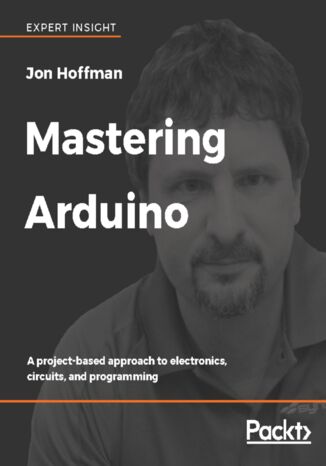
Mastering Arduino is an all-in-one guide to getting the most out of your Arduino. This practical, no-nonsense guide teaches you all of the electronics and programming skills that you need to create advanced Arduino projects. This book is packed full of real-world projects for you to practice on, bringing all of the knowledge in the book together and giving you the skills to build your own robot from the examples in this book. The final two chapters discuss wireless technologies and how they can be used in your projects. The book begins with the basics of electronics, making sure that you understand components, circuits, and prototyping before moving on. It then performs the same function for code, getting you into the Arduino IDE and showing you how to connect the Arduino to a computer and run simple projects on your Arduino.Once the basics are out of the way, the next 10 chapters of the book focus on small projects centered around particular components, such as LCD displays, stepper motors, or voice synthesizers. Each of these chapters will get you familiar with the technology involved, how to build with it, how to program it, and how it can be used in your own projects.
Mithun Pattankar, Malendra Hurbuns
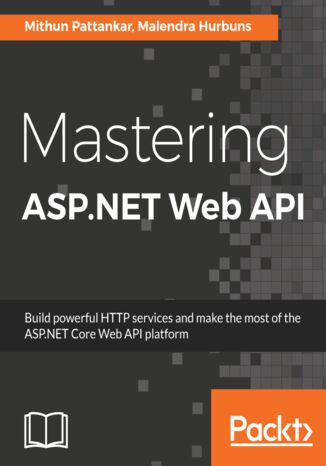
Microsoft has unified their main web development platforms. This unification will help develop web applications using various pieces of the ASP.NET platform that can be deployed on both Windows and LINUX. With ASP.NET Core (Web API), it will become easier than ever to build secure HTTP services that can be used from any client.Mastering ASP.NET Web API starts with the building blocks of the ASP.NET Core, then gradually moves on to implementing various HTTP routing strategies in the Web API. We then focus on the key components of building applications that employ the Web API, such as Kestrel, Middleware, Filters, Logging, Security, and Entity Framework.Readers will be introduced to take the TDD approach to write test cases along with the new Visual Studio 2017 live unit testing feature. They will also be introduced to integrate with the database using ORMs. Finally, we explore how the Web API can be consumed in a browser as well as by mobile applications by utilizing Angular 4, Ionic and ReactJS.By the end of this book, you will be able to apply best practices to develop complex Web API, consume them in frontend applications and deploy these applications to a modern hosting infrastructure.
Mastering Assembly Programming. From instruction set to kernel module with Intel processor
Alexey Lyashko
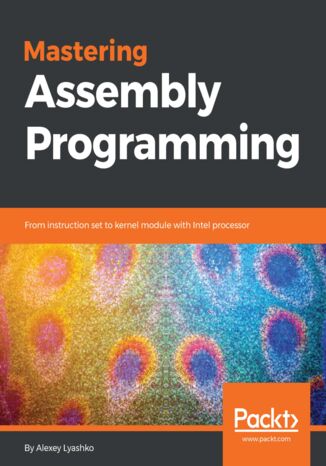
The Assembly language is the lowest level human readable programming language on any platform. Knowing the way things are on the Assembly level will help developers design their code in a much more elegant and efficient way. It may be produced by compiling source code from a high-level programming language (such as C/C++) but can also be written from scratch. Assembly code can be converted to machine code using an assembler.The first section of the book starts with setting up the development environment on Windows and Linux, mentioning most common toolchains. The reader is led through the basic structure of CPU and memory, and is presented the most important Assembly instructions through examples for both Windows and Linux, 32 and 64 bits. Then the reader would understand how high level languages are translated into Assembly and then compiled into object code. Finally we will cover patching existing code, either legacy code without sources or a running code in same or remote process.
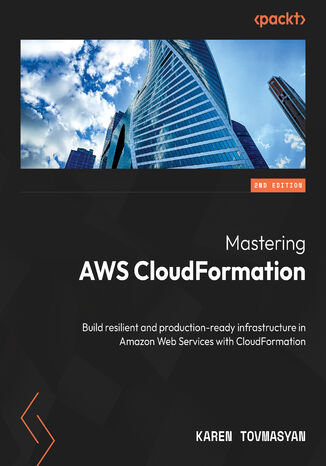
Karen Tovmasyan
The advent of DevOps and the cloud revolution has compelled software engineers and operations teams to rethink how to manage complex infrastructures and build resilient solutions. With this AWS book, you’ll find out how you can use Infrastructure as Code (IaC) to simplify infrastructure operations and manage the modern cloud with AWS CloudFormation.This guide covers AWS CloudFormation comprehensively, from template structures to developing complex and reusable infrastructure stacks. It takes you through template validation, stack deployment, and handling deployment failures. It also demonstrates the use of AWS CodeBuild and CodePipeline for automating resource delivery and implementing continuous integration and continuous delivery (CI/CD) practices.As you advance, you’ll learn how to modularize and unify your template on the fly using macros or by fixating the version using modules. You’ll create resources outside of AWS with custom resources and catalog them with the CloudFormation registry. Finally, you’ll improve the way you manage the modern cloud environment on AWS by extending CloudFormation through the AWS serverless application model (SAM) and the AWS cloud development kit (CDK).By the end of this book, you’ll have mastered key AWS CloudFormation concepts and will be able to extend its capabilities for developing and deploying your own infrastructure.
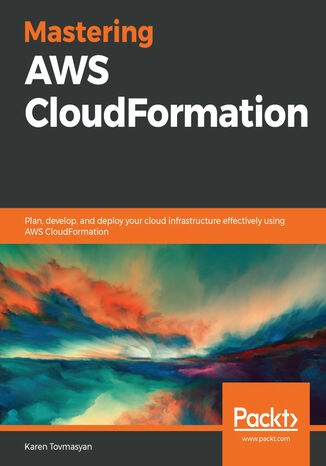
Karen Tovmasyan
DevOps and the cloud revolution have forced software engineers and operations teams to rethink how to manage infrastructures. With this AWS book, you'll understand how you can use Infrastructure as Code (IaC) to simplify IT operations and manage the modern cloud infrastructure effectively with AWS CloudFormation.This comprehensive guide will help you explore AWS CloudFormation from template structures through to developing complex and reusable infrastructure stacks. You'll then delve into validating templates, deploying stacks, and handling deployment failures. The book will also show you how to leverage AWS CodeBuild and CodePipeline to automate resource delivery and apply continuous integration and continuous delivery (CI/CD) practices to the stack. As you advance, you'll learn how to generate templates on the fly using macros and create resources outside AWS with custom resources. Finally, you'll improve the way you manage the modern cloud in AWS by extending CloudFormation using AWS serverless application model (SAM) and AWS cloud development kit (CDK).By the end of this book, you'll have mastered all the major AWS CloudFormation concepts and be able to simplify infrastructure management.
Mastering AWS Lambda. Learn how to build and deploy serverless applications
Yohan Wadia, Udita Gupta
AWS is recognized as one of the biggest market leaders for cloud computing and why not? It has evolved a lot since the time it started out by providing just basic services such as EC2 and S3 and today; they go all the way from IoT to Machine Learning, Image recognition, Chatbot Frameworks, and much more! One of those recent services that is also gaining a lot of traction is AWS Lambda! Although seemingly simple and easy to use, Lambda is a highly effective and scalable compute service that provides developers with a powerful platform to design and develop Serverless event-driven systems and applications. The book begins with a high-level introduction into the world of Serverless computing and its advantages and use cases, followed by a deep dive into AWS Lambda! You’ll learn what services AWS Lambda provides to developers; how to design, write, and test Lambda functions; as well as monitor and troubleshoot them. The book is designed and accompanied with a vast variety of real-world examples, use cases, and code samples that will enable you to get started on your Serverless applications quickly. By the end of the book, you will have gained all the skills required to work with AWS Lambda services!
Mastering AWS Security. Create and maintain a secure cloud ecosystem
Albert Anthony
Mastering AWS Security starts with a deep dive into the fundamentals of the shared security responsibility model. This book tells you how you can enable continuous security, continuous auditing, and continuous compliance by automating your security in AWS with the tools, services, and features it provides.Moving on, you will learn about access control in AWS for all resources. You will also learn about the security of your network, servers, data and applications in the AWS cloud using native AWS security services. By the end of this book, you will understand the complete AWS Security landscape, covering all aspects of end - to -end software and hardware security along with logging, auditing, and compliance of your entire IT environment in the AWS cloud. Lastly, the book will wrap up with AWS best practices for security.