
Programowanie gier
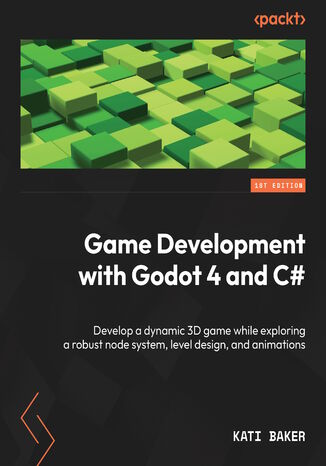
Kati Baker
Godot is a versatile, open-source game engine that empowers developers with creative freedom and ownership of their work. Written by a game developer and designer who's been creating games since her first game jam in 2016, this comprehensive guide helps you gain the essential skills you need to embark on an exciting journey into the realm of game development with Godot 4 and C#.This book guides you through the installation of the Godot Engine and introduces you to the powerful capabilities of C# within it. The chapters will help you smoothly integrate C# into your Godot project as you learn how to create a captivating 3D adventure game by exploring topics including project organization, player controller creation, world design, and user-friendly UI development. As you progress, you'll delve into advanced game development aspects such as audio integration, pathfinding algorithms, and dynamic lighting. You'll also get to grips with accessibility considerations in game development and effective bug reporting techniques. Toward the end, you'll discover the vibrant Godot community and gain access to a wealth of resources to further improve your game development skills.By the end of this Godot book, you'll have built a complete 3D adventure game and gained a solid foundation to continue creating your own games.
Game Development with Rust and WebAssembly. Learn how to run Rust on the web while building a game
Eric Smith
The Rust programming language has held the most-loved technology ranking on Stack Overflow for 6 years running, while JavaScript has been the most-used programming language for 9 years straight as it runs on every web browser. Now, thanks to WebAssembly (or Wasm), you can use the language you love on the platform that's everywhere.This book is an easy-to-follow reference to help you develop your own games, teaching you all about game development and how to create an endless runner from scratch. You'll begin by drawing simple graphics in the browser window, and then learn how to move the main character across the screen. You'll also create a game loop, a renderer, and more, all written entirely in Rust. After getting simple shapes onto the screen, you'll scale the challenge by adding sprites, sounds, and user input. As you advance, you'll discover how to implement a procedurally generated world. Finally, you'll learn how to keep your Rust code clean and organized so you can continue to implement new features and deploy your app on the web.By the end of this Rust programming book, you'll build a 2D game in Rust, deploy it to the web, and be confident enough to start building your own games.
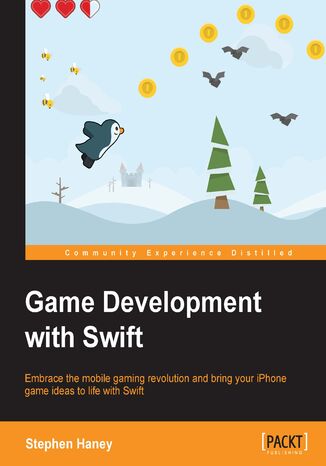
Stephen Haney
If you wish to create and publish fun iOS games using Swift, then this book is for you. You should be familiar with basic programming concepts. However, no prior game development or Apple ecosystem experience is required.
Jiadong Chen
Understand what makes Unity the world’s most widely used real-time 3D development platform and explore its powerful features for creating 3D and 2D games, as well as the Unity game engine and the Microsoft Game Dev, including the Microsoft Azure Cloud and Microsoft Azure PlayFab services, to create games.You will start by getting acquainted with the Unity editor and the basic concepts of Unity script programming with C#. You'll then learn how to use C# code to work with Unity's built-in modules, such as UI, animation, physics, video, and audio, and understand how to develop a game with Unity and C#. As you progress through the chapters, you'll cover advanced topics such as the math involved in computer graphics and how to create a custom render pipeline in Unity with the new Scriptable Render Pipeline, all while optimizing performance in Unity. Along the way, you'll be introduced to Microsoft Game Dev, Azure services, and Azure PlayFab, and using the Unity3D PlayFab SDK to access the PlayFab API.By the end of this Unity book, you'll have become familiar with the Unity engine and be ready to develop your own games while also addressing the performance issues that you could encounter in the development process.
Gabor Szauer
Physics is really important for game programmers who want to add realism and functionality to their games. Collision detection in particular is a problem that affects all game developers, regardless of the platform, engine, or toolkit they use.This book will teach you the concepts and formulas behind collision detection. You will also be taught how to build a simple physics engine, where Rigid Body physics is the main focus, and learn about intersection algorithms for primitive shapes.You’ll begin by building a strong foundation in mathematics that will be used throughout the book. We’ll guide you through implementing 2D and 3D primitives and show you how to perform effective collision tests for them. We then pivot to one of the harder areas of game development—collision detection and resolution. Further on, you will learn what a Physics engine is, how to set up a game window, and how to implement rendering. We’ll explore advanced physics topics such as constraint solving. You’ll also find out how to implement a rudimentary physics engine, which you can use to build an Angry Birds type of game or a more advanced game.By the end of the book, you will have implemented all primitive and some advanced collision tests, and you will be able to read on geometry and linear Algebra formulas to take forward to your own games!
Pavel Strakhov, Witold Wysota, Lorenz Haas
Qt is the leading cross-platform toolkit for all significant desktop, mobile, and embedded platforms and is becoming popular by the day, especially on mobile and embedded devices. It's a powerful tool that perfectly fits the needs of game developers. This book will help you learn the basics of Qt and will equip you with the necessary toolsets to build apps and games.The book begins by how to create an application and prepare a working environment for both desktop and mobile platforms. You will learn how to use built-in Qt widgets and Form Editor to create a GUI application and then learn the basics of creating graphical interfaces and Qt's core concepts.Further, you'll learn to enrich your games by implementing network connectivity and employing scripting. You will learn about Qt's capabilities for handling strings and files, data storage, and serialization.Moving on, you will learn about the new Qt Gamepad module and how to add it in your game and then delve into OpenGL and Vulcan, and how it can be used in Qt applications to implement hardware-accelerated 2D and 3D graphics. You will then explore various facets of Qt Quick: how it can be used in games to add game logic, add game physics, and build astonishing UIs for your games. By the end of this book, you will have developed the skillset to develop interesting games with Qt.
Nathan Thomas Auckett
This book is for users experienced with game development who now want to learn how to develop games in GameMaker: Studio in a fast-paced way.
Gamesalad Essentials. Create awesome cross-platform games in no time, and with no coding
Miguel DeQuadros
If you want to create your own game, but don't know where to start, this is the book for you. Whether you've used GameSalad before, or have prior game development experience or not you are sure to learn! Imaging software experience, such as Photoshop, is good to have, but art and assets are provided in the book's resources.