
Java
Aanand Shekhar Roy, Rashi Karanpuria
The Android team has announced first-class support for Kotlin 1.1. This acts as an added boost to the language and more and more developers are now looking at Kotlin for their application development. This recipe-based book will be your guide to learning the Kotlin programming language. The recipes in this book build from simple language concepts to more complex applications of the language. After the fundamentals of the language, you will learn how to apply the object-oriented programming features of Kotlin 1.1. Programming with Lambdas will show you how to use the functional power of Kotlin. This book has recipes that will get you started with Android programming with Kotlin 1.1, providing quick solutions to common problems encountered during Android app development. You will also be taken through recipes that will teach you microservice and concurrent programming with Kotlin. Going forward, you will learn to test and secure your applications with Kotlin. Finally, this book supplies recipes that will help you migrate your Java code to Kotlin and will help ensure that it's interoperable with Java.
Kotlin Quick Start Guide. Core features to get you ready for developing applications
Marko Devcic
Kotlin is a general purpose, object-oriented language that primarily targets the JVM and Android. Intended as a better alternative to Java, its main goals are high interoperability with Java and increased developer productivity. Kotlin is still a new language and this book will help you to learn the core Kotlin features and get you ready for developing applications with Kotlin.This book covers Kotlin features in detail and explains them with practical code examples.You will learn how to set up the environment and take your frst steps with Kotlin and its syntax. We will cover the basics of the language, including functions, variables, and basic data types. With the basics covered, the next chapters show how functions are first-class citizens in Kotlin and deal with the object-oriented side of Kotlin.You will move on to more advanced features of Kotlin. You will explore Kotlin's Standard Library and learn how to work with the Collections API. The book finishes by putting Kotlin in to practice, showing how to build a desktop app.By the end of this book, you will be confident enough to use Kotlin for your next project.
Dawn Griffiths, David Griffiths
Kariera Kotlina nabrała rozpędu, gdy w 2017 roku na konferencji Google ogłoszono go jednym z oficjalnie wspieranych języków programowania aplikacji dla Androida. Jest lubiany za zwartą składnię, elastyczność i ścisłą integrację z kodem Javy. Oczywiście odpowiada też kryteriom nowoczesnego i innowacyjnego języka programowania. Jest bardzo dobrym wyborem dla każdego, kto chce się stać profesjonalnym programistą, ale też osoby programujące hobbystycznie będą zadowolone z jego możliwości. Problemów z tym idealnym językiem programowania jest niewiele: trzeba poznać Kotlina, zrozumieć kilka niuansów i nauczyć się kodowania... Ta książka, podobnie jak inne pozycje z serii Rusz głową!, została przygotowana zgodnie z jedyną w swoim rodzaju metodyką nauczania wykorzystującą zasady funkcjonowania ludzkiego mózgu. Dzięki niej nauczysz się myśleć jak najlepsi programiści i niepostrzeżenie zaczniesz tworzyć wydajny kod w Kotlinie. Autorzy zastosowali najlepsze osiągnięcia psychologii, neurologii i innych nauk o uczeniu się, stąd niecodzienny wygląd i struktura książki. W efekcie zamiast klasycznego podręcznika otrzymujesz polisensoryczne doświadczenie poznawcze zaprojektowane tak, aby już wkrótce Kotlin stał się pewnym, niezawodnym narzędziem w Twoich rękach! W tej książce między innymi: solidne podstawy tworzenia kodu i pisanie pierwszych projektów typy sparametryzowane w Kotlinie praca na obiektach: dziedziczenie, klasy, kolekcje funkcje wyższego rzędu i wyrażenia lambda współbieżność wykonywania kodu i najciekawsze rozszerzenia Kotlin: oto radość z pisania kodu!
Samuel Urbanowicz
For developers who prefer a more simplistic approach to coding, Kotlin has emerged as a valuable solution for effective software development. The Kotlin standard library provides vital tools that make day-to-day Kotlin programming easier. This library features core attributes of the language, such as algorithmic problems, design patterns, data processing, and working with files and data streams.With a recipe-based approach, this book features coding solutions that you can readily execute. Through the book, you’ll encounter a variety of interesting topics related to data processing, I/O operations, and collections transformation. You’ll get started by exploring the most effective design patterns in Kotlin and understand how coroutines add new features to JavaScript. As you progress, you'll learn how to implement clean, reusable functions and scalable interfaces containing default implementations. Toward the concluding chapters, you’ll discover recipes on functional programming concepts, such as lambdas, monads, functors, and Kotlin scoping functions, which will help you tackle a range of real-life coding problems. By the end of this book, you'll be equipped with the expertise you need to address a range of challenges that Kotlin developers face by implementing easy-to-follow solutions.
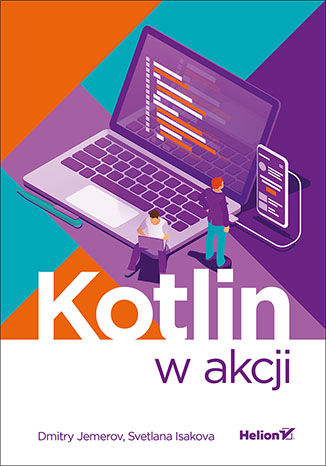
Dmitry Jemerov, Svetlana Isakova
Kotlin został zaprojektowany jako obiektowy język w pełni interoperacyjny z kodem napisanym w Javie. Został zaprezentowany w 2011 roku. Od tego czasu jest rozwijany, a jego popularność stale rośnie. Kotlin jest językiem o statycznie typowanych zmiennych. Charakteryzuje się czytelną składnią i ścisłą integracją z istniejącymi projektami, bibliotekami i platformami utworzonymi w Javie. Kompiluje się do postaci binarnego kodu JVM, więc można go uruchamiać wszędzie tam, gdzie jest Java, również w Androidzie. Kotlin zainteresuje programistów aplikacji mobilnych również dlatego, że kod napisany w tym języku obciąża system w minimalnym stopniu. Przy tym wszystkim środowisko Kotlina jest w całości otwartym oprogramowaniem do bezpłatnego korzystania w dowolnych celach! Ta książka jest przeznaczona dla osób, które mają pewne doświadczenia z Javą i chcą szybko poznać Kotlina w stopniu pozwalającym na tworzenie aplikacji serwerowych, dla systemu Android i maszyn JVM. Znalazł się tu opis podstawowych cech języka i jego najważniejszych struktur, a następnie przedstawiono bardziej zaawansowane zagadnienia, takie jak tworzenie wysokopoziomowych abstrakcji i języków domenowych. Duży nacisk położono na integrację kodu Kotlin z istniejącymi projektami Java oraz na sposoby wprowadzania Kotlina do aktualnie użytkowanego środowiska. Zaprezentowano kilka przydatnych bibliotek i narzędzi, znakomicie ułatwiających pracę programiście. Nie zabrakło również licznych przykładów kodu, ilustrujących omawiane zagadnienia. W tej książce między innymi: solidne wprowadzenie do Kotlina klasy, klasy danych i funkcje lambda typy danych, w tym kolekcje i puste zmienne własne interfejsy i abstrakcje w Kotlinie parametry reifikowanego typu, adnotacje i refleksje Kotlin - idealny dla Androida!
Nick Samoylov
Java is one of the preferred languages among developers, used in everything right from smartphones, and game consoles to even supercomputers, and its new features simply add to the richness of the language. This book on Java programming begins by helping you learn how to install the Java Development Kit. You will then focus on understanding object-oriented programming (OOP), with exclusive insights into concepts like abstraction, encapsulation, inheritance, and polymorphism, which will help you when programming for real-world apps. Next, you’ll cover fundamental programming structures of Java such as data structures and algorithms that will serve as the building blocks for your apps. You will also delve into core programming topics that will assist you with error handling, debugging, and testing your apps. As you progress, you’ll move on to advanced topics such as Java libraries, database management, and network programming, which will hone your skills in building professional-grade apps.Further on, you’ll understand how to create a graphic user interface using JavaFX and learn to build scalable apps by taking advantage of reactive and functional programming.By the end of this book, you’ll not only be well versed with Java 10, 11, and 12, but also gain a perspective into the future of this language and software development in general.
Stephen Samuel, Stefan Bocutiu
Kotlin is a general-purpose programming language used for developing cross-platform applications. Complete with a comprehensive introduction and projects covering the full set of Kotlin programming features, this book will take you through the fundamentals of Kotlin and get you up to speed in no time. Learn Kotlin Programming covers the installation, tools, and how to write basic programs in Kotlin. You'll learn how to implement object-oriented programming in Kotlin and easily reuse your program or parts of it. The book explains DSL construction, serialization, null safety aspects, and type parameterization to help you build robust apps. You'll learn how to destructure expressions and write your own. You'll then get to grips with building scalable apps by exploring advanced topics such as testing, concurrency, microservices, coroutines, and Kotlin DSL builders. Furthermore, you'll be introduced to the kotlinx.serialization framework, which is used to persist objects in JSON, Protobuf, and other formats.By the end of this book, you'll be well versed with all the new features in Kotlin and will be able to build robust applications skillfully.
Slava Schmidt
The second version of Scala has undergone multiple changes to support features and library implementations. Scala 2.13, with its main focus on modularizing the standard library and simplifying collections, brings with it a host of updates.Learn Scala Programming addresses both technical and architectural changes to the redesigned standard library and collections, along with covering in-depth type systems and first-level support for functions. You will discover how to leverage implicits as a primary mechanism for building type classes and look at different ways to test Scala code. You will also learn about abstract building blocks used in functional programming, giving you sufficient understanding to pick and use any existing functional programming library out there. In the concluding chapters, you will explore reactive programming by covering the Akka framework and reactive streams. By the end of this book, you will have built microservices and learned to implement them with the Scala and Lagom framework.