
Java
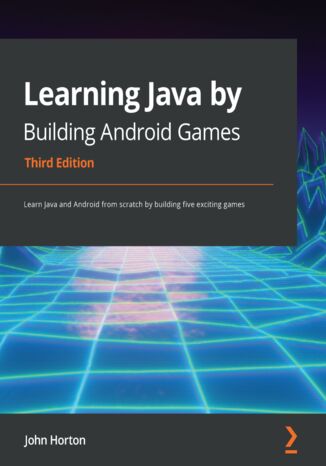
John Horton
Android is one of the most popular mobile operating systems today. It uses the most popular programming language, Java, as one of the primary languages for building apps of all types. Unlike most other Android books, this book doesn’t assume that you have any prior knowledge of Java programming, instead helps you get started with building Android games as a beginner.This new, improved, and updated third edition of Learning Java by Building Android Games helps you to build Android games from scratch. Once you've got to grips with the fundamentals, the difficulty level increases steadily as you explore key Java topics, such as variables, loops, methods, object-oriented programming (OOP), and design patterns while working with up-to-date code and supporting examples. At each stage, you'll be able to test your understanding by implementing the concepts that you’ve learned to develop a game. Toward the end, you’ll build games such as Sub Hunter, Retro Pong, Bullet Hell, Classic Snake, and Scrolling Shooter.By the end of this Java book, you'll not only have a solid understanding of Java and Android basics but will also have developed five cool games for the Android platform.
Learning Java Lambdas. An in-depth look at one of the most important features of modern Java
Toby Weston
In this short book, we take an in-depth look at lambdas in Java, and their supporting features. The book covers essential topics, such as functional interfaces and type inference, and the key differences between lambdas and closures. You will learn about the background to functional programming and lambdas, before moving on to understanding the basic syntax of lambdas and what differentiates these anonymous functions from standard anonymous classes. Lastly, you'll learn how to invoke lambdas and look at the bytecode generated.After reading this book, you'll understand lambdas in depth, their background, syntax, implementation details, and how and when to use them. You'll also have a clear knowledge of the difference between functions and classes, and why that's relevant to lambdas. This knowledge will enable you to appreciate the improvements to type inference that drive a lot of the new features in modern Java, and will increase your understanding of method references and scoping.
Rik Van Bruggen
Neo4j is the world's leading graph database and offers users a radical new way of dealing with connected data. This book has been created to help you get to grips with it, providing you with an accessible route through a tool built to contend with the complexity of modern data. Learn the fundamental concepts behind Neo4j, and put them into practice by following the featured examples and use cases that demonstrate how to apply your knowledge to real problems.Starting with a brief introduction to graph theory, this book will show you the advantages of using graph databases. Following on from that, you will be introduced to Neo4j and you will be shown how to install it on various operating systems. You will then be shown how you can model and import your data into Neo4j.This book has two use case examples that will show you how to model and implement a graph in Neo4j by analyzing a user case, and analyze the impact a change has on a process or a system. You will also gain an insight into graph visualization options and discover external sources where you can learn more about this exciting and popular graph database.
Nick Samoylov, Thomas Nield
RxJava is not just a popular library for building asynchronous and event-based applications; it also enables you to create a cleaner and more readable code base. In this book, you’ll cover the core fundamentals of reactive programming and learn how to design and implement reactive libraries and applications.Learning RxJava will help you understand how reactive programming works and guide you in writing your first example in reactive code. You’ll get to grips with the workings of Observable and Subscriber, and see how they are used in different contexts using real-world use cases. The book will also take you through multicasting and caching to help prevent redundant work with multiple Observers. You’ll then learn how to create your own RxJava operators by reusing reactive logic. As you advance, you’ll explore effective tools and libraries to test and debug RxJava code. Finally, you’ll delve into RxAndroid extensions and use Kotlin features to streamline your Android apps.By the end of this book, you'll become proficient in writing reactive code in Java and Kotlin to build concurrent applications, including Android applications.
Learning RxJava. Reactive, Concurrent, and responsive applications
Thomas Nield
RxJava is a library for composing asynchronous and event-based programs using Observable sequences for the JVM, allowing developers to build robust applications in less time.Learning RxJava addresses all the fundamentals of reactive programming to help readers write reactive code, as well as teach them an effective approach to designing and implementing reactive libraries and applications. Starting with a brief introduction to reactive programming concepts, there is an overview of Observables and Observers, the core components of RxJava, and how to combine different streams of data and events together. You will also learn simpler ways to achieve concurrency and remain highly performant, with no need for synchronization. Later on, we will leverage backpressure and other strategies to cope with rapidly-producing sources to prevent bottlenecks in your application. After covering custom operators, testing, and debugging, the book dives into hands-on examples using RxJava on Android as well as Kotlin.
Vikash Sharma
Scala is a general-purpose programming language that supports both functional and object-oriented programming paradigms. Due to its concise design and versatility, Scala's applications have been extended to a wide variety of fields such as data science and cluster computing. You will learn to write highly scalable, concurrent, and testable programs to meet everyday software requirements.We will begin by understanding the language basics, syntax, core data types, literals, variables, and more. From here you will be introduced to data structures with Scala and you will learn to work with higher-order functions. Scala's powerful collections framework will help you get the best out of immutable data structures and utilize them effectively. You will then be introduced to concepts such as pattern matching, case classes, and functional programming features. From here, you will learn to work with Scala's object-oriented features. Going forward, you will learn about asynchronous and reactive programming with Scala, where you will be introduced to the Akka framework. Finally, you will learn the interoperability of Scala and Java.After reading this book, you'll be well versed with this language and its features, and you will be able to write scalable, concurrent, and reactive programs in Scala.
Greg L. Turnquist
Spring Boot provides a variety of features that address today's business needs along with today's scalable requirements. In this book, you will learn how to leverage powerful databases and Spring Boot's state-of-the-art WebFlux framework. This practical guide will help you get up and running with all the latest features of Spring Boot, especially the new Reactor-based toolkit.The book starts off by helping you build a simple app, then shows you how to bundle and deploy it to the cloud. From here, we take you through reactive programming, showing you how to interact with controllers and templates and handle data access. Once you're done, you can start writing unit tests, slice tests, embedded container tests, and even autoconfiguration tests.We go into detail about developer tools, AMQP messaging, WebSockets, security, and deployment. You will learn how to secure your application using both routes and method-based rules. By the end of the book, you'll have built a social media platform from which to apply the lessons you have learned to any problem. If you want a good understanding of building scalable applications using the core functionality of Spring Boot, this is the book for you.
Piotr Filipowicz, Katarzyna B Ziolkowska, Katarzyna Zió?Çkowska,...