
Java
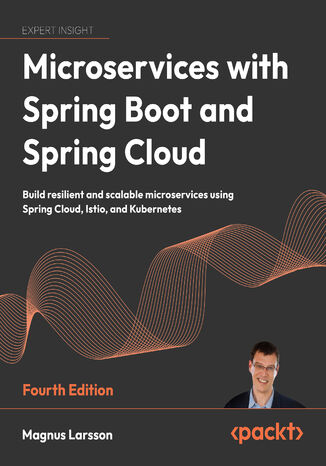
Magnus Larsson
Do you want to build and deploy microservices but are unsure where to begin? Check out the fully updated 2025 edition of Microservices with Spring Boot and Spring Cloud. Drawing from Magnus’ decades of experience, you’ll start with simple microservices and progress to complex distributed applications, learning essential functionality and deploying microservices using Kubernetes and Istio along the way. This book covers Java 24, Spring Boot 3.5, and Spring Cloud 2025, featuring updated code examples and replacing deprecated APIs. You’ll get a clear understanding of Spring’s Ahead of Time (AOT) module, observability, distributed tracing, and Helm for Kubernetes packaging. The chapters show you how to use Docker Compose to run microservices with databases and messaging services and deploy microservices on Kubernetes with Istio. You’ll also explore persistence, resilience, reactive microservices, and API documentation with OpenAPI, as well as learn service discovery with Netflix Eureka, edge servers with Spring Cloud Gateway, and monitoring with Prometheus, Grafana, and the EFK stack. By the end of this book, you’ll be able to confidently build scalable microservices using Spring Boot and Spring Cloud.
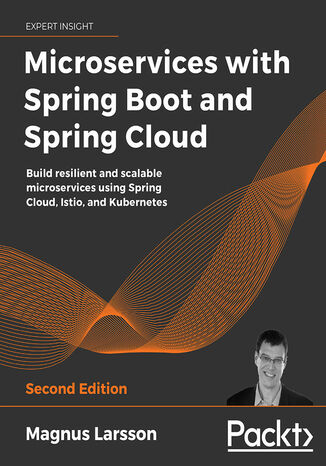
Magnus Larsson
Want to build and deploy microservices, but don’t know where to start? Welcome to Microservices with Spring Boot and Spring Cloud.This edition features the most recent versions of Spring, Java, Kubernetes, and Istio, demonstrating faster and simpler handling of Spring Boot, local Kubernetes clusters, and Istio installation. The expanded scope includes native compilation of Spring-based microservices, support for Mac and Windows with WSL2, and an introduction to Helm 3 for packaging and deployment. A revamped security chapter now follows the OAuth 2.1 specification and makes use of the newly launched Spring Authorization Server from the Spring team.You’ll start with a set of simple cooperating microservices, then add persistence and resilience, make your microservices reactive, and document their APIs using OpenAPI.Next, you’ll learn how fundamental design patterns are applied to add important functionality, such as service discovery with Netflix Eureka and edge servers with Spring Cloud Gateway. You’ll deploy your microservices using Kubernetes and adopt Istio, then explore centralized log management using the Elasticsearch, Fluentd, and Kibana (EFK) stack, and then monitor microservices using Prometheus and Grafana.By the end of this book, you'll be building scalable and robust microservices using Spring Boot and Spring Cloud.
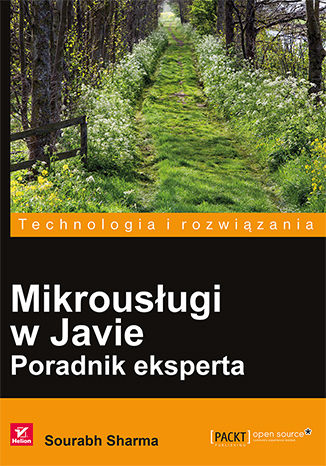
Mikrousługi w Javie. Poradnik eksperta
Sourabh Sharma
Chmury obliczeniowe otworzyły nowe możliwości projektowania aplikacji korporacyjnych. Obecnie konstruuje się je z małych, lekkich i zorientowanych na proces komponentów, nazywanych mikrousługami. Tworzone w ten sposób aplikacje są skalowalne i łatwe do zarządzania, a przy tym niezwykle elastyczne i wykorzystujące dostępne zasoby w wyjątkowo efektywny sposób. Jak łatwo się przekonać, projektowanie i implementacja mikrousług otwierają przed programistami Javy bardzo obiecujące perspektywy! Niniejsza książka jest przeznaczona dla programistów Javy, którzy znają podstawowe pojęcia dotyczące mikrousług i chcą tworzyć funkcjonalne aplikacje biznesowe w tej technologii. Przedstawiono tu najważniejsze zasady realizacji dużych projektów, zaprezentowano ważne szczegóły dotyczące konfiguracji środowiska programistycznego i ciągłej integracji, które ułatwią wdrażanie mikrousług. Opisano zalety i sposoby wykorzystania biblioteki Spring Security. Przedstawiono dobre praktyki projektowania mikrousług, a także techniki ich debugowania, tak aby bez problemu można było zaprojektować i wdrożyć aplikację w środowisku korporacyjnym. Niektóre zagadnienia omówione w książce: środowiska programistyczne i narzędzia do projektowania mikrousług różne technologie wdrażania mikrousług zabezpieczanie mikrousług, w tym uwierzytelnianie i autoryzacja testowanie mikrousług za pomocą klientów REST tworzenie interfejsów użytkownika w technologii Angular JS typowe problemy związane z projektowaniem mikrousług i ich rozwiązywanie Mikrousługi — sprytne rozwiązania biznesowe dla dużych korporacji! Sourabh Sharma tworzy aplikacje od ponad 10 lat. Jest cenionym ekspertem w dziedzinie tworzenia, wdrażania i testowania wielowarstwowych aplikacji internetowych. Opracował i wdrożył wiele rozwiązań samodzielnych i chmurowych dla klientów z listy Fortune 500. Jest autorem wielu systemów opartych na mikrousługach. Sharma jest pasjonatem Javy. Uwielbia analizowanie skomplikowanych problemów i poszukiwanie niestandardowych rozwiązań.
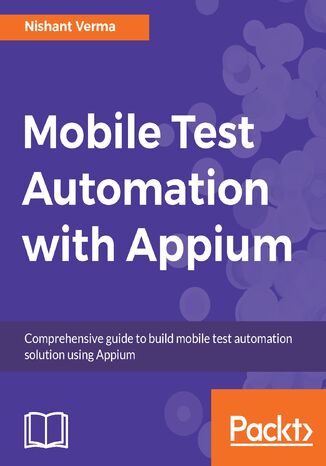
Mobile Test Automation with Appium. Mobile application testing made easy
Nishant Verma
Appium is an open source test automation framework for mobile applications. It allows you to test all three types of mobile applications: native, hybrid, and mobile web. It allows you to run the automated tests on actual devices, emulators, and simulators. Today, when every mobile app is made on at least two platforms, iOS and Android, you need a tool that allows you to test across platforms. Having two different frameworks for the same app increases the cost of the product and time to maintain it as well. Appium helps save this cost.With mobile app growth exploding, mobile app automation is mainstream now. In this book, author Nishant Verma provides you with a firm grounding in the concepts of Appium while diving into how to set up appium & Cucumber-jvm test automation framework, implement page object design pattern, automate gestures, test execution on emulators and physical devices, and implement continuous integration with Jenkins. The mobile app we have referenced in this book is Quikr because of its relatively lower learning curve to understand the application. It's a local classifieds shopping app.
Sourabh Sharma
Spring is a powerful and widely adopted framework for building scalable and reliable web applications in Java, complemented by Spring Boot, a popular extension to the framework that simplifies the setup and configuration of Spring-based applications. This book is an in-depth guide to harnessing Spring 6 and Spring Boot 3 for web development, offering practical knowledge of building modern robust web APIs and services.The book covers a wide range of topics that are essential for API development, including RESTful web service fundamentals, Spring concepts, and API specifications. It also explores asynchronous API design, security, designing user interfaces, testing APIs, and the deployment of web services. In addition to its comprehensive coverage, this book offers a highly contextual real-world sample app that you can use as a reference for building different types of APIs for real-world applications. This sample app will lead you through the entire API development cycle, encompassing design and specification, implementation, testing, and deployment.By the end of this book, you’ll have learned how to design, develop, test, and deploy scalable and maintainable modern APIs using Spring 6 and Spring Boot 3, along with best practices for bolstering the security and reliability of your applications and improving your application's overall functionality.
Sourabh Sharma
The philosophy of API development has evolved over the years to serve the modern needs of enterprise architecture, and developers need to know how to adapt to these modern API design principles. Apps are now developed with APIs that enable ease of integration for the cloud environment and distributed systems. With this Spring book, you'll discover various kinds of production-ready API implementation using REST APIs and explore async using the reactive paradigm, gRPC, and GraphQL.You'll learn how to design evolving REST-based APIs supported by HATEOAS and ETAGs and develop reactive, async, non-blocking APIs. After that, you'll see how to secure REST APIs using Spring Security and find out how the APIs that you develop are consumed by the app's UI. The book then takes you through the process of testing, deploying, logging, and monitoring your APIs. You'll also explore API development using gRPC and GraphQL and design modern scalable architecture with microservices. The book helps you gain practical knowledge of modern API implementation using a sample e-commerce app. By the end of this Spring book, you'll be able to develop, test, and deploy highly scalable, maintainable, and developer-friendly APIs to help your customers to transform their business.
Ilango gurusamy
Scala is both a functional programming and object-oriented programming language designed to express common programming patterns in a concise, readable, and type-safe way. Complete with step-by-step instructions, Modern Scala Projects will guide you in exploring Scala capabilities and learning best practices. Along the way, you'll build applications for professional contexts while understanding the core tasks and components.You’ll begin with a project for predicting the class of a flower by implementing a simple machine learning model. Next, you'll create a cancer diagnosis classification pipeline, followed by tackling projects delving into stock price prediction, spam filtering, fraud detection, and a recommendation engine. The focus will be on application of ML techniques that classify data and make predictions, with an emphasis on automating data workflows with the Spark ML pipeline API. The book also showcases the best of Scala’s functional libraries and other constructs to help you roll out your own scalable data processing frameworks.By the end of this Scala book, you’ll have a firm foundation in Scala programming and have built some interesting real-world projects to add to your portfolio.
Koushik Srinivas Kothagal
The Java 9 module system is an important addition to the language that affects the way we design, write, and organize code and libraries in Java. It provides a new way to achieve maintainable code by the encapsulation of Java types, as well as a way to write better libraries that have clear interfaces. Effectively using the module system requires an understanding of how modules work and what the best practices of creating modules are.This book will give you step-by-step instructions to create new modules as well as migrate code from earlier versions of Java to the Java 9 module system. You'll be working on a fully modular sample application and add features to it as you learn about Java modules. You'll learn how to create module definitions, setup inter-module dependencies, and use the built-in modules from the modular JDK. You will also learn about module resolution and how to use jlink to generate custom runtime images.We will end our journey by taking a look at the road ahead. You will learn some powerful best practices that will help you as you start building modular applications. You will also learn how to upgrade an existing Java 8 codebase to Java 9, handle issues with libraries, and how to test Java 9 applications.