
Techniki programowania
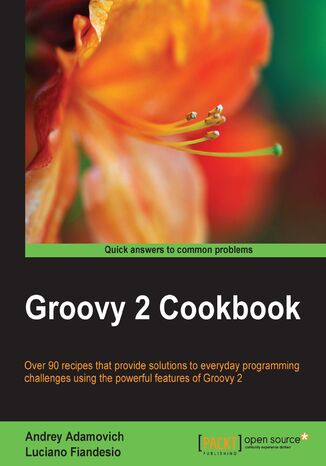
Andrey Adamovich, Luciano Fiandesio
Get up to speed with Groovy, a language for the Java Virtual Machine (JVM) that integrates features of both object-oriented and functional programming. This book will show you the powerful features of Groovy 2 applied to real-world scenarios and how the dynamic nature of the language makes it very simple to tackle problems that would otherwise require hours or days of research and implementation.Groovy 2 Cookbook contains a vast number of recipes covering many facets of today's programming landscape. From language-specific topics such as closures and metaprogramming, to more advanced applications of Groovy flexibility such as DSL and testing techniques, this book gives you quick solutions to everyday problems.The recipes in this book start from the basics of installing Groovy and running your first scripts and continue with progressively more advanced examples that will help you to take advantage of the language's amazing features.Packed with hundreds of tried-and-true Groovy recipes, Groovy 2 Cookbook includes code segments covering many specialized APIs to work with files and collections, manipulate XML, work with REST services and JSON, create asynchronous tasks, and more. But Groovy does more than just ease traditional Java development: it brings modern programming features to the Java platform like closures, duck-typing, and metaprogramming.In this new book, you'll find code examples that you can use in your projects right away along with a discussion about how and why the solution works. Focusing on what's useful and tricky, Groovy 2 Cookbook offers a wealth of useful code for all Java and Groovy programmers, not just advanced practitioners.
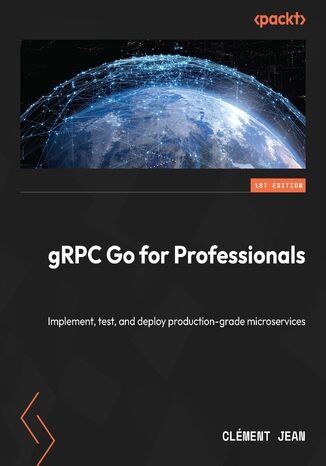
gRPC Go for Professionals. Implement, test, and deploy production-grade microservices
Clément Jean
In recent years, the popularity of microservice architecture has surged, bringing forth a new set of requirements. Among these, efficient communication between the different services takes center stage, and that's where gRPC shines. This book will take you through creating gRPC servers and clients in an efficient, secure, and scalable way. However, communication is just one aspect of microservices, so this book goes beyond that to show you how to deploy your application on Kubernetes and configure other tools that are needed for making your application more resilient. With these tools at your disposal, you’ll be ready to get started with using gRPC in a microservice architecture.In gRPC Go for Professionals, you'll explore core concepts such as message transmission and the role of Protobuf in serialization and deserialization. Through a step-by-step implementation of a TODO list API, you’ll see the different features of gRPC in action. You’ll then learn different approaches for testing your services and debugging your API endpoints. Finally, you’ll get to grips with deploying the application services via Docker images and Kubernetes.
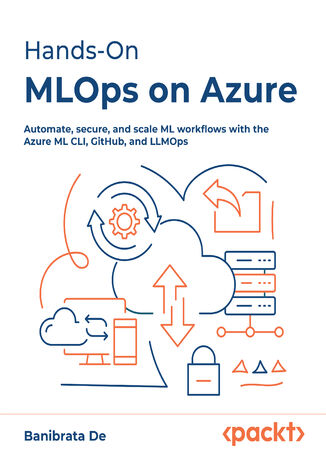
Banibrata De
Effective machine learning (ML) now demands not just building models but deploying and managing them at scale. Written by a seasoned senior software engineer with high-level expertise in both MLOps and LLMOps, Hands-On MLOps on Azure equips ML practitioners, DevOps engineers, and cloud professionals with the skills to automate, monitor, and scale ML systems across environments.The book begins with MLOps fundamentals and their roots in DevOps, exploring training workflows, model versioning, and reproducibility using pipelines. You'll implement CI/CD with GitHub Actions and the Azure ML CLI, automate deployments, and manage governance and alerting for enterprise use. The author draws on their production ML experience to provide you with actionable guidance and real-world examples. A dedicated section on LLMOps covers operationalizing large language models (LLMs) such as GPT-4 using RAG patterns, evaluation techniques, and responsible AI practices. You'll also work with case studies across Azure, AWS, and GCP that offer practical context for multi-cloud operations.Whether you're building pipelines, packaging models, or deploying LLMs, this guide delivers end-to-end strategy to build robust, scalable systems. By the end of this book, you'll be ready to design, deploy, and maintain enterprise-grade ML solutions with confidence.
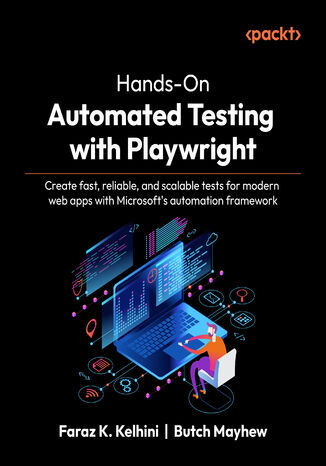
Faraz K. Kelhini, Butch Mayhew, Ben Fellows
Hands-On Automated Testing with Playwright draws from Faraz and Butch’s extensive experience to help you harness the full potential of Microsoft's Playwright framework.The book begins with a quick setup refresher, walking you through intermediate and advanced concepts such as dynamic content handling, accessibility testing, AI-generated test scripts, and parallel test execution. You'll explore real-world applications with end-to-end testing workflows for e-commerce and single-page applications. Alongside traditional topics such as accessibility, mobile, and visual regression testing, this book delves into modern trends such as CI/CD pipelines, DevOps integration, and AI-driven testing enhancements. Each chapter is packed with practical examples, expert techniques, and performance optimization tips, helping you gain a deep understanding of maintainable automation strategies. Whether you're transitioning from manual testing or expanding your automation toolbox, this Playwright book provides the skills and confidence to build future-proof testing systems in today's complex web development landscape.*Email sign-up and proof of purchase required
Ankur Roy
Python stands out as a powerhouse in DevOps, boasting unparalleled libraries and support, which makes it the preferred programming language for problem solvers worldwide. This book will help you understand the true flexibility of Python, demonstrating how it can be integrated into incredibly useful DevOps workflows and workloads, through practical examples.You'll start by understanding the symbiotic relation between Python and DevOps philosophies and then explore the applications of Python for provisioning and manipulating VMs and other cloud resources to facilitate DevOps activities. With illustrated examples, you’ll become familiar with automating DevOps tasks and learn where and how Python can be used to enhance CI/CD pipelines. Further, the book highlights Python’s role in the Infrastructure as Code (IaC) process development, including its connections with tools like Ansible, SaltStack, and Terraform. The concluding chapters cover advanced concepts such as MLOps, DataOps, and Python’s integration with generative AI, offering a glimpse into the areas of monitoring, logging, Kubernetes, and more.By the end of this book, you’ll know how to leverage Python in your DevOps-based workloads to make your life easier and save time.
Jim Yuill, Penn Linder
This updated edition of Hands-On RTOS with Microcontrollers is packed with cutting-edge content to help you expand your skills and stay ahead of the curve with embedded systems development. Written by senior engineers with decades of experience in embedded systems and related technologies, it covers the role of real-time OSs in today’s time-critical applications, and it covers FreeRTOS, including its key capabilities and APIs. You’ll find detailed descriptions of system design, hands-on system use, the hardware platform (dev-board, MCU, and debug-probe), and the development tools (IDE, build system, and debugging tools).This second edition teaches you how to implement over 20 real-world embedded applications, using FreeRTOS's primary features. The chapters include example programs on GitHub, with detailed instructions. You’ll create and install your own FreeRTOS system on the dev-board (purchased separately), and set up an IDE project with debugging tools.An ST dev-board is used with the book, and it is purchased separately (STM32 Nucleo-F767ZI - the dev-board is not required to read and understand the book).By the end of this book, you’ll have the hands-on skills to start designing, building, and optimizing embedded applications, using FreeRTOS, development boards, and debugging tools.
Brian Allbee
Software engineering is more than coding; it’s the strategic design and continuous improvement of systems that serve real-world needs. This newly updated second edition of Hands-On Software Engineering with Python expands on its foundational approach to help you grow into a senior or staff-level engineering role.Fully revised for today’s Python ecosystem, this edition includes updated tooling, practices, and architectural patterns. You’ll explore key changes across five minor Python versions, examine new features like dataclasses and type hinting, and evaluate modern tools such as Poetry, pytest, and GitHub Actions. A new chapter introduces high-performance computing in Python, and the entire development process is enhanced with cloud-readiness in mind.You’ll follow a complete redesign and refactor of a multi-tier system from the first edition, gaining insight into how software evolves—and what it takes to do that responsibly. From system modeling and SDLC phases to data persistence, testing, and CI/CD automation, each chapter builds your engineering mindset while updating your hands-on skills.By the end of this book, you'll have mastered modern Python software engineering practices and be equipped to revise and future-proof complex systems with confidence.

Nicolas Alejandro Borromeo
Unity is a cross-platform game engine that provides you with powerful but simple-to-use features to solve the most common problems in Game Development, such as rendering, animation, physics, sound, and effects. You’ll learn to use these features to create simple but complete games (and all the nuances needed to handle Unity).Complete with hands-on tutorials and projects, this book will teach you to use the Unity game engine, create C# and visual scripts, integrate graphics, sound, and animations, and manipulate physics to create interesting mechanics for your game. You’ll then code a simple AI agent to challenge the user and work with profiling tools to ensure code efficiency.Finally, you'll work with Unity's AR tools to create AR experiences for 3D apps and games before publishing them to the world.If you are interested in creating impressive, commercial-quality games that are playable on a variety of platforms, then you’ve come to the right place.
Miguel Angel Teheran Garcia, Hector Uriel Perez...
Visual Studio 2022 is the complete and ideal integrated development environment (IDE) for creating large, complex, and scalable applications. It is one of the most complete tools available for development, especially with Microsoft technologies.This book will teach you how to take advantage of the tools available with this IDE to write clean code faster. You’ll begin by learning how to set up and start Visual Studio 2022 and how to use all the tools provided by this IDE. You will then explore key combinations, tips, and additional utilities that can help you to code faster and review your code constantly. Next, you will see how to compile, debug, and inspect your project to analyze its current behavior using Visual Studio. The book also shows you how to insert reusable blocks of code writing simple statements. Later, you will learn about visual aids and artificial intelligence that will help you improve productivity and understand what is going on in the project.By the end of this book, you will be able to set up your development environment using Visual Studio 2022, personalize the tools and layout, and use shortcuts and extensions to improve your productivity.
John Boero
Creating machine images can be time-consuming and error-prone when done manually. HashiCorp Packer enables you to automate this process by defining the configuration in a simple, declarative syntax. This configuration is then used to create machine images for multiple environments and cloud providers.The book begins by showing you how to create your first manifest while helping you understand the available components. You’ll then configure the most common built-in builder options for Packer and use runtime provisioners to reconfigure a source image for desired tasks. You’ll also learn how to control logging for troubleshooting errors in complex builds and explore monitoring options for multiple logs at once. As you advance, you’ll build on your initial manifest for a local application that’ll easily migrate to another builder or cloud. The chapters also help you get to grips with basic container image options in different formats while scaling large builds in production. Finally, you’ll develop a life cycle and retention policy for images, automate packer builds, and protect your production environment from nefarious plugins.By the end of this book, you’ll be equipped to smoothen collaboration and reduce the risk of errors by creating machine images consistently and automatically based on your defined configuration.
Ryan Lemmer
Design patterns and idioms can widen our perspective byshowing us where to look, what to look at, and ultimatelyhow to see what we are looking at. At their best, patternsare a shorthand method of communicating better waysto code (writing less, more maintainable, and moreefficient code)This book starts with Haskell 98 and through the lens ofpatterns and idioms investigates the key advances andprogramming styles that together make modern Haskell.Your journey begins with the three pillars of Haskell.Then you'll experience the problem with Lazy I/O, togetherwith a solution. You'll also trace the hierarchy formedby Functor, Applicative, Arrow, and Monad. Next you'llexplore how Fold and Map are generalized by Foldableand Traversable, which in turn is unified in a broadercontext by functional Lenses. You'll delve more deeply intothe Type system, which will prepare you for an overviewof Generic programming. In conclusion you go to theedge of Haskell by investigating the Kind system andhow this relates to Dependently-typed programming
Samuli Thomasson
Haskell, with its power to optimize the code and its high performance, is a natural candidate for high performance programming. It is especially well suited to stacking abstractions high with a relatively low performance cost. This book addresses the challenges of writing efficient code with lazy evaluation and techniques often used to optimize the performance of Haskell programs. We open with an in-depth look at the evaluation of Haskell expressions and discuss optimization and benchmarking. You will learn to use parallelism and we'll explore the concept of streaming. We’ll demonstrate the benefits of running multithreaded and concurrent applications. Next we’ll guide you through various profiling tools that will help you identify performance issues in your program. We’ll end our journey by looking at GPGPU, Cloud and Functional Reactive Programming in Haskell. At the very end there is a catalogue of robust library recommendations with code samples.By the end of the book, you will be able to boost the performance of any app and prepare it to stand up to real-world punishment.
Head First Software Development. Edycja polska
Dan Pilone, Russ Miles
Opanuj niezwykłą sztukę wytwarzania oprogramowania! W jaki sposób zadowolić klienta? Jak wygląda proces wytwarzania oprogramowania? Jakie pułapki czekają na Ciebie? Proces wytwarzania oprogramowania -- już sam opis sugeruje trudności. I rzeczywiście -- jest to proces niezwykle złożony. Od samego początku trafiamy na kwestie takie, jak analiza potrzeb klienta i zebranie jego wymagań. Z każdym krokiem wszystko komplikuje się jeszcze bardziej... Konieczna jest implementacja poszczególnych wymagań klienta, testowanie tych rozwiązań, korekta znalezionych błędów. Na to wszystko nakłada się jeszcze konieczność tworzenia różnych wersji rozwiązań i zmienny nastrój klienta. Jak sobie z tym wszystkim poradzić? Jak bezboleśnie i skutecznie przejść przez cały ten proces? Tylko bez obaw! Oto podręcznik, który dzięki innowacyjnym metodom przekazywania wiedzy sprawi, że szybko zrozumiesz proces wytwarzania oprogramowania i nauczysz się gładko podążać jego wyboistą ścieżką. Autorzy książki "Head First Software Development. Edycja polska" -- Dan i Russ -- pokażą Ci, w jaki sposób zadowolić klienta i zebrać od niego wymagania oraz określić jego potrzeby. Dowiesz się, jak zapanować nad poszczególnymi wersjami Twojego projektu. Nauczysz się prowadzić testy i usuwać błędy. Zdobędziesz informacje dotyczące wytwarzania oprogramowania sterowanego testami, a na koniec zobaczysz, jak taki proces wygląda w rzeczywistości. Wszystkie te informacje przedstawione zostały na licznych ilustracjach, co wydatnie ułatwia przyswajanie wiedzy, dodatkowo przekazanej przystępnym i pełnym humoru językiem. Po lekturze tego podręcznika nawet laik będzie w stanie zarządzać takim procesem! Zbieranie wymagań Planowanie projektu Kontrola wersji Wytwarzanie sterowane testami Testy integracyjne Usuwanie błędów Tworzenie oprogramowania? Nic prostszego!!!
High Performance with MongoDB. Best practices for performance tuning, scaling, and architecture
Asya Kamsky, Ger Hartnett, Alex Bevilacqua, MongoDB...
With data as the new competitive edge, performance has become the need of the hour. As applications handle exponentially growing data and user demand for speed and reliability rises, three industry experts distill their decades of experience to offer you guidance on designing, building, and operating databases that deliver fast, scalable, and resilient experiences.MongoDB’s document model and distributed architecture provide powerful tools for modern applications, but unlocking their full potential requires a deep understanding of architecture, operational patterns, and tuning best practices. This MongoDB book takes a hands-on approach to diagnosing common performance issues and applying proven optimization strategies from schema design and indexing to storage engine tuning and resource management.Whether you’re optimizing a single replica set or scaling a sharded cluster, this book provides the tools to maximize deployment performance. Its modular chapters let you explore query optimization, connection management, and monitoring or follow a complete learning path to build a rock-solid performance foundation. With real-world case studies, code examples, and proven best practices, you’ll be ready to troubleshoot bottlenecks, scale efficiently, and keep MongoDB running at peak performance in even the most demanding production environments.
Doron Feinstein
3D graphics are becoming increasingly more realistic and sophisticated as the power of modern hardware improves. The High Level Shader Language (HLSL) allows you to harness the power of shaders within DirectX 11, so that you can push the boundaries of 3D rendering like never before.HLSL Development Cookbook will provide you with a series of essential recipes to help you make the most out of different rendering techniques used within games and simulations using the DirectX 11 API.This book is specifically designed to help build your understanding via practical example. This essential Cookbook has coverage ranging from industry-standard lighting techniques to more specialist post-processing implementations such as bloom and tone mapping. Explained in a clear yet concise manner, each recipe is also accompanied by superb examples with full documentation so that you can harness the power of HLSL for your own individual requirements.
Lucas Santos
Node.js makes it easy to get started, but just as easy to get things wrong.How Not to Node.js takes a practical, no-nonsense approach to uncovering the most common mistakes developers make, and shows you exactly how to avoid them.The book is structured around real-world anti-patterns, guiding you through how to identify, understand, and fix problematic code. You’ll start by learning how patterns and anti-patterns shape application design, before diving into asynchronous pitfalls, event loop behavior, and error handling. As you progress, you’ll explore architectural concerns such as logging, middleware design, environment management, and API reliability.By the end, you won’t just know how to write Node.js code, you’ll know how to avoid writing bad Node.js code, building applications that are clean, scalable, and production-ready.