
Techniki programowania
Jessica Ingrassellino
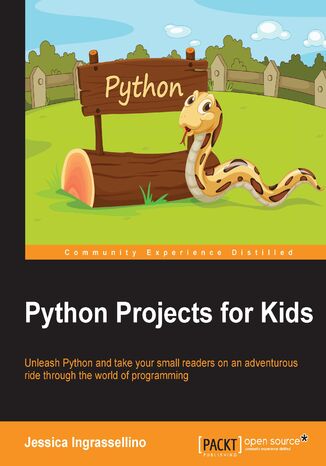
Kids are always the most fast-paced and enthusiastic learners, and are naturally willing to build stuff that looks like magic at the end (when it works!). Programming can be one such magic. Being able to write a program that works helps them feel they've really achieved something. Kids today are very tech-savvy and cannot wait to enter the fast-paced digital world.Because Python is one of the most popular languages and has a syntax that is quite simple to understand, even kids are eager to use it as a stepping stone to learning programming languages.This book will cover projects that are simple and fun, and teach kids how to write Python code that works.The book will teach the basics of Python programming, installation, and so on and then will move on to projects. A total of three projects, with each and every step explained carefully, without any assumption of previous experience.
Arun Tigeraniya
Python is a versatile programming language that can be used for a wide range of technical tasks—computation, statistics, data analysis, game development, and more. Though Python is easy to learn, it’s range of features means there are many aspects of it that even experienced Python developers don’t know about. Even if you’re confident with the basics, its logic and syntax, by digging deeper you can work much more effectively with Python – and get more from the language.Python Unlocked walks you through the most effective techniques and best practices for high performance Python programming - showing you how to make the most of the Python language. You’ll get to know objects and functions inside and out, and will learn how to use them to your advantage in your programming projects. You will also find out how to work with a range of design patterns including abstract factory, singleton, strategy pattern, all of which will help make programming with Python much more efficient. Finally, as the process of writing a program is never complete without testing it, you will learn to test threaded applications and run parallel tests. If you want the edge when it comes to Python, use this book to unlock the secrets of smarter Python programming.
Python w pigułce. Podręczny przewodnik po wersjach 3.10 i 3.11
Alex Martelli, Anna Martelli Ravenscroft, Steve Holden,...
Język Python został ostatnio sklasyfikowany w indeksie TIOBE jako najpopularniejszy obecnie język programowania, co zawdzięcza szerokim możliwościom stosowania go w projektowaniu, prototypowaniu, testach, wdrażaniu i konserwacji oprogramowania. To zaktualizowane i rozszerzone czwarte wydanie pokazuje, jak najlepiej używać Pythona, niezależnie od tego, czy jesteś profesjonalnym programistą, czy też chcesz użyć tego języka do rozwiązywania problemów w konkretnej dziedzinie. Nowe wydanie, starannie przygotowane przez uznawanych ekspertów dziedzinowych, skupia się na wersji 3.10, zapewniając pełną aktualność tej kluczowej pozycji dla pięciu ostatnich wersji języka, od 3.7 po niedawno wydaną wersję 3.11. Ten podręczny przewodnik pozwoli ci: - Nauczyć się tego, jak Python reprezentuje dane i sam program jako obiekty - Zrozumieć przydatnośc i zastosowania adnotacji typów - Dowiedzieć się, które funkcje języka pojawiły się w niedawnych wersjach i w której - Opanować idiomatyczne posługiwanie się nowoczesnym Pythonem - Poznać sposoby właściwego strukturyzowania projektów w Pythonie - Nauczyć się testować, debugować i optymalizować kod Pythona "Pogłębiony, zaktualizowany, przejrzysty i użyteczny opis języka Python. Doskonałe kompendium z wieloma spostrzeżeniami i poradami, które zaspokoi każdego, od średniozaawansowanych po ekspertów". -Mark Summerfield Dyrektor Qtrac Ltd. Cała czwórka autorów to członkowie Python Software Foundations, zaś troje z nich to zdobywcy Frank Willison Memorial Award. Są powszechnie uznawani za swój wkład w Pythona i jego społeczność. Ich łączne doświadczenie obejmuje najrozmaitsze środowiska i platformy, od akademickich, poprzez startupy, aż po międzynarodowe korporacje i instytucje rządowe. Wspólnie opracowali autorytatywny podręcznik składni i funkcjonalności języka Python, biblioteki standardowej oraz wybranych innych pakietów.
Alex Mandel, Víctor Olaya Ferrero, Anita Graser,...
QGIS is a user-friendly, cross-platform desktop geographic information system used to make maps and analyze spatial data. QGIS allows users to understand, question, interpret, and visualize spatial data in many ways that reveal relationships, patterns, and trends in the form of maps. This book is a collection of simple to advanced techniques that are needed in everyday geospatial work, and shows how to accomplishthem with QGIS. You will begin by understanding the different types of data management techniques, as well as how data exploration works. You will then learn how to perform classic vector and raster analysis with QGIS, apart from creating time-based visualizations. Finally, you will learn how to create interactive and visually appealing maps with custom cartography. By the end of this book, you will have all the necessaryknowledge to handle spatial data management, exploration, and visualization tasks in QGIS.
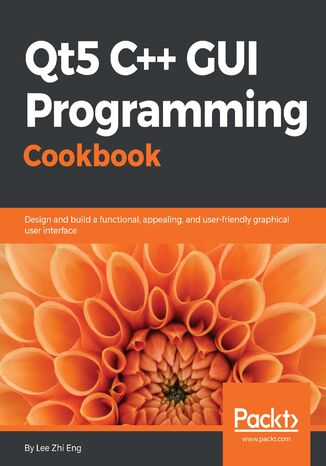
Lee Zhi Eng
With the advancement of computer technology, the software market is exploding with tons of software choices for the user, making their expectations higher in terms of functionality and the look and feel of the application. Therefore, improving the visual quality of your application is vital in order to overcome the market competition and stand out from the crowd.This book will teach you how to develop functional and appealing software using Qt5 through multiple projects that are interesting and fun. This book covers a variety of topics such as look-and-feel customization, GUI animation, graphics rendering, implementing Google Maps, and more. You will learn tons of useful information, and enjoy the process of working on the creative projects provided in this book
Jeremy Samuelson
Quantum computing is advancing rapidly, yet practical guidance for machine learning engineers remains limited. Most resources emphasize physics or theory, leaving practitioners unsure how quantum methods fit into real-world ML workflows. 'Quantum Machine Learning in Practice' addresses this gap with a hands-on, Python-first approach built for data scientists and ML engineers.Rather than presenting quantum models as replacements for classical ML, this book focuses on disciplined experimentation, hybrid architectures, and rigorous benchmarking. You will learn how classical data is encoded into quantum circuits, how variational models serve as classifiers and regressors, and how to evaluate quantum kernels and generative models responsibly. Concepts are grounded in simulator-based experiments using PennyLane, Qiskit, TensorFlow Quantum, and Cirq. Classical baselines are treated as first-class citizens throughout. You will design fair comparisons, analyze computational tradeoffs, and identify when classical ML remains superior. A complete end-to-end mini project reinforces transferable workflow skills, from problem framing through evaluation and interpretation.By the end, you will be able to design, implement, and critically assess hybrid quantum-classical machine learning systems with clarity and confidence.
Robert Loredo, Matt Broomhall
Prepare for a computing shift that will reshape security, optimization, and competitive advantage across every industry. This book helps you build a clear actionable approach to quantum readiness covering strategy, technology, talent, and risk in one framework.Written by Robert Loredo, Founder and CEO of Entangled Solutions Group, this book draws on 25 years of experience across IBM, academia, and enterprise innovation. As a former IBM Quantum Global Strategist, leader of the IBM Quantum Ambassador program, and holds over 275 patents, he translates this complex technology transition into decisions leaders can act on immediately.This book is organized as a complete strategic operating system for the quantum transition. Part One equips executives with investment frameworks, governance structures, and talent roadmaps. Part Two guides technical leaders through infrastructure assessment, workforce development, and quantum-era data strategy. Part Three delivers a security playbook covering post-quantum cryptography and adaptive architecture. Part Four maps the full quantum ecosystem and partnerships that will determine which institutions lead commercially.By the end, you’ll be able to define a quantum strategy, build the right capabilities, and lead your organization through quantum-driven change with clarity and control.
PKS Prakash, Achyutuni Sri Krishna Rao
In this book, we cover not only classical data structures, but also functional data structures.We begin by answering the fundamental question: why data structures? We then move on to cover the relationshipbetween data structures and algorithms, followed by an analysis and evaluation of algorithms. We introduce the fundamentals of data structures, such as lists, stacks, queues, and dictionaries, using real-world examples. We also cover topics such as indexing, sorting, and searching in depth.Later on, you will be exposed to advanced topics such as graph data structures, dynamic programming, and randomized algorithms. You will come to appreciate the intricacies of high performance and scalable programming using R. We also cover special R data structures such as vectors, data frames, and atomic vectors.With this easy-to-read book, you will be able to understand the power of linked lists, double linked lists, and circular linked lists. We will also explore the application of binary search and will go in depth into sorting algorithms such as bubble sort, selection sort, insertion sort, and merge sort.
Sigismondo Boschi, Gabriele Santomaggio
RabbitMQ is an open source message broker software (sometimes called message-oriented middleware) that implements the Advanced Message Queuing Protocol (AMQP). The RabbitMQ server is written in the Erlang programming language and is built on the Open Telecom Platform framework for clustering and failover. Messaging enables software applications to connect and scale. Applications can connect to each other as components of a larger application or to user devices and data.RabbitMQ Cookbook touches on all the aspects of RabbitMQ messaging. You will learn how to use this enabling technology for the solution of highly scalable problems dictated by the dynamic requirements of Web and mobile architectures, based for example on cloud computing platforms. This is a practical guide with several examples that will help you to understand the usefulness and the power of RabbitMQ.This book helps you learn the basic functionalities of RabbitMQ with simple examples which describe the use of RabbitMQ client APIs and how a RabbitMQ server works. You will find examples of RabbitMQ deployed in real-life use-cases, where its functionalities will be exploited combined with other technologies. This book helps you understand the advanced features of RabbitMQ that are useful for even the most demanding programmer. Over the course of the book, you will learn about the usage of basic AMQP functionalities and use RabbitMQ to let decoupled applications exchange messages as per enterprise integration applications. The same building blocks are used to implement the architecture of highly scalable applications like today's social networks, and they are presented in the book with some examples. You will also learn how to extend RabbitMQ functionalities by implementing Erlang plugins.This book combines information with detailed examples coupled with screenshots and diagrams to help you create a messaging application with ease.
Denis Rothman
Stop moving your data to the AI. This second edition defines a revolutionary architectural shift: bringing the AI to the data. By using Oracle Database 23ai as a converged engine in this book, you will architect Sovereign AI systems that eliminate the fragmentation, latency, and massive security risks inherent in traditional data extraction.You’ll work with DualRAG, synchronizing unstructured vector semantics with the deterministic truth of structured SQL, Graph, and Spatial retrieval. This allows your systems to reason over verified corporate data rather than probabilistic guesses, reducing hallucinations at the source. Moving beyond simple pipelines, you’ll also build MAS-RAG (multi-agent systems for RAG), where autonomous agents coordinate across hybrid retrieval workflows, multimodal video pipelines, and graph-based knowledge structures.Designed for developers and architects, these blueprints transform disconnected data silos into a unified engine to architect autonomous enterprise intelligence that scales with RLHF and model fine-tuning. By the end of the book, you’ll be able to design and deploy enterprise AI systems that combine retrieval, reasoning, and structured data to build reliable generative AI applications.*Email sign-up and proof of purchase required
Raspberry Pi By Example. Start building amazing projects with the Raspberry Pi right out of the box
Ashwin Pajankar, Arush Kakkar
Want to put your Raspberry Pi through its paces right out of the box? This tutorial guide is designed to get you learning all the tricks of the Raspberry Pi through building complete, hands-on hardware projects. Speed through the basics and then dive right in to development!Discover that you can do almost anything with your Raspberry Pi with a taste of almost everything. Get started with Pi Gaming as you learn how to set up Minecraft, and then program your own game with the help of Pygame. Turn the Pi into your own home security system with complete guidance on setting up a webcam spy camera and OpenCV computer vision for image recognition capabilities. Get to grips with GPIO programming to make a Pi-based glowing LED system, build a complete functioning motion tracker, and more. Finally, get ready to tackle projects that push your Pi to its limits. Construct a complete Internet of Things home automation system with the Raspberry Pi to control your house via Twitter; turn your Pi into a super-computer through linking multiple boards into a cluster and then add in advanced network capabilities for super speedy processing!
Richard Grimmett
The Raspberry Pi is a series of credit card-sized single-board computers developed in the UK by the Raspberry Pi Foundation with the intention of promoting the teaching of basic computer science in schools. The Raspberry Pi is known as a tiny computer built on a single circuit board. It runs a Linux operating system, and has connection ports for various peripherals so that it can be hooked up to sensors, motors, cameras, and more. Raspberry Pi has been hugely popular among hardware hobbyists for various projects, including robotics. This book gives you an insight into implementing several creative projects using the peripherals provided by Raspberry Pi. To start, we’ll walk through the basic robotics concepts that the world of Raspberry Pi offers us, implementing wireless communication to control your robot from a distance. Next, we demonstrate how to build a sensible and a visionary robot, maximizing the use of sensors and step controllers. After that, we focus on building a wheeled robot that can draw and play hockey. To finish with a bang, we’ll build an autonomous hexcopter, that is, a flying robot controlled by Raspberry Pi.By the end of this book, you will be a maestro in applying an array of different technologies to create almost any imaginable robot.
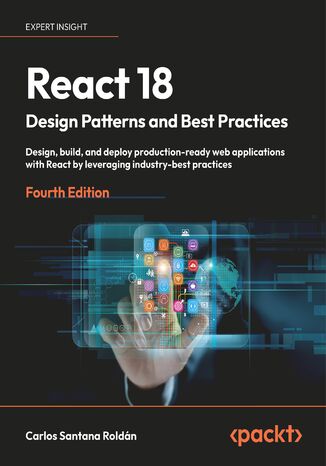
Carlos Santana Roldán
React helps you work smarter, not harder — but to reap the benefits of this popular JavaScript library and its components, you need a straightforward guide that will teach you how to make the most of it.React 18 Design Patterns and Best Practices will help you use React effectively to make your applications more flexible, easier to maintain, and improve their performance, while giving your workflow a huge boost. With a better organization of topics and knowledge about best practices added to your developer toolbox, the updated fourth edition ensures an enhanced learning experience.The book is split into three parts; the first will teach you the fundamentals of React patterns, the second will dive into how React works, and the third will focus on real-world applications. All the code samples are updated to the latest version of React and you’ll also find plenty of new additions that explore React 18 and Node 19’s newest features, alongside MonoRepo Architecture and a dedicated chapter on TypeScript.By the end of this book, you'll be able to efficiently build and deploy real-world React web applications.
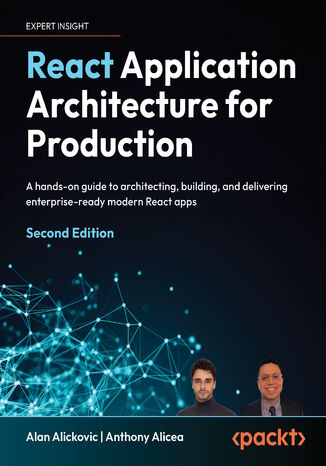
Alan Alickovic, Anthony Alicea
Building production-grade React applications requires making dozens of architectural decisions, often with little cohesive guidance. This book teaches proven architectural patterns for building scalable, maintainable frontend apps, based on timeless principles and modern best practices.This updated edition features a modern stack: React Router in framework mode, TypeScript, TanStack Query, Zustand, React Hook Form, Zod, Shadcn UI, Vitest, and Playwright. It also adds new chapters on performance, accessibility, and internationalization. You’ll work through a real-world example that brings modern architecture concepts to life.Starting with architectural foundations, you’ll make informed decisions about project structure, enforce code quality, build a well-designed component library, and implement the right rendering strategies. From there, you’ll build robust API layers with types generated from an OpenAPI specification and implement the right state management strategies for each use case. You will also learn about different testing strategies and when to use them, how to secure the application, and how to make it performant so that it remains scalable and maintainable.By the end, you’ll be prepared to design and build scalable React apps from the ground up and lead technical decisions in real-world projects.
React Components. Explore the power of React components for cutting-edge web development
Christopher Pitt
The reader will learn how to use React and its component-based architecture in order to develop modern user interfaces. A new holistic way of thinking about UI development will establish throughout this book and the reader will discover the power of React components with many examples. After reading the book and following the example application, the reader has built a small to a mid-size application with React using a component based UI architecture. The book will take the reader through a journey to discover the benefits of component-based user interfaces over the classical MVC architecture. Throughout the book, the reader will develop a wide range of components and then bring them together to build a component-based UI. By the end of this book, readers would have learned several techniques to build powerful components and how the component-based development is beneficial over regular web development.
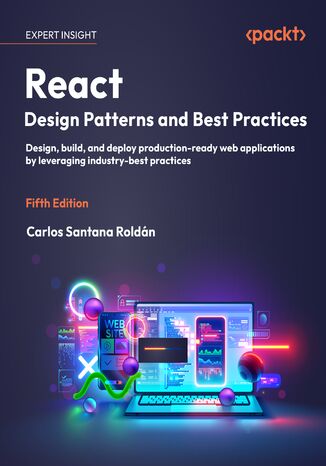
Carlos Santana Roldán
React continues to evolve, and so should the way you design, build, and ship applications. This new edition helps you make decisions that work reliably in production, focusing on patterns, real-world insights, and advanced techniques that streamline development and create robust, scalable applications. Along the way, it highlights common anti-patterns that slow teams down and demonstrates practical solutions.The book is organized into three parts, the first of which covers core design principles and modern component architecture. The second moves into an advanced state and data management using tools like Redux Toolkit, Zustand, Server Components, and Drizzle ORM, with a focus on building fast, predictable applications. The third part covers integration and delivery, including testing, CI/CD automation, backend work with Express and PostgreSQL, and deployment strategies that help you ship with confidence.This edition also shows how to bring AI-assisted development into your workflow. You’ll learn how tools like ChatGPT, Claude, and V0 can support tasks such as writing tests, improving documentation, and automating reviews, while still keeping control of quality and intent.By the end, you’ll have a clear understanding of the patterns and practices that shape modern React development and the skills to build future-ready apps.