
Techniki programowania
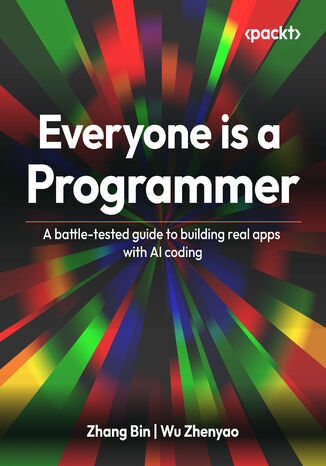
Everyone Is a Programmer. A battle-tested guide to building real apps with AI coding
Zhang Bin, Wu Zhenyao
This book is written by practitioners shaping AI coding tools and developer ecosystems in one of the world’s most application-driven tech environments.Vibe coding is a modern, AI-driven way of building software where you focus on what you want to create, and AI helps handle how it’s built. But it is not a shortcut or a gimmick. Effective vibe coding requires understanding how products are structured, how systems fit together, and how ideas turn into real, usable applications.This book introduces you to just that, helping you find your way to your first AI-coded apps.In six chapters, you’ll learn to ideate, plan, and execute your app ideas. You’ll hit the ground running with professional-grade tools like TRAE SOLO, Cursor, Figma, Vercel, and Supabase. The book’s coverage of end-to-end AI application development includes UI/UX, backend, hosting, authentication, and payment integration.By the end, you will have built two full projects and be equipped with a new way to create. What you build next is up to you.
Marcelo Guerra Hahn, Araks Tigranyan, John Asatryan,...
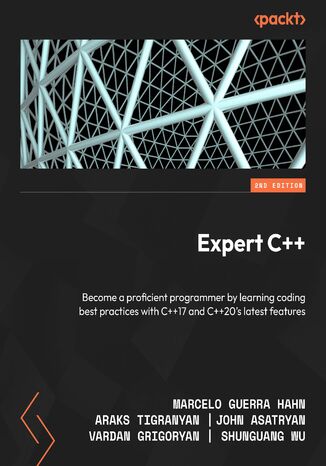
Are you an experienced C++ developer eager to take your skills to the next level? This updated edition of Expert C++ is tailored to propel you toward your goals.This book takes you on a journey of building C++ applications while exploring advanced techniques beyond object-oriented programming. Along the way, you'll get to grips with designing templates, including template metaprogramming, and delve into memory management and smart pointers. Once you have a solid grasp of these foundational concepts, you'll advance to more advanced topics such as data structures with STL containers and explore advanced data structures with C++. Additionally, the book covers essential aspects like functional programming, concurrency, and multithreading, and designing concurrent data structures. It also offers insights into designing world-ready applications, incorporating design patterns, and addressing networking and security concerns. Finally, it adds to your knowledge of debugging and testing and large-scale application design.With Expert C++ as your guide, you'll be empowered to push the boundaries of your C++ expertise and unlock new possibilities in software development.
Tarek Ziadé, Tarek Ziade
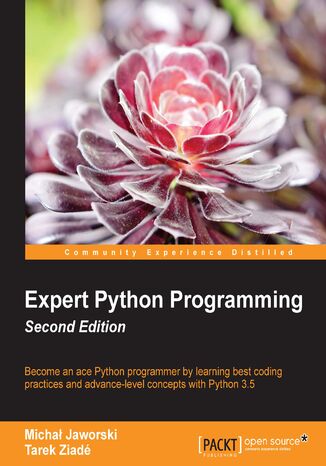
Python is a dynamic programming language, used in a wide range of domains by programmers who find it simple, yet powerful. Even if you find writing Python code easy, writing code that is efficient and easy to maintain and reuse is a challenge.The focus of the book is to familiarize you with common conventions, best practices, useful tools and standards used by python professionals on a daily basis when working with code.You will begin with knowing new features in Python 3.5 and quick tricks for improving productivity. Next, you will learn advanced and useful python syntax elements brought to this new version. Using advanced object-oriented concepts and mechanisms available in python, you will learn different approaches to implement metaprogramming. You will learn to choose good names, write packages, and create standalone executables easily.You will also be using some powerful tools such as buildout and vitualenv to release and deploy the code on remote servers for production use. Moving on, you will learn to effectively create Python extensions with C, C++, cython, and pyrex. The important factors while writing code such as code management tools, writing clear documentation, and test-driven development are also covered. You will now dive deeper to make your code efficient with general rules of optimization, strategies for finding bottlenecks, and selected tools for application optimization.By the end of the book, you will be an expert in writing efficient and maintainable code.
Abdullah Al Mohammad
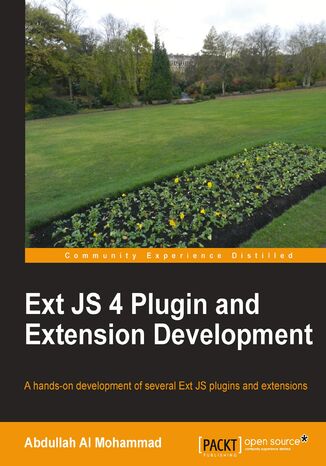
Ext JS is a pure JavaScript application framework for building interactive web applications using techniques such as Ajax, DHTML, and DOM scripting.Ext JS 4 Plugin and Extension Development is a practical, step-by-step tutorial which guides you to learn and develop ExtJS plugins and extensions. There are a lot of examples with explanations and plenty of code provided to make it easier and quicker to pick up.Starting with the fundamentals, this book introduces some of the ExtJS library and community provided plugins and extensions and finishes with several hands-on, real world development examples. You will get a clear concept of ExtJS plugins and extensions and learn how to use them. You will also learn how to develop an ExtJS plugin and extension by going through several examples with code and screenshots.Ext JS 4 Plugin and Extension Development book will provide you with the knowledge to develop ExtJS plugins and extensions using real-life examples.
Russ McKendrick
With Docker, it is possible to get a lot of apps running on the same old servers, making it very easy to package and ship programs. The ability to extend Docker using plugins and load third-party plugins is incredible, and organizations can massively benefit from it.In this book, you will read about what first and third party tools are available to extend the functionality of your existing Docker installation and how to approach your next Docker infrastructure deployment. We will show you how to work with Docker plugins, install it, and cover its lifecycle. We also cover network and volume plugins, and you will find out how to build your own plugin. You’ll discover how to integrate it with Puppet, Ansible, Jenkins, Flocker, Rancher, Packer, and more with third-party plugins. Then, you’ll see how to use Schedulers such as Kubernetes and Amazon ECS. Finally, we’ll delve into security, troubleshooting, and best practices when extending Docker.By the end of this book, you will learn how to extend Docker and customize it based on your business requirements with the help of various tools and plugins.
Donald Simpson
Jenkins CI is the leading open source continuous integration server. It is written in Java and has a wealth of plugins to support the building and testing of virtually any project. Jenkins supports multiple Software Configuration Management tools such as Git, Subversion, and Mercurial.This book explores and explains the many extension points and customizations that Jenkins offers its users, and teaches you how to develop your own Jenkins extensions and plugins.First, you will learn how to adapt Jenkins and leverage its abilities to empower DevOps, Continuous Integration, Continuous Deployment, and Agile projects. Next, you will find out how to reduce the cost of modern software development, increase the quality of deliveries, and thereby reduce the time to market. We will also teach you how to create your own custom plugins using Extension points.Finally, we will show you how to combine everything you learned over the course of the book into one real-world scenario.
Extending Puppet. Tools and Techniques for smarter infrastructure configuration - Second Edition
Alessandro Franceschi, Jaime Soriano Pastor
Puppet has changed the way we manage our systems, but Puppet itself is changing and evolving, and so are the ways we are using it. To tackle our IT infrastructure challenges and avoid common errors when designing our architectures, an up-to-date, practical, and focused view of the current and future Puppet evolution is what we need. With Puppet, you define the state of your IT infrastructure, and it automatically enforces the desired state.This book will be your guide to designing and deploying your Puppet architecture. It will help you utilize Puppet to manage your IT infrastructure. Get to grips with Hiera and learn how to install and configure it, before learning best practices for writing reusable and maintainable code. You will also be able to explore the latest features of Puppet 4, before executing, testing, and deploying Puppet across your systems. As you progress, Extending Puppet takes you through higher abstraction modules, along with tips for effective code workflow management.Finally, you will learn how to develop plugins for Puppet - as well as some useful techniques that can help you to avoid common errors and overcome everyday challenges.
Extending SaltStack. Build and write salt modules
Joseph Hall
Salt already ships with a very powerful set of tools, but that doesn't mean that they all suit your needs perfectly. By adding your own modules and enhancing existing ones, you can bring the functionality that you need to increase your productivity. Extending SaltStack follows a tutorial-based approach to explain different types of modules, from fundamentals to complete and full-functioning modules.Starting with the Loader system that drives Salt, this book will guide you through the most common types of modules. First you will learn how to write execution modules. Then you will extend the configuration using the grain, pillar, and SDB modules. Next up will be state modules and then the renderers that can be used with them. This will be followed with returner and output modules, which increase your options to manage return data. After that, there will be modules for external file servers, clouds, beacons, and finally external authentication and wheel modules to manage the master.With this guide in hand, you will be prepared to create, troubleshoot, and manage the most common types of Salt modules and take your infrastructure to new heights!