
Techniki programowania
Learning OpenCV 3 Application Development
Samyak Datta
Computer vision and machine learning concepts are frequently used in practical computer vision based projects. If you’re a novice, this book provides the steps to build and deploy an end-to-end application in the domain of computer vision using OpenCV/C++. At the outset, we explain how to install OpenCV and demonstrate how to run some simple programs. You will start with images (the building blocks of image processing applications), and see how they are stored and processed by OpenCV. You’ll get comfortable with OpenCV-specific jargon (Mat Point, Scalar, and more), and get to know how to traverse images and perform basic pixel-wise operations. Building upon this, we introduce slightly more advanced image processing concepts such as filtering, thresholding, and edge detection. In the latter parts, the book touches upon more complex and ubiquitous concepts such as face detection (using Haar cascade classifiers), interest point detection algorithms, and feature descriptors. You will now begin to appreciate the true power of the library in how it reduces mathematically non-trivial algorithms to a single line of code!The concluding sections touch upon OpenCV’s Machine Learning module. You will witness not only how OpenCV helps you pre-process and extract features from images that are relevant to the problems you are trying to solve, but also how to use Machine Learning algorithms that work on these features to make intelligent predictions from visual data!
Antonio L Zapata (GBP)
PHP is a great language for building web applications. It is essentially a server-side scripting language that is also used for general purpose programming. PHP 7 is the latest version with a host of new features, and it provides major backwards-compatibility breaks.This book begins with the fundamentals of PHP programming by covering the basic concepts such as variables, functions, class, and objects. You will set up PHP server on your machine and learn to read and write procedural PHP code. After getting an understanding of OOP as a paradigm, you will execute MySQL queries on your database. Moving on, you will find out how to use MVC to create applications from scratch and add tests. Then, you will build REST APIs and perform behavioral tests on your applications.By the end of the book, you will have the skills required to read and write files, debug, test, and work with MySQL.
Ninad Sathaye
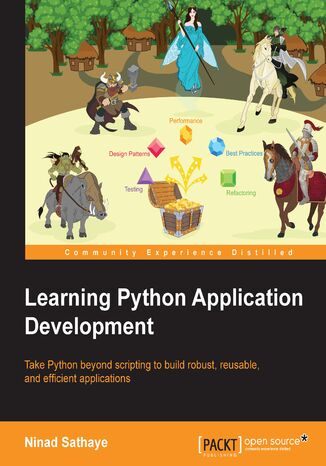
Python is one of the most widely used dynamic programming languages, supported by a rich set of libraries and frameworks that enable rapid development. But fast paced development often comes with its own baggage that could bring down the quality, performance, and extensibility of an application. This book will show you ways to handle such problems and write better Python applications.From the basics of simple command-line applications, develop your skills all the way to designing efficient and advanced Python apps. Guided by a light-hearted fantasy learning theme, overcome the real-world problems of complex Python development with practical solutions. Beginning with a focus on robustness, packaging, and releasing application code, you’ll move on to focus on improving application lifetime by making code extensible, reusable, and readable. Get to grips with Python refactoring, design patterns and best practices. Techniques to identify the bottlenecks and improve performance are covered in a series of chapters devoted to performance, before closing with a look at developing Python GUIs.
Anita Graser
QGIS is a user friendly open source geographic information system (GIS) that runs on Linux, Unix, Mac OSX, and Windows. The popularity of open source geographic information systems and QGIS in particular has been growing rapidly over the last few years. More and more companies and institutions are adopting QGIS and even switching to QGIS as their main GIS.Learning QGIS 2.0 is a practical, hands-on guide that provides you with clear, step-by-step exercises that will help you to apply your GIS knowledge to QGIS. Containing a number of clear, practical exercises, this book will introduce you to working with QGIS, quickly and painlessly. If you want to take advantage of the wide range of functionalities that QGIS offers, then this is the book for you.This book takes you from installing and configuring QGIS, through handling spatial data to creating great maps. You will learn how to load and visualize existing spatial data and how to create data from scratch. You will perform common geoprocessing and spatial analysis tasks and automate them. We will cover how to achieve great cartographic output and print maps. You will learn everything you need to know to handle spatial data management, processing, and visualization tasks in QGIS.
Learning RabbitMQ. Build and optimize efficient messaging applications with ease
Martin Toshev
RabbitMQ is Open Source Message Queuing software based on the Advanced Message Queue Protocol Standard written in the Erlang Language. RabbitMQ is an ideal candidate for large-scale projects ranging from e-commerce and finance to Big Data and social networking because of its ease of use and high performance. Managing RabbitMQ in such a dynamic environment can be a challenging task that requires a good understanding not only of how to work properly with the message broker but also of its best practices and pitfalls.Learning RabbitMQ starts with a concise description of messaging solutions and patterns, then moves on to concrete practical scenarios for publishing and subscribing to the broker along with basic administration. This knowledge is further expanded by exploring how to establish clustering and high availability at the level of the message broker and how to integrate RabbitMQ with a number of technologies such as Spring, and enterprise service bus solutions such as MuleESB and WSO2. We will look at advanced topics such as performance tuning, secure messaging, and the internals of RabbitMQ. Finally we will work through case-studies so that we can see RabbitMQ in action and, if something goes wrong, we'll learn to resolve it in the Troubleshooting section.
Mark van der Loo, Edwin de Jonge
Data is coming at us faster, dirtier, and at an ever increasing rate. The necessity to handle many, complex statistical analysis projects is hitting statisticians and analysts across the globe. This book will show you how to deal with it like never before, thus providing an edge and improving productivity.Learning RStudio for R Statistical Computing will teach you how to quickly and efficiently create and manage statistical analysis projects, import data, develop R scripts, and generate reports and graphics. R developers will learn about package development, coding principles, and version control with RStudio.This book will help you to learn and understand RStudio features to effectively perform statistical analysis and reporting, code editing, and R development.The book starts with a quick introduction where you will learn to load data, perform simple analysis, plot a graph, and generate automatic reports. You will then be able to explore the available features for effective coding, graphical analysis, R project management, report generation, and even project management.Learning RStudio for R Statistical Computing is stuffed with feature-rich and easy-to-understand examples, through step-by-step instructions helping you to quickly master the most popular IDE for R development.
Rawane Madi
Test Studio is Telerik's QA solution for automating your manual testing. With Test Studio's standalone edition or Visual Studio plugin, you can rule out the possibility of unreliable test execution and UI recognition, non indicative test results and reports, dispersed test repository, low code coverage, and unaffordable learning curves. With no code, this tool provides an intuitive IDE to effortlessly create maintainable tests. If you are looking for a solution to automate testing for your web, desktop, or mobile application, you can now benefit from Test Studio's rich automation features.Learning Software Testing with Test Studio will illustrate how to reliably automate test cases when it is time to relinquish manual testing habits. This book is all about less theory and more hands-on examples to present a complete manual and automated solution for your ASP .NET, WPF, Silverlight or iOS apps.This book gets you started directly with automation in Test Studio by exploiting its recording powers through series of concrete test cases built around the equipped applications. Each chapter starts with a typical automation problem which is then approached using Test Studio specialized automation features.You will learn how to create record and playback functional, performance, and load tests. Furthermore, we will see how to insert verification steps, logical constructs, convenient logging operations, and how to convert test scripts in order to implement keyword and data-driven architectures. To endow your tests with additional flexibility, each recorded automation feature will be approached from its coded perspective through the usage of the underlying ArtOfTest Test Studio automation library.This book also illustrates how Test Studio can automate pre-conditions, test result inputting, and the capturing of system states during manual test case execution in order to keep the tester's attention focused on the important details.
Greg L. Turnquist, Dave Syer, Mark Heckler,...
Spring Boot 3 brings more than just the powerful ability to build secure web apps on top of a rock-solid database. It delivers new options for testing, deployment, Docker support, and native images for GraalVM, along with ways to squeeze out more efficient usage of existing resources.This third edition of the bestseller starts off by helping you build a simple app, and then shows you how to secure, test, bundle, and deploy it to production. Next, you’ll familiarize yourself with the ability to go “native” and release using GraalVM. As you advance, you’ll explore reactive programming and get a taste of scalable web controllers and data operations. The book goes into detail about GraalVM native images and deployment, teaching you how to secure your application using both routes and method-based rules and enabling you to apply the lessons you’ve learned to any problem. If you want to gain a thorough understanding of building robust applications using the core functionality of Spring Boot, then this is the book for you.By the end of this Spring Boot book, you’ll be able to build an entire suite of web applications using Spring Boot and deploy them to any platform you need.