
Techniki programowania
W kategorii Techniki programowania znajdziecie książki dobrane pod względem merytorycznym zarówno dla amatorów jak i profesjonalistów z dziedziny programowania.
Dowiecie się jak poprawnie napisać i udokumentować własny kod oraz przeczytacie o najskuteczniejszych metodach refaktoryzacji czyli w jaki sposób poprawiać i optymalizować kod napisany przez innych programistów. Poznacie sposoby optymalizacji algorytmów, analizy złożoności, kompresji danych czy elementy algorytmiki grafów. Zaznajomicie się nie tylko z najlepszymi wzorcami w wytwarzaniu oprogramowania ale także nauczycie się rozpoznawać najczęstsze błędy i czyhające na Was pułapki.
Mastering AndEngine Game Development. Move beyond basic games and explore the limits of AndEngine
Maya Posch
AndEngine is a popular and easy-to-use game framework, best suited for Android game development. After learning the basics of creating an Android game using AndEngine it's time you move beyond the basics to explore further. For this you need to understand the theory behind many of the technologies AndEngine uses.This book aims to provide all the skills and tools you need to learn more about Android game development using AndEngine. With this book you will get a quick overview of the basics of AndEngine and Android application development. From there, you will learn how to use 3D models in a 2D scene, render a visual representation of a scene's objects, and create interaction between these objects. You will explore frame-based animations and learn to use skeletal animations.As the book progresses, you will be guided through exploring all the relevant aspects of rendering graphics with OpenGL ES, generating audio using OpenSL ES and OpenAL, making the best use of Android's network API, implementing anti-aliasing algorithms, shaders, dynamic lighting and much more. With all this, you will be ready to enhance the look and feel of your game with its user interface, sound effects and background music.After an in-depth study of 2D and 3D worlds and multi-player implementations, you will be a master in AndEngine and Android game development.
Antonio Pachon
There are millions of Android apps out there for people to download – how do you make sure yours has the edge? It’s not always about innovation and ideas – the most successful apps are those that are able to satisfy customer demands – they’re the ones that look the best, the fastest, and the easiest and most intuitive to use. This book shows you how to create Android applications that do precisely that – it has been designed help you consider and answer those questions throughout the development process, so you can create applications that stand out against the crowd. Learn how to create exemplary UIs that contribute to a satisfying user experience through the lens of Material Design, and explore how to harness the range of features within the Android SDK to help you. Dive deeper into complex programming concepts and discover how to leverage concurrency and navigate memory management and image handling. You’ll also find further guidance on testing and debugging so you can guarantee that your application is reliable and robust for users. Beyond this you’ll find out how to extend your app and add greater functionality, including notifications, location services, adverts and app billing (essential if you want to properly monetize your creation!). To make sure you have confidence at every stage in the process, the book also shows you how to release your app to the Play store – to make sure your maximising your efforts to create a popular Android application!
Siddique Hameed, Simone Casagranda, Javeed Chida
Wearable technology is the future of mobile devices. It looks set to be a breakthrough technology, just like the iPad was before it. With the Apple Watch being widely regarded as a success, all eyes are now on Google to provide a similar device for its users. Keep your skills ahead of the competition and be one of the first to fully understand this powerful new trend. This book will give you a very solid understanding of the philosophy, thought process, development details, and methodologies involved in building well-designed, robust Android Wear applications.We cover the advantages and disadvantages of the wearable computing paradigm and provide a good foundational knowledge for you to build practical, real-world wearable apps. You will learn about the various tools, platforms, libraries, SDKs, and technology needed to build Android Wear apps. By the end of the book, you will be an expert in building Android wearable apps.
Mastering Backbone.js. Design and build scalable web applications using Backbone.js
Abiee Echamea
Backbone.js is a popular library to build single page applications used by many start-ups around the world because of its flexibility, robustness and simplicity. It allows you to bring your own tools and libraries to make amazing webapps with your own rules. However, due to its flexibility it is not always easy to create scalable applications with it. By learning the best practices and project organization you will be able to create maintainable and scalable web applications with Backbone.js.With this book you will start right from organizing your Backbone.js application to learn where to put each module and how to wire them. From organizing your code in a logical and physical way, you will go on to delimit view responsibilities and work with complex layouts. Synchronizing models in a two-way binding can be difficult and with sub resources attached it can be even worse. The next chapter will explain strategies for how to deal with these models. The following chapters will help you to manage module dependencies on your projects, explore strategies to upload files to a RESTful API and store information directly in the browser for using it with Backbone.js. After testing your application, you are ready to deploy it to your production environment. The final chapter will cover different flavors of authorization.The Backbone.js library can be difficult to master, but in this book you will get the necessary skill set to create applications with it, and you will be able to use any other library you want in your stack.
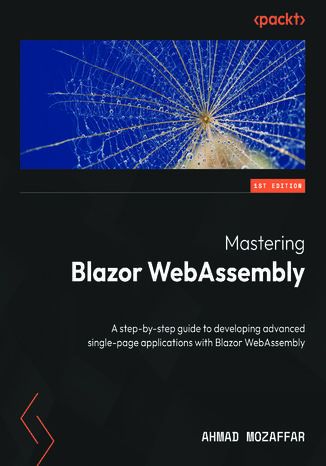
Ahmad Mozaffar
Blazor WebAssembly is a revolutionary technology in software development that enables you to develop web applications with a rich user interface using C# without JavaScript. It can be run natively in the browser and soon on mobile apps with .NET MAUI, making it a superweapon in the .NET developer’s toolbox. This capability has opened the doors for the JavaScript community to have a stable framework to build single page applications (SPAs) maintained by Microsoft and driven by the community.Mastering Blazor WebAssembly is a complete resource that teaches you everything you need to build client-side web applications using C# & .NET 7.0. Throughout this book, you’ll discover the anatomy of a Blazor WebAssembly project, along with the build, style, and structure of the components. You’ll implement forms to catch user input and collect data, as well as explore the topics of navigating between the pages in depth. The chapters will guide you through handling complex scenarios like RenderTrees, writing efficient unit tests, using variant security methods, and publishing the app to different providers, all in a practical manner.By the end of this book, you’ll have the skills necessary to build web apps with Blazor WebAssembly, along with the basics for a future in mobile development with .NET MAUI and Blazor.
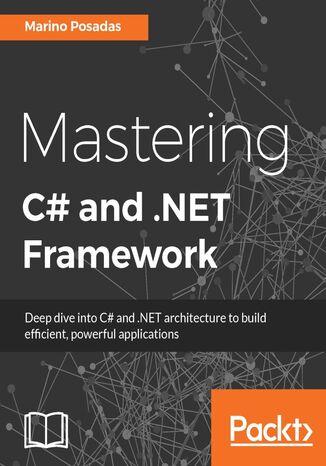
Mastering C# and .NET Framework. .NET Under the hood
Marino Posadas
Mastering C# and .NET Framework will take you in to the depths of C# 6.0/7.0 and .NET 4.6, so you can understand how the platform works when it runs your code, and how you can use this knowledge to write efficient applications. Take full advantage of the new revolution in .NET development, including open source status and cross-platform capability, and get to grips with the architectural changes of CoreCLR.Start with how the CLR executes code, and discover the niche and advanced aspects of C# programming – from delegates and generics, through to asynchronous programming. Run through new forms of type declarations and assignments, source code callers, static using syntax, auto-property initializers, dictionary initializers, null conditional operators, and many others. Then unlock the true potential of the .NET platform. Learn how to write OWASP-compliant applications, how to properly implement design patterns in C#, and how to follow the general SOLID principles and its implementations in C# code.We finish by focusing on tips and tricks that you'll need to get the most from C# and .NET.This book also covers .NET Core 1.1 concepts as per the latest RTM release in the last chapter.
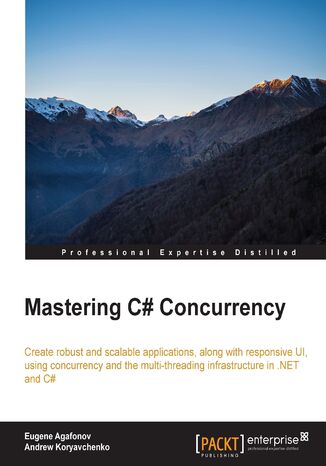
Evgenii Agafonov, Andrey Koryavchenko
Starting with the traditional approach to concurrency, you will learn how to write multithreaded concurrent programs and compose ways that won't require locking. You will explore the concepts of parallelism granularity, and fine-grained and coarse-grained parallel tasks by choosing a concurrent program structure and parallelizing the workload optimally. You will also learn how to use task parallel library, cancellations, timeouts, and how to handle errors. You will know how to choose the appropriate data structure for a specific parallel algorithm to achieve scalability and performance. Further, you'll learn about server scalability, asynchronous I/O, and thread pools, and write responsive traditional Windows and Windows Store applications.By the end of the book, you will be able to diagnose and resolve typical problems that could happen in multithreaded applications.
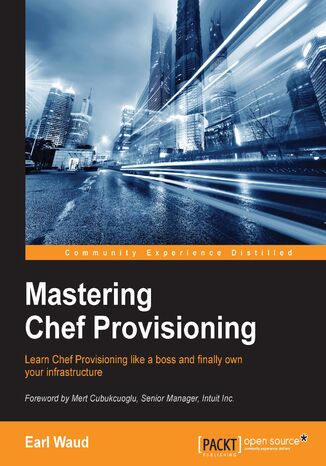
Mastering Chef Provisioning. Render your entire infrastructure as code with Chef
Earl Waud
This book will show you the best practices to describe your entire infrastructure as code. With the help of this book you can expand your knowledge of Chef because and implement robust and scalable automation solutions. You can automate and document every aspect of your network, from the hardware to software, middleware, and all your containers. You will become familiar with the Chef’s Chef Provisioning tool. You will be able to make a perfect model system where everything is represented as code beneath your fingertips.Make the best possible use of your resources, and deliver infrastructure as code, making it as versionable, testable and repeatable as application software