
Techniki programowania
Rheinwerk Publishing, Inc, Nouman Azam
This book begins by introducing the core concepts of Rust programming, starting with installation, writing basic programs, and understanding variables, data types, and functions. It covers Rust’s unique ownership system, which is central to the language, explaining how borrowing and memory management work to ensure safety and efficiency. Basic control flow concepts like conditionals and loops are also explored, providing a solid foundation for beginners.As the book progresses, more advanced topics are introduced, such as structs, enums, and collections, which allow for the creation of flexible and efficient data structures. Rust’s powerful memory management features, including smart pointers, lifetimes, and borrowing, are discussed in detail. Readers will also dive into functional programming aspects like closures, iterators, and function pointers, which enhance the flexibility and expressiveness of Rust code.The final chapters focus on concurrency and advanced topics such as macros and web programming. Readers will learn how to handle multithreading in Rust, work with asynchronous programming, and build web servers. Practical problems at the end help reinforce the concepts learned, providing readers with the tools to solve real-world challenges efficiently using Rust.
Nikola Mitrović , Santosh Yadav
Building modern web applications that are responsive and resilient is essential in this rapidly evolving digital world. Imagine effortlessly managing complex data streams and creating seamless user experiences—this book helps you do just that by adopting RxJS to boost your development skills and transform your approach to reactive programming.Written by a seasoned software engineer and consultant with a decade of industry experience, this book equips you to harness the power of RxJS techniques, patterns, and operators tailored for real-world scenarios. Each chapter is filled with practical recipes designed to tackle a variety of challenges, from managing side effects and ensuring error resiliency in client applications to developing real-time chat applications and event-driven microservices. You’ll learn how to integrate RxJS with popular frameworks, such as Angular and NestJS, gaining insights into modern web development practices that enhance performance and interactivity.By the end of this book, you’ll have mastered reactive programming principles, the RxJS library, and working with Observables, while crafting code that reacts to changes in data and events in a declarative and asynchronous way.
Rob Cowell, Lars Malmqvist
Rob Cowell is a Salesforce DevOps Advocate with extensive experience as a Salesforce Developer and Architect, guiding best practices for Salesforce DevOps. Lars Malmqvist, a 32x certified Salesforce CTA, has 15 years of experience building advanced Salesforce solutions and is the author of two books, Architecting AI Solutions on Salesforce and Salesforce Anti-Patterns. As the Salesforce Platform evolves, architects face increasing demand for advanced solutions. This book serves as your definitive guide to mastering effective DevOps practices crucial for successful Salesforce projects. Beginning with cultivating a DevOps mindset focused on collaboration and communication, it emphasizes governance, visibility, and accountability. You'll delve into tools and techniques, leveraging the robust capabilities of SFDX to craft your strategy efficiently. This book stands out for its practical approach to Salesforce packaging and CI/CD stack creation, guiding you to build a seamless automated change delivery system with freely available software. It addresses critical operational concerns such as ticket management, backups, change monitoring, and data seeding. In the final chapters, you'll discover third-party solutions to expedite your Salesforce DevOps journey, empowering you to deliver sophisticated and efficient projects.
Bass Jobsen
Sass and Compass Designer's Cookbook helps you to get most out of CSS3 and harness its benefits to create engaging and receptive applications. This book will help you develop faster and reduce the maintenance time for your web development projects by using Sass and Compass. You will learn how to use with CSS frameworks such as Bootstrap and Foundation and understand how to use other libraries of pre-built mixins. You will also learn setting up a development environment with Gulp. This book guides you through all the concepts and gives you practical examples for full understanding.
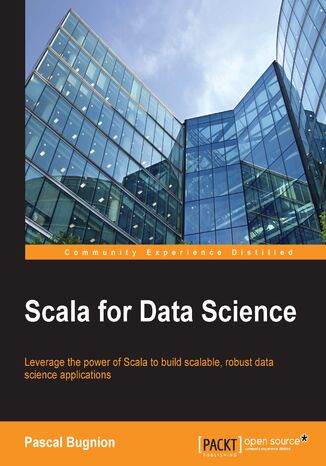
Pascal Bugnion
Scala is a multi-paradigm programming language (it supports both object-oriented and functional programming) and scripting language used to build applications for the JVM. Languages such as R, Python, Java, and so on are mostly used for data science. It is particularly good at analyzing large sets of data without any significant impact on performance and thus Scala is being adopted by many developers and data scientists. Data scientists might be aware that building applications that are truly scalable is hard. Scala, with its powerful functional libraries for interacting with databases and building scalable frameworks will give you the tools to construct robust data pipelines.This book will introduce you to the libraries for ingesting, storing, manipulating, processing, and visualizing data in Scala.Packed with real-world examples and interesting data sets, this book will teach you to ingest data from flat files and web APIs and store it in a SQL or NoSQL database. It will show you how to design scalable architectures to process and modelling your data, starting from simple concurrency constructs such as parallel collections and futures, through to actor systems and Apache Spark. As well as Scala’s emphasis on functional structures and immutability, you will learn how to use the right parallel construct for the job at hand, minimizing development time without compromising scalability. Finally, you will learn how to build beautiful interactive visualizations using web frameworks.This book gives tutorials on some of the most common Scala libraries for data science, allowing you to quickly get up to speed with building data science and data engineering solutions.
Scala Functional Programming Patterns. Grok and perform effective functional programming in Scala
Atul S. Khot
Scala is used to construct elegant class hierarchies for maximum code reuse and extensibility and to implement their behavior using higher-order functions. Its functional programming (FP) features are a boon to help you design “easy to reason about” systems to control the growing software complexities. Knowing how and where to apply the many Scala techniques is challenging. Looking at Scala best practices in the context of what you already know helps you grasp these concepts quickly, and helps you see where and why to use them. This book begins with the rationale behind patterns to help you understand where and why each pattern is applied. You will discover what tail recursion brings to your table and will get an understanding of how to create solutions without mutations. We then explain the concept of memorization and infinite sequences for on-demand computation. Further, the book takes you through Scala’s stackable traits and dependency injection, a popular technique to produce loosely-coupled software systems.You will also explore how to currying favors to your code and how to simplify it by de-construction via pattern matching. We also show you how to do pipeline transformations using higher order functions such as the pipes and filters pattern. Then we guide you through the increasing importance of concurrent programming and the pitfalls of traditional code concurrency. Lastly, the book takes a paradigm shift to show you the different techniques that functional programming brings to your plate.This book is an invaluable source to help you understand and perform functional programming and solve common programming problems using Scala’s programming patterns.
Scala Test-Driven Development. Write clean scala code that works
Gaurav Sood
Test-driven development (TDD) produces high-quality applications in less time than is possible with traditional methods. Due to the systematic nature of TDD, the application is tested in individual units as well as cumulatively, right from the design stage, to ensure optimum performance and reduced debugging costs. This step-by-step guide shows you how to use the principles of TDD and built-in Scala testing modules to write clean and fully tested Scala code and give your workflow the change it needs to let you create better applications than ever before. After an introduction to TDD, you will learn the basics of ScalaTest, one of the most flexible and most popular testing tools around for Scala, by building your first fully test-driven application. Building on from that you will learn about the ScalaTest API and how to refactor code to produce high-quality applications. We’ll teach you the concepts of BDD (Behavior-driven development) and you’ll see how to add functional tests to the existing suite of tests. You’ll be introduced to the concepts of Mocks and Stubs and will learn to increase test coverage using properties. With a concluding chapter on miscellaneous tools, this book will enable you to write better quality code that is easily maintainable and watch your apps change for the better.
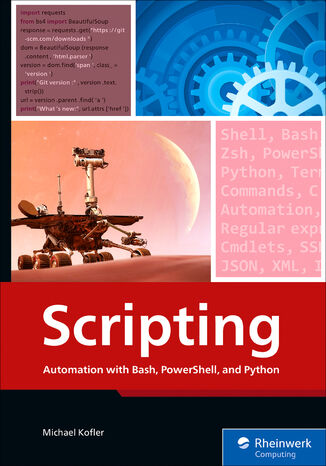
Scripting. Automation with Bash, PowerShell, and Python
Rheinwerk Publishing, Inc, Michael Kofler
This comprehensive scripting guide empowers system administrators, developers, and power users to automate repetitive IT tasks across platforms using three major scripting languages: Bash, PowerShell, and Python. The book opens with foundational scripting concepts and showcases what you can accomplish with just ten lines of code. It continues with in-depth chapters on each language, emphasizing syntax, control structures, error handling, and modularity.Readers will explore practical techniques for managing files, parsing text, utilizing regular expressions, and working with JSON, XML, and INI formats. The book dives into job automation with cron and Task Scheduler, secure communication via SSH, and scripting in professional environments with tools like Visual Studio Code and Git.The final section applies scripting to real-world cases, including system backups, image processing, web scraping, API consumption, database interactions, cloud integration, and virtual machine automation. With this book, readers build a strong scripting toolkit to efficiently manage modern IT workflows.