
Analiza danych
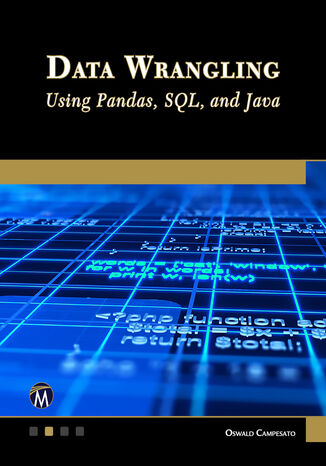
Mercury Learning and Information, Oswald Campesato
This book is designed for aspiring data scientists and those involved in data cleaning. It covers features of NumPy and Pandas, along with creating databases and tables in MySQL. It also addresses various data wrangling tasks using Python scripts and awk-based shell scripts. Companion files with code are available from the publisher.Understanding data cleaning and manipulation is vital for data scientists. This book provides a comprehensive introduction to essential tools and techniques. From Python basics to advanced data wrangling, it equips readers with the skills needed to manage and clean data effectively.The journey begins with an introduction to Python and progresses through working with data, Pandas, and SQL. It also covers Java, JSON, XML, and specific data cleaning tasks. The book culminates with detailed data wrangling techniques, ensuring readers gain practical, hands-on experience in data management.
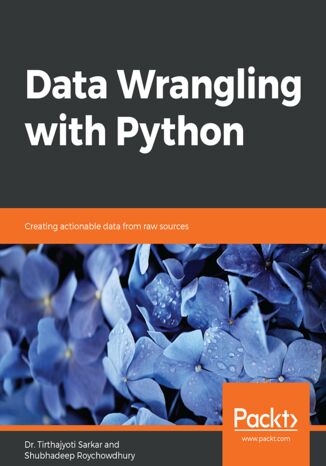
Data Wrangling with Python. Creating actionable data from raw sources
Dr. Tirthajyoti Sarkar , Shubhadeep Roychowdhury
For data to be useful and meaningful, it must be curated and refined. Data Wrangling with Python teaches you the core ideas behind these processes and equips you with knowledge of the most popular tools and techniques in the domain.The book starts with the absolute basics of Python, focusing mainly on data structures. It then delves into the fundamental tools of data wrangling like NumPy and Pandas libraries. You'll explore useful insights into why you should stay away from traditional ways of data cleaning, as done in other languages, and take advantage of the specialized pre-built routines in Python. This combination of Python tips and tricks will also demonstrate how to use the same Python backend and extract/transform data from an array of sources including the Internet, large database vaults, and Excel financial tables. To help you prepare for more challenging scenarios, you'll cover how to handle missing or wrong data, and reformat it based on the requirements from the downstream analytics tool. The book will further help you grasp concepts through real-world examples and datasets.By the end of this book, you will be confident in using a diverse array of sources to extract, clean, transform, and format your data efficiently.
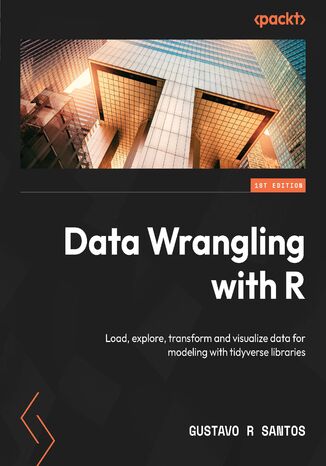
Gustavo Santos
In this information era, where large volumes of data are being generated every day, companies want to get a better grip on it to perform more efficiently than before. This is where skillful data analysts and data scientists come into play, wrangling and exploring data to generate valuable business insights. In order to do that, you’ll need plenty of tools that enable you to extract the most useful knowledge from data.Data Wrangling with R will help you to gain a deep understanding of ways to wrangle and prepare datasets for exploration, analysis, and modeling. This data book enables you to get your data ready for more optimized analyses, develop your first data model, and perform effective data visualization.The book begins by teaching you how to load and explore datasets. Then, you’ll get to grips with the modern concepts and tools of data wrangling. As data wrangling and visualization are intrinsically connected, you’ll go over best practices to plot data and extract insights from it. The chapters are designed in a way to help you learn all about modeling, as you will go through the construction of a data science project from end to end, and become familiar with the built-in RStudio, including an application built with Shiny dashboards.By the end of this book, you’ll have learned how to create your first data model and build an application with Shiny in R.
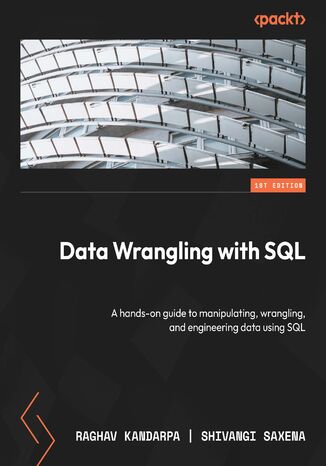
Data Wrangling with SQL. A hands-on guide to manipulating, wrangling, and engineering data using SQL
Raghav Kandarpa, Shivangi Saxena
The amount of data generated continues to grow rapidly, making it increasingly important for businesses to be able to wrangle this data and understand it quickly and efficiently. Although data wrangling can be challenging, with the right tools and techniques you can efficiently handle enormous amounts of unstructured data.The book starts by introducing you to the basics of SQL, focusing on the core principles and techniques of data wrangling. You’ll then explore advanced SQL concepts like aggregate functions, window functions, CTEs, and subqueries that are very popular in the business world. The next set of chapters will walk you through different functions within SQL query that cause delays in data transformation and help you figure out the difference between a good query and bad one. You’ll also learn how data wrangling and data science go hand in hand. The book is filled with datasets and practical examples to help you understand the concepts thoroughly, along with best practices to guide you at every stage of data wrangling.By the end of this book, you’ll be equipped with essential techniques and best practices for data wrangling, and will predominantly learn how to use clean and standardized data models to make informed decisions, helping businesses avoid costly mistakes.
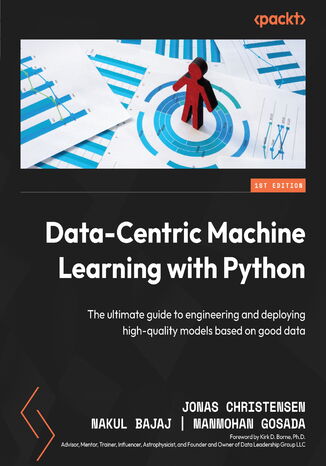
Jonas Christensen, Nakul Bajaj, Manmohan Gosada, Kirk...
In the rapidly advancing data-driven world where data quality is pivotal to the success of machine learning and artificial intelligence projects, this critically timed guide provides a rare, end-to-end overview of data-centric machine learning (DCML), along with hands-on applications of technical and non-technical approaches to generating deeper and more accurate datasets.This book will help you understand what data-centric ML/AI is and how it can help you to realize the potential of ‘small data’. Delving into the building blocks of data-centric ML/AI, you’ll explore the human aspects of data labeling, tackle ambiguity in labeling, and understand the role of synthetic data. From strategies to improve data collection to techniques for refining and augmenting datasets, you’ll learn everything you need to elevate your data-centric practices. Through applied examples and insights for overcoming challenges, you’ll get a roadmap for implementing data-centric ML/AI in diverse applications in Python.By the end of this book, you’ll have developed a profound understanding of data-centric ML/AI and the proficiency to seamlessly integrate common data-centric approaches in the model development lifecycle to unlock the full potential of your machine learning projects by prioritizing data quality and reliability.
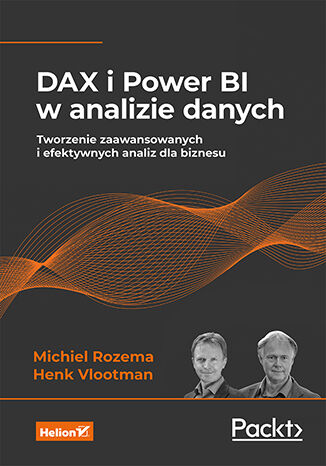
DAX i Power BI w analizie danych. Tworzenie zaawansowanych i efektywnych analiz dla biznesu
Michiel Rozema, Henk Vlootman
DAX i Power BI w analizie danych. Tworzenie zaawansowanych i efektywnych analiz dla biznesu Microsoft Power BI jest doskonałym narzędziem do profesjonalnej analizy danych. Jeśli jednak chcesz uzyskać za jego pomocą naprawdę spektakularne efekty, musisz się biegle posługiwać językiem DAX (Data Analysis Expressions). Pozwala on na wykonywanie zaawansowanych obliczeń i zapytań dotyczących danych w powiązanych tabelach i kolumnach w tabelarycznych modelach danych. To książka przeznaczona dla analityków biznesowych, którzy już poznali język DAX, chcą jednak skorzystać z pełnego potencjału formuł tego języka i modeli Power BI, by tworzyć wydajne i zaawansowane analizy danych. Opisano w niej zasady analizy biznesowej i reguły projektowania dobrych modeli. Zaprezentowano też praktyczne przykłady użycia języka DAX w rzeczywistych sytuacjach biznesowych. Pokazano niuanse pracy z modelami Power BI, a także z funkcjami DAX, filtrami i miarami. Nie zabrakło bardzo przydatnych wskazówek dotyczących błędów popełnianych często podczas tworzenia zaawansowanych agregacji danych. Do książki zostały dołączone materiały do pobrania (pliki PBIX), które ułatwią pełne zrozumienie prezentowanych treści i ich stosowanie we własnej praktyce zawodowej. Najciekawsze zagadnienia: koncepcje modelowania danych i struktur modele Power BI a modele systemów zarządzania relacyjnymi bazami danych bezpieczne poziomy agregacji, atrybuty i hierarchie koncepcja kontekstu i jej stosowanie standardowa analiza czasowa inteligentna ocena inwestycji za pomocą finansowych funkcji DAX Poznaj prawdziwy potencjał języka DAX w analizie danych!
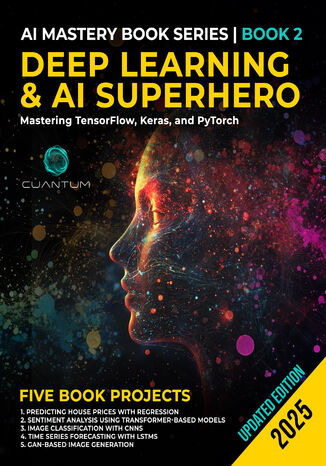
Cuantum Technologies LLC
Dive into the world of deep learning with this comprehensive guide that bridges theory and practice. From foundational neural networks to advanced architectures like CNNs, RNNs, and Transformers, this book equips you with the tools to build, train, and optimize AI models using TensorFlow, Keras, and PyTorch. Clear explanations of key concepts such as gradient descent, loss functions, and backpropagation are combined with hands-on exercises to ensure practical understanding.Explore cutting-edge AI frameworks, including generative adversarial networks (GANs) and autoencoders, while mastering real-world applications like image classification, text generation, and natural language processing. Detailed chapters cover transfer learning, fine-tuning pretrained models, and deployment strategies for cloud and edge computing. Practical exercises and projects further solidify your skills as you implement AI solutions for diverse challenges.Whether you're deploying AI models on cloud platforms like AWS or optimizing them for edge devices with TensorFlow Lite, this book provides step-by-step guidance. Designed for developers, AI enthusiasts, and data scientists, it balances theoretical depth with actionable insights, making it the ultimate resource for mastering modern deep learning frameworks and advancing your career in AI
Ahmed Menshawy
Deep learning is a popular subset of machine learning, and it allows you to build complex models that are faster and give more accurate predictions. This book is your companion to take your first steps into the world of deep learning, with hands-on examples to boost your understanding of the topic.This book starts with a quick overview of the essential concepts of data science and machine learning which are required to get started with deep learning. It introduces you to Tensorflow, the most widely used machine learning library for training deep learning models. You will then work on your first deep learning problem by training a deep feed-forward neural network for digit classification, and move on to tackle other real-world problems in computer vision, language processing, sentiment analysis, and more. Advanced deep learning models such as generative adversarial networks and their applications are also covered in this book.By the end of this book, you will have a solid understanding of all the essential concepts in deep learning. With the help of the examples and code provided in this book, you will be equipped to train your own deep learning models with more confidence.
Wei Di, Jianing Wei, Anurag Bhardwaj
Deep Learning a trending topic in the field of Artificial Intelligence today and can be considered to be an advanced form of machine learning. This book will help you take your first steps in training efficient deep learning models and applying them in various practical scenarios. You will model, train, and deploy different kinds of neural networks such as CNN, RNN, and will see some of their applications in real-world domains including computer vision, natural language processing, speech recognition, and so on. You will build practical projects such as chatbots, implement reinforcement learning to build smart games, and develop expert systems for image captioning and processing using Python library such as TensorFlow. This book also covers solutions for different problems you might come across while training models, such as noisy datasets, and small datasets.By the end of this book, you will have a firm understanding of the basics of deep learning and neural network modeling, along with their practical applications.
Dr. Pablo Rivas
With information on the web exponentially increasing, it has become more difficult than ever to navigate through everything to find reliable content that will help you get started with deep learning. This book is designed to help you if you're a beginner looking to work on deep learning and build deep learning models from scratch, and you already have the basic mathematical and programming knowledge required to get started.The book begins with a basic overview of machine learning, guiding you through setting up popular Python frameworks. You will also understand how to prepare data by cleaning and preprocessing it for deep learning, and gradually go on to explore neural networks. A dedicated section will give you insights into the working of neural networks by helping you get hands-on with training single and multiple layers of neurons. Later, you will cover popular neural network architectures such as CNNs, RNNs, AEs, VAEs, and GANs with the help of simple examples, and learn how to build models from scratch. At the end of each chapter, you will find a question and answer section to help you test what you've learned through the course of the book.By the end of this book, you'll be well-versed with deep learning concepts and have the knowledge you need to use specific algorithms with various tools for different tasks.
Rajalingappaa Shanmugamani
Deep learning has shown its power in several application areas of Artificial Intelligence, especially in Computer Vision. Computer Vision is the science of understanding and manipulating images, and finds enormous applications in the areas of robotics, automation, and so on. This book will also show you, with practical examples, how to develop Computer Vision applications by leveraging the power of deep learning. In this book, you will learn different techniques related to object classification, object detection, image segmentation, captioning, image generation, face analysis, and more. You will also explore their applications using popular Python libraries such as TensorFlow and Keras. This book will help you master state-of-the-art, deep learning algorithms and their implementation.
Vitor Cerqueira, Luís Roque
Most organizations exhibit a time-dependent structure in their processes, including fields such as finance. By leveraging time series analysis and forecasting, these organizations can make informed decisions and optimize their performance. Accurate forecasts help reduce uncertainty and enable better planning of operations. Unlike traditional approaches to forecasting, deep learning can process large amounts of data and help derive complex patterns. Despite its increasing relevance, getting the most out of deep learning requires significant technical expertise.This book guides you through applying deep learning to time series data with the help of easy-to-follow code recipes. You’ll cover time series problems, such as forecasting, anomaly detection, and classification. This deep learning book will also show you how to solve these problems using different deep neural network architectures, including convolutional neural networks (CNNs) or transformers. As you progress, you’ll use PyTorch, a popular deep learning framework based on Python to build production-ready prediction solutions.By the end of this book, you'll have learned how to solve different time series tasks with deep learning using the PyTorch ecosystem.
Mark Ryan
fastai is an easy-to-use deep learning framework built on top of PyTorch that lets you rapidly create complete deep learning solutions with as few as 10 lines of code. Both predominant low-level deep learning frameworks, TensorFlow and PyTorch, require a lot of code, even for straightforward applications. In contrast, fastai handles the messy details for you and lets you focus on applying deep learning to actually solve problems.The book begins by summarizing the value of fastai and showing you how to create a simple 'hello world' deep learning application with fastai. You'll then learn how to use fastai for all four application areas that the framework explicitly supports: tabular data, text data (NLP), recommender systems, and vision data. As you advance, you'll work through a series of practical examples that illustrate how to create real-world applications of each type. Next, you'll learn how to deploy fastai models, including creating a simple web application that predicts what object is depicted in an image. The book wraps up with an overview of the advanced features of fastai.By the end of this fastai book, you'll be able to create your own deep learning applications using fastai. You'll also have learned how to use fastai to prepare raw datasets, explore datasets, train deep learning models, and deploy trained models.
Deep Learning with Hadoop. Distributed Deep Learning with Large-Scale Data
Dipayan Dev
This book will teach you how to deploylarge-scale dataset in deep neural networks with Hadoop foroptimal performance.Starting with understanding what deeplearning is, and what the various modelsassociated with deep neural networks are, thisbook will then show you how to set up theHadoop environment for deep learning.In this book, you will also learn how toovercome the challenges that you facewhile implementing distributed deeplearning with large-scale unstructured datasets. The book willalso show you how you can implementand parallelize the widely used deep learning models such as Deep Belief Networks,Convolutional Neural Networks, Recurrent Neural Networks, Restricted Boltzmann machines and autoencoder using the popular deep learning library Deeplearning4j.Get in-depth mathematical explanationsand visual representations to helpyou understand the design and implementationsof Recurrent Neural network and Denoising Autoencoders withDeeplearning4j. To give you a morepractical perspective, the book will alsoteach you the implementation of large-scale video processing, image processing andnatural language processing on Hadoop.By the end of this book, you willknow how to deploy various deep neural networks indistributed systems using Hadoop.
Antonio Gulli, Sujit Pal
This book starts by introducing you to supervised learning algorithms such as simple linear regression, the classical multilayer perceptron and more sophisticated deep convolutional networks. You will also explore image processing with recognition of handwritten digit images, classification of images into different categories, and advanced objects recognition with related image annotations. An example of identification of salient points for face detection is also provided.Next you will be introduced to Recurrent Networks, which are optimized for processing sequence data such as text, audio or time series. Following that, you will learn about unsupervised learning algorithms such as Autoencoders and the very popular Generative Adversarial Networks (GANs). You will also explore non-traditional uses of neural networks as Style Transfer.Finally, you will look at reinforcement learning and its application to AI game playing, another popular direction of research and application of neural networks.
Willem Meints
Cognitive Toolkit is a very popular and recently open sourced deep learning toolkit by Microsoft. Cognitive Toolkit is used to train fast and effective deep learning models. This book will be a quick introduction to using Cognitive Toolkit and will teach you how to train and validate different types of neural networks, such as convolutional and recurrent neural networks.This book will help you understand the basics of deep learning. You will learn how to use Microsoft Cognitive Toolkit to build deep learning models and discover what makes this framework unique so that you know when to use it. This book will be a quick, no-nonsense introduction to the library and will teach you how to train different types of neural networks, such as convolutional neural networks, recurrent neural networks, autoencoders, and more, using Cognitive Toolkit. Then we will look at two scenarios in which deep learning can be used to enhance human capabilities. The book will also demonstrate how to evaluate your models' performance to ensure it trains and runs smoothly and gives you the most accurate results. Finally, you will get a short overview of how Cognitive Toolkit fits in to a DevOps environment
Deep Learning with PyTorch. A practical approach to building neural network models using PyTorch
Vishnu Subramanian
Deep learning powers the most intelligent systems in the world, such as Google Voice, Siri, and Alexa. Advancements in powerful hardware, such as GPUs, software frameworks such as PyTorch, Keras, TensorFlow, and CNTK along with the availability of big data have made it easier to implement solutions to problems in the areas of text, vision, and advanced analytics. This book will get you up and running with one of the most cutting-edge deep learning libraries—PyTorch. PyTorch is grabbing the attention of deep learning researchers and data science professionals due to its accessibility, efficiency and being more native to Python way of development. You'll start off by installing PyTorch, then quickly move on to learn various fundamental blocks that power modern deep learning. You will also learn how to use CNN, RNN, LSTM and other networks to solve real-world problems. This book explains the concepts of various state-of-the-art deep learning architectures, such as ResNet, DenseNet, Inception, and Seq2Seq, without diving deep into the math behind them. You will also learn about GPU computing during the course of the book. You will see how to train a model with PyTorch and dive into complex neural networks such as generative networks for producing text and images. By the end of the book, you'll be able to implement deep learning applications in PyTorch with ease.
Kunal Sawarkar, Dheeraj Arremsetty
Building and implementing deep learning (DL) is becoming a key skill for those who want to be at the forefront of progress.But with so much information and complex study materials out there, getting started with DL can feel quite overwhelming.Written by an AI thought leader, Deep Learning with PyTorch Lightning helps researchers build their first DL models quickly and easily without getting stuck on the complexities. With its help, you’ll be able to maximize productivity for DL projects while ensuring full flexibility – from model formulation to implementation.Throughout this book, you’ll learn how to configure PyTorch Lightning on a cloud platform, understand the architectural components, and explore how they are configured to build various industry solutions. You’ll build a neural network architecture, deploy an application from scratch, and see how you can expand it based on your specific needs, beyond what the framework can provide.In the later chapters, you’ll also learn how to implement capabilities to build and train various models like Convolutional Neural Nets (CNN), Natural Language Processing (NLP), Time Series, Self-Supervised Learning, Semi-Supervised Learning, Generative Adversarial Network (GAN) using PyTorch Lightning.By the end of this book, you’ll be able to build and deploy DL models with confidence.
David Julian
PyTorch is extremely powerful and yet easy to learn. It provides advanced features, such as supporting multiprocessor, distributed, and parallel computation. This book is an excellent entry point for those wanting to explore deep learning with PyTorch to harness its power. This book will introduce you to the PyTorch deep learning library and teach you how to train deep learning models without any hassle. We will set up the deep learning environment using PyTorch, and then train and deploy different types of deep learning models, such as CNN, RNN, and autoencoders. You will learn how to optimize models by tuning hyperparameters and how to use PyTorch in multiprocessor and distributed environments. We will discuss long short-term memory network (LSTMs) and build a language model to predict text.By the end of this book, you will be familiar with PyTorch's capabilities and be able to utilize the library to train your neural networks with relative ease.
Swarna Gupta, Rehan Ali Ansari, Dipayan Sarkar
Deep learning (DL) has evolved in recent years with developments such as generative adversarial networks (GANs), variational autoencoders (VAEs), and deep reinforcement learning. This book will get you up and running with R 3.5.x to help you implement DL techniques.The book starts with the various DL techniques that you can implement in your apps. A unique set of recipes will help you solve binomial and multinomial classification problems, and perform regression and hyperparameter optimization. To help you gain hands-on experience of concepts, the book features recipes for implementing convolutional neural networks (CNNs), recurrent neural networks (RNNs), and Long short-term memory (LSTMs) networks, as well as sequence-to-sequence models and reinforcement learning. You’ll then learn about high-performance computation using GPUs, along with learning about parallel computation capabilities in R. Later, you’ll explore libraries, such as MXNet, that are designed for GPU computing and state-of-the-art DL. Finally, you’ll discover how to solve different problems in NLP, object detection, and action identification, before understanding how to use pre-trained models in DL apps.By the end of this book, you’ll have comprehensive knowledge of DL and DL packages, and be able to develop effective solutions for different DL problems.
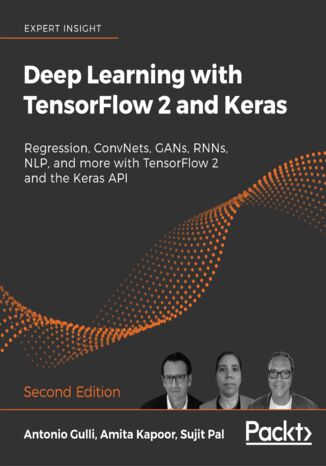
Antonio Gulli, Dr. Amita Kapoor, Sujit Pal
Deep Learning with TensorFlow 2 and Keras, Second Edition teaches neural networks and deep learning techniques alongside TensorFlow (TF) and Keras. You’ll learn how to write deep learning applications in the most powerful, popular, and scalable machine learning stack available.TensorFlow is the machine learning library of choice for professional applications, while Keras offers a simple and powerful Python API for accessing TensorFlow. TensorFlow 2 provides full Keras integration, making advanced machine learning easier and more convenient than ever before.This book also introduces neural networks with TensorFlow, runs through the main applications (regression, ConvNets (CNNs), GANs, RNNs, NLP), covers two working example apps, and then dives into TF in production, TF mobile, and using TensorFlow with AutoML.
Deep Learning with TensorFlow. Explore neural networks with Python
Giancarlo Zaccone, Fabrizio Milo, Md. Rezaul Karim
Deep learning is the step that comes after machine learning, and has more advancedimplementations. Machine learning is not just for academics anymore, but is becoming a mainstream practice through wide adoption, and deep learning has taken the front seat. As a data scientist, if you want to explore data abstraction layers, this book will be your guide. This book shows how this can be exploited in the real world with complex raw data using TensorFlow 1.x.Throughout the book, you’ll learn how to implement deep learning algorithms for machine learning systems and integrate them into your product offerings, includingsearch, image recognition, and language processing. Additionally, you’ll learn howto analyze and improve the performance of deep learning models. This can be done bycomparing algorithms against benchmarks, along with machine intelligence, to learnfrom the information and determine ideal behaviors within a specific context.After finishing the book, you will be familiar with machine learning techniques, in particular the use of TensorFlow for deep learning, and will be ready to apply your knowledge to research or commercial projects.
Developer, Advocate!. Conversations on turning a passion for talking about tech into a career
Geertjan Wielenga
What exactly is a developer advocate, and how do they connect developers and companies around the world? Why is the area of developer relations set to explode? Can anybody with a passion for tech become a developer advocate? What are the keys to success on a global scale? How does a developer advocate maintain authenticity when balancing the needs of their company and their tech community? What are the hot topics in areas including Java, JavaScript, tech for good, artificial intelligence, blockchain, the cloud, and open source?These are just a few of the questions addressed by developer advocate and author Geertjan Wielenga in Developer, Advocate!. 32 of the industry's most prominent developer advocates, from companies including Oracle, Microsoft, Google, and Amazon, open up about what it's like to turn a lifelong passion for knowledge sharing about tech into a rewarding career. These advocates run the gamut from working at large software vendors to small start-ups, along with independent developer advocates who work within organizations or for themselves.In Developer, Advocate!, readers will see how developer advocates are actively changing the world, not only for developers, but for individuals and companies navigating the fast-changing tech landscape. More importantly, Developer, Advocate! serves as a rallying cry to inspire and motivate tech enthusiasts and burgeoning developer advocates to get started and take their first steps within their tech community.
Developing Kaggle Notebooks. Pave your way to becoming a Kaggle Notebooks Grandmaster
Gabriel Preda, D. Sculley, Anthony Goldbloom
Developing Kaggle Notebooks introduces you to data analysis, with a focus on using Kaggle Notebooks to simultaneously achieve mastery in this fi eld and rise to the top of the Kaggle Notebooks tier. The book is structured as a sevenstep data analysis journey, exploring the features available in Kaggle Notebooks alongside various data analysis techniques.For each topic, we provide one or more notebooks, developing reusable analysis components through Kaggle's Utility Scripts feature, introduced progressively, initially as part of a notebook, and later extracted for use across future notebooks to enhance code reusability on Kaggle. It aims to make the notebooks' code more structured, easy to maintain, and readable.Although the focus of this book is on data analytics, some examples will guide you in preparing a complete machine learning pipeline using Kaggle Notebooks. Starting from initial data ingestion and data quality assessment, you'll move on to preliminary data analysis, advanced data exploration, feature qualifi cation to build a model baseline, and feature engineering. You'll also delve into hyperparameter tuning to iteratively refi ne your model and prepare for submission in Kaggle competitions. Additionally, the book touches on developing notebooks that leverage the power of generative AI using Kaggle Models.