
Analiza danych
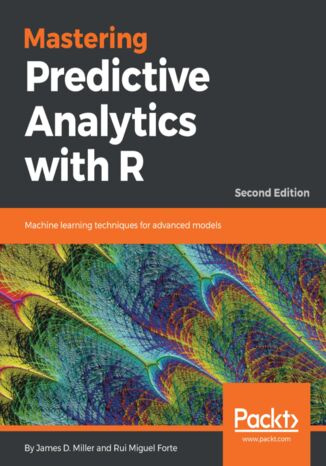
James D. Miller , Rui Miguel Forte
R offers a free and open source environment that is perfect for both learning and deploying predictive modeling solutions. With its constantly growing community and plethora of packages, R offers the functionality to deal with a truly vast array of problems.The book begins with a dedicated chapter on the language of models and the predictive modeling process. You will understand the learning curve and the process of tidying data. Each subsequent chapter tackles a particular type of model, such as neural networks, and focuses on the three important questions of how the model works, how to use R to train it, and how to measure and assess its performance using real-world datasets. How do you train models that can handle really large datasets? This book will also show you just that. Finally, you will tackle the really important topic of deep learning by implementing applications on word embedding and recurrent neural networks.By the end of this book, you will have explored and tested the most popular modeling techniques in use on real- world datasets and mastered a diverse range of techniques in predictive analytics using R.
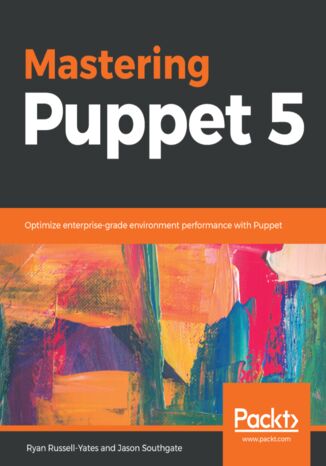
Mastering Puppet 5. Optimize enterprise-grade environment performance with Puppet
Ryan Russell-Yates, Jason Southgate
Puppet is a configuration management system and a language written for and by system administrators to manage a large number of systems efficiently and prevent configuration drift.The core topics this book addresses are Puppet's latest features and mastering Puppet Enterprise. You will begin by writing a new Puppet module, gaining an understanding of the guidelines and style of the Puppet community. Following on from this, you will take advantage of the roles and profiles pattern, and you will learn how to structure your code. Next, you will learn how to extend Puppet and write custom facts, functions, types, and providers in Ruby, and also use the new features of Hiera 5. You will also learn how to configure the new Code Manager component, and how to ensure code is automatically deployed to (multiple) Puppet servers. Next, you will learn how to integrate Puppet with Jenkins and Git to build an effective workflow for multiple teams, and use the new Puppet Tasks feature and the latest Puppet Orchestrator language extensions. Finally, you will learn how to scale and troubleshoot Puppet.By the end of the book, you will be able to deal with problems of scale and exceptions in your code, automate workflows, and support multiple developers working simultaneously.
Magnus Vilhelm Persson, Luiz Felipe Martins
Python, a multi-paradigm programming language, has become the language of choice for data scientists for data analysis, visualization, and machine learning. Ever imagined how to become an expert at effectively approaching data analysis problems, solving them, and extracting all of the available information from your data? Well, look no further, this is the book you want!Through this comprehensive guide, you will explore data and present results and conclusions from statistical analysis in a meaningful way. You’ll be able to quickly and accurately perform the hands-on sorting, reduction, and subsequent analysis, and fully appreciate how data analysis methods can support business decision-making.You’ll start off by learning about the tools available for data analysis in Python and will then explore the statistical models that are used to identify patterns in data. Gradually, you’ll move on to review statistical inference using Python, Pandas, and SciPy. After that, we’ll focus on performing regression using computational tools and you’ll get to understand the problem of identifying clusters in data in an algorithmic way. Finally, we delve into advanced techniques to quantify cause and effect using Bayesian methods and you’ll discover how to use Python’s tools for supervised machine learning.
Kirthi Raman
Python has a handful of open source libraries for numerical computations involving optimization, linear algebra, integration, interpolation, and other special functions using array objects, machine learning, data mining, and plotting. Pandas have a productive environment for data analysis. These libraries have a specific purpose and play an important role in the research into diverse domains including economics, finance, biological sciences, social science, health care, and many more. The variety of tools and approaches available within Python community is stunning, and can bolster and enhance visual story experiences.This book offers practical guidance to help you on the journey to effective data visualization. Commencing with a chapter on the data framework, which explains the transformation of data into information and eventually knowledge, this book subsequently covers the complete visualization process using the most popular Python libraries with working examples. You will learn the usage of Numpy, Scipy, IPython, MatPlotLib, Pandas, Patsy, and Scikit-Learn with a focus on generating results that can be visualized in many different ways. Further chapters are aimed at not only showing advanced techniques such as interactive plotting; numerical, graphical linear, and non-linear regression; clustering and classification, but also in helping you understand the aesthetics and best practices of data visualization. The book concludes with interesting examples such as social networks, directed graph examples in real-life, data structures appropriate for these problems, and network analysis.By the end of this book, you will be able to effectively solve a broad set of data analysis problems.
Kamon Ayeva, Sakis Kasampalis
Python is an object-oriented scripting language that is used in a wide range of categories. In software engineering, a design pattern is an elected solution for solving software design problems. Although they have been around for a while, design patterns remain one of the top topics in software engineering, and are a ready source for software developers to solve the problems they face on a regular basis. This book takes you through a variety of design patterns and explains them with real-world examples. You will get to grips with low-level details and concepts that show you how to write Python code, without focusing on common solutions as enabled in Java and C++. You'll also fnd sections on corrections, best practices, system architecture, and its designing aspects. This book will help you learn the core concepts of design patterns and the way they can be used to resolve software design problems. You'll focus on most of the Gang of Four (GoF) design patterns, which are used to solve everyday problems, and take your skills to the next level with reactive and functional patterns that help you build resilient, scalable, and robust applications. By the end of the book, you'll be able to effciently address commonly faced problems and develop applications, and also be comfortable working on scalable and maintainable projects of any size.
Hemant Kumar Mehta
In today's world, along with theoretical and experimental work, scientific computing has become an important part of scientific disciplines. Numerical calculations, simulations and computer modeling in this day and age form the vast majority of both experimental and theoretical papers. In the scientific method, replication and reproducibility are two important contributing factors. A complete and concrete scientific result should be reproducible and replicable. Python is suitable for scientific computing. A large community of users, plenty of help and documentation, a large collection of scientific libraries and environments, great performance, and good support makes Python a great choice for scientific computing.At present Python is among the top choices for developing scientific workflow and the book targets existing Python developers to master this domain using Python. The main things to learn in the book are the concept of scientific workflow, managing scientific workflow data and performing computation on this data using Python.The book discusses NumPy, SciPy, SymPy, matplotlib, Pandas and IPython with several example programs.
Mastering PyTorch. Build powerful neural network architectures using advanced PyTorch 1.x features
Ashish Ranjan Jha
Deep learning is driving the AI revolution, and PyTorch is making it easier than ever before for anyone to build deep learning applications. This PyTorch book will help you uncover expert techniques to get the most out of your data and build complex neural network models.The book starts with a quick overview of PyTorch and explores using convolutional neural network (CNN) architectures for image classification. You'll then work with recurrent neural network (RNN) architectures and transformers for sentiment analysis. As you advance, you'll apply deep learning across different domains, such as music, text, and image generation using generative models and explore the world of generative adversarial networks (GANs). You'll not only build and train your own deep reinforcement learning models in PyTorch but also deploy PyTorch models to production using expert tips and techniques. Finally, you'll get to grips with training large models efficiently in a distributed manner, searching neural architectures effectively with AutoML, and rapidly prototyping models using PyTorch and fast.ai.By the end of this PyTorch book, you'll be able to perform complex deep learning tasks using PyTorch to build smart artificial intelligence models.
Ralf Becher, Karl Pover, Jason Michaelides, Dilyana...
Qlik Sense is a powerful, self-servicing Business Intelligence tool for data discovery, analytics and visualization. It allows you to create personalized Business Intelligence solutions from raw data and get actionable insights from it.This book is your one-stop guide to mastering Qlik Sense, catering to all your organizational BI needs. You'll see how you can seamlessly navigate through tons of data from multiple sources and take advantage of the various APIs available in Qlik and its components for guided analytics. You'll also learn how to embed visualizations into your existing BI solutions and extend the capabilities of Qlik Sense to create new visualizations and dashboards that work across all platforms. We also cover other advanced concepts such as porting your Qlik View applications to Qlik Sense,and working with Qlik Cloud. Finally, you'll implement enterprise-wide security and access control for resources and data sources through practical examples.With the knowledge gained from this book, you'll have become the go-to expert in your organization when it comes to designing BI solutions using Qlik Sense.