Uczenie maszynowe
Uczenie maszynowe (ang. machine learning) zajmuje się teorią i praktycznym zastosowaniem algorytmów analizujących dane — stanowi najciekawszą dziedzinę informatyki. Żyjemy w czasach przetwarzania olbrzymiej ilości informacji; za pomocą samouczących się algorytmów będących częścią uczenia maszynowego informacje te są przekształcane w rzeczywistą wiedzę. Dzięki licznym i potężnym bibliotekom o jawnym kodzie źródłowym, które powstały w ostatnich latach, prawdopodobnie teraz jest najlepszy czas, aby zainteresować się uczeniem maszynowym i nauczyć się wykorzystywać potężne algorytmy do wykrywania wzorców w przetwarzanych danych oraz prognozować przyszłe zdarzenia. Przykładami zastosowania Machine Learning są np. mechanizmy wyszukiwarek internetowych, GPS, autokorekta w edytorze tekstu czy boty w komunikatorach. Jedną z dziedzin uczenia maszynowego jest deep learning, podczas którego komputer uczy się procesów naturalnych dla ludzkiego mózgu (tworzy sieci neuronowe). Technologia ta jest wykorzystywana np. przy identyfikacji głosu i obrazów.
David Ping
David Ping, Head of GenAI and ML Solution Architecture for global industries at AWS, provides expert insights and practical examples to help you become a proficient ML solutions architect, linking technical architecture to business-related skills.You'll learn about ML algorithms, cloud infrastructure, system design, MLOps , and how to apply ML to solve real-world business problems. David explains the generative AI project lifecycle and examines Retrieval Augmented Generation (RAG), an effective architecture pattern for generative AI applications. You’ll also learn about open-source technologies, such as Kubernetes/Kubeflow, for building a data science environment and ML pipelines before building an enterprise ML architecture using AWS. As well as ML risk management and the different stages of AI/ML adoption, the biggest new addition to the handbook is the deep exploration of generative AI.By the end of this book , you’ll have gained a comprehensive understanding of AI/ML across all key aspects, including business use cases, data science, real-world solution architecture, risk management, and governance. You’ll possess the skills to design and construct ML solutions that effectively cater to common use cases and follow established ML architecture patterns, enabling you to excel as a true professional in the field.
Hyatt Saleh
Machine learning algorithms are an integral part of almost all modern applications. To make the learning process faster and more accurate, you need a tool flexible and powerful enough to help you build machine learning algorithms quickly and easily. With The Machine Learning Workshop, you'll master the scikit-learn library and become proficient in developing clever machine learning algorithms.The Machine Learning Workshop begins by demonstrating how unsupervised and supervised learning algorithms work by analyzing a real-world dataset of wholesale customers. Once you've got to grips with the basics, you'll develop an artificial neural network using scikit-learn and then improve its performance by fine-tuning hyperparameters. Towards the end of the workshop, you'll study the dataset of a bank's marketing activities and build machine learning models that can list clients who are likely to subscribe to a term deposit. You'll also learn how to compare these models and select the optimal one.By the end of The Machine Learning Workshop, you'll not only have learned the difference between supervised and unsupervised models and their applications in the real world, but you'll also have developed the skills required to get started with programming your very own machine learning algorithms.
Rohan Chopra, Aniruddha M. Godbole, Nipun Sadvilkar,...
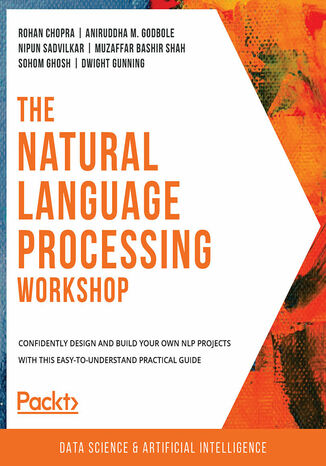
Do you want to learn how to communicate with computer systems using Natural Language Processing (NLP) techniques, or make a machine understand human sentiments? Do you want to build applications like Siri, Alexa, or chatbots, even if you’ve never done it before?With The Natural Language Processing Workshop, you can expect to make consistent progress as a beginner, and get up to speed in an interactive way, with the help of hands-on activities and fun exercises.The book starts with an introduction to NLP. You’ll study different approaches to NLP tasks, and perform exercises in Python to understand the process of preparing datasets for NLP models. Next, you’ll use advanced NLP algorithms and visualization techniques to collect datasets from open websites, and to summarize and generate random text from a document. In the final chapters, you’ll use NLP to create a chatbot that detects positive or negative sentiment in text documents such as movie reviews.By the end of this book, you’ll be equipped with the essential NLP tools and techniques you need to solve common business problems that involve processing text.
Liu Peng
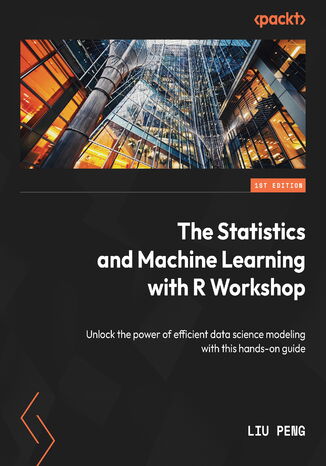
The Statistics and Machine Learning with R Workshop is a comprehensive resource packed with insights into statistics and machine learning, along with a deep dive into R libraries. The learning experience is further enhanced by practical examples and hands-on exercises that provide explanations of key concepts.Starting with the fundamentals, you’ll explore the complete model development process, covering everything from data pre-processing to model development. In addition to machine learning, you’ll also delve into R's statistical capabilities, learning to manipulate various data types and tackle complex mathematical challenges from algebra and calculus to probability and Bayesian statistics. You’ll discover linear regression techniques and more advanced statistical methodologies to hone your skills and advance your career.By the end of this book, you'll have a robust foundational understanding of statistics and machine learning. You’ll also be proficient in using R's extensive libraries for tasks such as data processing and model training and be well-equipped to leverage the full potential of R in your future projects.
Blaine Bateman, Ashish Ranjan Jha, Benjamin Johnston,...
Would you like to understand how and why machine learning techniques and data analytics are spearheading enterprises globally? From analyzing bioinformatics to predicting climate change, machine learning plays an increasingly pivotal role in our society.Although the real-world applications may seem complex, this book simplifies supervised learning for beginners with a step-by-step interactive approach. Working with real-time datasets, you’ll learn how supervised learning, when used with Python, can produce efficient predictive models.Starting with the fundamentals of supervised learning, you’ll quickly move to understand how to automate manual tasks and the process of assessing date using Jupyter and Python libraries like pandas. Next, you’ll use data exploration and visualization techniques to develop powerful supervised learning models, before understanding how to distinguish variables and represent their relationships using scatter plots, heatmaps, and box plots. After using regression and classification models on real-time datasets to predict future outcomes, you’ll grasp advanced ensemble techniques such as boosting and random forests. Finally, you’ll learn the importance of model evaluation in supervised learning and study metrics to evaluate regression and classification tasks.By the end of this book, you’ll have the skills you need to work on your real-life supervised learning Python projects.
Matthew Moocarme, Anthony So, Anthony Maddalone
Getting to grips with tensors, deep learning, and neural networks can be intimidating and confusing for anyone, no matter their experience level. The breadth of information out there, often written at a very high level and aimed at advanced practitioners, can make getting started even more challenging.If this sounds familiar to you, The TensorFlow Workshop is here to help. Combining clear explanations, realistic examples, and plenty of hands-on practice, it’ll quickly get you up and running.You’ll start off with the basics – learning how to load data into TensorFlow, perform tensor operations, and utilize common optimizers and activation functions. As you progress, you’ll experiment with different TensorFlow development tools, including TensorBoard, TensorFlow Hub, and Google Colab, before moving on to solve regression and classification problems with sequential models.Building on this solid foundation, you’ll learn how to tune models and work with different types of neural network, getting hands-on with real-world deep learning applications such as text encoding, temperature forecasting, image augmentation, and audio processing.By the end of this deep learning book, you’ll have the skills, knowledge, and confidence to tackle your own ambitious deep learning projects with TensorFlow.
Aaron Jones, Christopher Kruger, Benjamin Johnston
Do you find it difficult to understand how popular companies like WhatsApp and Amazon find valuable insights from large amounts of unorganized data? The Unsupervised Learning Workshop will give you the confidence to deal with cluttered and unlabeled datasets, using unsupervised algorithms in an easy and interactive manner.The book starts by introducing the most popular clustering algorithms of unsupervised learning. You'll find out how hierarchical clustering differs from k-means, along with understanding how to apply DBSCAN to highly complex and noisy data. Moving ahead, you'll use autoencoders for efficient data encoding.As you progress, you’ll use t-SNE models to extract high-dimensional information into a lower dimension for better visualization, in addition to working with topic modeling for implementing natural language processing (NLP). In later chapters, you’ll find key relationships between customers and businesses using Market Basket Analysis, before going on to use Hotspot Analysis for estimating the population density of an area.By the end of this book, you’ll be equipped with the skills you need to apply unsupervised algorithms on cluttered datasets to find useful patterns and insights.
Michaël Hoarau
Being a business analyst and data scientist, you have to use many algorithms and approaches to prepare, process, and build ML-based applications by leveraging time series data, but you face common problems, such as not knowing which algorithm to choose or how to combine and interpret them. Amazon Web Services (AWS) provides numerous services to help you build applications fueled by artificial intelligence (AI) capabilities. This book helps you get to grips with three AWS AI/ML-managed services to enable you to deliver your desired business outcomes.The book begins with Amazon Forecast, where you’ll discover how to use time series forecasting, leveraging sophisticated statistical and machine learning algorithms to deliver business outcomes accurately. You’ll then learn to use Amazon Lookout for Equipment to build multivariate time series anomaly detection models geared toward industrial equipment and understand how it provides valuable insights to reinforce teams focused on predictive maintenance and predictive quality use cases. In the last chapters, you’ll explore Amazon Lookout for Metrics, and automatically detect and diagnose outliers in your business and operational data.By the end of this AWS book, you’ll have understood how to use the three AWS AI services effectively to perform time series analysis.