
Uczenie maszynowe
Siamak Amirghodsi, Mohammed Guller, Shuen Mei, Meenakshi...
Machine learning aims to extract knowledge from data, relying on fundamental concepts in computer science, statistics, probability, and optimization. Learning about algorithms enables a wide range of applications, from everyday tasks such as product recommendations and spam filtering to cutting edge applications such as self-driving cars and personalized medicine. You will gain hands-on experience of applying these principles using Apache Spark, a resilient cluster computing system well suited for large-scale machine learning tasks.This book begins with a quick overview of setting up the necessary IDEs to facilitate the execution of code examples that will be covered in various chapters. It also highlights some key issues developers face while working with machine learning algorithms on the Spark platform. We progress by uncovering the various Spark APIs and the implementation of ML algorithms with developing classification systems, recommendation engines, text analytics, clustering, and learning systems. Toward the final chapters, we’ll focus on building high-end applications and explain various unsupervised methodologies and challenges to tackle when implementing with big data ML systems.
Ahmed Sherif, Amrith Ravindra, Michal Malohlava, Adnan...
Organizations these days need to integrate popular big data tools such as Apache Spark with highly efficient deep learning libraries if they’re looking to gain faster and more powerful insights from their data. With this book, you’ll discover over 80 recipes to help you train fast, enterprise-grade, deep learning models on Apache Spark.Each recipe addresses a specific problem, and offers a proven, best-practice solution to difficulties encountered while implementing various deep learning algorithms in a distributed environment. The book follows a systematic approach, featuring a balance of theory and tips with best practice solutions to assist you with training different types of neural networks such as convolutional neural networks (CNNs) and recurrent neural networks (RNNs). You’ll also have access to code written in TensorFlow and Keras that you can run on Spark to solve a variety of deep learning problems in computer vision and natural language processing (NLP), or tweak to tackle other problems encountered in deep learning.By the end of this book, you'll have the skills you need to train and deploy state-of-the-art deep learning models on Apache Spark.
Deepak Gowda
In the world of big data, efficiently processing and analyzing massive datasets for machine learning can be a daunting task. Written by Deepak Gowda, a data scientist with over a decade of experience and 30+ patents, this book provides a hands-on guide to mastering Spark’s capabilities for efficient data processing, model building, and optimization. With Deepak’s expertise across industries such as supply chain, cybersecurity, and data center infrastructure, he makes complex concepts easy to follow through detailed recipes.This book takes you through core machine learning concepts, highlighting the advantages of Spark for big data analytics. It covers practical data preprocessing techniques, including feature extraction and transformation, supervised learning methods with detailed chapters on regression and classification, and unsupervised learning through clustering and recommendation systems. You’ll also learn to identify frequent patterns in data and discover effective strategies to deploy and optimize your machine learning models. Each chapter features practical coding examples and real-world applications to equip you with the knowledge and skills needed to tackle complex machine learning tasks.By the end of this book, you’ll be ready to handle big data and create advanced machine learning models with Apache Spark.
Dr. Tania Moulik
Applied Data Visualization with R and ggplot2 introduces you to the world of data visualization by taking you through the basic features of ggplot2. To start with, you’ll learn how to set up the R environment, followed by getting insights into the grammar of graphics and geometric objects before you explore the plotting techniques.You’ll discover what layers, scales, coordinates, and themes are, and study how you can use them to transform your data into aesthetical graphs. Once you’ve grasped the basics, you’ll move on to studying simple plots such as histograms and advanced plots such as superimposing and density plots. You’ll also get to grips with plotting trends, correlations, and statistical summaries.By the end of this book, you’ll have created data visualizations that will impress your clients.
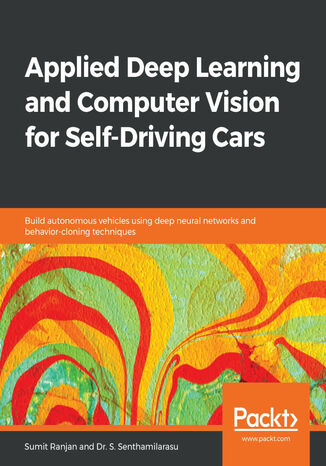
Balu Nair, Sumit Ranjan, Dr. S. Senthamilarasu
Thanks to a number of recent breakthroughs, self-driving car technology is now an emerging subject in the field of artificial intelligence and has shifted data scientists' focus to building autonomous cars that will transform the automotive industry. This book is a comprehensive guide to use deep learning and computer vision techniques to develop autonomous cars. Starting with the basics of self-driving cars (SDCs), this book will take you through the deep neural network techniques required to get up and running with building your autonomous vehicle. Once you are comfortable with the basics, you'll delve into advanced computer vision techniques and learn how to use deep learning methods to perform a variety of computer vision tasks such as finding lane lines, improving image classification, and so on. You will explore the basic structure and working of a semantic segmentation model and get to grips with detecting cars using semantic segmentation. The book also covers advanced applications such as behavior-cloning and vehicle detection using OpenCV, transfer learning, and deep learning methodologies to train SDCs to mimic human driving.By the end of this book, you'll have learned how to implement a variety of neural networks to develop your own autonomous vehicle using modern Python libraries.
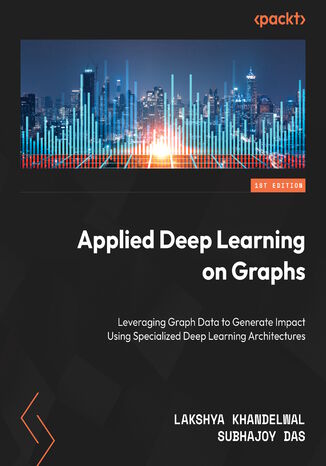
Lakshya Khandelwal, Subhajoy Das
With their combined expertise spanning cutting-edge AI product development at industry giants such as Walmart, Adobe, Samsung, and Arista Networks, Lakshya and Subhajoy provide real-world insights into the transformative world of graph neural networks (GNNs).This book demystifies GNNs, guiding you from foundational concepts to advanced techniques and real-world applications. You’ll see how graph data structures power today’s interconnected world, why specialized deep learning approaches are essential, and how to address challenges with existing methods. You’ll start by dissecting early graph representation techniques such as DeepWalk and node2vec. From there, the book takes you through popular GNN architectures, covering graph convolutional and attention networks, autoencoder models, LLMs, and technologies such as retrieval augmented generation on graph data. With a strong theoretical grounding, you’ll seamlessly navigate practical implementations, mastering the critical topics of scalability, interpretability, and application domains such as NLP, recommendations, and computer vision.By the end of this book, you’ll have mastered the underlying ideas and practical coding skills needed to innovate beyond current methods and gained strategic insights into the future of GNN technologies.
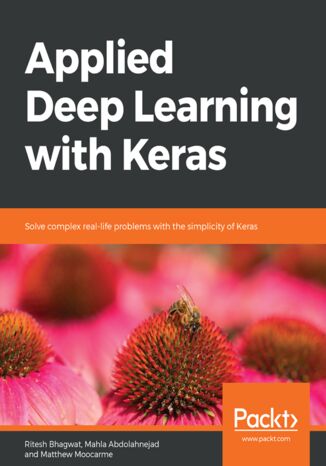
Applied Deep Learning with Keras. Solve complex real-life problems with the simplicity of Keras
Ritesh Bhagwat , Mahla Abdolahnejad , Matthew...
Though designing neural networks is a sought-after skill, it is not easy to master. With Keras, you can apply complex machine learning algorithms with minimum code.Applied Deep Learning with Keras starts by taking you through the basics of machine learning and Python all the way to gaining an in-depth understanding of applying Keras to develop efficient deep learning solutions. To help you grasp the difference between machine and deep learning, the book guides you on how to build a logistic regression model, first with scikit-learn and then with Keras. You will delve into Keras and its many models by creating prediction models for various real-world scenarios, such as disease prediction and customer churning. You’ll gain knowledge on how to evaluate, optimize, and improve your models to achieve maximum information. Next, you’ll learn to evaluate your model by cross-validating it using Keras Wrapper and scikit-learn. Following this, you’ll proceed to understand how to apply L1, L2, and dropout regularization techniques to improve the accuracy of your model. To help maintain accuracy, you’ll get to grips with applying techniques including null accuracy, precision, and AUC-ROC score techniques for fine tuning your model.By the end of this book, you will have the skills you need to use Keras when building high-level deep neural networks.
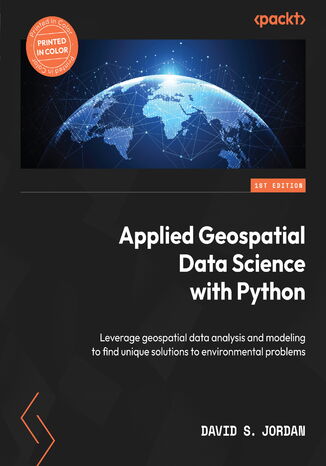
David S. Jordan
Data scientists, when presented with a myriad of data, can often lose sight of how to present geospatial analyses in a meaningful way so that it makes sense to everyone. Using Python to visualize data helps stakeholders in less technical roles to understand the problem and seek solutions. The goal of this book is to help data scientists and GIS professionals learn and implement geospatial data science workflows using Python.Throughout this book, you’ll uncover numerous geospatial Python libraries with which you can develop end-to-end spatial data science workflows. You’ll learn how to read, process, and manipulate spatial data effectively. With data in hand, you’ll move on to crafting spatial data visualizations to better understand and tell the story of your data through static and dynamic mapping applications. As you progress through the book, you’ll find yourself developing geospatial AI and ML models focused on clustering, regression, and optimization. The use cases can be leveraged as building blocks for more advanced work in a variety of industries.By the end of the book, you’ll be able to tackle random data, find meaningful correlations, and make geospatial data models.
Alok Malik, Bradford Tuckfield
Starting with the basics, Applied Unsupervised Learning with R explains clustering methods, distribution analysis, data encoders, and features of R that enable you to understand your data better and get answers to your most pressing business questions. This book begins with the most important and commonly used method for unsupervised learning - clustering - and explains the three main clustering algorithms - k-means, divisive, and agglomerative. Following this, you'll study market basket analysis, kernel density estimation, principal component analysis, and anomaly detection. You'll be introduced to these methods using code written in R, with further instructions on how to work with, edit, and improve R code. To help you gain a practical understanding, the book also features useful tips on applying these methods to real business problems, including market segmentation and fraud detection. By working through interesting activities, you'll explore data encoders and latent variable models. By the end of this book, you will have a better understanding of different anomaly detection methods, such as outlier detection, Mahalanobis distances, and contextual and collective anomaly detection.
Zsolt Nagy
Machine learning and neural networks are pillars on which you can build intelligent applications. Artificial Intelligence and Machine Learning Fundamentals begins by introducing you to Python and discussing AI search algorithms. You will cover in-depth mathematical topics, such as regression and classification, illustrated by Python examples.As you make your way through the book, you will progress to advanced AI techniques and concepts, and work on real-life datasets to form decision trees and clusters. You will be introduced to neural networks, a powerful tool based on Moore's law.By the end of this book, you will be confident when it comes to building your own AI applications with your newly acquired skills!
Denis Rothman, Nicolas GUET, Jérémie ROTHMAN
Artificial intelligence has the potential to replicate humans in every field. Artificial Intelligence By Example serves as a starting point for you to understand how AI is built, with the help of intriguing examples and case studies.Artificial Intelligence By Example will make you an adaptive thinker and help you apply concepts to real-life scenarios. Using some of the most interesting AI examples, right from a simple chess engine to a cognitive chatbot, you will learn how to tackle the machine you are competing with. You will study some of the most advanced machine learning models, understand how to apply AI to blockchain and IoT, and develop emotional quotient in chatbots using neural networks.You will move on to designing AI solutions in a simple manner rather than get confused by complex architectures and techniques. This comprehensive guide will be a starter kit for you to develop AI applications on your own.By the end of this book, you will have understood the fundamentals of AI and worked through a number of case studies that will help you develop your business vision.
Artificial Intelligence. Ethical, social, and security impacts for the present and the future
IT Governance Publishing, Dr. Julie E. Mehan
This book offers an in-depth exploration of Artificial Intelligence (AI), from its origins to the ethical and societal challenges it presents today. It provides a comprehensive understanding of AI’s impact on human interaction, collaboration, privacy, and security. Through analyzing both opportunities and risks, the book emphasizes the ethical concerns surrounding AI, such as bias, privacy violations, and security threats.Chapters explore AI’s transformative role in cybersecurity, misinformation, and human-machine collaboration, highlighting its implications for job markets and human relationships. Real-world examples illustrate how AI can drive progress or cause harm. The ethical dilemmas around AI, including its use in surveillance and decision-making, are thoroughly examined, presenting challenges central to modern technology.Looking ahead, the book offers a forward-thinking perspective on AI’s future, discussing emerging trends and the need for responsible policy-making. It concludes by addressing how society can prepare for AI’s continued growth, offering strategies for navigating the evolving landscape. With practical insights and deep analysis, this book helps readers grasp AI’s profound implications for our future.
Anand Deshpande, Manish Kumar, Albenzo Coletta, Giancarlo...
In this age of big data, companies have larger amount of consumer data than ever before, far more than what the current technologies can ever hope to keep up with. However, Artificial Intelligence closes the gap by moving past human limitations in order to analyze data.With the help of Artificial Intelligence for big data, you will learn to use Machine Learning algorithms such as k-means, SVM, RBF, and regression to perform advanced data analysis. You will understand the current status of Machine and Deep Learning techniques to work on Genetic and Neuro-Fuzzy algorithms. In addition, you will explore how to develop Artificial Intelligence algorithms to learn from data, why they are necessary, and how they can help solve real-world problems.By the end of this book, you'll have learned how to implement various Artificial Intelligence algorithms for your big data systems and integrate them into your product offerings such as reinforcement learning, natural language processing, image recognition, genetic algorithms, and fuzzy logic systems.
Francis X. Govers III
Artificial Intelligence for Robotics starts with an introduction to Robot Operating Systems (ROS), Python, robotic fundamentals, and the software and tools that are required to start out with robotics. You will learn robotics concepts that will be useful for making decisions, along with basic navigation skills.As you make your way through the chapters, you will learn about object recognition and genetic algorithms, which will teach your robot to identify and pick up an irregular object. With plenty of use cases throughout, you will explore natural language processing (NLP) and machine learning techniques to further enhance your robot. In the concluding chapters, you will learn about path planning and goal-oriented programming, which will help your robot prioritize tasks.By the end of this book, you will have learned to give your robot an artificial personality using simulated intelligence.
Adnan Masood
Every machine learning engineer deals with systems that have hyperparameters, and the most basic task in automated machine learning (AutoML) is to automatically set these hyperparameters to optimize performance. The latest deep neural networks have a wide range of hyperparameters for their architecture, regularization, and optimization, which can be customized effectively to save time and effort.This book reviews the underlying techniques of automated feature engineering, model and hyperparameter tuning, gradient-based approaches, and much more. You'll discover different ways of implementing these techniques in open source tools and then learn to use enterprise tools for implementing AutoML in three major cloud service providers: Microsoft Azure, Amazon Web Services (AWS), and Google Cloud Platform. As you progress, you’ll explore the features of cloud AutoML platforms by building machine learning models using AutoML. The book will also show you how to develop accurate models by automating time-consuming and repetitive tasks in the machine learning development lifecycle.By the end of this machine learning book, you’ll be able to build and deploy AutoML models that are not only accurate, but also increase productivity, allow interoperability, and minimize feature engineering tasks.
Trenton Potgieter
AWS provides a wide range of solutions to help automate a machine learning workflow with just a few lines of code. With this practical book, you'll learn how to automate a machine learning pipeline using the various AWS services.Automated Machine Learning on AWS begins with a quick overview of what the machine learning pipeline/process looks like and highlights the typical challenges that you may face when building a pipeline. Throughout the book, you'll become well versed with various AWS solutions such as Amazon SageMaker Autopilot, AutoGluon, and AWS Step Functions to automate an end-to-end ML process with the help of hands-on examples. The book will show you how to build, monitor, and execute a CI/CD pipeline for the ML process and how the various CI/CD services within AWS can be applied to a use case with the Cloud Development Kit (CDK). You'll understand what a data-centric ML process is by working with the Amazon Managed Services for Apache Airflow and then build a managed Airflow environment. You'll also cover the key success criteria for an MLSDLC implementation and the process of creating a self-mutating CI/CD pipeline using AWS CDK from the perspective of the platform engineering team.By the end of this AWS book, you'll be able to effectively automate a complete machine learning pipeline and deploy it to production.