
Uczenie maszynowe
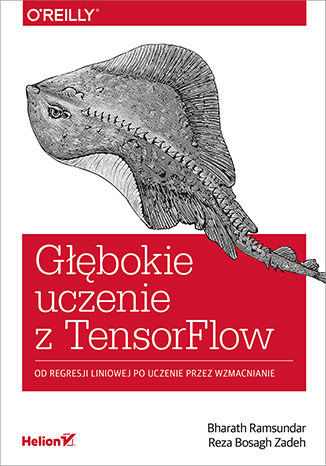
Głębokie uczenie z TensorFlow. Od regresji liniowej po uczenie przez wzmacnianie
Bharath Ramsundar, Reza Bosagh Zadeh
Uczenie maszynowe jest coraz powszechniejsze. Niemal każdego dnia stykamy się z tego rodzaju oprogramowaniem, a możliwości tworzonych systemów stale rosną. Zdobycie praktycznych umiejętności w zakresie budowy i treningu sieci neuronowych staje się dla profesjonalnych programistów koniecznością. Spośród wielu narzędzi służących do tworzenia systemów uczenia maszynowego warto zwrócić uwagę na TensorFlow - nową biblioteką udostępnioną przez Google, przeznaczoną do projektowania i wdrażania zaawansowanych architektur uczenia głębokiego. Bez wątpienia jest to narzędzie, które pozwala na wykonywanie zadań znacznie wykraczających poza standardowy zakres uczenia maszynowego. Ta książka jest przeznaczona dla praktyków, przede wszystkim programistów, architektów i naukowców, którzy chcą się nauczyć projektowania systemów uczących. Podstawowe pojęcia dotyczące uczenia maszynowego wyjaśniono tu poprzez praktyczne przykłady. Przedstawiono możliwości TensorFlow jako systemu do przeprowadzania obliczeń na tensorach. Omówiono zastosowania tej biblioteki w wielu bardzo różnych dziedzinach: do budowy systemów służących do rozpoznawania obrazów, rozumienia tekstu napisanego ręcznie przez człowieka czy przewidywania właściwości potencjalnych leków. Dzięki tej książce można bez trudu zrozumieć matematyczne podstawy systemów uczenia maszynowego, a następnie wykorzystać je podczas tworzenia profesjonalnych sieci neuronowych. W tej książce między innymi: podstawy uczenia maszynowego i rozpoczęcie pracy z TensorFlow budowa prototypów i modeli z optymalizacją hiperparametrów przetwarzanie obrazów w splotowych sieciach neuronowych obsługa zbiorów danych języka naturalnego trenowanie sieci za pomocą procesorów graficznych i procesorów tensorowych TensorFlow: trenuj sieć profesjonalnie!
Xuanyi Chew
Go is the perfect language for machine learning; it helps to clearly describe complex algorithms, and also helps developers to understand how to run efficient optimized code. This book will teach you how to implement machine learning in Go to make programs that are easy to deploy and code that is not only easy to understand and debug, but also to have its performance measured.The book begins by guiding you through setting up your machine learning environment with Go libraries and capabilities. You will then plunge into regression analysis of a real-life house pricing dataset and build a classification model in Go to classify emails as spam or ham. Using Gonum, Gorgonia, and STL, you will explore time series analysis along with decomposition and clean up your personal Twitter timeline by clustering tweets. In addition to this, you will learn how to recognize handwriting using neural networks and convolutional neural networks. Lastly, you'll learn how to choose the most appropriate machine learning algorithms to use for your projects with the help of a facial detection project.By the end of this book, you will have developed a solid machine learning mindset, a strong hold on the powerful Go toolkit, and a sound understanding of the practical implementations of machine learning algorithms in real-world projects.
Arvind Ravulavaru
Cognitive services are the new way of adding intelligence to applications and services. Now we can use Artificial Intelligence as a service that can be consumed by any application or other service, to add smartness and make the end result more practical and useful.Google Cloud AI enables you to consume Artificial Intelligence within your applications, from a REST API. Text, video and speech analysis are among the powerful machine learning features that can be used. This book is the easiest way to get started with the Google Cloud AI services suite and open up the world of smarter applications.This book will help you build a Smart Exchange, a forum application that will let you upload videos, images and perform text to speech conversions and translation services. You will use the power of Google Cloud AI Services to make our simple forum application smart by validating the images, videos, and text provided by users to Google Cloud AI Services and make sure the content which is uploaded follows the forum standards, without a human curator involvement.You will learn how to work with the Vision API, Video Intelligence API, Speech Recognition API, Cloud Language Process, and Cloud Translation API services to make your application smarter.By the end of this book, you will have a strong understanding of working with Google Cloud AI Services, and be well on the way to building smarter applications.
Kieran Kavanagh, Priyanka Vergadia
Most companies today are incorporating AI/ML into their businesses. Building and running apps utilizing AI/ML effectively is tough. This book, authored by a principal architect with about two decades of industry experience, who has led cross-functional teams to design, plan, implement, and govern enterprise cloud strategies, shows you exactly how to design and run AI/ML workloads successfully using years of experience from some of the world’s leading tech companies.You’ll get a clear understanding of essential fundamental AI/ML concepts, before moving on to complex topics with the help of examples and hands-on activities. This will help you explore advanced, cutting-edge AI/ML applications that address real-world use cases in today’s market. You’ll recognize the common challenges that companies face when implementing AI/ML workloads, and discover industry-proven best practices to overcome these. The chapters also teach you about the vast AI/ML landscape on Google Cloud and how to implement all the steps needed in a typical AI/ML project. You’ll use services such as BigQuery to prepare data; Vertex AI to train, deploy, monitor, and scale models in production; as well as MLOps to automate the entire process.By the end of this book, you will be able to unlock the full potential of Google Cloud's AI/ML offerings.
Grafowe sieci neuronowe. Teoria i praktyka
Filip Wójcik
Cicha rewolucja, która nadeszła Grafowe sieci neuronowe (ang. graph neural networks, GNN) to klasa modeli uczenia głębokiego przeznaczona do analizy danych o strukturze grafowej. W początkowym okresie ich rozwój ograniczał brak efektywnych metod projektowania i optymalizacji; w ostatnich latach bariery te w dużej mierze zostały pokonane, co przełożyło się na dynamiczny postęp teorii i praktyki. Modele GNN znajdują zastosowanie między innymi w analizie sieci społecznościowych, optymalizacji procesów logistycznych, marketingu i pracy z bazami wiedzy. Ta książka zawiera kompleksowe opracowanie tematyki sieci grafowych w kontekście uczenia maszynowego. Tym samym wypełnia istotną lukę na polskim rynku wydawniczym, oferując połączenie solidnych podstaw teoretycznych z praktycznym zastosowaniem GNN. To przewodnik, który systematycznie przeprowadza przez kolejne zagadnienia związane z sieciami grafowymi: od narzędzi klasycznej analizy grafów w środowisku Pythona i wybranych zagadnień teorii grafów przez wprowadzenie do grafowych sieci neuronowych, a także przegląd wybranych warstw splotu grafowego i dobrych praktyk ich projektowania po zagadnienia związane ze szkoleniem sieci GNN i praktyczne przykłady ich zastosowań
Aldo Marzullo, Enrico Deusebio, Claudio Stamile
Graph Machine Learning, Second Edition builds on its predecessor’s success, delivering the latest tools and techniques for this rapidly evolving field. From basic graph theory to advanced ML models, you’ll learn how to represent data as graphs to uncover hidden patterns and relationships, with practical implementation emphasized through refreshed code examples. This thoroughly updated edition replaces outdated examples with modern alternatives such as PyTorch and DGL, available on GitHub to support enhanced learning.The book also introduces new chapters on large language models and temporal graph learning, along with deeper insights into modern graph ML frameworks. Rather than serving as a step-by-step tutorial, it focuses on equipping you with fundamental problem-solving approaches that remain valuable even as specific technologies evolve. You will have a clear framework for assessing and selecting the right tools.By the end of this book, you’ll gain both a solid understanding of graph machine learning theory and the skills to apply it to real-world challenges.*Email sign-up and proof of purchase required -
Claudio Stamile, Aldo Marzullo, Enrico Deusebio
Graph Machine Learning will introduce you to a set of tools used for processing network data and leveraging the power of the relation between entities that can be used for predictive, modeling, and analytics tasks. The first chapters will introduce you to graph theory and graph machine learning, as well as the scope of their potential use. You’ll then learn all you need to know about the main machine learning models for graph representation learning: their purpose, how they work, and how they can be implemented in a wide range of supervised and unsupervised learning applications. You'll build a complete machine learning pipeline, including data processing, model training, and prediction in order to exploit the full potential of graph data. After covering the basics, you’ll be taken through real-world scenarios such as extracting data from social networks, text analytics, and natural language processing (NLP) using graphs and financial transaction systems on graphs. You’ll also learn how to build and scale out data-driven applications for graph analytics to store, query, and process network information, and explore the latest trends on graphs. By the end of this machine learning book, you will have learned essential concepts of graph theory and all the algorithms and techniques used to build successful machine learning applications.
David Dindi, Patrick D. Smith
Virtual Assistants, such as Alexa and Siri, process our requests, Google's cars have started to read addresses, and Amazon's prices and Netflix's recommended videos are decided by AI. Artificial Intelligence is one of the most exciting technologies and is becoming increasingly significant in the modern world.Hands-On Artificial Intelligence for Beginners will teach you what Artificial Intelligence is and how to design and build intelligent applications. This book will teach you to harness packages such as TensorFlow in order to create powerful AI systems. You will begin with reviewing the recent changes in AI and learning how artificial neural networks (ANNs) have enabled more intelligent AI. You'll explore feedforward, recurrent, convolutional, and generative neural networks (FFNNs, RNNs, CNNs, and GNNs), as well as reinforcement learning methods. In the concluding chapters, you'll learn how to implement these methods for a variety of tasks, such as generating text for chatbots, and playing board and video games.By the end of this book, you will be able to understand exactly what you need to consider when optimizing ANNs and how to deploy and maintain AI applications.
Devangini Patel
With the emergence of big data and modern technologies, AI has acquired a lot of relevance in many domains. The increase in demand for automation has generated many applications for AI in fields such as robotics, predictive analytics, finance, and more.In this book, you will understand what artificial intelligence is. It explains in detail basic search methods: Depth-First Search (DFS), Breadth-First Search (BFS), and A* Search, which can be used to make intelligent decisions when the initial state, end state, and possible actions are known. Random solutions or greedy solutions can be found for such problems. But these are not optimal in either space or time and efficient approaches in time and space will be explored. We will also understand how to formulate a problem, which involves looking at it and identifying its initial state, goal state, and the actions that are possible in each state. We also need to understand the data structures involved while implementing these search algorithms as they form the basis of search exploration. Finally, we will look into what a heuristic is as this decides the quality of one sub-solution over another and helps you decide which step to take.
Nisheeth Joshi
Artificial intelligence (AI) is increasingly in demand as well as relevant in the modern world, where everything is driven by technology and data. AI can be used for automating systems or processes to carry out complex tasks and functions in order to achieve optimal performance and productivity.Hands-On Artificial Intelligence with Java for Beginners begins by introducing you to AI concepts and algorithms. You will learn about various Java-based libraries and frameworks that can be used in implementing AI to build smart applications. In addition to this, the book teaches you how to implement easy to complex AI tasks, such as genetic programming, heuristic searches, reinforcement learning, neural networks, and segmentation, all with a practical approach.By the end of this book, you will not only have a solid grasp of AI concepts, but you'll also be able to build your own smart applications for multiple domains.
Sibanjan Das, Umit Mert Cakmak
AutoML is designed to automate parts of Machine Learning. Readily available AutoML tools are making data science practitioners’ work easy and are received well in the advanced analytics community. Automated Machine Learning covers the necessary foundation needed to create automated machine learning modules and helps you get up to speed with them in the most practical way possible. In this book, you’ll learn how to automate different tasks in the machine learning pipeline such as data preprocessing, feature selection, model training, model optimization, and much more. In addition to this, it demonstrates how you can use the available automation libraries, such as auto-sklearn and MLBox, and create and extend your own custom AutoML components for Machine Learning. By the end of this book, you will have a clearer understanding of the different aspects of automated Machine Learning, and you’ll be able to incorporate automation tasks using practical datasets. You can leverage your learning from this book to implement Machine Learning in your projects and get a step closer to winning various machine learning competitions.
Dmitrijs Cudihins
Hands-On Computer Vision with Julia is a thorough guide for developers who want to get started with building computer vision applications using Julia. Julia is well suited to image processing because it’s easy to use and lets you write easy-to-compile and efficient machine code..This book begins by introducing you to Julia's image processing libraries such as Images.jl and ImageCore.jl. You’ll get to grips with analyzing and transforming images using JuliaImages; some of the techniques discussed include enhancing and adjusting images. As you make your way through the chapters, you’ll learn how to classify images, cluster them, and apply neural networks to solve computer vision problems. In the concluding chapters, you will explore OpenCV applications to perform real-time computer vision analysis, for example, face detection and object tracking. You will also understand Julia's interaction with Tesseract to perform optical character recognition and build an application that brings together all the techniques we introduced previously to consolidate the concepts learned.By end of the book, you will have understood how to utilize various Julia packages and a few open source libraries such as Tesseract and OpenCV to solve computer vision problems with ease.
Iffat Zafar, Giounona Tzanidou, Richard Burton, Nimesh...
Convolutional Neural Networks (CNN) are one of the most popular architectures used in computer vision apps. This book is an introduction to CNNs through solving real-world problems in deep learning while teaching you their implementation in popular Python library - TensorFlow. By the end of the book, you will be training CNNs in no time!We start with an overview of popular machine learning and deep learning models, and then get you set up with a TensorFlow development environment. This environment is the basis for implementing and training deep learning models in later chapters. Then, you will use Convolutional Neural Networks to work on problems such as image classification, object detection, and semantic segmentation.After that, you will use transfer learning to see how these models can solve other deep learning problems. You will also get a taste of implementing generative models such as autoencoders and generative adversarial networks.Later on, you will see useful tips on machine learning best practices and troubleshooting. Finally, you will learn how to apply your models on large datasets of millions of images.
Yuxing Yan, James Yan
Anaconda is an open source platform that brings together the best tools for data science professionals with more than 100 popular packages supporting Python, Scala, and R languages. Hands-On Data Science with Anaconda gets you started with Anaconda and demonstrates how you can use it to perform data science operations in the real world.The book begins with setting up the environment for Anaconda platform in order to make it accessible for tools and frameworks such as Jupyter, pandas, matplotlib, Python, R, Julia, and more. You’ll walk through package manager Conda, through which you can automatically manage all packages including cross-language dependencies, and work across Linux, macOS, and Windows. You’ll explore all the essentials of data science and linear algebra to perform data science tasks using packages such as SciPy, contrastive, scikit-learn, Rattle, and Rmixmod. Once you’re accustomed to all this, you’ll start with operations in data science such as cleaning, sorting, and data classification. You’ll move on to learning how to perform tasks such as clustering, regression, prediction, and building machine learning models and optimizing them. In addition to this, you’ll learn how to visualize data using the packages available for Julia, Python, and R.
Doug Ortiz , Vitor Bianchi Lanzetta, Nataraj...
R is the most widely used programming language, and when used in association with data science, this powerful combination will solve the complexities involved with unstructured datasets in the real world. This book covers the entire data science ecosystem for aspiring data scientists, right from zero to a level where you are confident enough to get hands-on with real-world data science problems.The book starts with an introduction to data science and introduces readers to popular R libraries for executing data science routine tasks. This book covers all the important processes in data science such as data gathering, cleaning data, and then uncovering patterns from it. You will explore algorithms such as machine learning algorithms, predictive analytical models, and finally deep learning algorithms. You will learn to run the most powerful visualization packages available in R so as to ensure that you can easily derive insights from your data.Towards the end, you will also learn how to integrate R with Spark and Hadoop and perform large-scale data analytics without much complexity.
Sudharsan Ravichandiran
Deep learning is one of the most popular domains in the AI space that allows you to develop multi-layered models of varying complexities. This book introduces you to popular deep learning algorithms—from basic to advanced—and shows you how to implement them from scratch using TensorFlow. Throughout the book, you will gain insights into each algorithm, the mathematical principles involved, and how to implement it in the best possible manner. The book starts by explaining how you can build your own neural networks, followed by introducing you to TensorFlow, the powerful Python-based library for machine learning and deep learning. Moving on, you will get up to speed with gradient descent variants, such as NAG, AMSGrad, AdaDelta, Adam, and Nadam. The book will then provide you with insights into recurrent neural networks (RNNs) and LSTM and how to generate song lyrics with RNN. Next, you will master the math necessary to work with convolutional and capsule networks, widely used for image recognition tasks. You will also learn how machines understand the semantics of words and documents using CBOW, skip-gram, and PV-DM. Finally, you will explore GANs, including InfoGAN and LSGAN, and autoencoders, such as contractive autoencoders and VAE. By the end of this book, you will be equipped with all the skills you need to implement deep learning in your own projects.