
Uczenie maszynowe
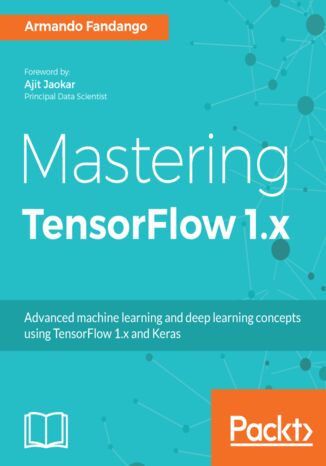
Armando Fandango, Ajit Jaokar
TensorFlow is the most popular numerical computation library built from the ground up for distributed, cloud, and mobile environments. TensorFlow represents the data as tensors and the computation as graphs.This book is a comprehensive guide that lets you explore the advanced features of TensorFlow 1.x. Gain insight into TensorFlow Core, Keras, TF Estimators, TFLearn, TF Slim, Pretty Tensor, and Sonnet. Leverage the power of TensorFlow and Keras to build deep learning models, using concepts such as transfer learning, generative adversarial networks, and deep reinforcement learning. Throughout the book, you will obtain hands-on experience with varied datasets, such as MNIST, CIFAR-10, PTB, text8, and COCO-Images.You will learn the advanced features of TensorFlow1.x, such as distributed TensorFlow with TF Clusters, deploy production models with TensorFlow Serving, and build and deploy TensorFlow models for mobile and embedded devices on Android and iOS platforms. You will see how to call TensorFlow and Keras API within the R statistical software, and learn the required techniques for debugging when the TensorFlow API-based code does not work as expected.The book helps you obtain in-depth knowledge of TensorFlow, making you the go-to person for solving artificial intelligence problems. By the end of this guide, you will have mastered the offerings of TensorFlow and Keras, and gained the skills you need to build smarter, faster, and efficient machine learning and deep learning systems.
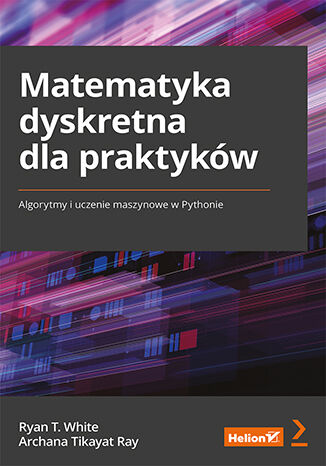
Matematyka dyskretna dla praktyków. Algorytmy i uczenie maszynowe w Pythonie
Ryan T. White, Archana Tikayat Ray
Mimo że osiągnięcia matematyczne stały się podwalinami algorytmiki, wielu inżynierów nie w pełni rozumie reguły matematyki dyskretnej. Nawet jeśli nie stanowi to szczególnego problemu w codziennej pracy, w końcu okazuje się, że matematyka dyskretna jest niezbędna do osiągnięcia prawdziwej biegłości w operowaniu algorytmami i w pracy na danych. Co więcej, znajomość tej dziedziny bardzo ułatwia rozwiązywanie problemów z zakresu uczenia maszynowego. W ten sposób praktyczna biegłość w matematyce zauważalnie poprawia wyniki pracy inżynierów. Ta książka jest kompleksowym wprowadzeniem do matematyki dyskretnej, przydatnym dla każdego, kto chce pogłębić i ugruntować swoje umiejętności informatyczne. W zrozumiały sposób przedstawiono tu metody matematyki dyskretnej i ich zastosowanie w algorytmach i analizie danych, włączając w to techniki uczenia maszynowego. Zaprezentowano również zasady oceny złożoności obliczeniowej algorytmów i używania wyników tej oceny do zarządzania pracą procesora. Omówiono także sposoby przechowywania struktur grafowych, ich przeszukiwania i znajdywania ścieżek między wierzchołkami. Pokazano też, jak wykorzystać przedstawione informacje podczas posługiwania się bibliotekami Pythona, takimi jak scikit-learn i NumPy. W książce między innymi: terminologia i metody matematyki dyskretnej zastosowanie metod matematyki dyskretnej w algorytmach i analizie danych algebra Boole'a i kombinatoryka w podstawowych strukturach algorytmów rozwiązywanie problemów z dziedziny teorii grafów zadania związane z uczeniem maszynowym a matematyka dyskretna Matematyka dyskretna - poznaj, zrozum, zastosuj!
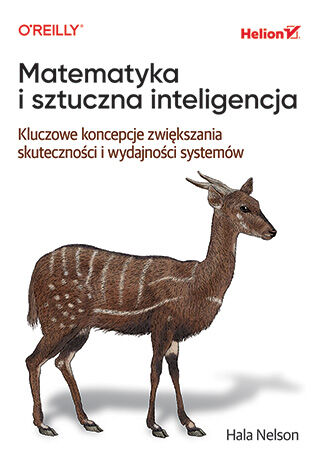
Hala Nelson
Sztuczna inteligencja i technologie oparte na danych są coraz częściej integrowane z istniejącymi systemami i operacjami. Ta tendencja dotyczy licznych branż. Dziś przy budowaniu systemów SI można korzystać z gotowych bibliotek, jeżeli jednak zależy Ci na w pełni świadomym tworzeniu doskonalszych aplikacji, musisz dobrze opanować matematykę leżącą u podstaw sztucznej inteligencji. Nawet jeśli nie darzysz królowej nauk płomiennym uczuciem, dzięki temu kompleksowemu opracowaniu z łatwością poradzisz sobie z jej lepszym poznaniem. Nie znajdziesz tu skomplikowanych teorii naukowych, tylko przystępnie podane koncepcje matematyczne niezbędne do rozwoju w dziedzinie sztucznej inteligencji, w szczególności do praktycznego stosowania najnowocześniejszych modeli. Poznasz takie zagadnienia jak regresja, sieci neuronowe, sieci konwolucyjne, optymalizacja, prawdopodobieństwo, procesy Markowa, równania różniczkowe i wiele innych w ekskluzywnym kontekście sztucznej inteligencji. Książkę docenią pasjonaci nowych technologii, twórcy aplikacji, inżynierowie i analitycy danych, a także matematycy i naukowcy. W książce: wyjaśnienie pojęć z zakresu uczenia maszynowego, inżynierii danych i matematyki ujednolicanie modeli w ramach jednej struktury matematycznej grafy i dane sieciowe eksploracja rzeczywistych danych, zmniejszanie liczby wymiarów i przetwarzanie obrazów korzystanie z modeli w różnych projektach opartych na danych implikacje i ograniczenia sztucznej inteligencji Ta książka w zachwycający sposób sprawia, że matematyka staje się zabawą dla licznych uczestników przyszłości opartej na sztucznej inteligencji! Adri Purkayastha, analityk oceny ryzyka, BNP Paribas O książce w mediach: Eksperyment Myślowy – recenzja książki
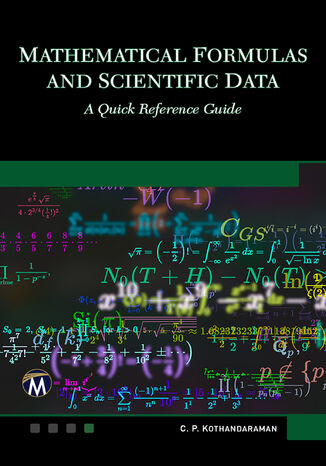
Mercury Learning and Information, C. P. Kothandaraman
This course serves as a comprehensive reference guide for engineers, mathematicians, scientists, and industry professionals, covering essential mathematical formulas and key scientific data. It is divided into two parts: mathematical formulas including algebra, trigonometry, analytic geometry, differential and integral calculus, and vectors; and scientific data covering units, properties of gases, elements, acoustics, materials, thermodynamics, radioactivity, and more.Understanding these concepts is crucial for professionals, providing a solid foundation for their work. The course explains technical terms, theorems, and applicable laws in detail, ensuring clarity and practical understanding. Each chapter provides valuable insights and data fundamental for scientific and engineering applications.Starting with algebra and geometry, the course advances through calculus and vectors, then explores scientific data in various fields. By the end, users will have a thorough reference of critical formulas and data, making it indispensable for students and professionals. This structured approach ensures learners gain both theoretical knowledge and practical applications essential for their careers.
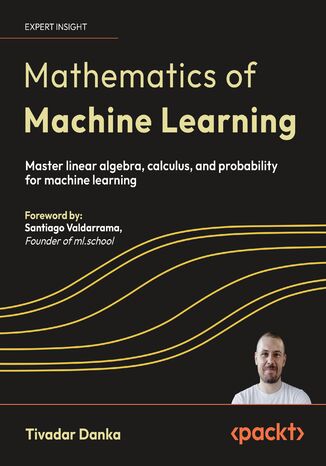
Tivadar Danka, Santiago Valdarrama
Mathematics of Machine Learning provides a rigorous yet accessible introduction to the mathematical underpinnings of machine learning, designed for engineers, developers, and data scientists ready to elevate their technical expertise. With this book, you’ll explore the core disciplines of linear algebra, calculus, and probability theory essential for mastering advanced machine learning concepts. PhD mathematician turned ML engineer Tivadar Danka—known for his intuitive teaching style that has attracted 100k+ followers—guides you through complex concepts with clarity, providing the structured guidance you need to deepen your theoretical knowledge and enhance your ability to solve complex machine learning problems. Balancing theory with application, this book offers clear explanations of mathematical constructs and their direct relevance to machine learning tasks. Through practical Python examples, you’ll learn to implement and use these ideas in real-world scenarios, such as training machine learning models with gradient descent or working with vectors, matrices, and tensors. By the end of this book, you’ll have gained the confidence to engage with advanced machine learning literature and tailor algorithms to meet specific project requirements.*Email sign-up and proof of purchase required
MATLAB for Machine Learning. Practical examples of regression, clustering and neural networks
Giuseppe Ciaburro
MATLAB is the language of choice for many researchers and mathematics experts for machine learning. This book will help you build a foundation in machine learning using MATLAB for beginners.You’ll start by getting your system ready with t he MATLAB environment for machine learning and you’ll see how to easily interact with the Matlab workspace. We’ll then move on to data cleansing, mining and analyzing various data types in machine learning and you’ll see how to display data values on a plot. Next, you’ll get to know about the different types of regression techniques and how to apply them to your data using the MATLAB functions. You’ll understand the basic concepts of neural networks and perform data fitting, pattern recognition, and clustering analysis. Finally, you’ll explore feature selection and extraction techniques for dimensionality reduction for performance improvement. At the end of the book, you will learn to put it all together into real-world cases covering major machine learning algorithms and be comfortable in performing machine learning with MATLAB.
Giuseppe Ciaburro
Discover why the MATLAB programming environment is highly favored by researchers and math experts for machine learning with this guide which is designed to enhance your proficiency in both machine learning and deep learning using MATLAB, paving the way for advanced applications.By navigating the versatile machine learning tools in the MATLAB environment, you’ll learn how to seamlessly interact with the workspace. You’ll then move on to data cleansing, data mining, and analyzing various types of data in machine learning, and visualize data values on a graph. As you progress, you’ll explore various classification and regression techniques, skillfully applying them with MATLAB functions.This book teaches you the essentials of neural networks, guiding you through data fitting, pattern recognition, and cluster analysis. You’ll also explore feature selection and extraction techniques for performance improvement through dimensionality reduction. Finally, you’ll leverage MATLAB tools for deep learning and managing convolutional neural networks.By the end of the book, you’ll be able to put it all together by applying major machine learning algorithms in real-world scenarios.
Sumit Mund
The book is intended for those who want to learn how to use Azure Machine Learning. Perhaps you already know a bit about Machine Learning, but have never used ML Studio in Azure; or perhaps you are an absolute newbie. In either case, this book will get you up-and-running quickly.