
Uczenie maszynowe
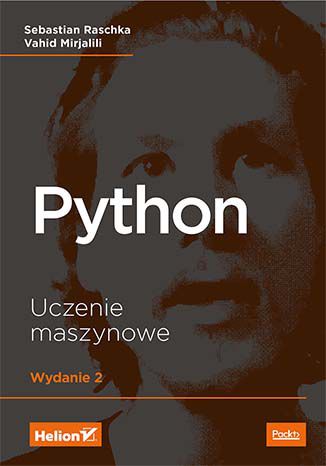
Python. Uczenie maszynowe. Wydanie II
Sebastian Raschka, Vahid Mirjalili
Uczenie maszynowe jest wyjątkowo fascynującą dziedziną inżynierii. Coraz częściej spotykamy się z praktycznym wykorzystaniem tego rodzaju innowacyjnych technologii. Samouczące algorytmy maszynowe pozwalają na uzyskiwanie wiedzy z ogromnych ilości danych. Dla osoby planującej rozwój kariery osiągnięcie biegłości w rozwiązywaniu problemów uczenia maszynowego jest nadzwyczaj atrakcyjną ścieżką. Użycie do tego celu Pythona pozwala dodatkowo skorzystać z bardzo przystępnego, wszechstronnego i potężnego narzędzia przeznaczonego do analizowania danych naukowych. Ta książka jest drugim, wzbogaconym i zaktualizowanym wydaniem znakomitego podręcznika do nauki o danych. Wyczerpująco opisano tu teoretyczne podwaliny uczenia maszynowego. Sporo uwagi poświęcono działaniu algorytmów uczenia głębokiego, sposobom ich wykorzystania oraz metodom unikania istotnych błędów. Dodano rozdziały prezentujące zaawansowane informacje o sieciach neuronowych: o sieciach splotowych, służących do rozpoznawania obrazów, oraz o sieciach rekurencyjnych, znakomicie nadających się do pracy z danymi sekwencyjnymi i danymi szeregów czasowych. Poszczególne zagadnienia zostały zilustrowane praktycznymi przykładami kodu napisanego w Pythonie, co ułatwi bezpośrednie zapoznanie się z tematyką uczenia maszynowego. W tej książce: struktury używane w analizie danych, uczeniu maszynowym i uczeniu głębokim metody uczenia sieci neuronowych implementowanie głębokich sieci neuronowych analiza sentymentów i analiza regresywna przetwarzanie obrazów i danych tekstowych najwartościowsze biblioteki Pythona przydatne w uczeniu maszynowym Uczenie maszynowe: oto droga do wiedzy ukrytej w oceanie danych!
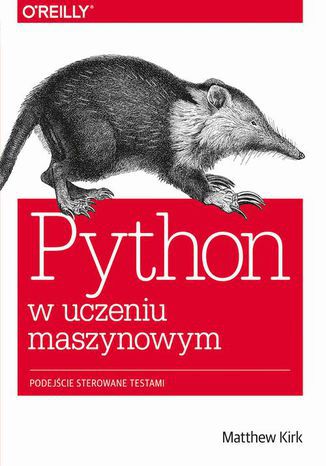
Matthew Kirk
Ten praktyczny przewodnik pozwoli osiągnąć biegłość w stosowaniu uczenia maszynowego w codziennej pracy. Autor, Matthew Kirk, bez akademickich rozważań pokazuje, jak integrować i testować algorytmy uczenia maszynowego w swoim kodzie. Książka przedstawia wykorzystanie testów z użyciem bibliotek naukowych NumPy, Pandas, Scikit-Learn oraz SciPy dla języka Python, ilustrując je licznymi wykresami oraz przykładami kodu. Książka ta pomoże programistom i analitykom biznesowym zainteresowanym badaniem danych w: Zapoznaniu się z rzeczywistymi przykładami testowania poszczególnych algorytmów poprzez zajmujące ćwiczenia praktyczne. Stosowaniu programowania sterowanego testami do pisania i uruchamiania testów przed rozpoczęciem kodowania. Badaniu technik poprawiających nasze modele uczenia maszynowego poprzez wydobywanie danych i opracowywanie funkcjonalności. Zwracaniu uwagi na ryzyka związane z uczeniem maszynowym takie jak niedopasowanie danych. Pracy z algorytmem K najbliższych sąsiadów, sieciami neuronowymi, klastrami i innymi technikami. Matthew Kirk jest konsultantem, autorem i międzynarodowym prelegentem, specjalizującym się w uczeniu maszynowym i analizie danych z wykorzystaniem języków Ruby i Python. Mieszka w Seattle i lubi pomagać innym programistom w integrowaniu analizy danych ze stosowanymi przez nich technologiami. Więcej zasobów dotyczących uczenia maszynowego można znaleźć pod adresem www.matthewkirk.com.
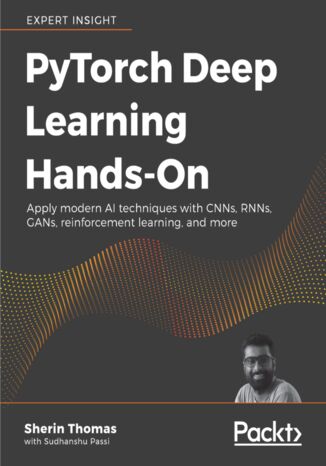
Sherin Thomas , Sudhanshu Passi , Xingyu...
PyTorch Deep Learning Hands-On is a book for engineers who want a fast-paced guide to doing deep learning work with PyTorch. It is not an academic textbook and does not try to teach deep learning principles. The book will help you most if you want to get your hands dirty and put PyTorch to work quickly.PyTorch Deep Learning Hands-On shows how to implement the major deep learning architectures in PyTorch. It covers neural networks, computer vision, CNNs, natural language processing (RNN), GANs, and reinforcement learning. You will also build deep learning workflows with the PyTorch framework, migrate models built in Python to highly efficient TorchScript, and deploy to production using the most sophisticated available tools.Each chapter focuses on a different area of deep learning. Chapters start with a refresher on how the model works, before sharing the code you need to implement it in PyTorch.This book is ideal if you want to rapidly add PyTorch to your deep learning toolset.
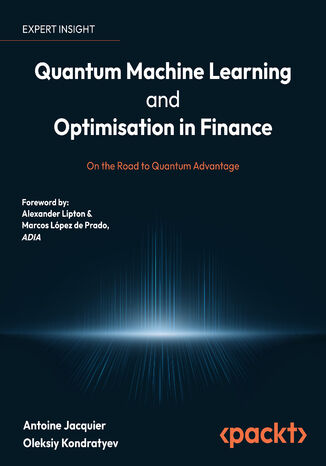
Quantum Machine Learning and Optimisation in Finance. On the Road to Quantum Advantage
Antoine Jacquier, Oleksiy Kondratyev
With recent advances in quantum computing technology, we finally reached the era of Noisy Intermediate-Scale Quantum (NISQ) computing. NISQ-era quantum computers are powerful enough to test quantum computing algorithms and solve hard real-world problems faster than classical hardware.Speedup is so important in financial applications, ranging from analysing huge amounts of customer data to high frequency trading. This is where quantum computing can give you the edge. Quantum Machine Learning and Optimisation in Finance shows you how to create hybrid quantum-classical machine learning and optimisation models that can harness the power of NISQ hardware.This book will take you through the real-world productive applications of quantum computing. The book explores the main quantum computing algorithms implementable on existing NISQ devices and highlights a range of financial applications that can benefit from this new quantum computing paradigm.This book will help you be one of the first in the finance industry to use quantum machine learning models to solve classically hard real-world problems. We may have moved past the point of quantum computing supremacy, but our quest for establishing quantum computing advantage has just begun!
R Deep Learning Cookbook. Solve complex neural net problems with TensorFlow, H2O and MXNet
PKS Prakash, Achyutuni Sri Krishna Rao
Deep Learning is the next big thing. It is a part of machine learning. It's favorable results in applications with huge and complex data is remarkable. Simultaneously, R programming language is very popular amongst the data miners and statisticians. This book will help you to get through the problems that you face during the execution of different tasks and Understand hacks in deep learning, neural networks, and advanced machine learning techniques. It will also take you through complex deep learning algorithms and various deep learning packages and libraries in R. It will be starting with different packages in Deep Learning to neural networks and structures. You will also encounter the applications in text mining and processing along with a comparison between CPU and GPU performance.By the end of the book, you will have a logical understanding of Deep learning and different deep learning packages to have the most appropriate solutions for your problems.
Mark Hodnett, Joshua F. Wiley
Deep learning is a powerful subset of machine learning that is very successful in domains such as computer vision and natural language processing (NLP). This second edition of R Deep Learning Essentials will open the gates for you to enter the world of neural networks by building powerful deep learning models using the R ecosystem.This book will introduce you to the basic principles of deep learning and teach you to build a neural network model from scratch. As you make your way through the book, you will explore deep learning libraries, such as Keras, MXNet, and TensorFlow, and create interesting deep learning models for a variety of tasks and problems, including structured data, computer vision, text data, anomaly detection, and recommendation systems. You’ll cover advanced topics, such as generative adversarial networks (GANs), transfer learning, and large-scale deep learning in the cloud. In the concluding chapters, you will learn about the theoretical concepts of deep learning projects, such as model optimization, overfitting, and data augmentation, together with other advanced topics.By the end of this book, you will be fully prepared and able to implement deep learning concepts in your research work or projects.
R Deep Learning Projects. Master the techniques to design and develop neural network models in R
Yuxi (Hayden) Liu, Pablo Maldonado
R is a popular programming language used by statisticians and mathematicians for statistical analysis, and is popularly used for deep learning. Deep Learning, as we all know, is one of the trending topics today, and is finding practical applications in a lot of domains.This book demonstrates end-to-end implementations of five real-world projects on popular topics in deep learning such as handwritten digit recognition, traffic light detection, fraud detection, text generation, and sentiment analysis. You'll learn how to train effective neural networks in R—including convolutional neural networks, recurrent neural networks, and LSTMs—and apply them in practical scenarios. The book also highlights how neural networks can be trained using GPU capabilities. You will use popular R libraries and packages—such as MXNetR, H2O, deepnet, and more—to implement the projects. By the end of this book, you will have a better understanding of deep learning concepts and techniques and how to use them in a practical setting.
Michele Usuelli
If your company is like most, the number one reason that projects have failed over the years don’t have to do with technology. They have to do with people. People didn’t like the new technology. People weren’t trained properly on the change. People hadn’t received adequate communications and didn’t understand the change. Sound familiar?