
Serwery internetowe
Microsoft HoloLens Developer???s Guide. A Complete Guide to HoloLens Application Development
Dennis Vroegop
HoloLens, Microsoft’s innovative augmented reality headset, overlaps holograms into a user’s vision of their environment. Your ideas are closer to becoming real when you can create and work with holograms in relation to the world around you. If you are dreaming beyond virtual worlds, beyond screens, beyond pixels, and want to take a big leap in the world of augmented reality, then this is the book you want. Starting off with brainstorming and the design process, you will take your first steps in creating your application for HoloLens. You will learn to add gestures and write an app that responds to verbal commands before gradually moving on creating sounds in the app and placing them in a 3D space. You will then communicate between devices in the boundaries of the UWP model.
Microsoft System Center Virtual Machine Manager 2012. Poradnik praktyczny
Edvaldo Alessandro Cardoso
Microsoft System Center 2012 jest wszechstronną platformą wirtualizacji, chmury i zarządzania infrastrukturą IT. Poprzez System Center 2012 możesz dużo łatwiej i wydajniej zarządzać swoimi aplikacjami i usługami w obrębie kilku różnych hiperwizorów oraz infrastruktur chmur publicznych i prywatnych w celu dostarczenia elastycznych i oszczędnych usług IT dla Twojego biznesu. Treść niniejszej książki obejmuje projekt architektury i planowanie, a przy tym zawiera wiele różnych porad, technik i rozwiązań wdrożeniowych, które pokażą Ci, w jaki sposób możesz usprawnić VMM 2012 w praktycznych scenariuszach. Poprowadzi Cię ona przez etapy tworzenia, wdrażania i zarządzania Twoją chmurą prywatną, zbudowaną w oparciu o różne hiperwizory: Hyper-V, VMware ESXi oraz Citrix XenServer. Uwzględnia ona także funkcje zawarte w VMM 2012 SP1. Dla kogo jest ta książka? Książka ta przeznaczona jest dla projektantów rozwiązań, konsultantów technicznych, administratorów, a także dla każdego innego miłośnika wirtualizacji, który musi korzystać na co dzień z Microsoft System Center Virtual Machine Manager 2012. Dzięki tej książce nauczysz się - Korzystać z architektury VMM oraz planować praktyczne wdrożenia - Wykorzystywać wirtualizację sieci, bramy czy magazynu, dławienie zasobów oraz opcje dostępności - Wdrażać system Operations Manager i integrować z VMM - Integrować z VMM kontroler SC App Controller w celu zarządzania chmurami prywatnymi i publicznymi (Azure) - Wdrażać klastry poprzez VMM Bare Metal - Tworzyć i wdrażać z szablonów maszyny wirtualne - Wdrażać wysoko dostępny serwer zarządzania VMM - Zarządzać Hyper-V, VMware oraz Citrix z poziomu VMM - Aktualizować SCVMM 2008 R2 do SCVMM 2012 SP1
Elton Stoneman
Kubernetes to system, który uruchamia aplikacje w kontenerach i nimi zarządza. Jest obsługiwany przez wszystkie ważne platformy chmurowe i znakomicie się sprawdza jako centrum danych. Został zbudowany w 2014 roku przez Google i do teraz prężnie się rozwija. Słynie ze skalowalności, z elastyczności, wszechstronności i potężnego zestawu funkcjonalności. Biegłość w posługiwaniu się Kubernetesem jest dziś receptą na sukces. Aby ją zdobyć, musisz zainwestować trochę zaangażowania i nieco ponad 20 godzin. Resztę znajdziesz w tej książce. Oto znakomity przewodnik po Kubernetesie. Dzięki niemu w ciągu 22 godzinnych lekcji poznasz najważniejsze możliwości Kubernetesa. Od początku będziesz się koncentrować na praktyce: dzięki codziennym ćwiczeniom, przykładom i laboratoriom zdobędziesz biegłość w używaniu najlepszych narzędzi Kubernetesa zgodnie ze sprawdzonymi praktykami. Dowiesz się, jak definiować aplikacje w manifestach YAML, nauczysz się konfigurować ruch sieciowy i uruchamiać zadania wsadowe. Płynnie przejdziesz do pracy w środowisku produkcyjnym i zapewnisz aplikacji wysoki poziom bezpieczeństwa. Zapoznasz się też z zagadnieniami zaawansowanymi, takimi jak skalowanie aplikacji w górę i w dół, kontrola dostępu oparta na rolach, a także używanie Kubernetesa jako platformy dla funkcji bezserwerowych i jako klastra wieloarchitekturowego. Najciekawsze zagadnienia ujęte w książce: cykl życia aplikacji Kubernetesa bezpieczeństwo w Kubernetesie wdrażanie aplikacji w klastrach Kubernetes tworzenie aplikacji skalowalnych i odpornych na błędy Kubernetes jako platforma dla nowych technologii Kubernetes: wystarczą Ci 22 godziny!
OpenStack for Architects. Design and implement successful private clouds with OpenStack
Michael Solberg, Benjamin Silverman
Over the last five years, hundreds of organizations have successfully implemented Infrastructure as a Service (IaaS) platforms based on OpenStack. The huge amount of investment from these organizations, industry giants such as IBM and HP, as well as open source leaders such as Red Hat have led analysts to label OpenStack as the most important open source technology since the Linux operating system. Because of its ambitious scope, OpenStack is a complex and fast-evolving open source project that requires a diverse skill-set to design and implement it.This guide leads you through each of the major decision points that you'll face while architecting an OpenStack private cloud for your organization. At each point, we offer you advice based on the experience we've gained from designing and leading successful OpenStack projects in a wide range of industries. Each chapter also includes lab material that gives you a chance to install and configure the technologies used to build production-quality OpenStack clouds. Most importantly, we focus on ensuring that your OpenStack project meets the needs of your organization, which will guarantee a successful rollout.
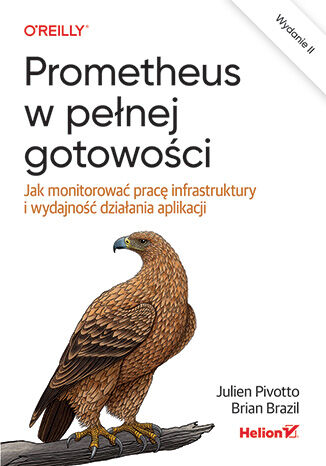
Julien Pivotto, Brian Brazil
Monitorowanie wydajności systemu jest ważnym zadaniem i nie polega tylko na obserwacji pracy procesora. Trzeba się orientować, pod jakim obciążeniem pracuje baza danych, czy przepustowość urządzeń sieciowych jest wystarczająca i jaki jest koszt niepełnego użycia bufora. Warto też wiedzieć, czy stopień wykorzystania droższych elementów uzasadnia ich utrzymywanie. W tej książce znajdziesz bezcenne wskazówki dotyczące wdrażania serwera Prometheus i jego używania w rzeczywistych rozwiązaniach. Julius Volz, współtwórca oprogramowania Prometheus To drugie, zaktualizowane wydanie przewodnika po systemie Prometheus. Znajdziesz w nim wyczerpujące wprowadzenie do tego oprogramowania, a także wskazówki dotyczące monitorowania aplikacji i infrastruktury, tworzenia wykresów, przekazywania ostrzeżeń, bezpośredniej instrumentacji kodu i pobierania wskaźników pochodzących z systemów zewnętrznych. Zrozumiesz zasady konfiguracji systemu Prometheus, komponentu Node Exporter i menedżera ostrzeżeń Alertmanager. Zapoznasz się też z nowymi funkcjonalnościami języka PromQL, dostawców mechanizmu odkrywania usług i odbiorców menedżera ostrzeżeń Alertmanager. Dokładnie zaprezentowano tu również zagadnienia bezpieczeństwa po stronie serwera, w tym mechanizm TLS i uwierzytelniania podstawowego. W książce między innymi: czym jest Prometheus i jak wygląda jego architektura monitorowanie infrastruktury za pomocą komponentów takich jak Node Exporter instrumentacja w kodzie aplikacji tworzenie paneli sterowania za pomocą Grafany współpraca oprogramowania Prometheus i Kubernetes Dzięki najlepszym praktykom i wskazówkom dotyczącym instrumentacji w kodzie ta książka pomoże Ci w niezawodnym monitorowaniu usług! TJ Hoplock, starszy inżynier monitorowania, NS1
Anirban Saha
If you are a professional associated with system and infrastructure management, looking at automated infrastructure and deployments, then this book is for you. No prior experience of Salt is required.
Mohit Gupta
Serverless Architecture with AWS begins with an introduction to the serverless model and helps you get started with AWS and Lambda. You'll also get to grips with other capabilities of the AWS Serverless Platform and see how AWS supports enterprise-grade serverless applications with and without Lambda.This book will guide you in deploying your first serverless project and exploring the capabilities of serverless Amazon Athena, an interactive query service that makes it easy to analyze data in Amazon Simple Storage Service (S3 Amazon) using standard SQL. You’ll also learn about AWS Glue, a fully managed ETL service that makes categorizing data easy and cost-effective. You'll study how Amazon Kinesis makes it possible to unleash the potential of real-time data insights and analytics with capabilities such as video streams, data streams, data firehose, and data analytics. Last but not least, you’ll be equipped to combine Amazon Kinesis capabilities with AWS Lambda to create lightweight serverless architectures.By the end of the book, you will be ready to create and run your first serverless application that takes advantage of the high availability, security, performance, and scalability of AWS.
Onur Yilmaz , Sathsara Sarathchandra
Kubernetes has established itself as the standard platform for container management, orchestration, and deployment. By learning Kubernetes, you’ll be able to design your own serverless architecture by implementing the function-as-a-service (FaaS) model.After an accelerated, hands-on overview of the serverless architecture and various Kubernetes concepts, you’ll cover a wide range of real-world development challenges faced by real-world developers, and explore various techniques to overcome them. You’ll learn how to create production-ready Kubernetes clusters and run serverless applications on them. You'll see how Kubernetes platforms and serverless frameworks such as Kubeless, Apache OpenWhisk and OpenFaaS provide the tooling to help you develop serverless applications on Kubernetes. You'll also learn ways to select the appropriate framework for your upcoming project. By the end of this book, you’ll have the skills and confidence to design your own serverless applications using the power and flexibility of Kubernetes.
Systemy reaktywne. Wzorce projektowe i ich stosowanie
Roland Kuhn Dr., Brian Hanafee, Jamie Allen
Systemy reaktywne. Wzorce projektowe i ich stosowanie Uznane duże aplikacje internetowe, takie jak portale społecznościowe, systemy bankowe czy handlowe, działają szybko i niezawodnie. Muszą radzić sobie nawet wtedy, gdy ich niektóre części ulegną awarii. Nie mogą zawieść, gdy będzie z nich korzystać większa liczba użytkowników niż zwykle. Naturalnie, muszą być odporne na różne zagrożenia, a oprócz tego skalowalne i łatwe w rozbudowie. Tym i wielu innym wymaganiom odpowiadają systemy responsywne — które bez względu na okoliczności sprawnie przetwarzają dane wprowadzane przez użytkowników. Pomyślne wdrożenie systemu reaktywnego wymaga jednak nieco innego spojrzenia na tworzenie oprogramowania. Jakie cechy wyrózniają system reaktywny? O tym mówi tzw. Manifest reaktywny i jego podstawowe 4 postulaty: responsywność - system musi reagować na interakcje użytkowników, niezawodność - system musi reagować na awarie i być dostępny non stop, elastyczność - system musi reagować na zmieniające się obciążenie, sterowanie za pomocą komunikatów - system musi reagować na wprowadzane dane. Niniejsza książka jest wyczerpującym wprowadzeniem do implementacji systemów reaktywnych. Opisano tu filozofię programowania reaktywnego, zasady projektowania aplikacji, wzorce projektowe i ich zastosowanie. Szczegółowo wyjaśniono, jakie problemy można rozwiązywać w ten sposób, a podane przykłady opatrzono pełnymi kodami źródłowymi. Bazując na postulatach Manifestu reaktywnego, przedstawiono metodykę budowy architektury modułowej, zasady tworzenia komunikatów, które sterują tą architekturą, opisano też potrzebne narzędzia i sposób ich wykorzystania. Nie zabrakło informacji o dobrych praktykach programowania i testowaniu aplikacji. Na pewno do lektury przyda Ci się znajomość podstawowych zagadnień programistycznych i pewne doświadczenie w pracy z systemami rozproszonymi. Najważniejsze zagadnienia w książce: manifest reaktywny i jego postulaty hierarchia modułów i przepływy danych programowanie funkcyjne i reaktywne obsługa awarii wzorce projektowe i ich stosowanie Systemy reaktywne — odpowiedź na wyzwania naszych czasów! Dr Roland Kuhn jest ekspertem w dziedzinie rozproszonych systemów obliczeniowych. Obronił doktorat w instytucie CERN w Szwajcarii. Później pracował dla Niemieckiej Agencji Kosmicznej. Obecnie tworzy systemy reaktywne. Brian Hanafee jest głównym architektem systemów w Wells Fargo Bank. Wcześniej tworzył nowe produkty dla Oracle i pisał oprogramowanie do systemów wizyjnych montowanych w hełmach pilotów samolotów wojskowych. Jamie Allen jest programistą i architektem oprogramowania. Pracuje jako dyrektor techniczny projektu platformy handlowej UCP w Starbucks. Od 2008 r. tworzy w języku Scala reaktywne aplikacje dla klientów na całym świecie.
The Complete Kubernetes Guide. Become an expert in container management with the power of Kubernetes
Jonathan Baier, Gigi Sayfan, Jesse White
If you are running a number of containers and want to be able to automate the way they’re managed, it can be helpful to have Kubernetes at your disposal. This Learning Path guides you through core Kubernetes constructs, such as pods, services, replica sets, replication controllers, and labels. You'll get started by learning how to integrate your build pipeline and deployments in a Kubernetes cluster. As you cover more chapters in the Learning Path, you'll get up to speed with orchestrating updates behind the scenes, avoiding downtime on your cluster, and dealing with underlying cloud provider instability in your cluster. With the help of real-world use cases, you'll also explore options for network configuration, and understand how to set up, operate, and troubleshoot various Kubernetes networking plugins. In addition to this, you'll gain insights into custom resource development and utilization in automation and maintenance workflows.By the end of this Learning Path, you'll have the expertise you need to progress from an intermediate to an advanced level of understanding Kubernetes.This Learning Path includes content from the following Packt products:• Getting Started with Kubernetes - Third Edition by Jonathan Baier and Jesse White• Mastering Kubernetes - Second Edition by Gigi Sayfan
The Complete VMware vSphere Guide. Design a virtualized data center with VMware vSphere 6.7
Mike Brown , Hersey Cartwright , Martin...
vSphere 6.7 is the latest release of VMware's industry-leading virtual cloud platform. By understanding how to manage, secure, and scale apps with vSphere 6.7, you can easily run even the most demanding of workloads. This Learning Path begins with an overview of the features of the vSphere 6.7 suite. You'll learn how to plan and design a virtual infrastructure. You'll also gain insights into best practices to efficiently configure, manage, and secure apps. Next, you'll pick up on how to enhance your infrastructure with high-performance storage access, such as remote direct memory access (RDMA) and Persistent memory. The book will even guide you in securing your network with security features, such as encrypted vMotion and VM-level encryption. Finally, by learning how to apply Proactive High Availability and Predictive Distributed Resource Scheduler (DRS), you'll be able to achieve enhanced computing, storage, network, and management capabilities for your virtual data center.By the end of this Learning Path, you'll be able to build your own VMware vSphere lab that can run high workloads.This Learning Path includes content from the following Packt products:VMware vSphere 6.7 Data Center Design Cookbook - Third Edition by Mike Brown and Hersey CartwrightMastering VMware vSphere 6.7 - Second Edition by Martin Gavanda, Andrea Mauro, Karel Novak, and Paolo Valsecchi
Viktor Farcic
Building on The DevOps 2.3 Toolkit: Kubernetes, Viktor Farcic brings his latest exploration of the Docker technology as he records his journey to continuously deploying applications with Jenkins into a Kubernetes cluster.The DevOps 2.4 Toolkit: Continuously Deploying Applications with Jenkins to a Kubernetes Cluster is the latest book in Viktor Farcic’s series that helps you build a full DevOps Toolkit. This book guides readers through the process of building, testing, and deploying applications through fully automated pipelines.Within this book, Viktor will cover a wide-range of emerging topics, including an exploration of continuous delivery and deployment in Kubernetes using Jenkins. It also shows readers how to perform continuous integration inside these clusters, and discusses the distribution of Kubernetes applications, as well as installing and setting up Jenkins.Work with Viktor and dive into the creation of self-adaptive and self-healing systems within Docker.
Viktor Farcic
Building on The DevOps 2.3 Toolkit: Kubernetes, and The DevOps 2.4 Toolkit: Continuous Deployment to Kubernetes, Viktor Farcic brings his latest exploration of the Docker technology as he records his journey to monitoring, logging, and autoscaling Kubernetes.The DevOps 2.5 Toolkit: Monitoring, Logging, and Auto-Scaling Kubernetes: Making Resilient, Self-Adaptive, And Autonomous Kubernetes Clusters is the latest book in Viktor Farcic’s series that helps you build a full DevOps Toolkit. This book helps readers develop the necessary skillsets needed to be able to operate Kubernetes clusters, with a focus on metrics gathering and alerting with the goal of making clusters and applications inside them autonomous through self-healing and self-adaptation.Work with Viktor and dive into the creation of self-adaptive and self-healing systems within Kubernetes.
Irena Cronin, Robert Scoble, Steve Wozniak
What is Spatial Computing, and why are companies like Tesla, Apple, and Meta investing billions into it? In The Infinite Retina, Irena Cronin and Robert Scoble explore how spatial computing—where humans and machines interact in a digital–physical space—has progressed beyond theory into real-world applications.This second edition has many substantial updates, including two new chapters on the relevance of Generative AI in Spatial Computing and a new chapter on the impact of Apple Vision Pro. Each existing chapter has been updated to have the most current information and commentary. The book offers a fresh look at seven major industries, including healthcare and retail, featuring updated case studies, expert commentary, and real-world examples. Additionally, it addresses crucial risks and challenges, such as data privacy, automation's impact on employment, and ethical concerns. This edition moves beyond speculation to critically analyze what Spatial Computing means for businesses and individuals today.*Email sign-up and proof of purchase required
Nassim Kebbani, Piotr Tylenda, Russ McKendrick
With its broad adoption across various industries, Kubernetes is helping engineers with the orchestration and automation of container deployments on a large scale, making it the leading container orchestration system and the most popular choice for running containerized applications.This Kubernetes book starts with an introduction to Kubernetes and containerization, covering the setup of your local development environment and the roles of the most important Kubernetes components. Along with covering the core concepts necessary to make the most of your infrastructure, this book will also help you get acquainted with the fundamentals of Kubernetes. As you advance, you'll learn how to manage Kubernetes clusters on cloud platforms, such as Amazon Web Services (AWS), Microsoft Azure, and Google Cloud Platform (GCP), and develop and deploy real-world applications in Kubernetes using practical examples. Additionally, you'll get to grips with managing microservices along with best practices.By the end of this book, you'll be equipped with battle-tested knowledge of advanced Kubernetes topics, such as scheduling of Pods and managing incoming traffic to the cluster, and be ready to work with Kubernetes on cloud platforms.
The Kubernetes Workshop. Learn how to build and run highly scalable workloads on Kubernetes
Zachary Arnold , Sahil Dua , Wei...
Thanks to its extensive support for managing hundreds of containers that run cloud-native applications, Kubernetes is the most popular open source container orchestration platform that makes cluster management easy. This workshop adopts a practical approach to get you acquainted with the Kubernetes environment and its applications.Starting with an introduction to the fundamentals of Kubernetes, you’ll install and set up your Kubernetes environment. You’ll understand how to write YAML files and deploy your first simple web application container using Pod. You’ll then assign human-friendly names to Pods, explore various Kubernetes entities and functions, and discover when to use them. As you work through the chapters, this Kubernetes book will show you how you can make full-scale use of Kubernetes by applying a variety of techniques for designing components and deploying clusters. You’ll also get to grips with security policies for limiting access to certain functions inside the cluster. Toward the end of the book, you’ll get a rundown of Kubernetes advanced features for building your own controller and upgrading to a Kubernetes cluster without downtime.By the end of this workshop, you’ll be able to manage containers and run cloud-based applications efficiently using Kubernetes.