
Python
W kategorii Python zostały zebrane podręczniki poruszające tematykę programowania z zastosowaniem praktycznie niezależnego sprzętowo, dostępnego na licencji Open Source języka. Książki przedstawią Wam wszechstronności i elastyczności Pythona a także różne typy tworzenia kodu poprzez programowanie strukturalne, obiektowe czy funkcjonalne.
Nauczycie się tworzyć aplikacje sieciowe o dowolnym przeznaczeniu, komunikujące się z systemami operacyjnymi, lub korzystające z baz danych. Techniki analizy składni, przetwarzanie tekstu czy rozłożenie obciążenia programu na wiele wątków i procesów przestanie być problematyczne.
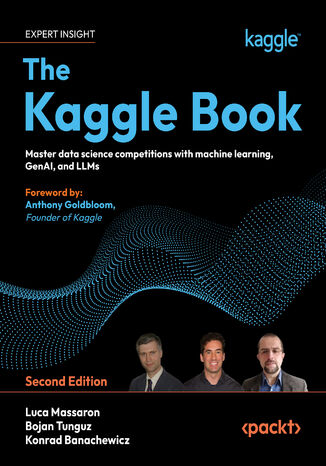
Luca Massaron, Bojan Tunguz, Konrad Banachewicz, Anthony...
Kaggle has become the proving ground for millions of data enthusiasts worldwide, offering what no classroom tutorial can match: battle-tested skills built through real-world challenges and the hands-on experience that employers seek. Every competition sharpens your data analysis skills, expands your network within the data scientist community, and gives compelling proof of expertise to unlock career opportunities.The first book of its kind, The Kaggle Book brings together everything you need to excel in competitions, data science projects, and beyond. This new edition includes fresh content and new chapters on Kaggle Models, time series, and Generative AI competitions, with three Kaggle Grandmasters guiding you through modeling strategies and sharing hard-earned insights accumulated over years of competition.The book extends far past competition tactics, revealing techniques for tackling image, tabular, and textual data as well as reinforcement learning tasks. You’ll also discover tips for designing better validation schemes and working confidently with both standard and unconventional evaluation metrics.Whether you want to climb the Kaggle leaderboard, accelerate your data science career, or improve the accuracy of your models, this book is for you.Join our Discord community of over 1,000 members to learn, share, and grow together!
Hyatt Saleh , John Wesley Doyle ,...
Machine learning algorithms are an integral part of almost all modern applications. To make the learning process faster and more accurate, you need a tool flexible and powerful enough to help you build machine learning algorithms quickly and easily. With The Machine Learning Workshop, you'll master the scikit-learn library and become proficient in developing clever machine learning algorithms.The Machine Learning Workshop begins by demonstrating how unsupervised and supervised learning algorithms work by analyzing a real-world dataset of wholesale customers. Once you've got to grips with the basics, you'll develop an artificial neural network using scikit-learn and then improve its performance by fine-tuning hyperparameters. Towards the end of the workshop, you'll study the dataset of a bank's marketing activities and build machine learning models that can list clients who are likely to subscribe to a term deposit. You'll also learn how to compare these models and select the optimal one.By the end of The Machine Learning Workshop, you'll not only have learned the difference between supervised and unsupervised models and their applications in the real world, but you'll also have developed the skills required to get started with programming your very own machine learning algorithms.
Rohan Chopra , Aniruddha M. Godbole ,...
Do you want to learn how to communicate with computer systems using Natural Language Processing (NLP) techniques, or make a machine understand human sentiments? Do you want to build applications like Siri, Alexa, or chatbots, even if you’ve never done it before?With The Natural Language Processing Workshop, you can expect to make consistent progress as a beginner, and get up to speed in an interactive way, with the help of hands-on activities and fun exercises.The book starts with an introduction to NLP. You’ll study different approaches to NLP tasks, and perform exercises in Python to understand the process of preparing datasets for NLP models. Next, you’ll use advanced NLP algorithms and visualization techniques to collect datasets from open websites, and to summarize and generate random text from a document. In the final chapters, you’ll use NLP to create a chatbot that detects positive or negative sentiment in text documents such as movie reviews.By the end of this book, you’ll be equipped with the essential NLP tools and techniques you need to solve common business problems that involve processing text.
Tobias Zwingmann, Armand Ruiz
Artificial Intelligence has the power to dramatically enhance business performance—but knowing where to begin can be overwhelming. The Profitable AI Advantage offers a clear, actionable roadmap for business leaders, entrepreneurs, and CTOs to identify, design, and scale profitable AI initiatives. You'll learn how AI expands margins by reducing costs, increasing throughput, minimizing risk, and unlocking new revenue streams—without incurring proportional costs.Instead of relying on complex financial models, this guide presents simple thresholds, cost caps, and quick-sizing techniques you can apply to your own financials. The book moves efficiently from foundational AI concepts to practical applications, covering predictive AI, generative AI, and agent-based tools.Frameworks like the Pain Points and Bottlenecks Canvas and the Integration-Automation AI Framework help you identify high-impact opportunities, design use cases, build roadmaps, and prototype solutions quickly and cost-effectively. With real-world case studies from seasoned AI expert Tobias Zwingmann, you’ll sidestep pitfalls, streamline implementation, and drive measurable P&L impact.By the end, you’ll be equipped to scale AI strategically, align your teams, and boost decision-making, productivity, and competitive edge.
The Python Apprentice. Introduction to the Python Programming Language
Robert Smallshire, Austin Bingham
Experienced programmers want to know how to enhance their craft and we want to help them start as apprentices with Python. We know that before mastering Python you need to learn the culture and the tools to become a productive member of any Python project. Our goal with this book is to give you a practical and thorough introduction to Python programming, providing you with the insight and technical craftsmanship you need to be a productive member of any Python project. Python is a big language, and it’s not our intention with this book to cover everything there is to know. We just want to make sure that you, as the developer, know the tools, basic idioms and of course the ins and outs of the language, the standard library and other modules to be able to jump into most projects.
Andrew Bird, Dr. Lau Cher Han, Mario...
Have you always wanted to learn Python, but never quite known how to start?More applications than we realize are being developed using Python because it is easy to learn, read, and write. You can now start learning the language quickly and effectively with the help of this interactive tutorial.The Python Workshop starts by showing you how to correctly apply Python syntax to write simple programs, and how to use appropriate Python structures to store and retrieve data. You'll see how to handle files, deal with errors, and use classes and methods to write concise, reusable, and efficient code.As you advance, you'll understand how to use the standard library, debug code to troubleshoot problems, and write unit tests to validate application behavior.You'll gain insights into using the pandas and NumPy libraries for analyzing data, and the graphical libraries of Matplotlib and Seaborn to create impactful data visualizations. By focusing on entry-level data science, you'll build your practical Python skills in a way that mirrors real-world development. Finally, you'll discover the key steps in building and using simple machine learning algorithms.By the end of this Python book, you'll have the knowledge, skills and confidence to creatively tackle your own ambitious projects with Python.
Alessandro Palmas , Emanuele Ghelfi , Dr....
Various intelligent applications such as video games, inventory management software, warehouse robots, and translation tools use reinforcement learning (RL) to make decisions and perform actions that maximize the probability of the desired outcome. This book will help you to get to grips with the techniques and the algorithms for implementing RL in your machine learning models.Starting with an introduction to RL, youÔÇÖll be guided through different RL environments and frameworks. YouÔÇÖll learn how to implement your own custom environments and use OpenAI baselines to run RL algorithms. Once youÔÇÖve explored classic RL techniques such as Dynamic Programming, Monte Carlo, and TD Learning, youÔÇÖll understand when to apply the different deep learning methods in RL and advance to deep Q-learning. The book will even help you understand the different stages of machine-based problem-solving by using DARQN on a popular video game Breakout. Finally, youÔÇÖll find out when to use a policy-based method to tackle an RL problem.By the end of The Reinforcement Learning Workshop, youÔÇÖll be equipped with the knowledge and skills needed to solve challenging problems using reinforcement learning.
Peter Farrell , Alvaro Fuentes , Ajinkya...
Are you looking to start developing artificial intelligence applications? Do you need a refresher on key mathematical concepts? Full of engaging practical exercises, The Statistics and Calculus with Python Workshop will show you how to apply your understanding of advanced mathematics in the context of Python.The book begins by giving you a high-level overview of the libraries you'll use while performing statistics with Python. As you progress, you'll perform various mathematical tasks using the Python programming language, such as solving algebraic functions with Python starting with basic functions, and then working through transformations and solving equations. Later chapters in the book will cover statistics and calculus concepts and how to use them to solve problems and gain useful insights. Finally, you'll study differential equations with an emphasis on numerical methods and learn about algorithms that directly calculate values of functions.By the end of this book, you’ll have learned how to apply essential statistics and calculus concepts to develop robust Python applications that solve business challenges.
Liu Peng
The Statistics and Machine Learning with R Workshop is a comprehensive resource packed with insights into statistics and machine learning, along with a deep dive into R libraries. The learning experience is further enhanced by practical examples and hands-on exercises that provide explanations of key concepts.Starting with the fundamentals, you’ll explore the complete model development process, covering everything from data pre-processing to model development. In addition to machine learning, you’ll also delve into R's statistical capabilities, learning to manipulate various data types and tackle complex mathematical challenges from algebra and calculus to probability and Bayesian statistics. You’ll discover linear regression techniques and more advanced statistical methodologies to hone your skills and advance your career.By the end of this book, you'll have a robust foundational understanding of statistics and machine learning. You’ll also be proficient in using R's extensive libraries for tasks such as data processing and model training and be well-equipped to leverage the full potential of R in your future projects.
Blaine Bateman, Ashish Ranjan Jha, Benjamin Johnston,...
Would you like to understand how and why machine learning techniques and data analytics are spearheading enterprises globally? From analyzing bioinformatics to predicting climate change, machine learning plays an increasingly pivotal role in our society.Although the real-world applications may seem complex, this book simplifies supervised learning for beginners with a step-by-step interactive approach. Working with real-time datasets, you’ll learn how supervised learning, when used with Python, can produce efficient predictive models.Starting with the fundamentals of supervised learning, you’ll quickly move to understand how to automate manual tasks and the process of assessing date using Jupyter and Python libraries like pandas. Next, you’ll use data exploration and visualization techniques to develop powerful supervised learning models, before understanding how to distinguish variables and represent their relationships using scatter plots, heatmaps, and box plots. After using regression and classification models on real-time datasets to predict future outcomes, you’ll grasp advanced ensemble techniques such as boosting and random forests. Finally, you’ll learn the importance of model evaluation in supervised learning and study metrics to evaluate regression and classification tasks.By the end of this book, you’ll have the skills you need to work on your real-life supervised learning Python projects.
Matthew Moocarme, Abhranshu Bagchi, Anthony So ,...
Getting to grips with tensors, deep learning, and neural networks can be intimidating and confusing for anyone, no matter their experience level. The breadth of information out there, often written at a very high level and aimed at advanced practitioners, can make getting started even more challenging.If this sounds familiar to you, The TensorFlow Workshop is here to help. Combining clear explanations, realistic examples, and plenty of hands-on practice, it’ll quickly get you up and running.You’ll start off with the basics – learning how to load data into TensorFlow, perform tensor operations, and utilize common optimizers and activation functions. As you progress, you’ll experiment with different TensorFlow development tools, including TensorBoard, TensorFlow Hub, and Google Colab, before moving on to solve regression and classification problems with sequential models.Building on this solid foundation, you’ll learn how to tune models and work with different types of neural network, getting hands-on with real-world deep learning applications such as text encoding, temperature forecasting, image augmentation, and audio processing.By the end of this deep learning book, you’ll have the skills, knowledge, and confidence to tackle your own ambitious deep learning projects with TensorFlow.
Aaron Jones , Christopher Kruger , Benjamin...
Do you find it difficult to understand how popular companies like WhatsApp and Amazon find valuable insights from large amounts of unorganized data? The Unsupervised Learning Workshop will give you the confidence to deal with cluttered and unlabeled datasets, using unsupervised algorithms in an easy and interactive manner.The book starts by introducing the most popular clustering algorithms of unsupervised learning. You'll find out how hierarchical clustering differs from k-means, along with understanding how to apply DBSCAN to highly complex and noisy data. Moving ahead, you'll use autoencoders for efficient data encoding.As you progress, you’ll use t-SNE models to extract high-dimensional information into a lower dimension for better visualization, in addition to working with topic modeling for implementing natural language processing (NLP). In later chapters, you’ll find key relationships between customers and businesses using Market Basket Analysis, before going on to use Hotspot Analysis for estimating the population density of an area.By the end of this book, you’ll be equipped with the skills you need to apply unsupervised algorithms on cluttered datasets to find useful patterns and insights.
Tarek A. Atwan
Time series data is everywhere, available at a high frequency and volume. It is complex and can contain noise, irregularities, and multiple patterns, making it crucial to be well-versed with the techniques covered in this book for data preparation, analysis, and forecasting.This book covers practical techniques for working with time series data, starting with ingesting time series data from various sources and formats, whether in private cloud storage, relational databases, non-relational databases, or specialized time series databases such as InfluxDB. Next, you’ll learn strategies for handling missing data, dealing with time zones and custom business days, and detecting anomalies using intuitive statistical methods, followed by more advanced unsupervised ML models. The book will also explore forecasting using classical statistical models such as Holt-Winters, SARIMA, and VAR. The recipes will present practical techniques for handling non-stationary data, using power transforms, ACF and PACF plots, and decomposing time series data with multiple seasonal patterns. Later, you’ll work with ML and DL models using TensorFlow and PyTorch.Finally, you’ll learn how to evaluate, compare, optimize models, and more using the recipes covered in the book.
Tarek A. Atwan
To use time series data to your advantage, you need to master data preparation, analysis, and forecasting. This fully refreshed second edition helps you unlock insights from time series data with new chapters on probabilistic models, signal processing techniques, and new content on transformers. You’ll work with the latest releases of popular libraries like Pandas, Polars, Sktime, stats models, stats forecast, Darts, and Prophet through up-to-date examples.You'll hit the ground running by ingesting time series data from various sources and formats and learn strategies for handling missing data, dealing with time zones and custom business days, and detecting anomalies using intuitive statistical methods.Through detailed instructions, you'll explore forecasting using classical statistical models such as Holt-Winters, SARIMA, and VAR, and learn practical techniques for handling non-stationary data using power transforms, ACF and PACF plots, and decomposing time series data with seasonal patterns. The recipes then level up to cover more advanced topics such as building ML and DL models using TensorFlow and PyTorch and applying probabilistic modeling techniques. In this part, you’ll also be able to evaluate, compare, and optimize models, finishing with a strong command of wrangling data with Python.
Yoni Ramaswami, Dael Williamson, Jan Govaere
Written by Databricks Senior Solutions Architect Yoni Ramaswami, whose expertise in Data and AI has shaped innovative digital transformations across industries, this comprehensive guide bridges foundational concepts of time series analysis with the Spark framework and Databricks, preparing you to tackle real-world challenges with confidence.From preparing and processing large-scale time series datasets to building reliable models, this book offers practical techniques that scale effortlessly for big data environments. You’ll explore advanced topics such as scaling your analyses, deploying time series models into production, Generative AI, and leveraging Spark's latest features for cutting-edge applications across industries. Packed with hands-on examples and industry-relevant use cases, this guide is perfect for data engineers, ML engineers, data scientists, and analysts looking to enhance their expertise in handling large-scale time series data.By the end of this book, you’ll have mastered the skills to design and deploy robust, scalable time series models tailored to your unique project needs—qualifying you to excel in the rapidly evolving world of big data analytics.*Email sign-up and proof of purchase required
Time Series with PyTorch. Modern Deep Learning Toolkit for Real-World Forecasting Challenges
Graeme Davidson, Lei Ma
Neural networks are powerful tools for time-series forecasting, but applying them effectively requires both practical experience and a clear understanding of architectures, training strategies, and evaluation methods. This book brings these ideas together in a structured and practical way.Starting with PyTorch fundamentals, you will build neural networks from scratch and progress through recurrent networks, attention mechanisms, and transformers before exploring forecasting architectures such as N-BEATS, N-HiTS, and the Temporal Fusion Transformer. Along the way, you will learn robust hyperparameter tuning, conformal prediction for uncertainty estimation, and reliable evaluation practices.Unlike most forecasting books, this text also explores topics often overlooked or treated separately, including transfer learning across collections of series, synthetic data generation with diffusion models, and self-supervised representation learning. Beyond forecasting, later chapters cover classification, clustering, anomaly detection, and embeddings for large-scale time-series modeling.Throughout, the focus is pragmatic: theory is reinforced through experimentation and implementation so you can apply these methods confidently to real-world time-series problems.
Bhaskar Chaudhary
Tkinter is the built-in GUI package that comes with standard Python distributions. It is a cross-platform package, which means you build once and deploy everywhere. It is simple to use and intuitive in nature, making it suitable for programmers and non-programmers alike.This book will help you master the art of GUI programming. It delivers the bigger picture of GUI programming by building real-world, productive, and fun applications such as a text editor, drum machine, game of chess, audio player, drawing application, piano tutor, chat application, screen saver, port scanner, and much more. In every project, you will build on the skills acquired in the previous project and gain more expertise. You will learn to write multithreaded programs, network programs, database-driven programs, asyncio based programming and more. You will also get to know the modern best practices involved in writing GUI apps. With its rich source of sample code, you can build upon the knowledge gained with this book and use it in your own projects in the discipline of your choice.
Alejandro Rodas de Paz
As one of the more versatile programming languages, Python is well-known for its batteries-included philosophy, which includes a rich set of modules in its standard library; Tkinter is the library included for building desktop applications. Due to this, Tkinter is a common choice for rapid GUI development, and more complex applications can benefit from the full capabilities of this library. This book covers all of your Tkinter and Python GUI development problems and solutions.Tkinter GUI Application Development Cookbook starts with an overview of Tkinter classes and at the same time provides recipes for basic topics, such as layout patterns and event handling. Next, we cover how to develop common GUI patterns, such as entering and saving data, navigating through menus and dialogs, and performing long-running actions in the background.You can then make your apps leverage network resources effectively and perform graphical operations on a canvas and related tasks such as detecting collisions between items. Finally, this book covers using themed widgets, an extension of Tk widgets that have a more native look and feel. Finally, this book covers using the canvas and themed widgets.By the end of the book, you will have an in-depth knowledge of Tkinter classes, and will know how to use them to build efficient and rich GUI applications.
David Love
Tkinter is a modular, cross-platform application development toolkit for Python. When developing GUI-rich applications, the most important choices are which programming language(s) and which GUI framework to use. Python and Tkinter prove to be a great combination. This book will get you familiar with Tkinter by having you create fun and interactive projects. These projects have varying degrees of complexity. We'll start with a simple project, where you'll learn the fundamentals of GUI programming and the basics of working with a Tkinter application. After getting the basics right, we'll move on to creating a project of slightly increased complexity, such as a highly customizable Python editor. In the next project, we'll crank up the complexity level to create an instant messaging app. Toward the end, we'll discuss various ways of packaging our applications so that they can be shared and installed on other machines without the user having to learn how to install and run Python programs.
Curtis Miller
Python's ease-of-use and multi-purpose nature has made it one of the most popular tools for data scientists and machine learning developers. Its rich libraries are widely used for data analysis, and more importantly, for building state-of-the-art predictive models. This book is designed to guide you through using these libraries to implement effective statistical models for predictive analytics.You’ll start by delving into classical statistical analysis, where you will learn to compute descriptive statistics using pandas. You will focus on supervised learning, which will help you explore the principles of machine learning and train different machine learning models from scratch. Next, you will work with binary prediction models, such as data classification using k-nearest neighbors, decision trees, and random forests. The book will also cover algorithms for regression analysis, such as ridge and lasso regression, and their implementation in Python. In later chapters, you will learn how neural networks can be trained and deployed for more accurate predictions, and understand which Python libraries can be used to implement them.By the end of this book, you will have the knowledge you need to design, build, and deploy enterprise-grade statistical models for machine learning using Python and its rich ecosystem of libraries for predictive analytics.
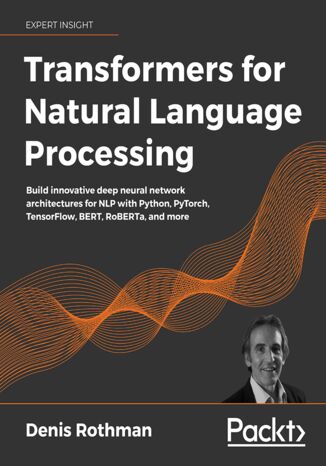
Denis Rothman
The transformer architecture has proved to be revolutionary in outperforming the classical RNN and CNN models in use today. With an apply-as-you-learn approach, Transformers for Natural Language Processing investigates in vast detail the deep learning for machine translations, speech-to-text, text-to-speech, language modeling, question answering, and many more NLP domains with transformers.The book takes you through NLP with Python and examines various eminent models and datasets within the transformer architecture created by pioneers such as Google, Facebook, Microsoft, OpenAI, and Hugging Face.The book trains you in three stages. The first stage introduces you to transformer architectures, starting with the original transformer, before moving on to RoBERTa, BERT, and DistilBERT models. You will discover training methods for smaller transformers that can outperform GPT-3 in some cases. In the second stage, you will apply transformers for Natural Language Understanding (NLU) and Natural Language Generation (NLG). Finally, the third stage will help you grasp advanced language understanding techniques such as optimizing social network datasets and fake news identification.By the end of this NLP book, you will understand transformers from a cognitive science perspective and be proficient in applying pretrained transformer models by tech giants to various datasets.
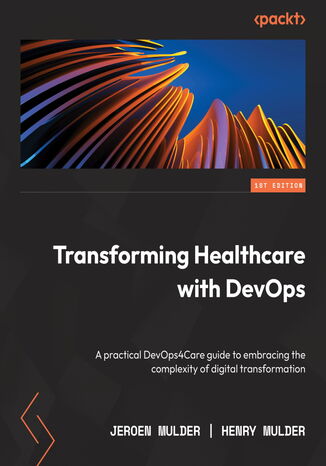
Jeroen Mulder, Henry Mulder
Healthcare today faces a multitude of challenges, which can be summed up as the barriers architects and consultants face in transforming the healthcare system into a more sustainable one. This book helps you to guide that transformation step by step.You’ll begin by understanding the need for this transformation, exploring related challenges, the possibilities of technology, and how human factors can be involved in digital transformation. The book will enable you to overcome inhibitions and plan various transformation steps using the Transformation into Sustainable Healthcare (TiSH) model and DevOps4Care. Next, you’ll use the observe, orient, decide, and act (OODA) loop as an iterative approach to address all stakeholders and adapt swiftly when situations change. Further, you’ll be able to build shared platforms that enable interaction between various stakeholders, including the technology-enabled care service teams. The final chapters will help you execute the transformation to sustainable healthcare using the knowledge you’ve gained while getting familiar with common pitfalls and learning how to avoid or mitigate them.By the end of this DevOps book, you will have an overview of the challenges, opportunities, and directions of solutions and be on your way toward starting the transformation into sustainable healthcare.
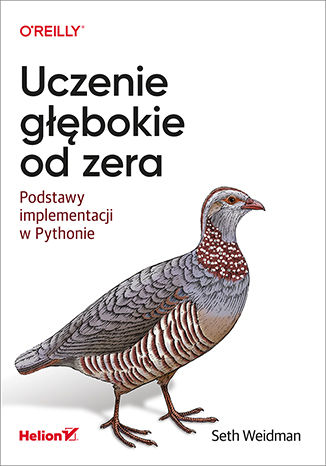
Uczenie głębokie od zera. Podstawy implementacji w Pythonie
Seth Weidman
Uczenie głębokie (ang. deep learning) zyskuje ostatnio ogromną popularność. Jest to ściśle związane z coraz częstszym zastosowaniem sieci neuronowych w przeróżnych branżach i dziedzinach. W konsekwencji inżynierowie oprogramowania, specjaliści do spraw przetwarzania danych czy osoby w praktyce zajmujące się uczeniem maszynowym muszą zdobyć solidną wiedzę o tych zagadnieniach. Przede wszystkim trzeba dogłębnie zrozumieć podstawy uczenia głębokiego. Dopiero po uzyskaniu biegłości w posługiwaniu się poszczególnymi koncepcjami i modelami możliwe jest wykorzystanie w pełni potencjału tej dynamicznie rozwijającej się technologii. Ten praktyczny podręcznik, poświęcony podstawom uczenia głębokiego, zrozumiale i wyczerpująco przedstawia zasady działania sieci neuronowych z trzech różnych poziomów: matematycznego, obliczeniowego i konceptualnego. Takie podejście wynika z faktu, że dogłębne zrozumienie sieci neuronowych wymaga nie jednego, ale kilku modeli umysłowych, z których każdy objaśnia inny aspekt działania tych sieci. Zaprezentowano tu również techniki implementacji poszczególnych elementów w języku Python, co pozwala utworzyć działające sieci neuronowe. Dzięki tej książce stanie się jasne, w jaki sposób należy tworzyć, uczyć i stosować wielowarstwowe, konwolucyjne i rekurencyjne sieci neuronowe w różnych praktycznych zastosowaniach. W książce między innymi: matematyczne podstawy uczenia głębokiego tworzenie modeli do rozwiązywania praktycznych problemów standardowe i niestandardowe techniki treningu sieci neuronowych rozpoznawanie obrazów za pomocą konwolucyjnych sieci neuronowych rekurencyjne sieci neuronowe, ich działanie i implementacja praca z wykorzystaniem biblioteki PyTorch Uczenie głębokie: zrozum, zanim zaimplementujesz!
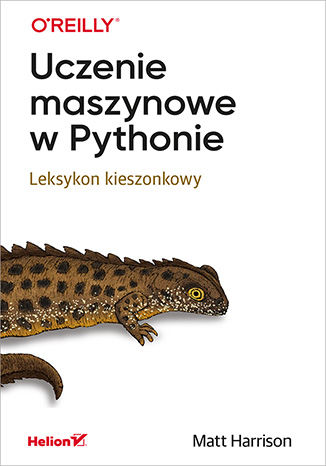
Uczenie maszynowe w Pythonie. Leksykon kieszonkowy
Matt Harrison
Uczenie maszynowe i nauka o danych są dziś ogromnie popularne. Dziedziny te szybko się rozwijają, a poszczególne techniki uczenia maszynowego znajdują coraz więcej różnorodnych zastosowań. Wiedza, którą można uzyskać dzięki odpowiedniemu przygotowaniu danych i ich eksploracji, często jest bezcenna. Umiejętność ich analizy oraz wiedza o możliwych sposobach rozwiązywania problemów napotykanych podczas uczenia maszynowego są więc dużymi atutami i mogą być wykorzystywane w wielu gałęziach nauki, techniki i biznesu. Z tego zwięzłego przewodnika po technikach uczenia maszynowego opartego na strukturalnych danych skorzystają programiści, badacze, osoby zajmujące się nauką o danych oraz twórcy systemów sztucznej inteligencji. Znalazł się tu wyczerpujący opis procesu uczenia maszynowego i klasyfikacji danych strukturalnych. Przedstawiono też metody klastrowania danych, analizy regresji, redukcji wymiarowości oraz inne ważne zagadnienia. Prezentowane treści zostały zilustrowane uwagami, tabelami i przykładami kodu. Nie zabrakło opisu przydatnych bibliotek, niezwykle użytecznych w pracy analityka danych. W efekcie książka pozwala na szybkie rozwiązywanie różnego rodzaju problemów związanych z przetwarzaniem danych strukturalnych. W książce między innymi: klasyfikacja, oczyszczanie i uzupełnianie braków danych eksploracyjna analiza danych i dobór modelu danych przykłady analiz regresji redukcja wymiarowości potoki w bibliotece scikit-learn Uczenie maszynowe: nowy wymiar analizy danych!