
Python
W kategorii Python zostały zebrane podręczniki poruszające tematykę programowania z zastosowaniem praktycznie niezależnego sprzętowo, dostępnego na licencji Open Source języka. Książki przedstawią Wam wszechstronności i elastyczności Pythona a także różne typy tworzenia kodu poprzez programowanie strukturalne, obiektowe czy funkcjonalne.
Nauczycie się tworzyć aplikacje sieciowe o dowolnym przeznaczeniu, komunikujące się z systemami operacyjnymi, lub korzystające z baz danych. Techniki analizy składni, przetwarzanie tekstu czy rozłożenie obciążenia programu na wiele wątków i procesów przestanie być problematyczne.
Snowflake Cookbook. Techniques for building modern cloud data warehousing solutions
Hamid Mahmood Qureshi, Hammad Sharif
Snowflake is a unique cloud-based data warehousing platform built from scratch to perform data management on the cloud. This book introduces you to Snowflake's unique architecture, which places it at the forefront of cloud data warehouses.You'll explore the compute model available with Snowflake, and find out how Snowflake allows extensive scaling through the virtual warehouses. You will then learn how to configure a virtual warehouse for optimizing cost and performance. Moving on, you'll get to grips with the data ecosystem and discover how Snowflake integrates with other technologies for staging and loading data.As you progress through the chapters, you will leverage Snowflake's capabilities to process a series of SQL statements using tasks to build data pipelines and find out how you can create modern data solutions and pipelines designed to provide high performance and scalability. You will also get to grips with creating role hierarchies, adding custom roles, and setting default roles for users before covering advanced topics such as data sharing, cloning, and performance optimization.By the end of this Snowflake book, you will be well-versed in Snowflake's architecture for building modern analytical solutions and understand best practices for solving commonly faced problems using practical recipes.
Anand Balachandran Pillai
This book starts by explaining how Python fits into an application's architecture. As you move along, you will get to grips with architecturally significant demands and how to determine them. Later, you’ll gain a complete understanding of the different architectural quality requirements for building a product that satisfies business needs, such as maintainability/reusability, testability, scalability, performance, usability, and security.You will also use various techniques such as incorporating DevOps, continuous integration, and more to make your application robust. You will discover when and when not to use object orientation in your applications, and design scalable applications.The focus is on building the business logic based on the business process documentation, and understanding which frameworks to use and when to use them. The book also covers some important patterns that should be taken into account while solving design problems, as well as those in relatively new domains such as the Cloud.By the end of this book, you will have understood the ins and outs of Python so that you can make critical design decisions that not just live up to but also surpassyour clients’ expectations.
Maxwell Flitton
Python has made software development easier, but it falls short in several areas including memory management that lead to poor performance and security. Rust, on the other hand, provides memory safety without using a garbage collector, which means that with its low memory footprint, you can build high-performant and secure apps relatively easily. However, rewriting everything in Rust can be expensive and risky as there might not be package support in Rust for the problem being solved. This is where Python bindings and pip come in.This book will help you, as a Python developer, to start using Rust in your Python projects without having to manage a separate Rust server or application. Seeing as you'll already understand concepts like functions and loops, this book covers the quirks of Rust such as memory management to code Rust in a productive and structured manner. You'll explore the PyO3 crate to fuse Rust code with Python, learn how to package your fused Rust code in a pip package, and then deploy a Python Flask application in Docker that uses a private Rust pip module. Finally, you'll get to grips with advanced Rust binding topics such as inspecting Python objects and modules in Rust.By the end of this Rust book, you'll be able to develop safe and high-performant applications with better concurrency support.
Abbas Ali
This book is a step-by-step guide for an absolute beginner. It covers everything, from installing to configuring, to get you started quickly. It has numerous code examples that the reader can try on their own and learn while doing so. It has two full-fledged applications as examples that readers can follow. This book is specifically focused on the Search feature of web applications. This book is for developers who are new to Sphinx Search. All code examples use PHP but the logic is same for any other web scripting languages as well.
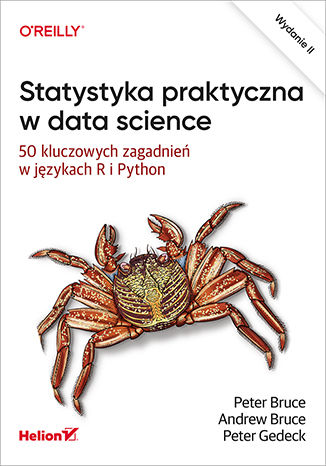
Statystyka praktyczna w data science. 50 kluczowych zagadnień w językach R i Python. Wydanie II
Peter Bruce, Andrew Bruce, Peter Gedeck
Metody statystyczne są kluczowym narzędziem w data science, mimo to niewielu analityków danych zdobyło wykształcenie w ich zakresie. Może im to utrudniać uzyskiwanie dobrych efektów. Zrozumienie praktycznych zasad statystyki okazuje się ważne również dla programistów R i Pythona, którzy tworzą rozwiązania dla data science. Kursy podstaw statystyki rzadko jednak uwzględniają tę perspektywę, a większość podręczników do statystyki w ogóle nie zajmuje się narzędziami wywodzącymi się z informatyki. To drugie wydanie popularnego podręcznika statystyki przeznaczonego dla analityków danych. Uzupełniono je o obszerne przykłady w Pythonie oraz wyjaśnienie, jak stosować poszczególne metody statystyczne w problemach data science, a także jak ich nie używać. Skoncentrowano się też na tych zagadnieniach statystyki, które odgrywają istotną rolę w data science. Wyjaśniono, które koncepcje są ważne i przydatne z tej perspektywy, a które mniej istotne i dlaczego. Co ważne, poszczególne koncepcje i zagadnienia praktyczne przedstawiono w sposób przyswajalny i zrozumiały również dla osób nienawykłych do posługiwania się statystyką na co dzień. W książce między innymi: analiza eksploracyjna we wstępnym badaniu danych próby losowe a jakość dużych zbiorów danych podstawy planowania eksperymentów regresja w szacowaniu wyników i wykrywaniu anomalii statystyczne uczenie maszynowe uczenie nienadzorowane a znaczenie danych niesklasyfikowanych Statystyka: klasyczne narzędzia w najnowszych technologiach!
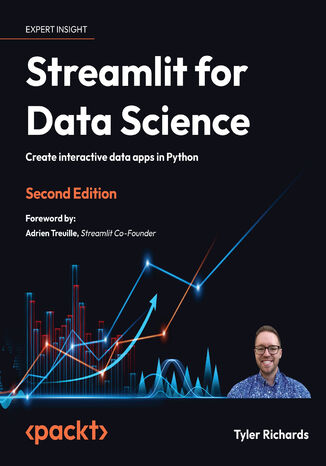
Streamlit for Data Science. Create interactive data apps in Python - Second Edition
Tyler Richards
If you work with data in Python and are looking to create data apps that showcase ML models and make beautiful interactive visualizations, then this is the ideal book for you. Streamlit for Data Science, Second Edition, shows you how to create and deploy data apps quickly, all within Python. This helps you create prototypes in hours instead of days!Written by a prolific Streamlit user and senior data scientist at Snowflake, this fully updated second edition builds on the practical nature of the previous edition with exciting updates, including connecting Streamlit to data warehouses like Snowflake, integrating Hugging Face and OpenAI models into your apps, and connecting and building apps on top of Streamlit databases. Plus, there is a totally updated code repository on GitHub to help you practice your newfound skills.You'll start your journey with the fundamentals of Streamlit and gradually build on this foundation by working with machine learning models and producing high-quality interactive apps. The practical examples of both personal data projects and work-related data-focused web applications will help you get to grips with more challenging topics such as Streamlit Components, beautifying your apps, and quick deployment.By the end of this book, you'll be able to create dynamic web apps in Streamlit quickly and effortlessly.
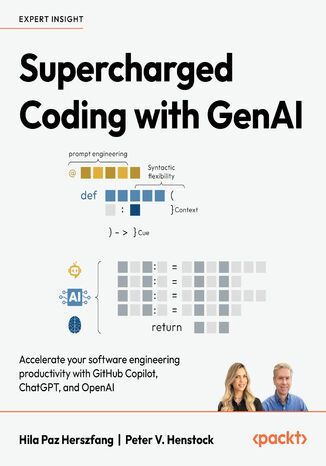
Hila Paz Herszfang, Peter V. Henstock, Mike...
Software development is being transformed by GenAI tools, such as ChatGPT, OpenAI API, and GitHub Copilot, redefining how developers work. This book will help you become a power user of GenAI for Python code generation, enabling you to write better software faster. Written by an ML advisor with a thriving tech social media presence and a top AI leader who brings Harvard-level instruction to the table, this book combines practical industry insights with academic expertise.With this book, you'll gain a deep understanding of LLMs and develop a systematic approach to solving complex tasks with AI. Through real-world examples and practical exercises, you’ll master best practices for leveraging GenAI, including prompt engineering techniques like few-shot learning and Chain-of-Thought (CoT).Going beyond simple code generation, this book teaches you how to automate debugging, refactoring, performance optimization, testing, and monitoring. By applying reusable prompt frameworks and AI-driven workflows, you’ll streamline your SDLC and produce high-quality, well-structured code.By the end of this book, you'll know how to select the right AI tool for each task, boost efficiency, and anticipate your next coding moves—helping you stay ahead in the AI-powered development era.*Email sign-up and proof of purchase required
Taylor Smith
Supervised machine learning is used in a wide range of sectors, such as finance, online advertising, and analytics, to train systems to make pricing predictions, campaign adjustments, customer recommendations, and much more by learning from the data that is used to train it and making decisions on its own. This makes it crucial to know how a machine 'learns' under the hood.This book will guide you through the implementation and nuances of many popular supervised machine learning algorithms, and help you understand how they work. You’ll embark on this journey with a quick overview of supervised learning and see how it differs from unsupervised learning. You’ll then explore parametric models, such as linear and logistic regression, non-parametric methods, such as decision trees, and a variety of clustering techniques that facilitate decision-making and predictions. As you advance, you'll work hands-on with recommender systems, which are widely used by online companies to increase user interaction and enrich shopping potential. Finally, you’ll wrap up with a brief foray into neural networks and transfer learning.By the end of this book, you’ll be equipped with hands-on techniques and will have gained the practical know-how you need to quickly and effectively apply algorithms to solve new problems.