
Python
W kategorii Python zostały zebrane podręczniki poruszające tematykę programowania z zastosowaniem praktycznie niezależnego sprzętowo, dostępnego na licencji Open Source języka. Książki przedstawią Wam wszechstronności i elastyczności Pythona a także różne typy tworzenia kodu poprzez programowanie strukturalne, obiektowe czy funkcjonalne.
Nauczycie się tworzyć aplikacje sieciowe o dowolnym przeznaczeniu, komunikujące się z systemami operacyjnymi, lub korzystające z baz danych. Techniki analizy składni, przetwarzanie tekstu czy rozłożenie obciążenia programu na wiele wątków i procesów przestanie być problematyczne.
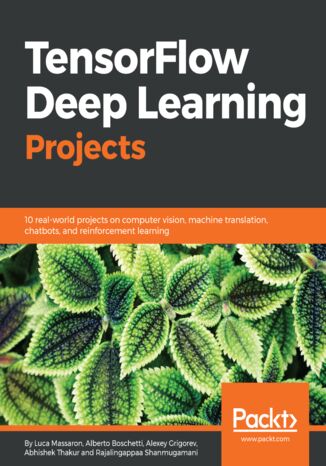
Alexey Grigorev, Srinivas Kulkarni, Rajalingappaa Shanmugamani
TensorFlow is one of the most popular frameworks used for machine learning and, more recently, deep learning. It provides a fast and efficient framework for training different kinds of deep learning models, with very high accuracy. This book is your guide to master deep learning with TensorFlow with the help of 10 real-world projects.TensorFlow Deep Learning Projects starts with setting up the right TensorFlow environment for deep learning. You'll learn how to train different types of deep learning models using TensorFlow, including Convolutional Neural Networks, Recurrent Neural Networks, LSTMs, and Generative Adversarial Networks. While doing this, you will build end-to-end deep learning solutions to tackle different real-world problems in image processing, recommendation systems, stock prediction, and building chatbots, to name a few. You will also develop systems that perform machine translation and use reinforcement learning techniques to play games.By the end of this book, you will have mastered all the concepts of deep learning and their implementation with TensorFlow, and will be able to build and train your own deep learning models with TensorFlow confidently.
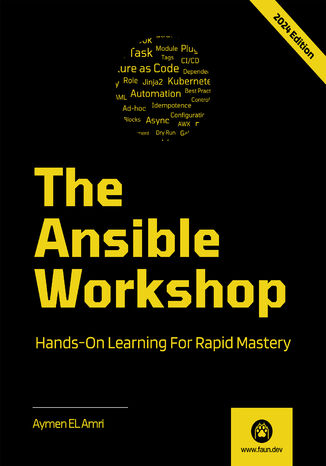
The Ansible Workshop. Hands-On Learning For Rapid Mastery
Aymen El Amri
The Ansible Workshop offers a comprehensive journey through the world of Ansible, guiding readers from foundational concepts to advanced applications in automation. Readers delve into creating and managing inventories, an essential aspect of organizing systems for automation.As the journey progresses, the book covers the creation and use of playbooks, providing step-by-step instructions and practical examples. Readers learn how to gather and utilize Ansible facts, debug issues effectively, and manage sensitive data with Ansible Vault. The exploration of Ansible blocks, modules, plugins, and filters further enhances the reader's ability to customize and extend Ansible's functionality.The book then introduces the concept of Ansible roles, enabling readers to structure and reuse their automation tasks efficiently. Performance optimization techniques are also discussed, ensuring that automation workflows are both fast and reliable. The practical applications of Ansible are showcased through chapters on managing Docker and Docker Compose, as well as automating Kubernetes, highlighting Ansible's versatility in modern IT environments. To provide a quick reference and reinforce learning, an Ansible cheat sheet is included, summarizing key commands and concepts.
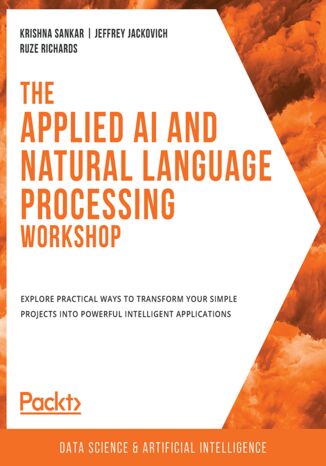
Krishna Sankar , Jeffrey Jackovich , Ruze...
Are you fascinated with applications like Alexa and Siri and how they accurately process information within seconds before returning accurate results? Are you looking for a practical guide that will teach you how to build intelligent applications that can revolutionize the world of artificial intelligence? The Applied AI and NLP Workshop will take you on a practical journey where you will learn how to build artificial intelligence (AI) and natural language processing (NLP) applications with Amazon Web services (AWS).Starting with an introduction to AI and machine learning, this book will explain how Amazon S3, or Amazon Simple Storage Service, works. You’ll then integrate AI with AWS to build serverless services and use Amazon’s NLP service Comprehend to perform text analysis on a document. As you advance, the book will help you get to grips with topic modeling to extract and analyze common themes on a set of documents with unknown topics. You’ll also work with Amazon Lex to create and customize a chatbot for task automation and use Amazon Rekognition for detecting objects, scenes, and text in images.By the end of The Applied AI and NLP Workshop, you’ll be equipped with the knowledge and skills needed to build scalable intelligent applications with AWS.
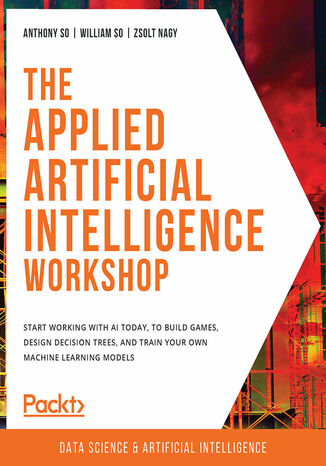
Anthony So , William So , Zsolt...
You already know that artificial intelligence (AI) and machine learning (ML) are present in many of the tools you use in your daily routine. But do you want to be able to create your own AI and ML models and develop your skills in these domains to kickstart your AI career?The Applied Artificial Intelligence Workshop gets you started with applying AI with the help of practical exercises and useful examples, all put together cleverly to help you gain the skills to transform your career.The book begins by teaching you how to predict outcomes using regression. You will then learn how to classify data using techniques such as k-nearest neighbor (KNN) and support vector machine (SVM) classifiers. As you progress, you’ll explore various decision trees by learning how to build a reliable decision tree model that can help your company find cars that clients are likely to buy. The final chapters will introduce you to deep learning and neural networks. Through various activities, such as predicting stock prices and recognizing handwritten digits, you’ll learn how to train and implement convolutional neural networks (CNNs) and recurrent neural networks (RNNs).By the end of this applied AI book, you’ll have learned how to predict outcomes and train neural networks and be able to use various techniques to develop AI and ML models.
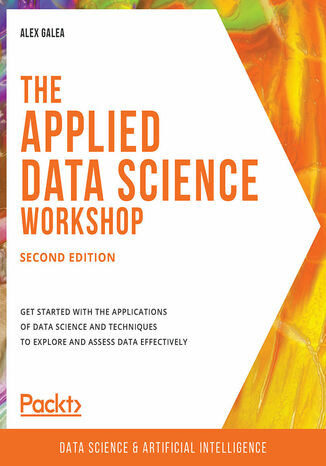
Alex Galea, Paul Van Branteghem, Guillermina Bea...
From banking and manufacturing through to education and entertainment, using data science for business has revolutionized almost every sector in the modern world. It has an important role to play in everything from app development to network security.Taking an interactive approach to learning the fundamentals, this book is ideal for beginners. You’ll learn all the best practices and techniques for applying data science in the context of real-world scenarios and examples.Starting with an introduction to data science and machine learning, you’ll start by getting to grips with Jupyter functionality and features. You’ll use Python libraries like sci-kit learn, pandas, Matplotlib, and Seaborn to perform data analysis and data preprocessing on real-world datasets from within your own Jupyter environment. Progressing through the chapters, you’ll train classification models using sci-kit learn, and assess model performance using advanced validation techniques. Towards the end, you’ll use Jupyter Notebooks to document your research, build stakeholder reports, and even analyze web performance data.By the end of The Applied Data Science Workshop, you’ll be prepared to progress from being a beginner to taking your skills to the next level by confidently applying data science techniques and tools to real-world projects.
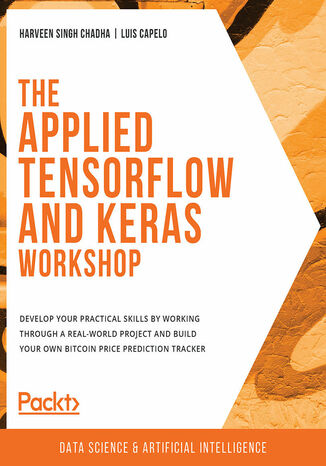
Harveen Singh Chadha , Luis Capelo ,...
Machine learning gives computers the ability to learn like humans. It is becoming increasingly transformational to businesses in many forms, and a key skill to learn to prepare for the future digital economy.As a beginner, you’ll unlock a world of opportunities by learning the techniques you need to contribute to the domains of machine learning, deep learning, and modern data analysis using the latest cutting-edge tools.The Applied TensorFlow and Keras Workshop begins by showing you how neural networks work. After you’ve understood the basics, you will train a few networks by altering their hyperparameters. To build on your skills, you’ll learn how to select the most appropriate model to solve the problem in hand. While tackling advanced concepts, you’ll discover how to assemble a deep learning system by bringing together all the essential elements necessary for building a basic deep learning system - data, model, and prediction. Finally, you’ll explore ways to evaluate the performance of your model, and improve it using techniques such as model evaluation and hyperparameter optimization.By the end of this book, you'll have learned how to build a Bitcoin app that predicts future prices, and be able to build your own models for other projects.
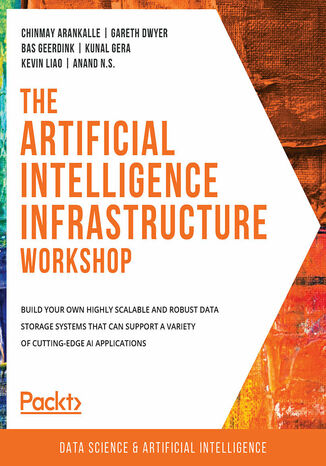
Chinmay Arankalle , Gareth Dwyer , Bas...
Social networking sites see an average of 350 million uploads daily - a quantity impossible for humans to scan and analyze. Only AI can do this job at the required speed, and to leverage an AI application at its full potential, you need an efficient and scalable data storage pipeline. The Artificial Intelligence Infrastructure Workshop will teach you how to build and manage one.The Artificial Intelligence Infrastructure Workshop begins taking you through some real-world applications of AI. You’ll explore the layers of a data lake and get to grips with security, scalability, and maintainability. With the help of hands-on exercises, you’ll learn how to define the requirements for AI applications in your organization. This AI book will show you how to select a database for your system and run common queries on databases such as MySQL, MongoDB, and Cassandra. You’ll also design your own AI trading system to get a feel of the pipeline-based architecture. As you learn to implement a deep Q-learning algorithm to play the CartPole game, you’ll gain hands-on experience with PyTorch. Finally, you’ll explore ways to run machine learning models in production as part of an AI application.By the end of the book, you’ll have learned how to build and deploy your own AI software at scale, using various tools, API frameworks, and serialization methods.
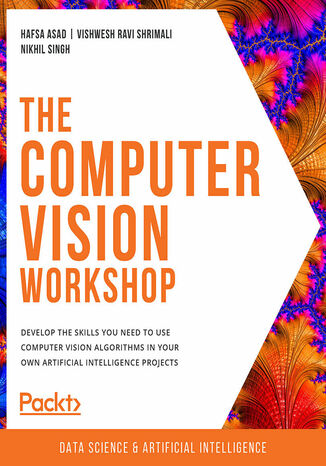
Hafsa Asad , Vishwesh Ravi Shrimali ,...
Computer Vision (CV) has become an important aspect of AI technology. From driverless cars to medical diagnostics and monitoring the health of crops to fraud detection in banking, computer vision is used across all domains to automate tasks. The Computer Vision Workshop will help you understand how computers master the art of processing digital images and videos to mimic human activities.Starting with an introduction to the OpenCV library, you'll learn how to write your first script using basic image processing operations. You'll then get to grips with essential image and video processing techniques such as histograms, contours, and face processing. As you progress, you'll become familiar with advanced computer vision and deep learning concepts, such as object detection, tracking, and recognition, and finally shift your focus from 2D to 3D visualization. This CV course will enable you to experiment with camera calibration and explore both passive and active canonical 3D reconstruction methods.By the end of this book, you'll have developed the practical skills necessary for building powerful applications to solve computer vision problems.